

Important aspects for the planning of biogas energy plants: Malatya case study
Open accessThe DOI matches its Crossref record; 41 of the 41 references it cites were found in a registry or an index.
Abstract
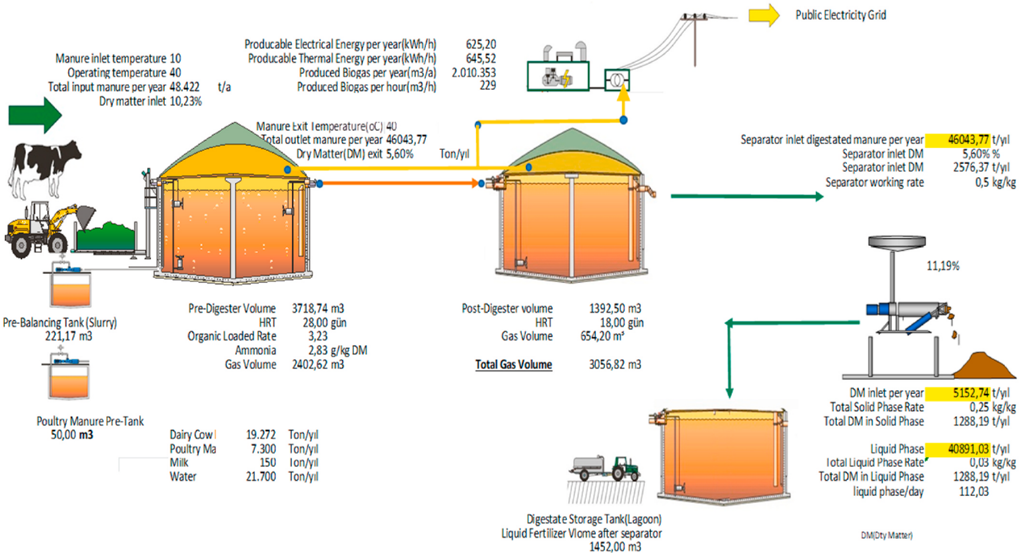
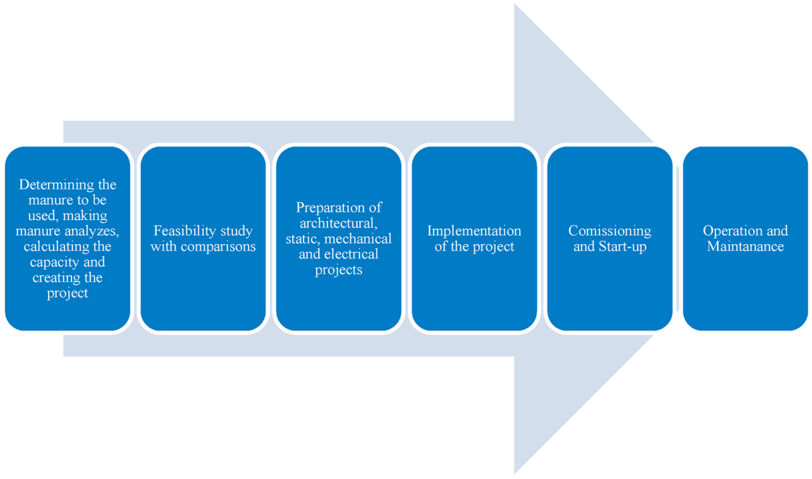
Conventional energy use causes various environmental impacts of global warming. Also, as a result, renewable energy sources are more beneficial because they generate virtually no emissions. Biogas is historically recognized as a by-product of the anaerobic (oxygen-free) decomposition of agricultural waste. One of the most critical issues for biogas plants in electricity production is the economically and environmentally safe disposal of vast volumes of digestate. In this study, an extensive pathway for the establishment of a large-scale biogas energy plant was presented. Under these lightings, a case plant built in Akçadağ-Malatya was investigated from the techno-economic point of view. The case plant was built to generate heat and power as well as solid and liquid fertilizer. The produced biogas and methane were respectively recorded as 229,49 m3/h and 139,08 m3/h. It was determined that electricity generation in an amount of 5,256,000 kWh per year from the digested feedstock was available with the maximum power capacity of 625 kWh. The annual and daily heat energy outputs were calculated as 6,482,400 kWh and 640 kWh, respectively. The solid and liquid fertilizers were respectively determined as 40,891.03 t/a and 5,152.74 t/a. According to the results, total investment costs per the produced electricity for the biogas energy plant were calculated as 1451.53 €/kWh. The payback period was calculated as 2.22 with a net present value of 944,714.44 €. CO2 emissions have been reduced by 14,105 tons per year thanks to the co-generation system.
Overview
The claims and statistics of this paper haven’t been checked yet.
Free: it reads the open-access text and checks the first 5 claims that cite a source we can check. Create a free account to check every claim.
Integrity signals
Registry
Cites
Statistics
Figures


Verification
Claims the paper makes
The claims and statistics of this paper haven’t been checked yet.
Free: it reads the open-access text and checks the first 5 claims that cite a source we can check. Create a free account to check every claim.
Claims other papers make about this one
Each is checked against this paper’s own text: does it say what the citing paper says it does?
In the citing paper
“Biomass waste conversion to biogas provides a sustainable pathway for a more circular economy with benefits like reduced carbon emissions, better and useful organic waste management, and greater resource use efficiency [26,32].”
From Biogas Production and Applications in the Sustainable Energy Transition (2022) · cites this paper as [32]
In the citing paper
“The main benefits of a cogeneration system are a reduction in fuel use and reduced cost of generation [151], while the use of biogas as heat sources is a way of mitigating greenhouse gas emissions and global warming [26,32,152].”
From Biogas Production and Applications in the Sustainable Energy Transition (2022) · cites this paper as [32]
Self-check
Percentages, sums and reported differences re-computed from the paper’s own numbers.
The self-check needs the paper’s full text.
Citations
Cites
Reviewing the anaerobic digestion of food waste for biogas production
Zhang, C., Su, H., Baeyens, J., & Tan, T. (2014) · Renewable and Sustainable Energy Reviews · doi:10.1016/j.rser.2014.05.038 · Cited by 1,327
Anaerobic co-digestion process for biogas production: Progress, challenges and perspectives
Hagos, K., Zong, J., Li, D., Liu, C., & Lu, X. (2017) · Renewable and Sustainable Energy Reviews · doi:10.1016/j.rser.2016.11.184 · Cited by 904
Rulkens, W. (2008) · Energy & Fuels · doi:10.1021/ef700267m · Cited by 563
Environmental systems analysis of biogas systems—Part I: Fuel-cycle emissions
Börjesson, P., & Berglund, M. (2006) · Biomass and Bioenergy · doi:10.1016/j.biombioe.2005.11.014 · Cited by 315
Evaluation of biogas production from different biomass wastes with/without hydrothermal pretreatment
Qiao, W., Yan, X., Ye, J., Sun, Y., Wang, W., & Zhang, Z. (2011) · Renewable Energy · doi:10.1016/j.renene.2011.05.002 · Cited by 307
Components of Dairy Manure Management Systems
Van Horn, H. H., Wilkie, A. C., Powers, W. J., & Nordstedt, R. A. (1994) · Journal of Dairy Science · doi:10.3168/jds.s0022-0302(94)77147-2 · Cited by 266
Tabatabaei, M., Aghbashlo, M., Valijanian, E., Kazemi Shariat Panahi, H., Nizami, A.-S., Ghanavati, H., Sulaiman, A., Mirmohamadsadeghi, S., & Karimi, K. (2020) · Renewable Energy · doi:10.1016/j.renene.2019.07.037 · Cited by 265
Bacenetti, J., Negri, M., Fiala, M., & González-García, S. (2013) · Science of The Total Environment · doi:10.1016/j.scitotenv.2013.06.058 · Cited by 212
Akbulut, A. (2012) · Energy · doi:10.1016/j.energy.2012.06.017 · Cited by 166
Self-citationBiogas production from anaerobic co-digestion of cow manure with kitchen waste and Water Hyacinth
Tasnim, F., Iqbal, S. A., & Chowdhury, A. R. (2017) · Renewable Energy · doi:10.1016/j.renene.2017.03.044 · Cited by 136
Research works printed but not linked: 1
- E. Weiland, P. Hassan, Production of biogas from forage beets, in: Ninth World Congr. Anaerob. Convers. Sustain., Antwerpen, Belgium, 2001, pp. 631-633.
Cited by
Biogas Production and Applications in the Sustainable Energy Transition
Kabeyi, M. J. B., & Olanrewaju, O. A. (2022) · Journal of Energy · doi:10.1155/2022/8750221 · Cited by 442
“provide incentives in form of attractive feed-in tariffs and other technical and financial incentives including technical support [26, 32].”
BackgroundAlengebawy, A., Ran, Y., Osman, A. I., Jin, K., Samer, M., & Ai, P. (2024) · Environmental Chemistry Letters · doi:10.1007/s10311-024-01789-1 · Cited by 247
“However, due to their far higher consumption rate than their synthesis rate, these energy sources have been depleted and are not replenished [6].”
Chang, L., Wu, Z., & Ghadimi, N. (2023) · Process Safety and Environmental Protection · doi:10.1016/j.psep.2023.07.045 · Cited by 118
Rice straw for energy and value-added products in China: a review
Alengebawy, A., Yi, R., Ghimire, N., Osman, A. I., & Ai, P. (2023) · Environmental Chemistry Letters · doi:10.1007/s10311-023-01612-3 · Cited by 124
“Biogas contains carbon dioxide along with methane, which lowers the calorific value (22 megajoule/cubic meter); therefore, biogas needs to be cleaned and purified into pure biomethane (36 megajoule/cubic meter), which can be used as a vehicle fuel or injected into the gas grid (Akbulut et al. 2021).”
MethodZieliński, M., Kazimierowicz, J., & Dębowski, M. (2022) · Energies · doi:10.3390/en16010083 · Cited by 110
Alengebawy, A., Mohamed, B. A., Ghimire, N., Jin, K., Liu, T., Samer, M., & Ai, P. (2022) · Environmental Research · doi:10.1016/j.envres.2022.113632 · Cited by 91
Issahaku, M., Derkyi, N. S. A., & Kemausuor, F. (2024) · Heliyon · doi:10.1016/j.heliyon.2024.e24019 · Cited by 98
“In contrast, the benefits of large-scale biogas digesters, such as the high capacity to process and generate large volumes of biogas, benefit from economies of scale [151].”
BackgroundMahdi, S. M., Akrami, M., Gheibi, M., Kavianpour, B., Fathollahi‐Fard, A. M., & Behzadian, K. (2021) · Energy Conversion and Management · doi:10.1016/j.enconman.2021.114794 · Cited by 88
Arslan, O., & Arslan, A. E. (2022) · Process Safety and Environmental Protection · doi:10.1016/j.psep.2022.08.073 · Cited by 61
Self-citationEnergy management for maintaining anaerobic digestion temperature in biogas plants
Garkoti, P., Ni, J. Q., & Thengane, S. K. (2024) · Renewable and Sustainable Energy Reviews · doi:10.1016/j.rser.2024.114430 · Cited by 65
Ma, T., Lan, L., & Marefati, M. (2023) · Process Safety and Environmental Protection · doi:10.1016/j.psep.2023.01.071 · Cited by 59
Ma, L., Mao, J., & Marefati, M. (2022) · Process Safety and Environmental Protection · doi:10.1016/j.psep.2022.05.053 · Cited by 58
Sudalai, S., Prabakaran, S., Varalakksmi, V., Kireeti, I. S., Upasana, B., Yuvasri, A., & Arumugam, A. (2024) · Energy Conversion and Management · doi:10.1016/j.enconman.2024.118724 · Cited by 53
Arslan, O., Arslan, A. E., & Boukelia, T. E. (2023) · Energy and Buildings · doi:10.1016/j.enbuild.2023.112792 · Cited by 50
Self-citationArslan, A. E., Arslan, O., & Genç, M. S. (2023) · Energy · doi:10.1016/j.energy.2023.129590 · Cited by 48
Self-citationPotential of renewable agricultural wastes in the smart and sustainable steelmaking process
Shukla, I. (2022) · Journal of Cleaner Production · doi:10.1016/j.jclepro.2022.133422 · Cited by 40
Alrbai, M., Ahmad, A. D., Al‐Dahidi, S., Abubaker, A. M., Al‐Ghussain, L., Alahmer, A. I., & Akafuah, N. K. (2023) · Energy · doi:10.1016/j.energy.2023.128486 · Cited by 36
A comprehensive review of advances in bioenergy including emerging trends and future directions
Dadi, M., Siwale, W., Munalula, F., Ravi, S. N., Mundike, J., Subbaiya, R., & Mulenga, C. (2025) · Discover Energy · doi:10.1007/s43937-025-00095-3 · Cited by 38
“When it comes to usage, economic analyses highlight Stirling engines and internal combustion engines as the most cost-effective technologies for converting biogas into electricity, particularly for small-scale power production [147].”
Tulun, Ş., Arsu, T., & Gürbüz, E. (2022) · Biomass Conversion and Biorefinery · doi:10.1007/s13399-022-03404-1 · Cited by 34
Promoting energy and resource recovery from livestock waste: Case study Yuge Farm, Japan
Richards, D., & Yabar, H. (2023) · Case Studies in Chemical and Environmental Engineering · doi:10.1016/j.cscee.2023.100299 · Cited by 29
Biogas plants accidents: Analyzing occurrence, severity, and associations between 1990 and 2023
Hegazy, H., Saady, N. M. C., Khan, F. I., Zendehboudi, S., & Albayati, T. M. (2024) · Safety Science · doi:10.1016/j.ssci.2024.106597 · Cited by 26
Performance assessment of Brayton-biogas multigeneration system fed by the municipal wastes
Erikgenoglu, D. K., & Arslan, O. (2024) · Process Safety and Environmental Protection · doi:10.1016/j.psep.2024.05.097 · Cited by 17
Self-citationEvaluating agro-biomass feedstock for energy transition and rural sustainability
Sebestyén, T. T., & Benedek, J. (2026) · Next Energy · doi:10.1016/j.nxener.2025.100502 · Cited by 15
Farajollahi, M., Almasi, N., Zahedi, A., & Kanani, B. (2024) · Process Safety and Environmental Protection · doi:10.1016/j.psep.2024.11.129 · Cited by 14
Abourida, M., Short, M., Victorovich, K. O., Khamis, N. M., Mahammedi, C., Al-Mhdawi, M. K. S., & Sakr, A.-H. (2025) · Waste Management Bulletin · doi:10.1016/j.wmb.2025.100271 · Cited by 15
An Overview of Anaerobic Digestion of Cow Dung
Nekhubvi, V. M. (2024) · Nature Environment and Pollution Technology · doi:10.46488/nept.2024.v23i01.015 · Cited by 11
“Akbulut et al. (2021) showed that a family-size biogas digester could produce biogas volumes like 3,816.85 m 3 .a -1 -1 from only cow manure.”
BackgroundInfluentialFeasibility analysis of circular economy-based biogas plants for Indian cattle shelters
Garkoti, P., & Thengane, S. K. (2024) · Biomass and Bioenergy · doi:10.1016/j.biombioe.2024.107259 · Cited by 9
Arat, H., & Arslan, O. (2025) · Solar Energy · doi:10.1016/j.solener.2025.113873 · Cited by 8
Self-citationMajd, A. B., Seydlari, G. H., & Yaghoubi, S. (2025) · Energy · doi:10.1016/j.energy.2025.136371 · Cited by 8
Wu, B., & Li, Y. (2025) · Desalination · doi:10.1016/j.desal.2025.118690 · Cited by 7
Akbulut, A., & Akçay, S. (2025) · Biomass and Bioenergy · doi:10.1016/j.biombioe.2025.108762 · Cited by 6
Self-citationRenewable Energy, Alternative Fuels, and Technological Innovations for Sustainable Development
Kaushik, V., Priyadarshini, L. A. S., & Kataria, R. (2025) · Advances in geographical and environmental sciences · doi:10.1007/978-981-96-0535-4_15 · Cited by 7
da Silva, M. A., de Mello, B. S., Rodrigues, B. C. G., Ribeiro, C. A., Fertonani, I. A. P., & Sarti, A. (2025) · Journal of Environmental Management · doi:10.1016/j.jenvman.2024.123974 · Cited by 7
Akbulut, A. (2025) · Case Studies in Chemical and Environmental Engineering · doi:10.1016/j.cscee.2025.101118 · Cited by 6
Self-citationRoadmapping of Biogas Production Technology in Sub-Saharan Africa: Waste to Energy
Onyekaozuoro, E. C., Daim, T. U., & Herstatt, C. (2023) · Science, technology and innovation studies · doi:10.1007/978-3-031-38575-9_8 · Cited by 7
Özcan, M. D., & Akın, A. N. (2023) · Sustainable Chemistry and Pharmacy · doi:10.1016/j.scp.2023.101165 · Cited by 6
Oghoghorie, O., Erhinyodavwe, O., & Orhorhoro, E. K. (2024) · Discovery · doi:10.54905/disssi.v60i336.e24d1453 · Cited by 6
Erikgenoglu, D. K., Arslan, A. E., Selvı, A. O., & Arslan, O. (2026) · International Journal of Hydrogen Energy · doi:10.1016/j.ijhydene.2026.155619 · Cited by 2
Self-citationBiogas production using waste water: Methodologies and applications
Yadav, P., Singh, R. P., Singh, S. K., Mahjabin, Kumar, A., Raj, A., & Ferreira, L. F. R. (2023) · Advances in chemical pollution, environmental management and protection · doi:10.1016/bs.apmp.2023.08.005 · Cited by 2
Methanization—Transforming Waste to Energy for a Sustainable Future: Mini Review
Azoulay, K., Bencheikh, I., Mohammed, B., Rachiq, T., & Mabrouki, J. (2024) · Environmental science and engineering · doi:10.1007/978-3-031-50871-4_22 · Cited by 2
Asciuto, A., Agosta, M., Attard, G., Comparetti, A., Greco, C., & Mammano, M. M. (2023) · Lecture notes in civil engineering · doi:10.1007/978-3-031-30329-6_26 · Cited by 2
Dada, O. R., & Laseinde, O. T. (2024) · Key engineering materials · doi:10.4028/p-olu4ob · Cited by 1
“Biogas is a type of biofuel consisting of a mixture of different gases, and it is considered a product of an Anaerobic Digestion (AD) process from organic feedstock containing the integrated process such as feedstock supply and pre-treatment [13], [14] .”
BackgroundThermo-economic optimization of a biogas-based multigeneration system with hydrogen injection
Erikgenoglu, D. K., Arslan, A. E., & Arslan, O. (2026) · Applied Thermal Engineering · doi:10.1016/j.applthermaleng.2026.130131 · Cited by 1
Self-citationRifai, A., Hasibuan, H. S., Sutjiningsih, D., & Mahasti, N. N. N. (2026) · Water Science & Technology Water Supply · doi:10.2166/ws.2026.162 · Cited by 1
Sebestyén, T. T. (2026) · Energy efficiency first. · doi:10.1016/j.eef.2026.100017 · Cited by 1
Common Practice in Plant Design with Interoperability Standards
Stjepandić, J., Lützenberger, J., & Kremer, P. (2024) · Springer eBooks · doi:10.1007/978-3-031-47316-6_4
Practical Application of Digital Twin of a Process Plant
Stjepandić, J., Lützenberger, J., & Kremer, P. (2024) · Springer eBooks · doi:10.1007/978-3-031-47316-6_8
Shafie, S. M., Nu’man, A. H., & Yusuf, N. N. A. N. (2024) · Journal of Advanced Research in Fluid Mechanics and Thermal Sciences · doi:10.37934/arfmts.114.1.6975
“Currently, there are many studies refer to small and medium biogas production and power plants only[13].”
BackgroundPrasad, R. R., Prasad, R., Nadan, M. K., Lata, S. V., Comparetti, A., & Charan, D. (2025) · Recycling · doi:10.3390/recycling10050183
Sebestyén, T. T., & BABOS, E. (2025) · Acta Universitatis Sapientiae Agriculture and Environment · doi:10.47745/ausae-2024-0006
Revitalizing Lebanon’s Energy Sector: A Hybrid Waste-to-Energy Solution in the Chouf District
Nassereddine, M., Al-Khatib, O., Rammal, A., & Nassreddine, G. (2025) · International Conference on Electrical, Computer, Communications and Mechatronics Engineering (ICECCME) · doi:10.1109/iceccme64568.2025.11277512
“The total Energy Content in MJ is given by: / R By considering the system efficiency η equal to 54%, the usable Energy is computed using [23]: From these equations, Table IV is generated.”
Potential of Green Hydrogen Synthesis from Sewage Sludge: Assessing Emission Factors
Sipos, D., Bodizs, D., Racz, E. V. P., Machera, G. Z., & Pecsinger, J. (2025) · Chemical engineering transactions · doi:10.3303/cet25119094
Doğu Anadolu Bölgesinin Biyokütle Enerji Potansiyelinin İncelenmesi
Deniz, A., & Yılmaz, M. (2025) · Bayburt Üniversitesi Fen Bilimleri Dergisi · doi:10.55117/bufbd.1829079
Energy balance and economic analysis of rural distributed generation systems using biogas
Rimoldi, A., de Souza, S. N. M., de Souza, J., Bassegio, D., Bortolini, J., & Vargas, M. C. (2026) · Waste Management & Research The Journal for a Sustainable Circular Economy · doi:10.1177/0734242x261462307
Biogas production from agricultural residues
Mohan, A., Santhanam, K., Bharathiraja, B., Kumar, R. P., & Gayathri, D. (2026) · Elsevier eBooks · doi:10.1016/b978-0-443-24726-2.00001-8
Wani, S. S., & Parveez, M. (2026) · Biomass and Bioenergy · doi:10.1016/j.biombioe.2026.110109
Metadata
- Authors
- Akbulut, A., Arslan, O., Arat, H., & Erbaş, O.
- Affiliations
- Kütahya Dumlupınar Üniversitesi (TR)
- Bilecik Şeyh Edebali Üniversitesi (TR)
- Corresponding author
- Akbulut, Abdullah
- Venue
- Case Studies in Thermal Engineering
- Publisher
- Elsevier BV
- Published
- 2021-08
- Volume
- 26
- Pages
- 101076
- ISSN
- 2214-157X (ISSN-L)
- OpenAlex
- W3165797412
- Cited by
- 56
- References
- 41
- Citations by year
- 2026: 8 · 2025: 14 · 2024: 15 · 2023: 11 · 2022: 7 · 2021: 1
- FWCI
- 3.90
- Type
- journal article
- Language
- en
- Open access
- gold
- doi.org
- Licence
- cc-by-nc-nd
- www.elsevier.com/tdm/userlicense/1.0/ (tdm)
- www.elsevier.com/legal/tdmrep-license (tdm)
- creativecommons.org/licenses/by-nc-nd/4.0/ (vor)
- Locations
- Case Studies in Thermal Engineering (publishedVersion, cc-by-nc-nd)
- Bilecik Şeyh Edebali University Institutional Repository (submittedVersion, cc-by-nc-nd)
- DOAJ (DOAJ: Directory of Open Access Journals) (submittedVersion, cc-by-sa)
- Topics
- Physical Sciences › Energy › Renewable Energy, Sustainability and the Environment › Anaerobic Digestion and Biogas Production
- Physical Sciences › Energy › Renewable Energy, Sustainability and the Environment › Renewable energy and sustainable power systems
- Physical Sciences › Energy › Energy Engineering and Power Technology › Hybrid Renewable Energy Systems
- Keywords
- anaerobic digestion, agricultural waste, techno-economic analysis, electricity generation, investment costs, payback period, CO2 emission reduction, Malatya
About these checks
Registry, retraction, Cites and statistics results are computed, not judged, with one exception: a printed reference that no index lists is read once by a model before it counts as a citation error. Claims are extracted by a model and kept only when their quote appears verbatim in the text; each cited source is then checked, with a model’s help, for whether it says what the claim relies on. Those verdicts can be wrong — read the claim’s quote and the cited source before relying on one.
Statistics and arithmetic are recomputed, not judged.
Confidence bands are shown only for fields calibrated on our annotated test set. None is calibrated yet, so no band is shown.
What counts as a claim ›How we measure confidence ›How we check this ›
Are you an author, or do you see a problem with this page? Request a review
Data sources
Bibliographic data: Semantic Scholar, OpenAlex, Crossref.
Contains information from the Semantic Scholar Academic Graph Datasets, made available under the ODC Attribution License (ODC-BY 1.0).
Semantic Scholar’s data is described in: Kinney, R., et al. (2023). The Semantic Scholar Open Data Platform. arXiv:2301.10140.
