

Quantitative analysis of pigment mixtures on paper using fiber-optic reflectance spectroscopy and advanced optical modeling
Open accessThe DOI matches its Crossref record; 45 of the 46 references it cites were found in a registry or an index, and 1 are not checked yet; none of the 51 sources its claims cite is checked for support yet.
Abstract
Non-invasive methods are essential for studying materials in cultural heritage artworks. Among them, Fiber Optic Reflectance Spectroscopy (FORS) is widely employed for in situ analysis due to its portability and direct relationship with the optical properties governing color. However, FORS remains largely qualitative, as reflectance spectra of pigment mixtures show nonlinear behavior caused by complex absorption and scattering processes, especially on strongly scattering substrates such as paper. This work introduces the first quantitative application of the Yang–Miklavcic model to heritage pigments on paper. This model, an extension of the Kubelka–Munk theory, retrieves intrinsic absorption and scattering coefficients in inhomogeneous, highly scattering layers by accounting for the scattering-induced path variation of photons. Experimental tests were performed on mock-ups prepared on paper with single and binary mixtures of five pigments: ultramarine blue, chromium oxide green, burnt sienna, titanium white, and Naples yellow. Reflectance spectra were acquired with an integrating-sphere setup to measure diffuse reflectance. By using intrinsically derived optical coefficients, the method enables the separation of pigment scattering from that of the paper substrate, allowing accurate identification and quantitative estimation of the components in binary pigment mixtures on paper. The results demonstrate that FORS, when coupled with advanced optical modelling, provides reliable, non-invasive, and cost-effective quantitative compositional data for painted surfaces.
Checked 2026-11-24 · 1 reference not checked yet
Overview
CoChat Summary
TL;DR
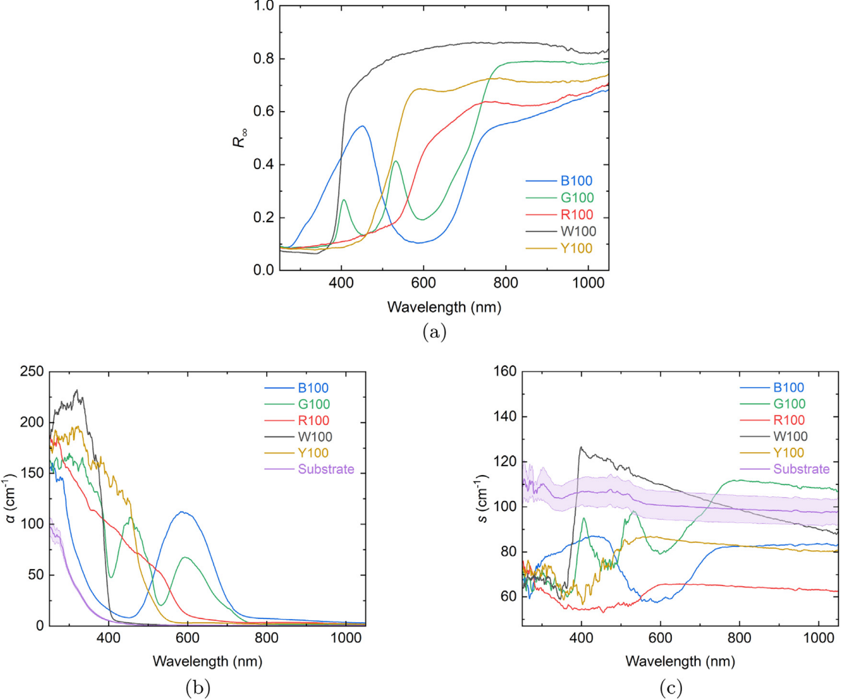
This paper applies the Yang-Miklavcic (Y-M) optical model to fiber-optic reflectance spectroscopy (FORS) data from single and binary pigment mixtures on paper, enabling quantitative estimation of pigment proportions. It reports successful de-mixing for many binary mixtures, with eight of twelve relative errors below 15%, and derives intrinsic optical coefficients for pigments and substrate.
Key findings
- The Y-M model is applied for the first time to heritage pigments on paper, separating pigment scattering from paper-substrate scattering and allowing quantitative estimation of components in binary pigment mixtures.
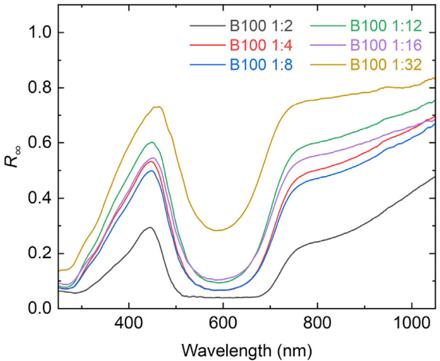
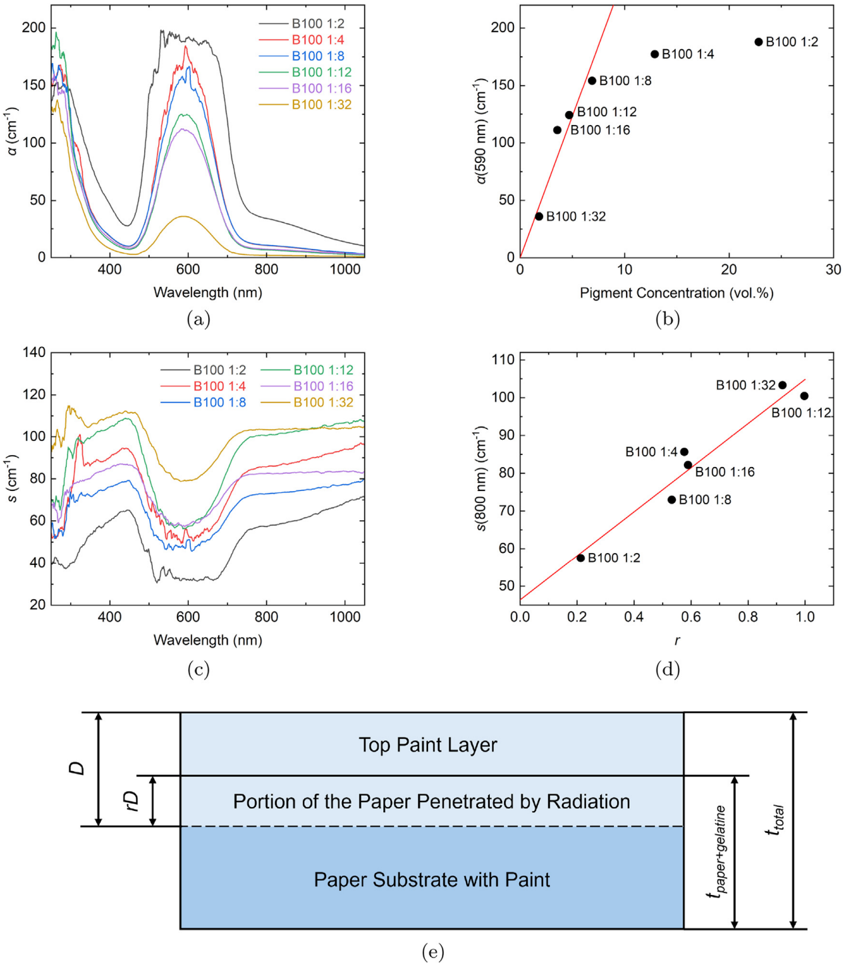
- For ultramarine blue, absorption at 590 nm is linear with pigment volume concentration up to a 1:8 pigment-to-binder ratio; the linear fit has a slope of (24.6 ± 1.9) cm⁻¹ and r² = 0.98250, yielding a molar extinction coefficient of (1900 ± 150) L mol⁻¹ cm⁻¹.
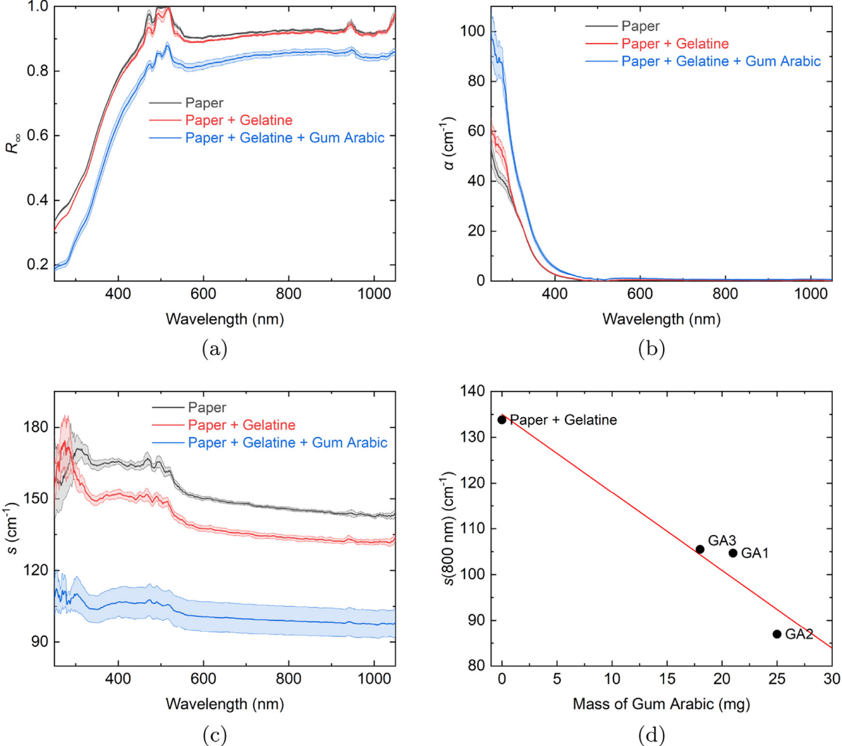
- Gum Arabic linearly decreases the paper scattering coefficient with added mass: slope (−1.7 ± 0.3) mg⁻¹, extrapolated value (135 ± 5) cm⁻¹ in the absence of binder, r² = 0.94448.
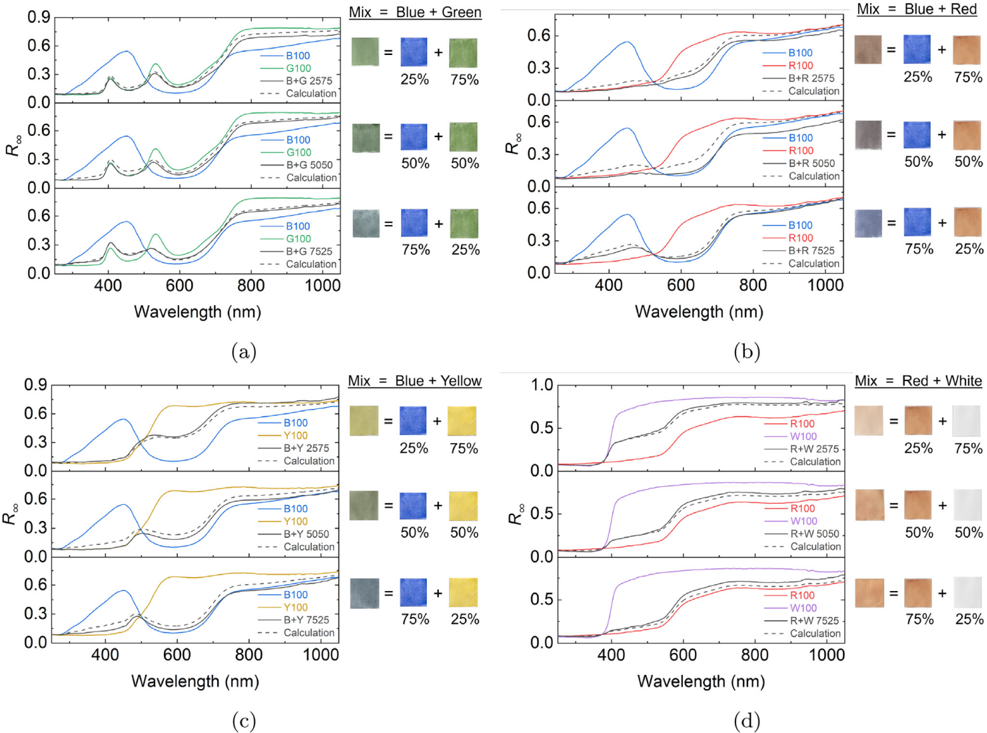
- Binary mixture de-mixing reproduced experimental spectra well: six of twelve simulations had relative errors below 10%, two below 15%, and four between 15% and 30%; the discussion states eight out of twelve mock-ups showed relative errors below 15%.
Methods
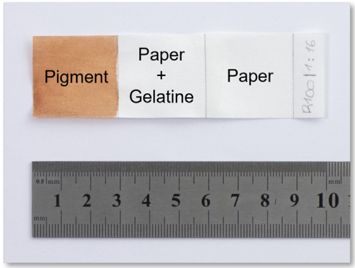
- Mock-ups were prepared on Whatman paper n.1 gelatin-sized on about two-thirds of their length, using five pigments (ultramarine blue, chromium oxide green, burnt sienna, titanium white, Naples yellow) mixed with 30% gum Arabic; single pigments and four binary mixtures (Blue+Yellow, Blue+Green, Blue+Red, Red+White) were made at 25%–75%, 50%–50%, and 75%–25% volume ratios, plus an ultramarine blue series at pigment-to-binder ratios from 1:2 to 1:32.
- FORS spectra were acquired with an Avantes integrating-sphere setup covering 250–1050 nm at 4.3 nm resolution, using white (99%) and black (2%) Spectralon references; K-M and Y-M coefficients were derived from reflectances, and binary compositions were estimated by least-squares minimization of the difference between derivatives of experimental and simulated reflectance spectra (Eq. 16).
Limitations
- The paper states that discrepancies between nominal and calculated concentrations arise from uncertainties in pigment densities used to calculate nominal volume concentrations, absorption saturation due to the spectrometer stray light limit (R_l = 4%, corresponding to absorbance ~1.4), and local variations in layer thickness contributing about 5%–10% uncertainty.
- Evident from the text: the study is limited to five pigments, binary mixtures, and mock-ups on gelatin-sized paper with gum Arabic, not actual artworks; the sample set for quantitative de-mixing is twelve binary mixtures, with no ternary or more complex mixtures tested.
- Evident from the text: the method relies on two-constant K-M/Y-M mixing assumptions and on samples being partially opaque within the measured wavelength range, which may not hold for all heritage paint systems.
Model-written summary. Check it against the paper before relying on it.
Integrity signals
Registry
Cites
Statistics
Figures

Verification
Claims the paper makes
0 Valid · 1 Not valid · 25 Not checked · 61 Own results and interpretations
A result the paper reports from its own data — it cites no other source for it, so there is none to check. The quote shows it is in the paper.
In the paper
“A linear relationship exists between the pigment volume concentration of ultramarine blue and the absorption maximum at 590 nm for concentrations up to 1:8, yielding a molar extinction coefficient of (1900 ± 150) L mol -1 cm -1 .”
- Also stated in: § 6. Conclusions · plain
“Ultramarine blue was studied as a function of pigment volume concentration, identifying the linear range of the absorption coefficient α and the molar extinction coefficient (1900 ± 150) L mol -1 cm -1 at 590 nm.”
§ Quantitative analysis of pigment mixtures on paper using fiber-optic reflectance spectroscopy and advanced optical modeling > 5. Discussion
plainstates an association- Asserted: passes — The authors put it forward as true.
- Checkable: passes — It can be checked against evidence.
- Load-bearing: passes — The paper’s conclusions depend on it.
- Based: passes — The paper gives a reason why it holds.
- Also stated in: § 6. Conclusions · plain
A result the paper states — it cites no source for it, so there is none to check. The quote shows it is in the paper.
In the paper
“Paint layer optical properties were strongly influenced by substrate scattering, which depends on the pigment-to-binder ratio.”
§ Quantitative analysis of pigment mixtures on paper using fiber-optic reflectance spectroscopy and advanced optical modeling > 6. Conclusions
boostedstates a cause- Asserted: passes — The authors put it forward as true.
- Checkable: passes — It can be checked against evidence.
- Load-bearing: passes — The paper’s conclusions depend on it.
- Based: passes — The paper gives a reason why it holds.
A result the paper reports from its own data — it cites no other source for it, so there is none to check. The quote shows it is in the paper.
In the paper
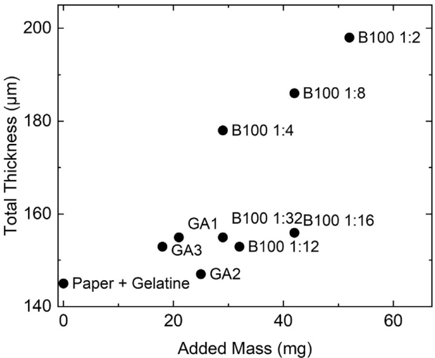
“The very small difference between t total and t paper+gelatin for almost all pigment mixtures indicates that r is close to 1 (see Supplementary Material).”
§ Quantitative analysis of pigment mixtures on paper using fiber-optic reflectance spectroscopy and advanced optical modeling > 5. Discussion
hedgedstates a cause- Asserted: passes — The authors put it forward as true.
- Checkable: passes — It can be checked against evidence.
- Load-bearing: passes — The paper’s conclusions depend on it.
- Based: passes — The paper gives a reason why it holds.
A result the paper reports from its own data — it cites no other source for it, so there is none to check. The quote shows it is in the paper.
In the paper
“This trend is supported by the linear decrease of s with added gum Arabic mass.”
- Also stated in: § 6. Conclusions · plain
“Gum Arabic caused a linear decrease in the scattering coefficient of the paper.”
§ Quantitative analysis of pigment mixtures on paper using fiber-optic reflectance spectroscopy and advanced optical modeling > 5. Discussion
plainstates a cause- Asserted: passes — The authors put it forward as true.
- Checkable: passes — It can be checked against evidence.
- Load-bearing: passes — The paper’s conclusions depend on it.
- Based: passes — The paper gives a reason why it holds.
- Also stated in: § 6. Conclusions · plain
A result the paper states — it cites no source for it, so there is none to check. The quote shows it is in the paper.
In the paper
“At higher concentrations, the measured absorbance saturates because of the stray light limit ( R l = 4% ), which corresponds to an absorbance of A 1 .4 .”
§ Quantitative analysis of pigment mixtures on paper using fiber-optic reflectance spectroscopy and advanced optical modeling > 5. Discussion
plainstates a cause- Asserted: passes — The authors put it forward as true.
- Checkable: passes — It can be checked against evidence.
- Load-bearing: unclear — It is unclear whether the paper’s conclusions depend on it.
- Based: passes — The paper gives a reason why it holds.
35 more claims
Create a free account to see all 87 claims and every source verdict.
- It may state two separate claims as one. 38
- Probably not a substantial claim. 10
Self-check
Percentages, sums and reported differences re-computed from the paper’s own numbers.
Each contradiction between two passages listed here was confirmed by an independent check.
Rated minor: it would not touch a result — a value no result rests on, a p-value that stays on the same side of the significance level, or a conflict that is clerical, resolved elsewhere in the paper, or outside its own findings.
In the paper
§ Quantitative analysis of pigment mixtures on paper using fiber-optic reflectance spectroscopy and advanced optical modeling > Sample ENC (%)
“For six of the twelve simulations, relative errors were below 10%; two were below 15%, and four ranged from 15% to 30%.”
§ Quantitative analysis of pigment mixtures on paper using fiber-optic reflectance spectroscopy and advanced optical modeling > Table 2
“Error is the absolute difference between nominal and calculated volume concentrations.”
Rated minor: it would not touch a result — a value no result rests on, a p-value that stays on the same side of the significance level, or a conflict that is clerical, resolved elsewhere in the paper, or outside its own findings.
In the paper
§ Quantitative analysis of pigment mixtures on paper using fiber-optic reflectance spectroscopy and advanced optical modeling > 3.2. Quantitative Approaches
“The original Kubelka-Munk formulation [35] was conceived for homogeneous dispersions of identical particles.”
§ Quantitative analysis of pigment mixtures on paper using fiber-optic reflectance spectroscopy and advanced optical modeling > References
“35. S. Chandrasekhar, Radiative transfer, Q. J. R. Meteorol. Soc. 76 (1950) 498, doi: 10.1002/qj.49707633016 .”
Citations
Cites
Chandrasekhar, S. (1950) · CERN Document Server (European Organization for Nuclear Research) · Cited by 8,702
New Contributions to the Optics of Intensely Light-Scattering Materials Part I
Kubelka, P. (1948) · Journal of the Optical Society of America · doi:10.1364/josa.38.000448 · Cited by 2,681
Kortüm, G. (1969) · Springer eBooks · doi:10.1007/978-3-642-88071-1 · Cited by 1,429
Revised Kubelka–Munk theory I Theory and application
Yang, L., & Kruse, B. (2004) · Journal of the Optical Society of America A · doi:10.1364/josaa.21.001933 · Cited by 410
Aceto, M., Agostino, A., Fenoglio, G., Idone, A., Gulmini, M., Picollo, M., Ricciardi, P., & Delaney, J. K. (2014) · Analytical Methods · doi:10.1039/c3ay41904e · Cited by 402
Cucci, C., Delaney, J. K., & Picollo, M. (2016) · Accounts of Chemical Research · doi:10.1021/acs.accounts.6b00048 · Cited by 373
Reflection infrared spectroscopy for the non-invasive in situ study of artists’ pigments
Miliani, C., Rosi, F., Daveri, A., & Brunetti, B. G. (2012) · Applied Physics A · doi:10.1007/s00339-011-6708-2 · Cited by 277
Picollo, M., Aceto, M., & Vitorino, T. (2018) · Physical Sciences Reviews · doi:10.1515/psr-2018-0008 · Cited by 229
The colour of pigment mixtures
Duncan, D. (1940) · Proceedings of the Physical Society · doi:10.1088/0959-5309/52/3/310 · Cited by 141
Yang, L., & Miklavcic, S. J. (2005) · Journal of the Optical Society of America A · doi:10.1364/josaa.22.001866 · Cited by 129
Cited by
Xie, Q., Liang, J., Zhang, S., Li, R., Ruan, L., Tang, G. H., & Zhang, H. (2026) · SSRN Electronic Journal · doi:10.2139/ssrn.7422893
Metadata
- Authors
- Vicente Rojas, R. P., Sotgiu, S., Cachia, V., DelRe, E., Schiavon, N., Giustini, M., & Missori, M.
- Affiliations
- Rome National Central Library (IT)
- Sapienza University of Rome (IT)
- Institute for Complex Systems (IT)
- Venue
- Journal of Cultural Heritage
- Publisher
- Elsevier BV
- Published
- 2026-07
- Volume
- 80
- Pages
- 470-479
- ISSN
- 1296-2074 (ISSN-L)
- OpenAlex
- W7167906819
- Cited by
- 1
- References
- 41
- Citations by year
- 2026: 1
- FWCI
- 7.22
- Type
- journal article
- Language
- en
- Open access
- hybrid
- doi.org
- Licence
- cc-by
- www.elsevier.com/tdm/userlicense/1.0/ (tdm)
- www.elsevier.com/legal/tdmrep-license (tdm)
- creativecommons.org/licenses/by/4.0/ (vor, 2 d)
- Locations
- Journal of Cultural Heritage (publishedVersion, cc-by)
- Funders
- European Commission
- Erasmus Plus (Project 101082567)
- Topics
- Social Sciences › Arts and Humanities › Archeology (arts and humanities) › Cultural Heritage Materials Analysis
- Physical Sciences › Physics and Astronomy › Atomic and Molecular Physics, and Optics › Color Science and Applications
- Physical Sciences › Chemistry › Analytical Chemistry › Spectroscopy and Chemometric Analyses
- Keywords
- fiber optic reflectance spectroscopy, pigment mixtures, paper substrates, Kubelka-Munk theory, diffuse reflectance, optical modeling, absorption and scattering coefficients, ultramarine, titanium white, Naples yellow, non-invasive analysis, pigment identification
About these checks
Registry, retraction, Cites and statistics results are computed, not judged, with one exception: a printed reference that no index lists is read once by a model before it counts as a citation error. Claims are extracted by a model and kept only when their quote appears verbatim in the text; each cited source is then checked, with a model’s help, for whether it says what the claim relies on. Those verdicts can be wrong — read the claim’s quote and the cited source before relying on one.
A language model drew the claims from the paper on 2026-11-24, under version 3 of the claim definition (model deepseek-v4.1-flash, prompt extract-v3).
A second model labelled each claim on 2026-11-24 (model jev-1.13-20260917, definition revision gold-guideline-v0.2).
Statistics and arithmetic are recomputed, not judged.
Confidence bands are shown only for fields calibrated on our annotated test set. None is calibrated yet, so no band is shown.
What counts as a claim ›How we measure confidence ›How we check this ›
Are you an author, or do you see a problem with this page? Request a review
How to cite
Cite CoChat for the checks on this page, and the paper for its own findings.
- This page
- CoChat. (2026). Citation check: Quantitative analysis of pigment mixtures on paper using fiber-optic reflectance spectroscopy and advanced optical modeling. https://app.cochat.ai/papers/10.1016/j.culher.2026.06.025
- The paper
- Vicente Rojas, R. P., Sotgiu, S., Cachia, V., DelRe, E., Schiavon, N., Giustini, M., & Missori, M. (2026). Quantitative analysis of pigment mixtures on paper using fiber-optic reflectance spectroscopy and advanced optical modeling. Journal of Cultural Heritage. https://doi.org/10.1016/j.culher.2026.06.025
Data sources
Bibliographic data: Semantic Scholar, OpenAlex, Crossref.
Contains information from the Semantic Scholar Academic Graph Datasets, made available under the ODC Attribution License (ODC-BY 1.0).
Semantic Scholar’s data is described in: Kinney, R., et al. (2023). The Semantic Scholar Open Data Platform. arXiv:2301.10140.
