

Fault detection in new wind turbines with limited data by generative transfer learning
Open accessThe DOI matches its Crossref record; 55 of the 55 references it cites were found in a registry or an index; none of the 53 sources its claims cite is checked for support yet.
Abstract
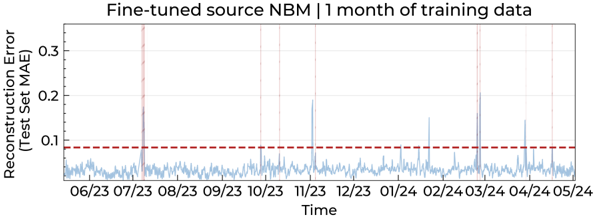
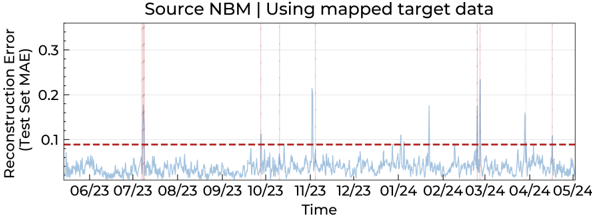
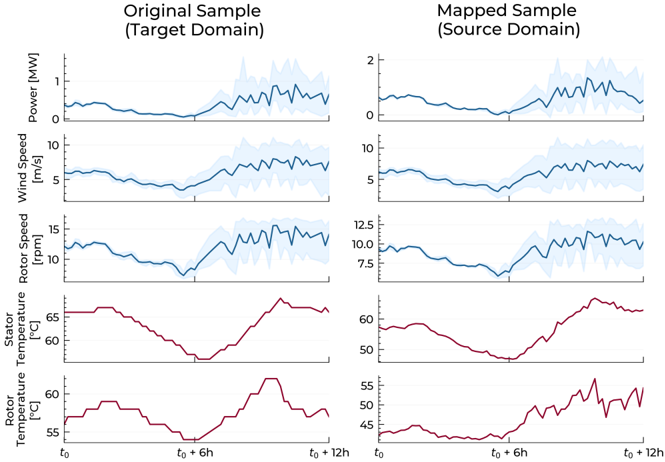
Intelligent condition monitoring of wind turbines is essential for reducing downtimes. Machine learning models trained on wind turbine operation data are commonly used to detect anomalies and, eventually, operation faults. However, data-driven normal behavior models (NBMs) require a substantial amount of training data, as NBMs trained with scarce data may result in unreliable fault detection. To overcome this limitation, we present a novel generative deep transfer learning approach to make SCADA samples from one wind turbine lacking training data resemble SCADA data from wind turbines with representative training data. Through CycleGAN-based domain mapping, our method enables the application of an NBM trained on an existing wind turbine to a new one with severely limited data. We demonstrate our approach on field data mapping SCADA samples across 7 substantially different WTs. Our findings show significantly improved fault detection in wind turbines with scarce data. Our method achieves the most similar anomaly scores to an NBM trained with abundant data, outperforming NBMs trained on scarce training data with improvements of +10.3% in F1-score when 1 month of training data is available and +16.8% when 2 weeks are available. The domain mapping approach outperforms conventional fine-tuning at all considered degrees of data scarcity, ranging from 1 to 8 weeks of training data. The proposed technique enables earlier and more reliable fault detection in newly installed wind farms, demonstrating a novel and promising research direction to improve anomaly detection when faced with training data scarcity.
Overview
CoChat Summary
TL;DR
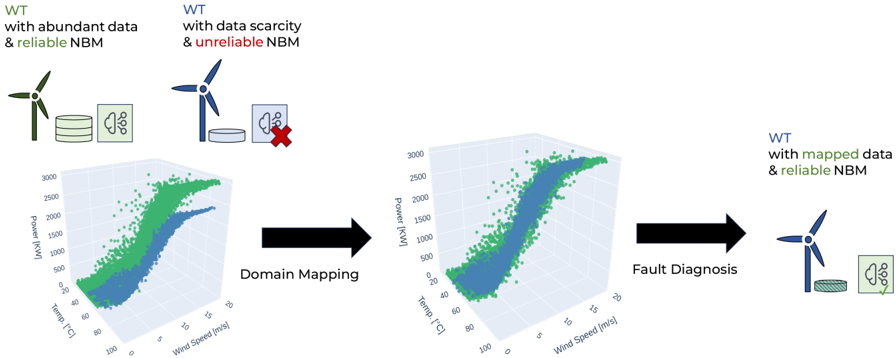
The paper proposes a CycleGAN-based domain mapping method that translates scarce target wind turbine SCADA data into a source turbine’s domain so a normal behavior model trained on abundant source data can be used for fault diagnosis. Across 28 source-target turbine pairs and 1–8 weeks of target training data, it improves F1-score similarity to a fully trained target NBM over scarce-data NBMs and fine-tuning, especially under severe scarcity.
Key findings
- Domain mapping improved mean F1-score over the scarce-data NBM by +10.3 percentage points with 1 month of target training data and +16.8 points with 2 weeks; fine-tuning improved by +4.7 and +9.3 points, respectively.
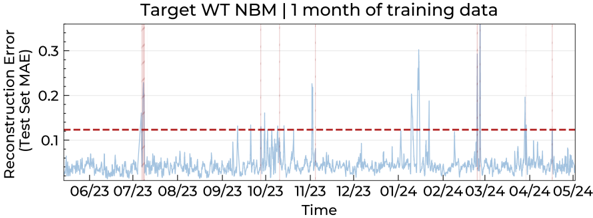
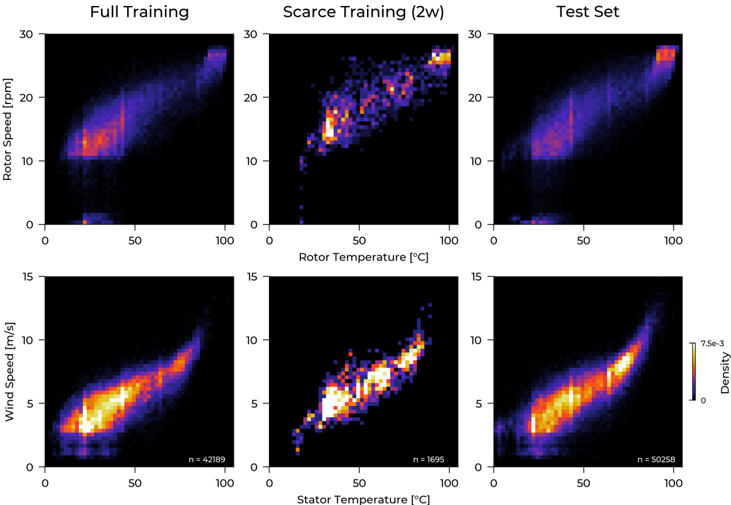
- NBMs trained on scarce target data alone degraded sharply: mean F1-score was 84.3% with 2 months of data but 51.3% with only 2 weeks across the 6 target WTs.
- Domain mapping outperformed fine-tuning across all considered training set sizes on average, with Table 2 averages ranging from −5.2 vs −9.8 points at 2 months to +15.2 vs +10.8 points at 1 week.
- In the detailed WT07→WT05 pair with 1 month of data, the scarce NBM achieved 63.9% F1, fine-tuning 68.8% (+4.9), and domain mapping 76.5% (+12.6).
Methods
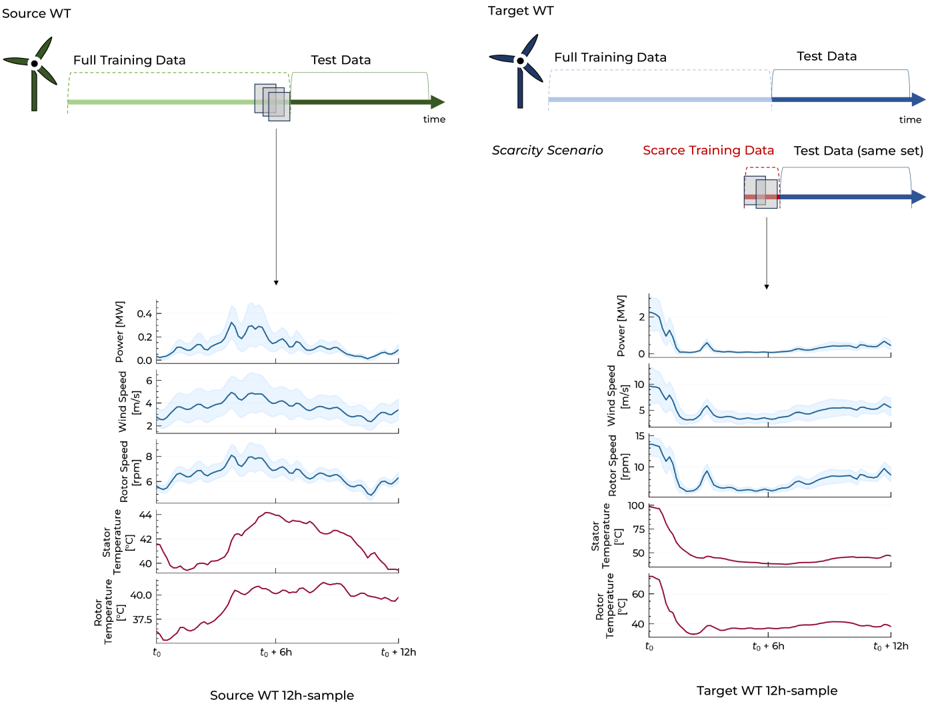
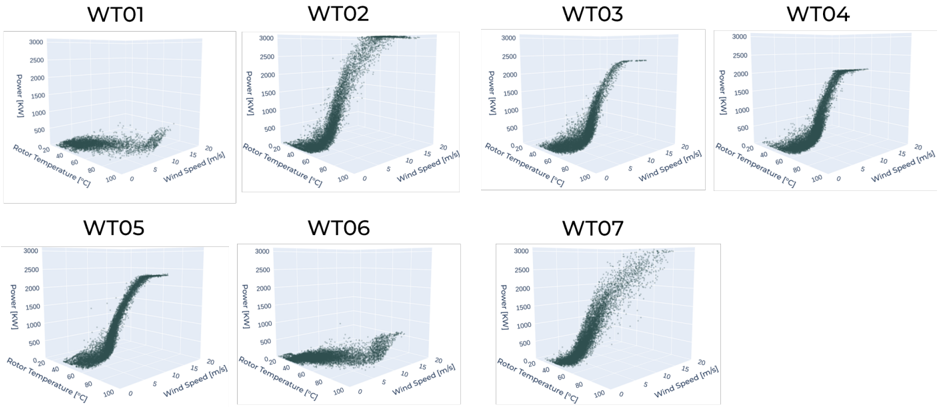
- Data: 10-minute averaged SCADA data from 7 wind turbines from distinct wind farms, same manufacturer but different model types, power ratings, maintenance/fault history, and locations; 12-hour sliding-window samples with 11 channels; 28 source-target pairs using 6 target WTs, with WT07 reserved for model selection and hyperparameter optimization; scarcity scenarios of 1–8 weeks immediately preceding a fixed test set.
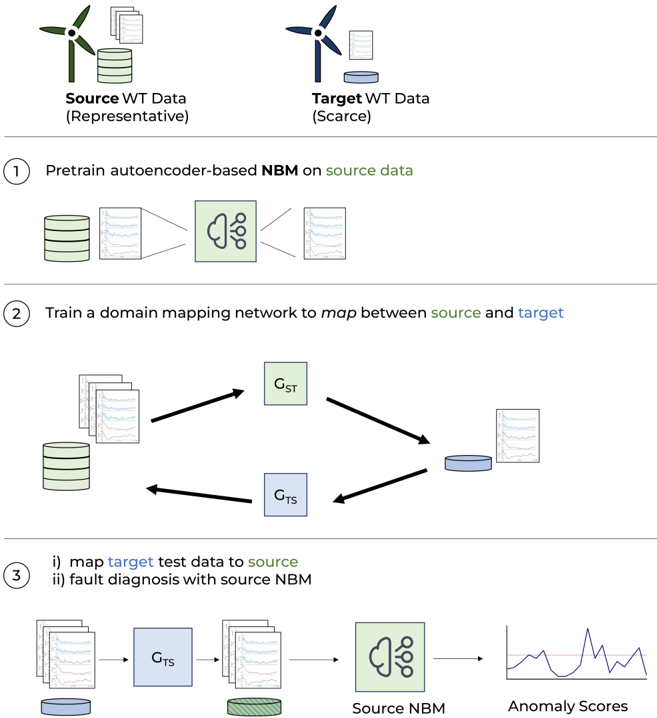
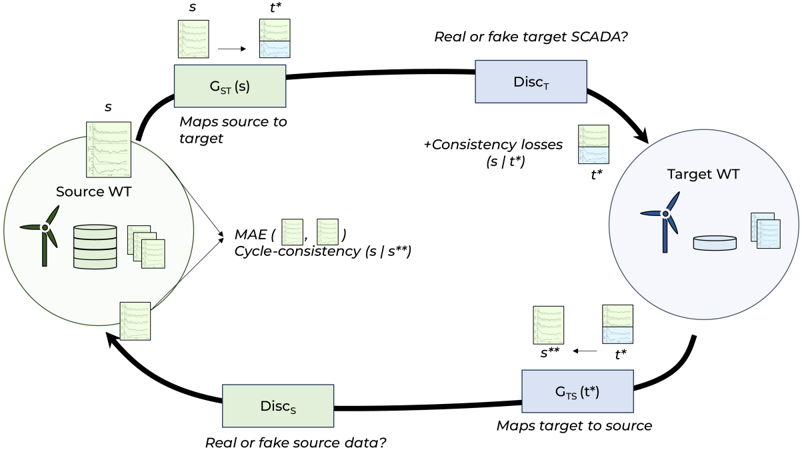
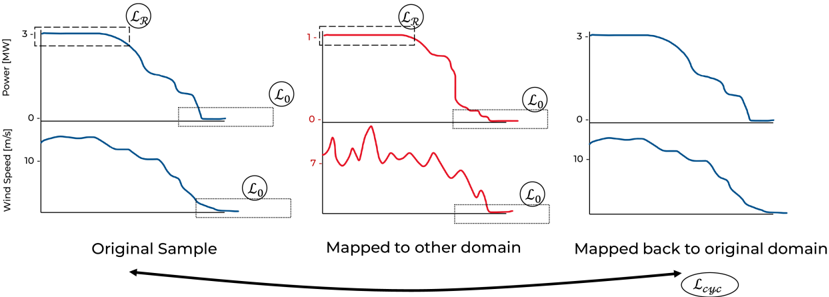
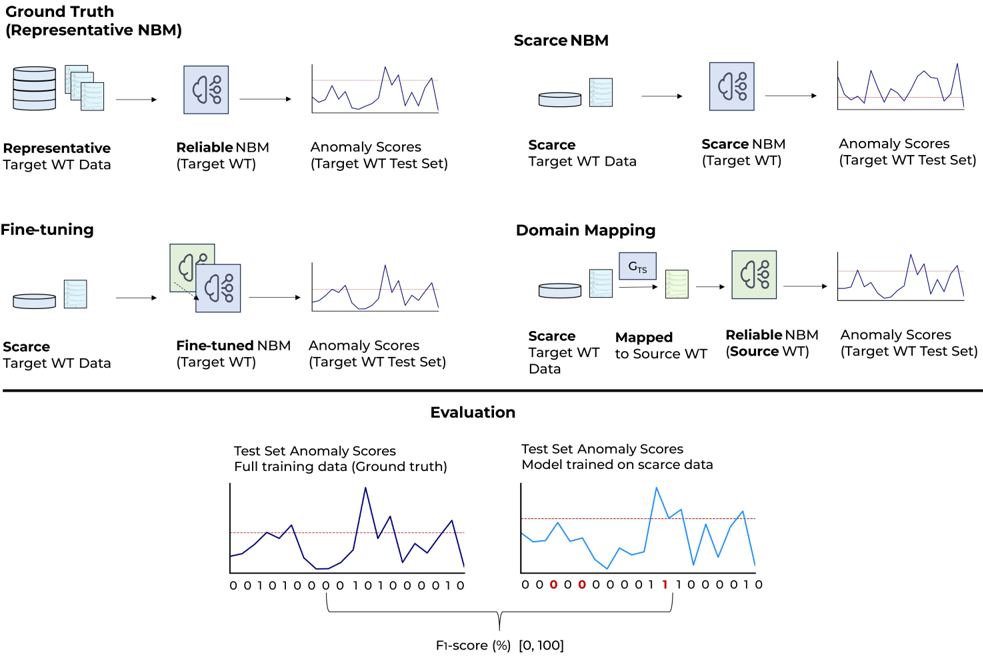
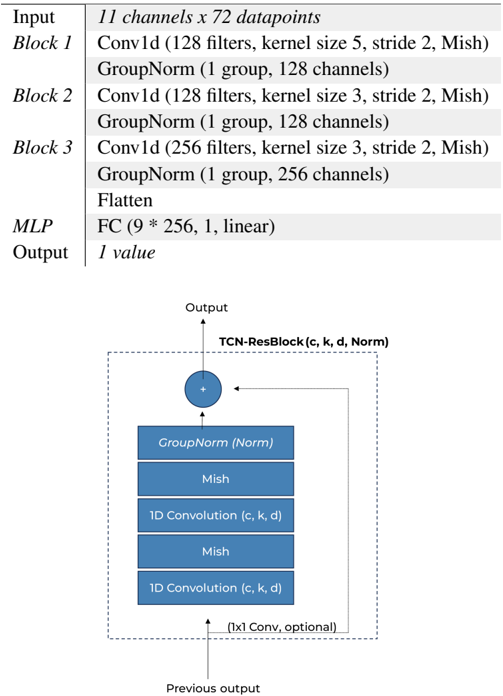
- Models: an autoencoder-based normal behavior model trained on normal source-domain data; a CycleGAN-based domain mapping network with generators/discriminators trained via GAN-QP, plus cycle-consistency, zero-state, and rated-power consistency losses; target test data mapped to the source domain for anomaly scoring.
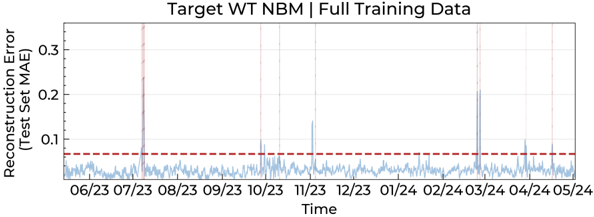
- Evaluation: thresholded anomaly scores compared by F1-score to a ground-truth NBM trained on full target training data; benchmarks were an NBM trained on scarce target data only and a fine-tuning approach that adapts the source NBM on scarce target data.
Limitations
- Stated: hyperparameter tuning was evaluated on the test set of one selected domain pair using 1 month of target training data, so it may not generalize across WT pairs with different domain shifts; domain mapping is more complex and computationally heavier/longer to train than fine-tuning; experiments were limited to WTs of the same manufacturer and a selection of SCADA features, requiring future work with more versatile wind farms, WT types, SCADA variables, and fault types.
- Stated/evident: performance decreases with abundant data (e.g., 2 months), where both fine-tuning and domain mapping showed limited improvements or drops; hyperparameters optimized for 1 month may be suboptimal when abundant data are available.
- Evident: strong WT-specific performance differences and cases where fine-tuning may be better or both methods drop, creating uncertainty in method selection at training time because the test set is unknown.
Model-written summary. Check it against the paper before relying on it.
Integrity signals
Registry
Cites
Statistics
Figures
Verification
Claims the paper makes
0 Valid · 3 Not valid · 37 Not checked · 81 Own results and interpretations
A result the paper reports from its own data — it cites no other source for it, so there is none to check. The quote shows it is in the paper.
In the paper
“Our findings show significantly improved fault diagnosis in wind turbines with scarce data.”
§ FAULT DIAGNOSIS IN NEW WIND TURBINES USING KNOWLEDGE FROM EXISTING TURBINES BY GENERATIVE DOMAIN ADAPTATION > Abstract
boostedstates a cause- Asserted: passes — The authors put it forward as true.
- Checkable: passes — It can be checked against evidence.
- Load-bearing: passes — The paper’s conclusions depend on it.
- Based: passes — The paper gives a reason why it holds.
A result the paper reports from its own data — it cites no other source for it, so there is none to check. The quote shows it is in the paper.
In the paper
“outperforming NBMs trained on scarce training data with improvements of +10.3% in F1-score when 1 month of training data is available”
§ FAULT DIAGNOSIS IN NEW WIND TURBINES USING KNOWLEDGE FROM EXISTING TURBINES BY GENERATIVE DOMAIN ADAPTATION > Abstract
plainstates a cause- Asserted: passes — The authors put it forward as true.
- Checkable: passes — It can be checked against evidence.
- Load-bearing: passes — The paper’s conclusions depend on it.
- Based: passes — The paper gives a reason why it holds.
A result the paper reports from its own data — it cites no other source for it, so there is none to check. The quote shows it is in the paper.
In the paper
“The domain mapping approach outperforms conventional fine-tuning at all considered degrees of data scarcity, ranging from 1 to 8 weeks of training data.”
§ FAULT DIAGNOSIS IN NEW WIND TURBINES USING KNOWLEDGE FROM EXISTING TURBINES BY GENERATIVE DOMAIN ADAPTATION > Abstract
plainstates a cause- Asserted: passes — The authors put it forward as true.
- Checkable: passes — It can be checked against evidence.
- Load-bearing: passes — The paper’s conclusions depend on it.
- Based: passes — The paper gives a reason why it holds.
A result the paper reports from its own data — it cites no other source for it, so there is none to check. The quote shows it is in the paper.
In the paper
“and +16.8% when 2 weeks are available.”
§ FAULT DIAGNOSIS IN NEW WIND TURBINES USING KNOWLEDGE FROM EXISTING TURBINES BY GENERATIVE DOMAIN ADAPTATION > Abstract
plainstates a cause- Asserted: passes — The authors put it forward as true.
- Checkable: passes — It can be checked against evidence.
- Load-bearing: passes — The paper’s conclusions depend on it.
- Based: passes — The paper gives a reason why it holds.
A result the paper reports from its own data — it cites no other source for it, so there is none to check. The quote shows it is in the paper.
In the paper
“Our method achieves the most similar anomaly scores to an NBM trained with abundant data”
§ FAULT DIAGNOSIS IN NEW WIND TURBINES USING KNOWLEDGE FROM EXISTING TURBINES BY GENERATIVE DOMAIN ADAPTATION > Abstract
plainstates an association- Asserted: passes — The authors put it forward as true.
- Checkable: passes — It can be checked against evidence.
- Load-bearing: passes — The paper’s conclusions depend on it.
- Based: passes — The paper gives a reason why it holds.
43 more claims
Create a free account to see all 121 claims and to verify the 52 references still open.
- It may state two separate claims as one. 31
- The quote only partly states this claim. 1
- Probably not a substantial claim. 47
Self-check
Percentages, sums and reported differences re-computed from the paper’s own numbers.
Each contradiction between two passages listed here was confirmed by an independent check.
Rated minor: it would not touch a result — a value no result rests on, a p-value that stays on the same side of the significance level, or a conflict that is clerical, resolved elsewhere in the paper, or outside its own findings.
In the paper
§ FAULT DIAGNOSIS IN NEW WIND TURBINES USING KNOWLEDGE FROM EXISTING TURBINES BY GENERATIVE DOMAIN ADAPTATION > 4.4 Content preservation losses
“L cyc = λ cyc (M AE (t, G ST (G T S (t))) + M AE (s, G T S (G ST (s))))(1)”
§ FAULT DIAGNOSIS IN NEW WIND TURBINES USING KNOWLEDGE FROM EXISTING TURBINES BY GENERATIVE DOMAIN ADAPTATION > 6 Conclusion
“GAN ← L GAN ST + L GAN T S + λ cyc L cyc + λ 0 L 0 + λ R L R”
Citations
Cites
Unpaired image-to-image translation using cycle-consistent adversarial networks
Zhu, J.-Y., Park, T., Isola, P., & Efros, A. A. (2017) · 2017 IEEE International Conference on Computer Vision (ICCV) · doi:10.1109/iccv.2017.244 · Cited by 23,602
Pan, S. J., & Yang, Q. (2010) · IEEE Transactions on Knowledge and Data Engineering · doi:10.1109/tkde.2009.191 · Cited by 23,387
Proceedings of the 24th international conference on Machine learning
(2007) · doi:10.1145/1273496 · Cited by 11,630
Domain-Adversarial Training of Neural Networks
Ganin, Y., Ustinova, E., Ajakan, H., Germain, P., Larochelle, H., Laviolette, F., Marchand, M., & Lempitsky, V. (2017) · Advances in Computer Vision and Pattern Recognition · doi:10.1007/978-3-319-58347-1_10 · Cited by 8,318
An Empirical Evaluation of Generic Convolutional and Recurrent Networks for Sequence Modeling
Bai, S., Kolter, J. Z., & Koltun, V. (2018) · arXiv · doi:10.48550/arxiv.1803.01271 · Cited by 4,655
Proceedings of the 21st International Conference on Neural Information Processing Systems
Koller, D., Schuurmans, D., Bengio, Y., & Bottou, L. (2008) · Cited by 4,461
Deep CORAL: Correlation Alignment for Deep Domain Adaptation
Sun, B., & Saenko, K. (2016) · Lecture Notes in Computer Science · doi:10.1007/978-3-319-49409-8_35 · Cited by 3,757
Wu, Y., & He, K. (2020) · International Journal of Computer Vision · doi:10.1007/s11263-019-01198-w · Cited by 3,601
Deep domain confusion Maximizing for domain invariance
Tzeng, E., Hoffman, J., Zhang, N., Saenko, K., & Darrell, T. (2014) · arXiv · doi:10.48550/arxiv.1412.3474 · Cited by 2,285
Domain-adversarial training of neural networks
GaninYaroslav, UstinovaEvgeniya, AjakanHana, GermainPascal, LarochelleHugo, LavioletteFrançois, MarchandMario, & LempitskyVictor (2016) · Journal of Machine Learning Research · doi:10.5555/2946645.2946704 · Cited by 1,201
A survey of unsupervised deep domain adaptation
Wilson, G., & Cook, D. J. (2020) · ACM Transactions on Intelligent Systems and Technology · doi:10.1145/3400066 · Cited by 987
A Unifying Review of Deep and Shallow Anomaly Detection
Ruff, L., Kauffmann, J. R., Vandermeulen, R. A., Montavon, G., Samek, W., Kloft, M., Dietterich, T. G., & Muller, K.-R. (2021) · Proceedings of the IEEE · doi:10.1109/jproc.2021.3052449 · Cited by 914
Machine learning methods for wind turbine condition monitoring: A review
Stetco, A., Dinmohammadi, F., Zhao, X., Robu, V., Flynn, D., Barnes, M., Keane, J., & Nenadic, G. (2019) · Renewable Energy · doi:10.1016/j.renene.2018.10.047 · Cited by 831
A comprehensive survey on design and application of autoencoder in deep learning
Li, P., Pei, Y., & Li, J. (2023) · Applied Soft Computing · doi:10.1016/j.asoc.2023.110176 · Cited by 602
Mish: A Self Regularized Non-Monotonic Activation Function
Misra, D. (2019) · arXiv · doi:10.48550/arxiv.1908.08681 · Cited by 541
Unsupervised Image-to-Image Translation Networks
Liu, M.-Y., Breuel, T. M., & Kautz, J. (2017) · arXiv (Cornell University) · doi:10.48550/arxiv.1703.00848 · Cited by 477
Using SCADA data for wind turbine condition monitoring – a review
Tautz‐Weinert, J., & Watson, S. J. (2017) · IET Renewable Power Generation · doi:10.1049/iet-rpg.2016.0248 · Cited by 458
Mish: A Self Regularized Non-Monotonic Activation Function
Misra, D. (2020) · Proceedings of the British Machine Vision Conference 2020 · doi:10.5244/c.34.191 · Cited by 432
CycleGAN-VC: Non-parallel Voice Conversion Using Cycle-Consistent Adversarial Networks
Kaneko, T., & Kameoka, H. (2018) · 2018 26th European Signal Processing Conference (EUSIPCO) · doi:10.23919/eusipco.2018.8553236 · Cited by 358 · cited 1×
“Domain mapping with CycleGAN has been used in various applications, e.g. in medical settings [26], voice conversion [27], machine fault diagnosis [20], or also for synthetic data augmentation in WT icing detection [28].”
A Review of Single-Source Deep Unsupervised Visual Domain Adaptation
Zhao, S., Yue, X., Zhang, S., Li, B., Zhao, H., Wu, B., Krishna, R., Gonzalez, J. E., Sangiovanni-Vincentelli, A. L., Seshia, S. A., et al. (2022) · IEEE Transactions on Neural Networks and Learning Systems · doi:10.1109/tnnls.2020.3028503 · Cited by 352
Wind turbine downtime and its importance for offshore deployment
Faulstich, S., Hahn, B., & Tavner, P. J. (2011) · Wind Energy · doi:10.1002/we.421 · Cited by 351
A simple more general boxplot method for identifying outliers
Schwertman, N. C., Owens, M. A., & Adnan, R. (2004) · Computational Statistics & Data Analysis · doi:10.1016/j.csda.2003.10.012 · Cited by 346
Deep Unsupervised Domain Adaptation: A Review of Recent Advances and Perspectives
Liu, X., Yoo, C., Xing, F., Oh, H., El Fakhri, G., Kang, J.-W., & Woo*, J. (2022) · APSIPA Transactions on Signal and Information Processing · doi:10.1561/116.00000192 · Cited by 299
Augmented CycleGAN: Learning Many-to-Many Mappings from Unpaired Data
Almahairi, A., Rajeswar, S., Sordoni, A., Bachman, P., & Courville, A. C. (2018) · arXiv (Cornell University) · doi:10.48550/arxiv.1802.10151 · Cited by 285
Deep Learning for fault detection in wind turbines
Helbing, G., & Ritter, M. (2018) · Renewable and Sustainable Energy Reviews · doi:10.1016/j.rser.2018.09.012 · Cited by 278
Yan, P., Abdulkadir, A., Luley, P.-P., Rosenthal, M., Schatte, G. A., Grewe, B. F., & Stadelmann, T. (2024) · IEEE Access · doi:10.1109/access.2023.3349132 · Cited by 212
(2015) · Lecture Notes in Computer Science · doi:10.1007/978-3-319-16181-5 · Cited by 174
Ren, H., Liu, W., Shan, M., & Wang, X. (2019) · Measurement · doi:10.1016/j.measurement.2019.106906 · Cited by 125
Proceedings of the 20th ACM Conference on Embedded Networked Sensor Systems
(2022) · doi:10.1145/3560905 · Cited by 103
System-wide anomaly detection in wind turbines using deep autoencoders
Renström, N., Bangalore, P., & Highcock, E. (2020) · Renewable Energy · doi:10.1016/j.renene.2020.04.148 · Cited by 102
A Systematic Survey of Regularization and Normalization in GANs
Li, Z., Usman, M., Tao, R., Xia, P., Wang, C., Chen, H., & Li, B. (2023) · ACM Computing Surveys · doi:10.1145/3569928 · Cited by 101
Luleci, F., Necati Catbas, F., & Avci, O. (2023) · Mechanical Systems and Signal Processing · doi:10.1016/j.ymssp.2023.110370 · Cited by 96
Deep Unsupervised Domain Adaptation with Time Series Sensor Data: A Survey
Shi, Y., Ying, X., & Yang, J. (2022) · Sensors · doi:10.3390/s22155507 · Cited by 82
Zhu, Y., Zhu, C., Tan, J., Tan, Y., & Rao, L. (2022) · Renewable Energy · doi:10.1016/j.renene.2022.02.061 · Cited by 81
Multi-target normal behaviour models for wind farm condition monitoring
Meyer, A. (2021) · Applied Energy · doi:10.1016/j.apenergy.2021.117342 · Cited by 80
Self-citationRenewables: Share data on wind energy
Kusiak, A. (2016) · Nature · doi:10.1038/529019a · Cited by 69
Autoencoder-based anomaly root cause analysis for wind turbines
Roelofs, C. M. A., Lutz, M.-A., Faulstich, S., & Vogt, S. (2021) · Energy and AI · doi:10.1016/j.egyai.2021.100065 · Cited by 57
Palladino, J. A., Slezak, D. F., & Ferrante, E. (2020) · International Symposium on Medical Information Processing and Analysis (SIPAIM) · doi:10.1117/12.2579548 · Cited by 41
Dual-Domain Feature Interaction Network for Automatic Colorectal Polyp Segmentation
Yue, G., Li, Y., Wu, S., Jiang, B., Zhou, T., Yan, W., Lin, H., & Wang, T. (2024) · IEEE Transactions on Instrumentation and Measurement · doi:10.1109/tim.2024.3470962 · Cited by 34
Anomaly Detection with Domain Adaptation
Yang, Z., Soltani, I., & Darve, E. (2023) · 2023 IEEE/CVF Conference on Computer Vision and Pattern Recognition Workshops (CVPRW) · doi:10.1109/cvprw59228.2023.00297 · Cited by 29
Schröder, L., Dimitrov, N. K., Verelst, D. R., & Sørensen, J. A. (2022) · Energies · doi:10.3390/en15020558 · Cited by 26
Yue, R., Jiang, G., Jin, X., He, Q., & Xie, P. (2024) · IEEE Transactions on Instrumentation and Measurement · doi:10.1109/tim.2024.3350147 · Cited by 24
Liu, X., Ma, H., & Liu, Y. (2022) · Sustainability · doi:10.3390/su14095441 · Cited by 23
Privacy-Preserving Fleet-Wide Learning of Wind Turbine Conditions with Federated Learning
Jenkel, L., Jonas, S., & Meyer, A. (2023) · Energies · doi:10.3390/en16176377 · Cited by 22
Self-citationGAN-QP: A Novel GAN Framework without Gradient Vanishing and Lipschitz ConstraintPreprint
Su, J. (2018) · arXiv (Cornell University) · doi:10.48550/arxiv.1811.07296 · Cited by 22
Investigation of deep transfer learning for cross-turbine diagnosis of wind turbine faults
Xie, P., Zhang, X., Jiang, G., Cui, J., & He, Q. (2023) · Measurement Science and Technology · doi:10.1088/1361-6501/acadf7 · Cited by 17
Jonas, S., Anagnostos, D., Brodbeck, B., & Meyer, A. (2023) · Energies · doi:10.3390/en16041760 · Cited by 16
Self-citationCondition Monitoring of Wind Turbine Generators Based on SCADA Data and Feature Transfer Learning
Jin, X., Wang, H., Kong, Z., Xu, Z., & Qiao, W. (2023) · IEEE Access · doi:10.1109/access.2023.3240306 · Cited by 14
Wind Turbine Condition Monitoring Based on Intra- and Inter-Farm Federated Learning
Grataloup, A., Jonas, S., & Meyer, A. (2025) · IEEE Access · doi:10.1109/access.2025.3599360 · Cited by 13
Self-citationChatterjee, J., Alvela Nieto, M. T., Gelbhardt, H., Dethlefs, N., Ohlendorf, J.-H., Greulich, A., & Thoben, K.-D. (2023) · Environmental Data Science · doi:10.1017/eds.2023.9 · Cited by 12
Transfer Learning Approaches for Wind Turbine Fault Detection using Deep Learning
Zgraggen, J., Ulmer, M., Jarlskog, E., Pizza, G., & Goren Huber, L. (2021) · PHM Society European Conference · doi:10.36001/phme.2021.v6i1.2835 · Cited by 11
CycleGAN Based Unsupervised Domain Adaptation for Machine Fault Diagnosis
Pattnaik, N., Vemula, U. S., Kumar, K., Kumar, A. A., Majumdar, A., Chandra, M. G., & Pal, A. (2022) · Proceedings of the 20th ACM Conference on Embedded Networked Sensor Systems · doi:10.1145/3560905.3568303 · Cited by 1
Comparison of novel SCADA Data Cleaning Technique for Wind Turbine Electric Pitch System
McKinnon, C., Tartt, K., Carroll, J., McDonald, A., Plumley, C., & Ferguson, D. (2022) · Journal of Physics: Conference Series · doi:10.1088/1742-6596/2151/1/012005 · Cited by 1
Wind turbine condition monitoring based on intra- and inter-farm federated learning
Grataloup, A., Jonas, S., & Meyer, A. (2024) · arXiv · doi:10.48550/arxiv.2409.03672
Self-citationPalladino, J. A., Slezak, D. F., & Ferrante, E. (2020) · arXiv · doi:10.48550/arxiv.2009.04985
Research works printed but not linked: 3
- S. Zhao, X. Yue, S. Zhang, et al., "A Review of Single-Source Deep Unsupervised Visual Domain Adaptation," IEEE Transactions on Neural Networks and Learning Systems, vol. 33, no. 2, pp. 473-493, 2022. DOI: 10.1109/ TNNLS.2020.3028503. · DOI · Paper page
- L. Liu, H. Jiang, P. He, et al., "On the variance of the adaptive learning rate and beyond," in International Conference on Learning Representations, 2020. [Online]. Available: https://openreview.net/forum?id= rkgz2aEKDr.
- Y. Yazıcı, C.-S. Foo, S. Winkler, K.-H. Yap, G. Piliouras, and V. Chandrasekhar, "The unusual effectiveness of averaging in GAN training," in International Conference on Learning Representations, 2019. [Online]. Available: https://openreview.net/forum?id=SJgw_sRqFQ.
Cited by
Jia, N., Feng, J., Zuo, Z., Liu, Z., Wang, T., Cai, C., & Li, Q. (2026) · Energies · doi:10.3390/en19051370 · Cited by 11
Akhtar, R., Mohammadi-Ivatloo, B., & Lassila, J. (2026) · Renewable and Sustainable Energy Reviews · doi:10.1016/j.rser.2026.116941 · Cited by 7
Qu, H., Wei, T., Huang, G., Xin, Z., Qu, Z., Jiang, Y., & Gu, Z. (2026) · Ocean Engineering · doi:10.1016/j.oceaneng.2026.126286 · Cited by 4
Marzouk, M., Mansouri, M. M., Kahloul, A. A., Kermani, M., Sakly, A., & Nounou, H. N. (2026) · IEEE Access · doi:10.1109/access.2026.3713261 · Cited by 3
Wei, Z., Zhongming, W. U., Wan, N., FeiLan, L., & Chen, Q. (2026) · Measurement Science and Technology · doi:10.1088/1361-6501/ae74fa · Cited by 2
Metadata
- Authors
- Jonas, S., & Meyer, A.
- Affiliations
- Bern University of Applied Sciences (CH)
- Corresponding author
- Jonas, Stefan
- Venue
- Energy and AI
- Publisher
- Elsevier BV
- Published
- 2025-12
- Volume
- 22
- Pages
- 100626
- ISSN
- 2666-5468 (ISSN-L)
- OpenAlex
- W4415219061
- Cited by
- 14
- References
- 53
- Citations by year
- 2026: 13 · 2025: 1
- FWCI
- 3.17
- Type
- journal article
- Language
- en
- Open access
- gold
- doi.org
- Licence
- cc-by-nc-nd
- www.elsevier.com/tdm/userlicense/1.0/ (tdm)
- www.elsevier.com/legal/tdmrep-license (tdm)
- creativecommons.org/licenses/by/4.0/ (vor)
- Locations
- Energy and AI (publishedVersion, cc-by-nc-nd)
- arXiv (Cornell University) (submittedVersion, cc-by-nc-nd)
- Funders
- Swiss National Science Foundation (206342)
- Topics
- Physical Sciences › Engineering › Control and Systems Engineering › Machine Fault Diagnosis Techniques
- Physical Sciences › Engineering › Control and Systems Engineering › Fault Detection and Control Systems
- Physical Sciences › Engineering › Electrical and Electronic Engineering › Wind Turbine Control Systems
- Keywords
- wind turbine fault detection, data scarcity, SCADA data, CycleGAN, domain adaptation, anomaly detection, condition monitoring, wind farms
About these checks
Registry, retraction, Cites and statistics results are computed, not judged, with one exception: a printed reference that no index lists is read once by a model before it counts as a citation error. Claims are extracted by a model and kept only when their quote appears verbatim in the text; each cited source is then checked, with a model’s help, for whether it says what the claim relies on. Those verdicts can be wrong — read the claim’s quote and the cited source before relying on one.
A language model drew the claims from the paper on 2026-11-24, under version 3 of the claim definition (model deepseek-v4.1-flash, prompt extract-v3).
A second model labelled each claim on 2026-11-24 (model jev-1.13-20260917, definition revision gold-guideline-v0.2).
Statistics and arithmetic are recomputed, not judged.
Confidence bands are shown only for fields calibrated on our annotated test set. None is calibrated yet, so no band is shown.
What counts as a claim ›How we measure confidence ›How we check this ›
Are you an author, or do you see a problem with this page? Request a review
Data sources
Bibliographic data: Semantic Scholar, OpenAlex, Crossref.
Contains information from the Semantic Scholar Academic Graph Datasets, made available under the ODC Attribution License (ODC-BY 1.0).
Semantic Scholar’s data is described in: Kinney, R., et al. (2023). The Semantic Scholar Open Data Platform. arXiv:2301.10140.
