

The DOI matches its Crossref record.
Risk of consuming products with or without precautionary wheat or gluten labelling for persons with coeliac disease
Open accessAbstract
Persons with Coeliac disease (CD) need to keep a lifelong diet without gluten and therefore need to know which foods are safe to eat. The objective of this study was to analyse ordinary foods products without gluten containing ingredients (PWG) with or without the precautionary allergen statement (PAL) "May contain wheat/gluten" or similar wording and use these data to perform a probabilistic risk assessment. Foods with and without PAL were analysed for gluten. Inputs for the risk assessment were analytical results, daily food consumption and data from a 90-days challenge study in coeliac patients (Catassi et al., 2007).20/77 products with PAL and 10/51 without PAL had gluten ≥5 mg/kg 3/77 with PAL and 3/51 without PAL had gluten ≥20 mg/kg. A coconut cookie brand was outlier with 421 mg gluten/kg. The likelihood of developing mucosal damage in the CD population when eating the same PWG for 90 days in addition to certified gluten-free products was low (0.2-3.2%) with little difference between with or without PAL. Including the coconut cookie results increased the risk to 3.8-9.2%. Caution should be taken in connection to foods where there is an obvious chance of contamination.
Overview
The claims and statistics of this paper haven’t been checked yet.
Run the check — free, no account needed. It reads the open-access text and checks the sources it cites.
Integrity signals
Registry
Cites
Statistics
Figures
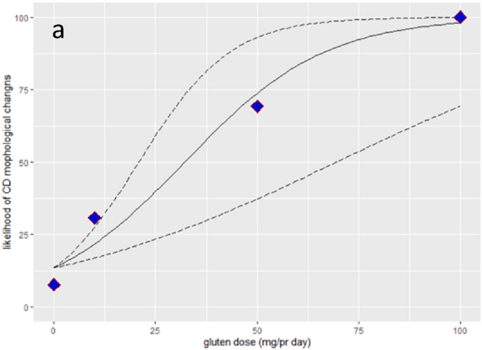
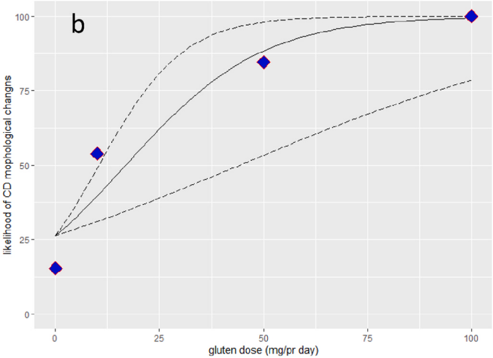
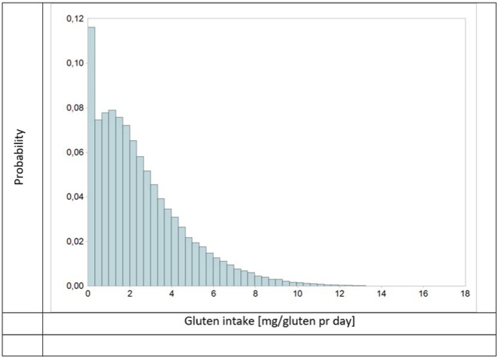
Verification
Claims the paper makes
The claims and statistics of this paper haven’t been checked yet.
Run the check — free, no account needed. It reads the open-access text and checks the sources it cites.
Claims other papers make about this one
Each is checked against this paper’s own text: does it say what the citing paper says it does?
The cited source says what the claim attributes to it.
In the citing paper
“In Denmark, foods with PAL had a gluten content >20mg/kg in 3.9% of products compared with 5.9% in foods without PAL (57), with no statistical difference.”
The cited source says what the claim attributes to it.
In the citing paper
“In adults, the likelihood of developing mucosal damage in the CD population when eating foods not labelled as 'gluten-free' in a regular diet, with or without PAL, together with certified products, was estimated to be low, at the level of 0.2-3.2% (57).”
Self-check
Percentages, sums and reported differences re-computed from the paper’s own numbers.
The self-check needs the paper’s full text.
Citations
Cites
Still being checked.
Research works printed but not linked: 14
- Birot, 2017, A procedure for grouping food consumption data for use in food allergen risk assessment, J. Food Compos. Anal., 59, 111, 10.1016/j.jfca.2017.01.008 · DOI
- Catassi, 2007, A prospective, double-blind, placebo-controlled trial to establish a safe gluten threshold for patients with celiac disease, Am. J. Clin. Nutr., 85, 160, 10.1093/ajcn/85.1.160 · DOI
- Catassi, 1993, Dose dependent effects of protracted ingestion of small amounts of gliadin in coeliac disease children: a clinical and jejunal morphometric study, Gut, 34, 1515, 10.1136/gut.34.11.1515 · DOI
- DunnGalvin, 2019, Evidence-based approaches to the application of precautionary allergen labelling: report from two iFAAM workshops, Clin. Exp. Allergy : J. Brit. Soc. Allergy Clin. Immunol., 49, 1191, 10.1111/cea.13464 · DOI
- Fasano, 2001, Current approaches to diagnosis and treatment of celiac disease: an evolving spectrum, Gastroenterology, 120, 636, 10.1053/gast.2001.22123 · DOI
- Gibert, 2013, Might gluten traces in wheat substitutes pose a risk in patients with celiac disease? A population-based probabilistic approach to risk estimation, Am. J. Clin. Nutr., 97, 109, 10.3945/ajcn.112.047985 · DOI
- Guennouni, 2021, Gluten contamination in labelled gluten-free, naturally gluten-free and meals in food services in low-, middle- and high-income countries: a systematic review and meta-analysis, Br. J. Nutr., 1
- Madsen, 2009, Approaches to risk assessment in food allergy: report from a workshop “developing a framework for assessing the risk from allergenic foods.”, Food Chem. Toxicol., 47, 480, 10.1016/j.fct.2008.12.001 · DOI
- Madsen, 2020, Can we define a level of protection for allergic consumers that everyone can accept?, Regul. Toxicol. Pharmacol., 117, 10.1016/j.yrtph.2020.104751 · DOI
- 2014, Commission implementing regulation (EU) No. 828/2014 of 30 july 2014 on the requirements for the provision of information to consumers on the absence or reduced presence of gluten in food, Off. J. Eur. Union, L228, 5
- Remington, 2015, Unintended allergens in precautionary labelled and unlabelled products pose significant risks to UK allergic consumers, Allergy, 70, 813, 10.1111/all.12625 · DOI
- Di Sabatino, 2009, Coeliac disease, Lancet, 373, 1480, 10.1016/S0140-6736(09)60254-3 · DOI
- Sharma, 2020, Evaluation of sampling plans for measurement of gluten in oat groats, Food Control, 114, 10.1016/j.foodcont.2020.107241 · DOI
- Taavela, 2013, Validation of morphometric analyses of small-intestinal biopsy readouts in celiac disease, PLoS One, 8, 10.1371/journal.pone.0076163 · DOI
Cited by
Luque, V., Crespo‐Escobar, P., Hård af Segerstad, E. M., Koltai, T., Norsa, L., Roman, E., Vreugdenhil, A., Fueyo‐Díaz, R., & Ribes‐Koninckx, C. (2024) · Journal of Pediatric Gastroenterology and Nutrition · doi:10.1002/jpn3.12079 · Cited by 44
Metadata
- Authors
- Rasmussen, S. N., Vigre, H., & Madsen, C. B.
- Affiliations
- Novo Nordisk (Denmark) (DK)
- Technical University of Denmark (DK)
- Corresponding author
- Madsen, Charlotte Bernhard
- Venue
- Food and Chemical Toxicology
- Publisher
- Elsevier BV
- Published
- 2022-08
- Volume
- 166
- Pages
- 113231
- ISSN
- 0278-6915 (ISSN-L)
- OpenAlex
- W4282580755
- Cited by
- 10
- References
- 0
- Citations by year
- 2026: 6 · 2025: 1 · 2024: 2 · 2023: 1
- FWCI
- 0.88
- Type
- journal article
- Language
- en
- Open access
- hybrid
- doi.org
- Licence
- Locations
- Food and Chemical Toxicology (publishedVersion, cc-by)
- PubMed (publishedVersion)
- Technical University of Denmark, DTU Orbit (Technical University of Denmark, DTU) (submittedVersion, cc-by)
- Topics
- Health Sciences › Medicine › Gastroenterology › Celiac Disease Research and Management
- Health Sciences › Medicine › Immunology and Allergy › Food Allergy and Anaphylaxis Research
- Life Sciences › Agricultural and Biological Sciences › Food Science › Food Safety and Hygiene
- Keywords
- celiac disease, precautionary allergen labelling, gluten, wheat, gluten-free foods, food contamination, mucosal injury, risk assessment
- MeSH terms
- Allergens, Celiac Disease, Food, Glutens, Humans, Triticum, Diet, Gluten-Free
About these checks
Registry, retraction, Cites and statistics results are computed, not judged, with one exception: a printed reference that no index lists is read once by a model before it counts as a citation error. Claims are extracted by a model and kept only when their quote appears verbatim in the text; each cited source is then checked, with a model’s help, for whether it says what the claim relies on. Those verdicts can be wrong — read the claim’s quote and the cited source before relying on one.
Statistics and arithmetic are recomputed, not judged.
Confidence bands are shown only for fields calibrated on our annotated test set. None is calibrated yet, so no band is shown.
What counts as a claim ›How we measure confidence ›How we check this ›
Are you an author, or do you see a problem with this page? Request a review
How to cite
Cite CoChat for the checks on this page, and the paper for its own findings.
- This page
- CoChat. (2026). Citation check: Risk of consuming products with or without precautionary wheat or gluten labelling for persons with coeliac disease. https://app.cochat.ai/papers/10.1016/j.fct.2022.113231
- The paper
- Rasmussen, S. N., Vigre, H., & Madsen, C. B. (2022). Risk of consuming products with or without precautionary wheat or gluten labelling for persons with coeliac disease. Food and Chemical Toxicology. https://doi.org/10.1016/j.fct.2022.113231
