

Unsheltered Homelessness and Health: A Literature Review
Open accessThe DOI matches its Crossref record; 55 of the 56 references it cites were found in a registry or an index, and 1 are not checked yet; none of the 131 sources its claims cite is checked for support yet.
Abstract
Context: In recent years, cities across the world have seen widespread growth in unsheltered homelessness, in which a person sleeps in a place not meant for human habitation such as cars, parks, sidewalks, and abandoned buildings. It is widely understood that people experiencing homelessness have poorer health outcomes than the general population. Less is known about the health of people who are unsheltered, yet they may be exposed to greater health risks than their sheltered counterparts. The purpose of this literature review is to evaluate and summarize the evidence on unsheltered homelessness and health. Evidence Acquisition: A literature search was conducted using PubMed to identify publications on unsheltered homelessness and health. A total of 42 studies were included for review. Evidence Synthesis: Unsheltered populations experience higher rates of chronic disease, serious mental illness, and substance abuse than sheltered populations. Unsheltered homelessness is strongly associated with chronic homelessness that exacerbates serious mental illness and substance use, which is often co-occurring. Despite having large unmet health needs, unsheltered populations have lower healthcare utilization and often lack health insurance. Conclusions: Evaluating the impact of shelter status on health outcomes has important implications for the allocation of housing and health services. Longitudinal studies are needed to examine the relationship between the duration of sheltered and unsheltered homelessness and health outcomes and explore the mediating mechanisms that lead to poor health among unsheltered populations. Despite these limitations, our results also suggest an urgent need to address the unique and severe challenges facing unsheltered populations and the need for intervention approaches that are sensitive to these unique disease burdens.
Overview
CoChat Summary
TL;DR
This literature review synthesizes 42 studies comparing unsheltered and sheltered homeless adults and finds consistently worse physical health, mental health, substance use, mortality, and lower healthcare utilization among unsheltered populations. Evidence quality is mixed, and the authors call for longitudinal research on causal mechanisms.
Key findings
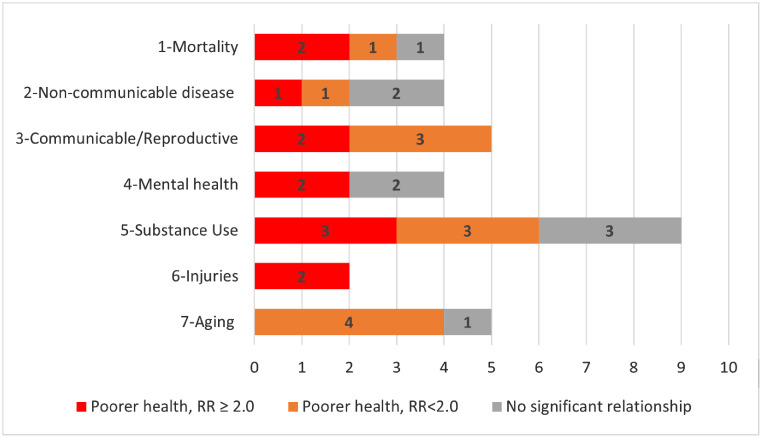
- Across 48 Tier 1 directional associations, 44% (21/48) indicated substantially poorer health for unsheltered persons (RR/OR ≥2.0), 29% (14/48) somewhat poorer health (RR/OR 1.0–2.0), and 27% (13/48) no significant relationship; no Tier 1 study supported better health for unsheltered persons.
- Mortality was higher among unsheltered cohorts: Boston SMR=2.7 (95% CI=2.3, 3.2) versus sheltered; high-risk unsheltered SMR=4.0 (95% CI=3.0, 5.2); a national 100,000 Homes analysis found AOR=1.12 (95% CI=1.05, 1.19).
- Unsheltered women in Los Angeles had greater odds of fair/poor physical health (AOR=3.40; 95% CI=2.34, 4.94), pain (AOR=2.28; 95% CI=1.54, 3.37), poor mental health (AOR=12.69; 95% CI=6.68, 24.13), multiple sex partners (AOR=2.79; 95% CI=1.93, 4.03), STI (AOR=2.10; 95% CI=1.05, 4.21), physical assault (AOR=2.74; 95% CI=1.91, 3.94), and robbery (AOR=5.37; 95% CI=3.64, 7.92).
- Unsheltered populations had lower healthcare access/utilization: not residing on streets was associated with recent health services use (AOR=11.39; 95% CI=3.58, 36.24); unsheltered women were less likely to have seen a dentist (AOR=0.34; 95% CI=0.21, 0.53), received a Pap test (AOR=0.40; 95% CI=0.28, 0.59), or received a TB test (AOR=0.22; 95% CI=0.15, 0.33); unsheltered persons in England were less likely to be registered with a GP (AOR=0.45; 95% CI=0.30, 0.66), and unsheltered populations often lack health insurance.
Methods
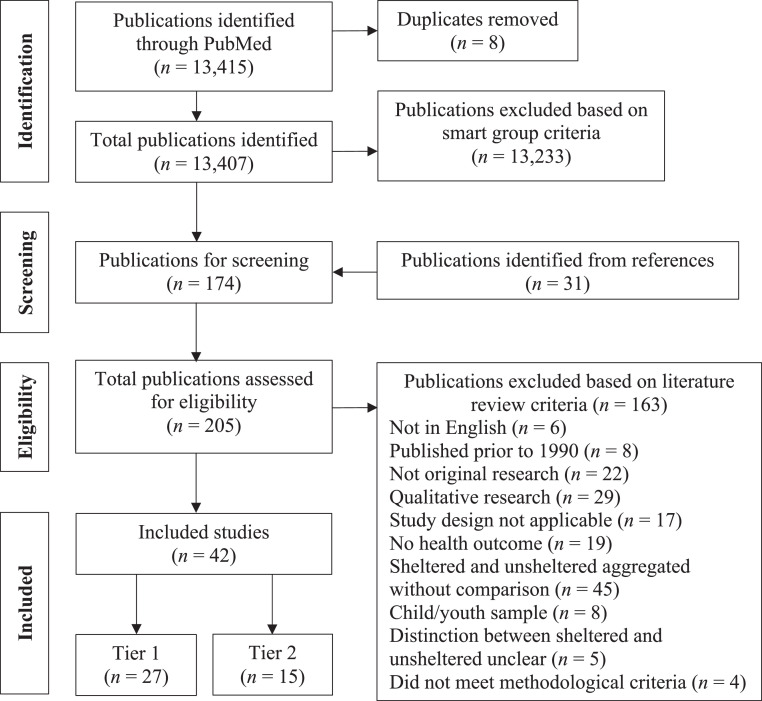
- Literature review following Fazel et al., using PubMed in May 2020 for 1990–2020 with keywords including unshelter*, rough sleeper*, and street homeless*; 13,415 publications were identified, 174 screened, 31 additional screened from reference lists, and 42 publications selected (Tier 1: 27; Tier 2: 15).
- Included studies estimated an association between unsheltered homelessness and a health-related outcome; results were grouped into mortality, noncommunicable diseases, reproductive health, communicable disease, mental health, substance abuse, health services utilization, and injuries. Tier 2 evidence was reported only if it contradicted Tier 1 evidence or if Tier 1 evidence did not exist.
- Study quality was scored on sampling rigor, use of validated health measures, and control/accounting for population composition; score-1 studies were excluded. From 27 Tier 1 comparative studies, 48 unique directional associations were extracted and classified as substantially poorer (RR/OR ≥2.0), somewhat poorer (RR/OR 1.0–2.0), or not statistically significant.
Limitations
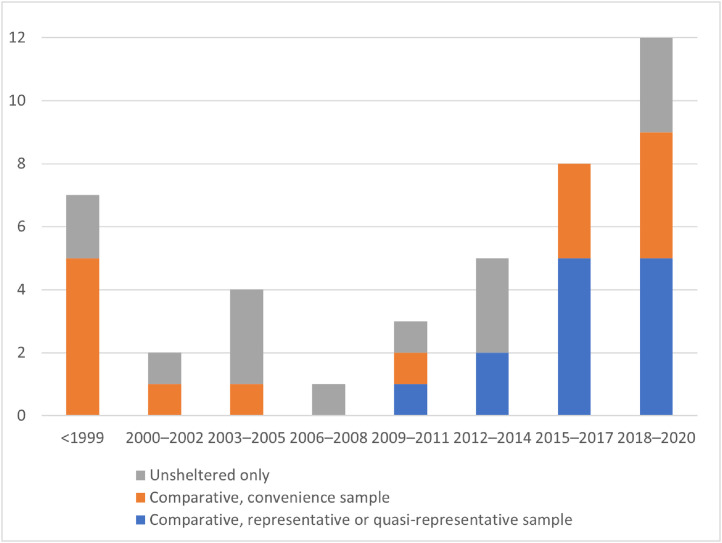
- The authors state that few studies addressed injuries, communicable diseases, and sexual/reproductive health; definitions of unshelteredness and comparison groups varied substantially; and sampling quality was variable, with few probability samples and only half of comparative studies using quasi-representative methods.
- The authors state that longitudinal designs are needed to assess causal mechanisms and reverse causality; only 1 reviewed paper attempted to isolate a causal factor, and risk factors such as chronic low-quality food exposure and sleep disruption from light/noise pollution were not addressed. They also call for more research on intersectionality by race, ethnicity, sex, gender, sexual orientation, and other marginalized identities.
- Evident from the text: the review synthesizes mostly cross-sectional studies, predominantly from the U.S. (29 of 42), so causal inference is limited; publication bias was checked via gray literature but no formal meta-analysis was performed.
Model-written summary. Check it against the paper before relying on it.
Integrity signals
Registry
Cites
Statistics
Figures
Verification
Claims the paper makes
0 Valid · 4 Not valid · 108 Not checked · 38 Own results and interpretations
None of the sources cited for this claim have been checked yet.
In the paper
“Evidence is mixed regarding the impact of shelter status and chronic homelessness on chronic health conditions.17,31,32”
§ Unsheltered Homelessness and Health: A Literature Review > EVIDENCE SYNTHESIS > Noncommunicable Diseases and Associated Markers
What the sources say
- Not checked yetcites [17] Montgomery AE Szymkowiak D Marcus J Howard P Culhane DP. Homelessness, unsheltered status, and risk factors for mortality: findings from the 100 000 homes campaign Public Health Rep 131 6 2016 765 772 10.1177/0033354916667501 28123222 PMC5230839 source
- Not checked yetcites [31] O’Toole TP Gibbon JL Hanusa BH Fine MJ. Utilization of health care services among subgroups of urban homeless and housed poor J Health Polit Policy Law 24 1999 91 114 10.1215/03616878-24-1-91 10342256 source
- Not checked yetcites [32] Tsai J Kasprow WJ Kane V Rosenheck RA. Street outreach and other forms of engagement with literally homeless veterans J Health Care Poor Underserved 25 2 2014 694 704 10.1353/hpu.2014.0087 24858879 source
plain- Asserted: passes — The authors put it forward as true.
- Checkable: passes — It can be checked against evidence.
- Load-bearing: passes — The paper’s conclusions depend on it.
- Based: passes — The paper gives a reason why it holds.
In the paper
“Compared with that of a sheltered homeless cohort, the standardized mortality ratio (SMR) for an unsheltered homeless cohort in Boston was nearly 3 (SMR=2.7; 95% CI=2.3, 3.2) times higher.25”
§ Unsheltered Homelessness and Health: A Literature Review > EVIDENCE SYNTHESIS > Mortality and Cause of Death
What the sources say
- Not checked yetcites [25] Roncarati JS Baggett TP O'Connell JJ Mortality among unsheltered homeless adults in Boston, Massachusetts, 2000–2009 JAMA Intern Med 178 9 2018 1242 1248 10.1001/jamainternmed.2018.2924 30073282 PMC6142967 source
plainstates an association- Asserted: passes — The authors put it forward as true.
- Checkable: passes — It can be checked against evidence.
- Load-bearing: passes — The paper’s conclusions depend on it.
- Based: passes — The paper gives a reason why it holds.
In the paper
“The past decade has seen a sizable increase in the proportion of the U.S. homeless population who are unsheltered.”
§ Unsheltered Homelessness and Health: A Literature Review > CONTEXT
What the sources say
- Not checked yetcites [1] Henry M, de Sousa T, Roddey C, Gayen S, Bednar T. The 2020 Annual Homeless Assessment Report (AHAR) to Congress. U.S. Department of Housing and Urban Development. https://www.huduser.gov/portal/sites/default/files/pdf/2020-AHAR-Part-1.pdf. Published January 2021. Accessed December 2021.
plainstates a cause- Asserted: passes — The authors put it forward as true.
- Checkable: passes — It can be checked against evidence.
- Load-bearing: unclear — It is unclear whether the paper’s conclusions depend on it.
- Based: passes — The paper gives a reason why it holds.
None of the sources cited for this claim have been checked yet.
In the paper
“Unsheltered populations often experience poor adult health outcomes.”
§ Unsheltered Homelessness and Health: A Literature Review > EVIDENCE SYNTHESIS > Noncommunicable Diseases and Associated Markers
plainstates an association- Asserted: passes — The authors put it forward as true.
- Checkable: passes — It can be checked against evidence.
- Load-bearing: passes — The paper’s conclusions depend on it.
- Based: passes — The paper gives a reason why it holds.
A result the paper reports from its own data — it cites no other source for it, so there is none to check. The quote shows it is in the paper.
In the paper
“No Tier 1 studies provided support for unsheltered individuals having better health than sheltered comparators.”
§ Unsheltered Homelessness and Health: A Literature Review > EVIDENCE SYNTHESIS
plain- Asserted: passes — The authors put it forward as true.
- Checkable: passes — It can be checked against evidence.
- Load-bearing: passes — The paper’s conclusions depend on it.
- Based: passes — The paper gives a reason why it holds.
77 more claims
Create a free account to see all 150 claims and to verify the 126 references still open.
- It may state two separate claims as one. 55
- Probably not a substantial claim. 25
Citations
Cites
Fazel, S., Geddes, J. R., & Kushel, M. (2014) · The Lancet · doi:10.1016/s0140-6736(14)61132-6 · Cited by 1,568 · cited 3×
“, point-in-time homeless counts); (2) convenience samples where the sample was not selected on the basis of health or health risk (i.”
BackgroundMortality Among Homeless Adults in Boston: Shifts in Causes of Death Over a 15-Year Period
Baggett, T. P., Hwang, S. W., O’Connell, J. J., Porneala, B. C., Stringfellow, E. J., Orav, E. J., Singer, D. E., & Rigotti, N. A. (2013) · JAMA Internal Medicine · doi:10.1001/jamainternmed.2013.1604 · Cited by 566
Homelessness as an independent risk factor for mortality: results from a retrospective cohort study
Morrison, D. S. (2009) · International Journal of Epidemiology · doi:10.1093/ije/dyp160 · Cited by 373
Interventions to Improve the Health of the HomelessA Systematic Review
HWANG, S., TOLOMICZENKO, G., KOUYOUMDJIAN, F., & GARNER, R. (2005) · American Journal of Preventive Medicine · doi:10.1016/j.amepre.2005.06.017 · Cited by 264
Mortality Among Unsheltered Homeless Adults in Boston, Massachusetts, 2000-2009
Roncarati, J. S., Baggett, T. P., O’Connell, J. J., Hwang, S. W., Cook, E. F., Krieger, N., & Sorensen, G. (2018) · JAMA Internal Medicine · doi:10.1001/jamainternmed.2018.2924 · Cited by 213
Geriatric Conditions in a Population-Based Sample of Older Homeless Adults
Brown, R. T., Hemati, K., Riley, E. D., Lee, C. T., Ponath, C., Tieu, L., Guzman, D., & Kushel, M. B. (2017) · The Gerontologist · doi:10.1093/geront/gnw011 · Cited by 189
No digital divide? Technology use among homeless adults
Rhoades, H., Wenzel, S. L., Rice, E., Winetrobe, H., & Henwood, B. (2017) · Journal of Social Distress and the Homeless · doi:10.1080/10530789.2017.1305140 · Cited by 148
Utilization of Health Care Services among Subgroups of Urban Homeless and Housed Poor
O'Toole, T. P., Gibbon, J. L., Hanusa, B. H., & Fine, M. J. (1999) · Journal of Health Politics, Policy and Law · doi:10.1215/03616878-24-1-91 · Cited by 125
Nyamathi, A. M., Leake, B., & Gelberg, L. (2000) · Journal of General Internal Medicine · doi:10.1046/j.1525-1497.2000.07007.x · Cited by 122
Eyrich-Garg, K. M. (2010) · Journal of Urban Health · doi:10.1007/s11524-010-9456-2 · Cited by 120
Topp, L., Iversen, J., Baldry, E., & Maher, L. (2012) · Journal of Urban Health · doi:10.1007/s11524-012-9730-6 · Cited by 90
Montgomery, A. E., Szymkowiak, D., Marcus, J., Howard, P., & Culhane, D. P. (2016) · Public Health Reports® · doi:10.1177/0033354916667501 · Cited by 90
Levitt, A. J., Culhane, D. P., DeGenova, J., O'Quinn, P., & Bainbridge, J. (2009) · Psychiatric Services · doi:10.1176/ps.2009.60.7.978 · Cited by 88
“If you’re gonna help me, help me”: Barriers to housing among unsheltered homeless adults
Wusinich, C., Bond, L., Nathanson, A., & Padgett, D. K. (2019) · Evaluation and Program Planning · doi:10.1016/j.evalprogplan.2019.101673 · Cited by 81
Burden of mental disorders and unmet needs among street homeless people in Addis Ababa, Ethiopia
Fekadu, A., Hanlon, C., Gebre-Eyesus, E., Agedew, M., Solomon, H., Teferra, S., Gebre-Eyesus, T., Baheretibeb, Y., Medhin, G., Shibre, T., et al. (2014) · BMC Medicine · doi:10.1186/s12916-014-0138-x · Cited by 76
Raven, M. C., Kaplan, L. M., Rosenberg, M., Tieu, L., Guzman, D., & Kushel, M. (2018) · JMIR mHealth and uHealth · doi:10.2196/10049 · Cited by 76
Homelessness research: A guide for economists (and friends)
O’Flaherty, B. (2019) · Journal of Housing Economics · doi:10.1016/j.jhe.2019.01.003 · Cited by 74
Montgomery, A. E., Szymkowiak, D., & Culhane, D. (2017) · Women's Health Issues · doi:10.1016/j.whi.2017.03.014 · Cited by 70
McInnes, D. K., Sawh, L., Petrakis, B. A., Rao, S. R., Shimada, S. L., Eyrich‐Garg, K. M., Gifford, A. L., Anaya, H. D., & Smelson, D. A. (2014) · Telemedicine Journal and e-Health · doi:10.1089/tmj.2013.0329 · Cited by 69
Residential patterns in older homeless adults: results of a cluster analysis
Lee, C. T., Guzman, D., Ponath, C., Tieu, L., Riley, E., & Kushel, M. (2016) · Social Science & Medicine · doi:10.1016/j.socscimed.2016.02.004 · Cited by 65
Prevalence and correlates of substance use in homeless youth and young adults
Santa Maria, D. M., Narendorf, S. C., & Cross, M. B. (2018) · Journal of Addictions Nursing · doi:10.1097/jan.0000000000000206 · Cited by 65
Smereck, G. A. D., & Hockman, E. M. (1998) · The American Journal of Drug and Alcohol Abuse · doi:10.3109/00952999809001714 · Cited by 63
Fountain, J., Howes, S., Marsden, J., Taylor, C., & Strang, J. (2003) · Addiction Research & Theory · doi:10.1080/1606635031000135631 · Cited by 59
Health Status of and Access to Health Services by Residents of Urban Encampments in Los Angeles
Cousineau, M. R. (1997) · Journal of Health Care for the Poor and Underserved · doi:10.1353/hpu.2010.0378 · Cited by 53
Homeless Veteransʼ Utilization of Medical, Psychiatric, and Substance Abuse Services
WENZEL, S. L., BAKHTIAR, L., CASKEY, N. H., HARDIE, E., REDFORD, C., SADLER, N., & GELBERG, L. (1995) · Medical Care · doi:10.1097/00005650-199511000-00006 · Cited by 52
Elwell-Sutton, T., Fok, J., Albanese, F., Mathie, H., & Holland, R. (2016) · Journal of Public Health · doi:10.1093/pubmed/fdw008 · Cited by 41
Homelessness and discrimination among US adults: the role of intersectionality
Otiniano Verissimo, A. D., Henley, N., Gee, G. C., Davis, C., & Grella, C. (2023) · Journal of Social Distress and Homelessness · doi:10.1080/10530789.2021.1935650 · Cited by 40
Other tobacco product and electronic cigarette use among homeless cigarette smokers
Baggett, T. P., Campbell, E. G., Chang, Y., & Rigotti, N. A. (2016) · Addictive Behaviors · doi:10.1016/j.addbeh.2016.04.006 · Cited by 40
Petrovich, J. C., Hunt, J. J., North, C. S., Pollio, D. E., & Roark Murphy, E. (2020) · Community Mental Health Journal · doi:10.1007/s10597-019-00470-0 · Cited by 36
Persistent homelessness and violent victimization among older adults in the HOPE HOME Study
Tong, M. S., Kaplan, L. M., Guzman, D., Ponath, C., & Kushel, M. B. (2021) · Journal of Interpersonal Violence · doi:10.1177/0886260519850532 · Cited by 34
Old and Sleeping Rough: Elderly Homeless Persons on the Streets of Boston
O'Connell, J., Roncarati, J. S., Reilly, E. C., Kane, C. A., Morrison, S., Swain, S., Allen, J., & Jones, K. (2004) · Care Management Journals · doi:10.1891/cmaj.5.2.101.66284 · Cited by 31
Unsheltered homelessness among veterans: correlates and profiles
Byrne, T., Montgomery, A. E., & Fargo, J. D. (2016) · Community Mental Health Journal · doi:10.1007/s10597-015-9922-0 · Cited by 30
Sutter, A., Curtis, M., & Frost, T. (2019) · International Journal of Drug Policy · doi:10.1016/j.drugpo.2018.11.007 · Cited by 29
Mosites, E., Morris, S. B., Self, J., & Butler, J. C. (2021) · American Journal of Epidemiology · doi:10.1093/aje/kwab051 · Cited by 29
Lifetime prevalence of mental disorders among homeless people in a southeast city in Brazil
Heckert, U., Andrade, L., Alves, M. J. M., & Martins, C. (1999) · European Archives of Psychiatry and Clinical Neuroscience · doi:10.1007/s004060050080 · Cited by 28
The power divide: Mobile communication in Los Angeles’ Skid Row
Galperin, H., Bar, F., & Nguyen, H. (2020) · Mobile Media & Communication · doi:10.1177/2050157920932608 · Cited by 25
The use of high-risk criteria to assess mortality risk among unsheltered homeless persons
Roncarati, J. S., O'Connell, J. J., Hwang, S. W., Baggett, T. P., Cook, E. F., Krieger, N., & Sorensen, G. (2020) · Journal of Health Care for the Poor and Underserved · doi:10.1353/hpu.2020.0032 · Cited by 25
Military veterans’ overdose risk behavior: Demographic and biopsychosocial influences
Bennett, A. S., Watford, J. A., Elliott, L., Wolfson-Stofko, B., & Guarino, H. (2019) · Addictive Behaviors · doi:10.1016/j.addbeh.2019.106036 · Cited by 24
When warm and cold don't mix: the implications of climate for the determinants of homelessness
Corinth, K., & Lucas, D. S. (2018) · Journal of Housing Economics · doi:10.1016/j.jhe.2018.01.001 · Cited by 23
Suicidal behavior among homeless people in Japan
Okamura, T., Ito, K., Morikawa, S., & Awata, S. (2014) · Social Psychiatry and Psychiatric Epidemiology · doi:10.1007/s00127-013-0791-y · Cited by 22
Factors associated with the health service utilization of unsheltered, chronically homeless adults
Linton, K. F., & Shafer, M. S. (2014) · Social Work in Public Health · doi:10.1080/19371918.2011.619934 · Cited by 21
Robinson, L., Schlesinger, P., & Keene, D. E. (2022) · Housing Policy Debate · doi:10.1080/10511482.2022.2113816 · Cited by 21
Abbs, E., Brown, R., Guzman, D., Kaplan, L., & Kushel, M. (2020) · Journal of General Internal Medicine · doi:10.1007/s11606-020-05637-0 · Cited by 21
Street outreach and other forms of engagement with literally homeless veterans
Tsai, J., Kasprow, W. J., Kane, V., & Rosenheck, R. A. (2014) · Journal of Health Care for the Poor and Underserved · doi:10.1353/hpu.2014.0087 · Cited by 20
Giamarino, C., Brozen, M., & Blumenberg, E. (2023) · Journal of the American Planning Association · doi:10.1080/01944363.2022.2050936 · Cited by 20
O'toole, T. P., Freyder, P. J., Gibbon, J. L., Hanusa, B. J., Seltzer, D., & Fine, M. J. (2004) · Journal of Addictive Diseases · doi:10.1300/j069v23n01_01 · Cited by 19
Counting the homeless: a previously incalculable tuberculosis risk and its social determinants
Feske, M. L., Teeter, L. D., Musser, J. M., & Graviss, E. A. (2013) · American Journal of Public Health · doi:10.2105/ajph.2012.300973 · Cited by 18
DeMarco, A. L., Hardenbrook, R., Rose, J., & Mendoza, D. L. (2020) · International Journal of Environmental Research and Public Health · doi:10.3390/ijerph17228413 · Cited by 17
Unmet drug and alcohol service needs of homeless people in London: a complex issue
Fountain, J., Howes, S., & Strang, J. (2003) · Substance Use & Misuse · doi:10.1081/ja-120017378 · Cited by 16
Health care needs and services utilization among sheltered and unsheltered Michigan homeless
Douglass, R. L., Torres, R. E., Surfus, P., Krinke, B., & Dale, L. (1999) · Journal of Health Care for the Poor and Underserved · doi:10.1353/hpu.2010.0755 · Cited by 14
Addressing the Needs of the Street Homeless: A Collaborative Approach
Stergiopoulos, V., Dewa, C. S., Tanner, G., Chau, N. N. S., Pett, M., & Connelly, J. (2010) · International Journal of Mental Health · doi:10.2753/imh0020-7411390101 · Cited by 14
Better Data and Policies to Fight Homelessness in the OECD
OECD (2019) · OECD eBooks · doi:10.1787/0eef075a-en · Cited by 13
Disparities in health care utilization among urban homeless in South Korea: a cross-sectional study
Yoon, C., Ju, Y.-S., & Kim, C.-Y. (2011) · Journal of Preventive Medicine and Public Health · doi:10.3961/jpmph.2011.44.6.267 · Cited by 13
Salem, B. E., Nyamathi, A., Brecht, M.-L., Phillips, L. R., Mentes, J. C., Sarkisian, C., & Stein, J. A. (2014) · Archives of Gerontology and Geriatrics · doi:10.1016/j.archger.2013.09.005 · Cited by 12
Richards, W., & Keauffling, J. (2009) · Primary Dental Care · doi:10.1308/135576109788634287 · Cited by 9
The association of psychiatric diagnosis with weather conditions in a large urban homeless sample
North, C. S., Pollio, D. E., Thompson, S. J., Spitznagel, E. L., & Smith, E. M. (1998) · Social Psychiatry and Psychiatric Epidemiology · doi:10.1007/s001270050044 · Cited by 6
Research works printed but not linked: 10
- Feleke DG Wage EK Getachew T Gedefie A. Intestinal parasitic infections and associated factors among street dwellers’ in Dessie town, North-East Ethiopia: a cross sectional study BMC Res Notes 12 2019 262 10.1186/s13104-019-4302-4 31077232 PMC6511131 · DOI · Paper page
- Moges F Kebede Y Kassu A Degu G Tiruneh M Gedefaw M. Infection with HIV and intestinal parasites among street dwellers in Gondar city, northwest Ethiopia Jpn J Infect Dis 59 6 2006 400 403 Accessed March 2020. https://pubmed.ncbi.nlm.nih.gov/17186963/ 17186963 · DOI · Paper page
- Ray SK Biswas R Kumar S Chatterjee T Misra R Lahiri SK. Reproductive health needs and care seeking behaviour of pavement dwellers of Calcutta J Indian Med Assoc 99 2001 142 145 Accessed March 2020. https://www.ijsr.net/archive/v5i6/SUB156678.pdf 11478757
- Wakgari N Woyo T Kebede E Gemeda H Gebremedhin S. Sexually transmitted disease among street dwellers in southern Ethiopia: a mixed methods study design BMC Public Health 20 1 2020 434 10.1186/s12889-020-08584-x 32245375 PMC7118816 · DOI · Paper page
- Hynes F Kilbride K Fenton J. A survey of mental disorder in the long-term, rough sleeping, homeless population of inner Dublin–corrigendum Ir J Psychol Med 36 2019 81 30931877 · DOI · Paper page
- Macnee CL Forrest LJ. Factors associated with return visits to a homeless clinic J Health Care Poor Underserved 8 4 1997 437 445 10.1353/hpu.2010.0034 9334536 · DOI · Paper page
- MacKenzie OW Trimbur MC Vanjani R. An isolation hotel for people experiencing homelessness N Engl J Med 383 6 2020 e41 10.1056/NEJMc2022860 32706951 PMC7397556 · DOI · Paper page
- Weisz C Quinn DM. Stigmatized identities, psychological distress, and physical health: intersections of homelessness and race Stigma Health 3 3 2018 229 240 10.1037/sah0000093 · DOI · Paper page
- Lynch KA Harris T Jain SH Hochman M. The case for mobile “Street Medicine” for patients experiencing homelessness J Gen Intern Med Online June 9, 2022 10.1007/s11606-022-07689-w In press PMC9640493 35680694 · DOI · Paper page
- Goto H Culhane DP Marr MD. Why street homelessness has decreased in Japan: a comparison of public assistance in Japan and the U.S Eur J Homelessness 16 1 2022 81 99 Accessed August 2022. https://www.feantsaresearch.org/public/user/Observatory/2022/EJH_16-1/EJH_16-1_A4_v02.pdf
Cited by
Harris, D. R., Fu, S., Wen, A., Corbeau, A., Henderson, D., Hilsman, J., Oniani, D., & Wang, Y. (2024) · Journal of Clinical and Translational Science · doi:10.1017/cts.2024.543 · Cited by 6
“We conducted a literature review of studies involving housing instability and homelessness to identify relevant works and to help construct a lexicon of housing-related terms [7,12,14,15].”
Metadata
- Authors
- Richards, J., & Kuhn, R.
- Affiliations
- University of California, Los Angeles (US)
- Corresponding author
- Kuhn, Randall
- Venue
- AJPM Focus
- Publisher
- Elsevier BV
- Published
- 2023-03
- Volume
- 2
- Issue
- 1
- Pages
- 100043
- ISSN
- 2773-0654 (ISSN-L)
- PMC
- PMC10546518
- OpenAlex
- W4307818637
- Cited by
- 201
- References
- 56
- Citations by year
- 2026: 93 · 2025: 63 · 2024: 39 · 2023: 6
- FWCI
- 2.98
- Type
- journal article
- Language
- en
- Open access
- gold
- doi.org
- Licence
- cc-by
- www.elsevier.com/tdm/userlicense/1.0/ (tdm)
- www.elsevier.com/legal/tdmrep-license (tdm)
- creativecommons.org/licenses/by/4.0/ (vor)
- Locations
- AJPM Focus (publishedVersion, cc-by)
- PubMed Central (publishedVersion, cc-by)
- PubMed (publishedVersion)
- eScholarship (California Digital Library) (submittedVersion, cc-by)
- DOAJ (DOAJ: Directory of Open Access Journals) (submittedVersion)
- Funders
- Eunice Kennedy Shriver National Institute of Child Health and Human Development (P2CHD041022)
- Topics
- Social Sciences › Sociology and Political Science › Homelessness and Social Issues
- Social Sciences › Urban Studies › Urban and Rural Development Challenges
- Health Sciences › Medicine › Epidemiology › HIV, Drug Use, Sexual Risk
- Keywords
- unsheltered homelessness, chronic homelessness, health outcomes, severe mental illness, substance use, chronic disease, health care utilization, health insurance, unmet health needs
About these checks
Registry, retraction, Cites and statistics results are computed, not judged, with one exception: a printed reference that no index lists is read once by a model before it counts as a citation error. Claims are extracted by a model and kept only when their quote appears verbatim in the text; each cited source is then checked, with a model’s help, for whether it says what the claim relies on. Those verdicts can be wrong — read the claim’s quote and the cited source before relying on one.
A language model drew the claims from the paper on 2026-11-25, under version 3 of the claim definition (model deepseek-v4.1-flash, prompt extract-v3).
A second model labelled each claim on 2026-11-25 (model jev-1.13-20260917, definition revision gold-guideline-v0.2).
Statistics and arithmetic are recomputed, not judged.
Confidence bands are shown only for fields calibrated on our annotated test set. None is calibrated yet, so no band is shown.
What counts as a claim ›How we measure confidence ›How we check this ›
Are you an author, or do you see a problem with this page? Request a review
Data sources
Bibliographic data: Semantic Scholar, OpenAlex, Crossref.
Contains information from the Semantic Scholar Academic Graph Datasets, made available under the ODC Attribution License (ODC-BY 1.0).
Semantic Scholar’s data is described in: Kinney, R., et al. (2023). The Semantic Scholar Open Data Platform. arXiv:2301.10140.
