

The DOI matches its Crossref record.
Epstein-Barr virus-derived vector suitable for long-term expression in neurons
Open accessAbstract
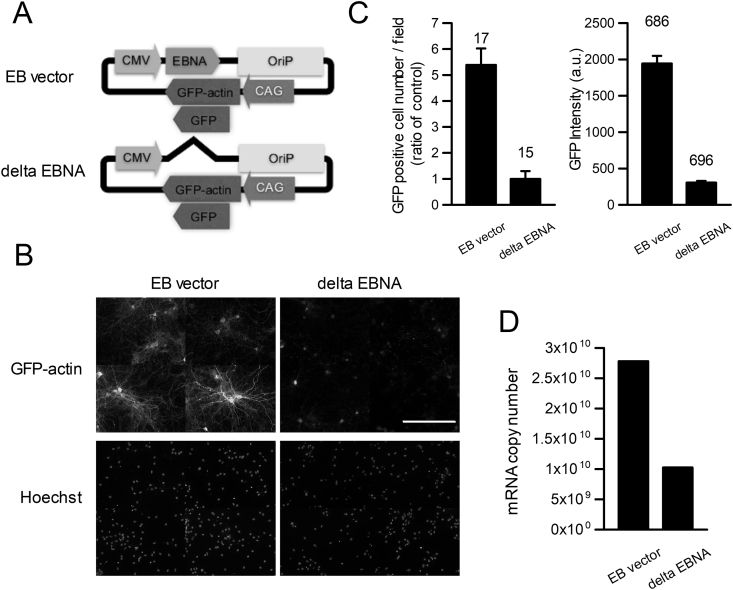
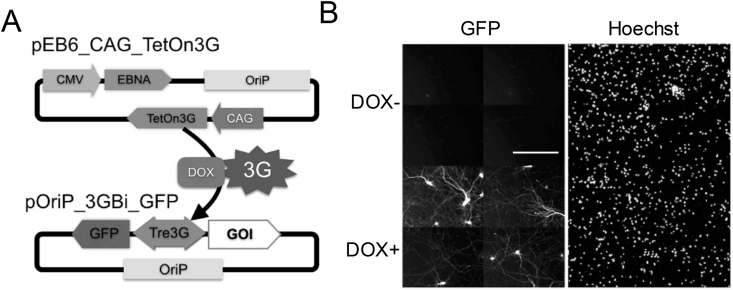
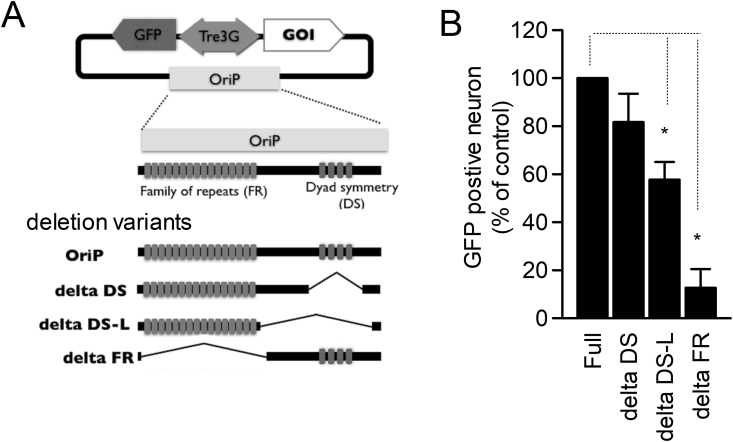
Exogenous gene expression is a fundamental and indispensable technique for testing gene function in neurons. Several ways to express exogenous genes in neurons are available, but each method has pros and cons. The lentivirus vector is useful for high efficiency gene transfer to neurons and stabilizes gene expression via genome integration, but this integration may destroy the host genome. The Epstein-Barr virus (EBV)-derived vector (EB vector) is an accessible and useful vector in human cell lines because the vector is not integrated into the host genome but stays in the nucleus as an episome. However, there has been no report on this process in rodent neurons. We examined the usefulness of the EB vector for testing gene function in neurons. We found that EB vector-derived exogenous proteins such as green fluorescent protein (GFP) and GFP-tagged actin were easily detectable even after three weeks of transfection. Second, a tetracycline-induced gene expression system in the EB vector was active after three weeks of transfection, indicating that plasmids were retained in neurons for up to three weeks. Third, we determined that only Family of repeat element of the plasmid vector is essential for its long-term presence in neurons. These results show that the modified EB vector is a useful tool for examining gene function in neurons.
Overview
The claims and statistics of this paper haven’t been checked yet.
Run the check — free, no account needed. It reads the open-access text and checks the sources it cites.
Integrity signals
Registry
Cites
Statistics
Figures
Verification
Claims the paper makes
The claims and statistics of this paper haven’t been checked yet.
Run the check — free, no account needed. It reads the open-access text and checks the sources it cites.
Claims other papers make about this one
Each is checked against this paper’s own text: does it say what the citing paper says it does?
The source backs part of the claim, not all of it — or backs it for a different population, condition or comparison.
In the citing paper
“This approach had high transgenic efficiency [68].”
From Non-Integrating Lentiviral Vectors in Clinical Applications: A Glance Through (2022) · cites this paper as [68]
Experimental — accuracy not yet measured
Self-check
Percentages, sums and reported differences re-computed from the paper’s own numbers.
The self-check needs the paper’s full text.
Citations
Cites
No references could be resolved yet.
Research works printed but not linked: 21
- Lentz, 2012, Viral vectors for gene delivery to the central nervous system, Neurobiol. Dis., 48, 179, 10.1016/j.nbd.2011.09.014 · DOI
- Karra, 2010, Transfection techniques for neuronal cells, J. Neurosci., 30, 6171, 10.1523/JNEUROSCI.0183-10.2010 · DOI · Paper page
- Davidson, 2003, Viral vectors for gene delivery to the nervous system, Nat. Rev. Neurosci., 4, 353, 10.1038/nrn1104 · DOI
- Yates, 1984, A cis-acting element from the Epstein-Barr viral genome that permits stable replication of recombinant plasmids in latently infected cells, Proc. Natl. Acad. Sci. U.S.A., 81, 3806, 10.1073/pnas.81.12.3806 · DOI
- Yates, 1985, Stable replication of plasmids derived from Epstein–Barr virus in various mammalian cells, Nature, 313, 812, 10.1038/313812a0 · DOI
- Lupton, 1985, Mapping genetic elements of Epstein-Barr virus that facilitate extrachromosomal persistence of Epstein-Barr virus-derived plasmids in human cells, Mol. Cell Biol., 5, 2533
- Tanaka, 1999, Construction of Epstein-Barr virus-based expression vector containing mini-oriP, Biochem. Biophys. Res. Commun., 264, 938, 10.1006/bbrc.1999.1617 · DOI
- Lufino, 2008, Advances in high-capacity extrachromosomal vector technology: episomal maintenance, vector delivery, and transgene expression, Mol. Ther., 16, 1525, 10.1038/mt.2008.156 · DOI
- Rawlins, 1985, Sequence-specific DNA binding of the Epstein-Barr virus nuclear antigen (EBNA-1) to clustered sites in the plasmid maintenance region, Cell, 42, 859, 10.1016/0092-8674(85)90282-X · DOI
- Nakayama, 2005, Diminished neuronal activity increases neuron-neuron connectivity underlying silent synapse formation and the rapid conversion of silent to functional synapses, J. Neurosci., 25, 4040, 10.1523/JNEUROSCI.4115-04.2005 · DOI
- Edelstein, 2014, Advanced methods of microscope control using μManager software, J. Biol. Methods, 1, 10
- Hayes, 2018, Computer-aided neurophysiology and imaging with open-source PhysImage, J. Neurophysiol., 120, 23, 10.1152/jn.00048.2017 · DOI
- Fan, 2012, Transient, inducible, placenta-specific gene expression in mice, Endocrinology, 153, 5637, 10.1210/en.2012-1556 · DOI
- Akamatsu, 2016, The AMPA receptor antagonist perampanel robustly rescues amyotrophic lateral sclerosis (ALS) pathology in sporadic ALS model mice, Sci. Rep., 6, 28649, 10.1038/srep28649 · DOI
- Tateno, 2004, Calcium-permeable AMPA receptors promote misfolding of mutant SOD1 protein and development of amyotrophic lateral sclerosis in a transgenic mouse model, Hum. Mol. Genet., 13, 2183, 10.1093/hmg/ddh246 · DOI
- Bowie, 1995, Inward rectification of both AMPA and kainate subtype glutamate receptors generated by polyamine-mediated ion channel block, Neuron, 15, 453, 10.1016/0896-6273(95)90049-7 · DOI
- Shi, 2001, Subunit-specific rules governing AMPA receptor trafficking to synapses in hippocampal pyramidal neurons, Cell, 105, 331, 10.1016/S0092-8674(01)00321-X · DOI · Paper page
- Wysokenski, 1989, Multiple EBNA1-binding sites are required to form an EBNA1-dependent enhancer and to activate a minimal replicative origin within oriP of Epstein-Barr virus, J. Virol., 63, 2657, 10.1128/jvi.63.6.2657-2666.1989 · DOI
- Reisinger, 2006, Visualization of episomal and integrated Epstein-Barr virus DNA by fiber fluorescence in situ hybridization, Int. J. Canc., 118, 1603, 10.1002/ijc.21498 · DOI
- Howard, 2008, Tropism and toxicity of adeno-associated viral vector serotypes 1, 2, 5, 6, 7, 8, and 9 in rat neurons and glia in vitro, Virology, 372, 24, 10.1016/j.virol.2007.10.007 · DOI · Paper page
- Lo, 2009, Development of a hybrid baculoviral vector for sustained transgene expression, Mol. Ther., 17, 658, 10.1038/mt.2009.13 · DOI
Cited by
Sorted by citations
Non-Integrating Lentiviral Vectors in Clinical Applications: A Glance Through
Gurumoorthy, N., Nordin, F., Tye, G. J., Wan Kamarul Zaman, W. S., & Ng, M. H. (2022) · Biomedicines · doi:10.3390/biomedicines10010107 · Cited by 69
Metadata
- Authors
- Kiyosue, K., & Miwa, Y.
- Affiliations
- National Institute of Advanced Industrial Science and Technology (JP)
- University of Tsukuba (JP)
- Corresponding author
- Kiyosue, Kazuyuki
- Venue
- Heliyon
- Publisher
- Elsevier BV
- Published
- 2020-03
- Volume
- 6
- Issue
- 3
- Pages
- e03504
- ISSN
- 2405-8440 (ISSN-L)
- PMC
- PMC7068671
- OpenAlex
- W3011573275
- Cited by
- 8
- References
- 0
- Citations by year
- 2026: 1 · 2025: 1 · 2024: 2 · 2023: 1 · 2022: 1 · 2021: 2
- FWCI
- 0.59
- Type
- journal article
- Language
- en
- Open access
- gold
- doi.org
- Licence
- Locations
- Heliyon (publishedVersion, cc-by-nc-nd)
- Europe PMC (PubMed Central) (publishedVersion, cc-by-nc-nd)
- PubMed Central (publishedVersion, cc-by-nc-nd)
- PubMed (publishedVersion)
- DOAJ (DOAJ: Directory of Open Access Journals) (submittedVersion, cc-by-sa)
- Funders
- Japan Society for the Promotion of Science (15H04281, 16H01630, 16K14589, JP24500400)
- National Institute of Advanced Industrial Science and Technology
- Topics
- Life Sciences › Biochemistry, Genetics and Molecular Biology › Genetics › Virus-based gene therapy research
- Life Sciences › Biochemistry, Genetics and Molecular Biology › Molecular Biology › RNA Interference and Gene Delivery
- Life Sciences › Biochemistry, Genetics and Molecular Biology › Molecular Biology › Viral Infectious Diseases and Gene Expression in Insects
- Keywords
- episomes, tetracycline-inducible expression, plasmid retention, GFP expression, transfection
About these checks
Registry, retraction, Cites and statistics results are computed, not judged, with one exception: a printed reference that no index lists is read once by a model before it counts as a citation error. Claims are extracted by a model and kept only when their quote appears verbatim in the text; each cited source is then checked, with a model’s help, for whether it says what the claim relies on. Those verdicts can be wrong — read the claim’s quote and the cited source before relying on one.
Statistics and arithmetic are recomputed, not judged.
Confidence bands are shown only for fields calibrated on our annotated test set. None is calibrated yet, so no band is shown.
What counts as a claim ›How we measure confidence ›How we check this ›
Are you an author, or do you see a problem with this page? Request a review
How to cite
Cite CoChat for the checks on this page, and the paper for its own findings.
- This page
- CoChat. (2026). Citation check: Epstein-Barr virus-derived vector suitable for long-term expression in neurons. https://app.cochat.ai/papers/10.1016/j.heliyon.2020.e03504
- The paper
- Kiyosue, K., & Miwa, Y. (2020). Epstein-Barr virus-derived vector suitable for long-term expression in neurons. Heliyon. https://doi.org/10.1016/j.heliyon.2020.e03504
