

The DOI matches its Crossref record; 5 of the 5 references it cites were found in a registry or an index.
Identification of knowledge anxiety factors among researchers based on grounded theory
Open accessPublished version of a preprint
Abstract
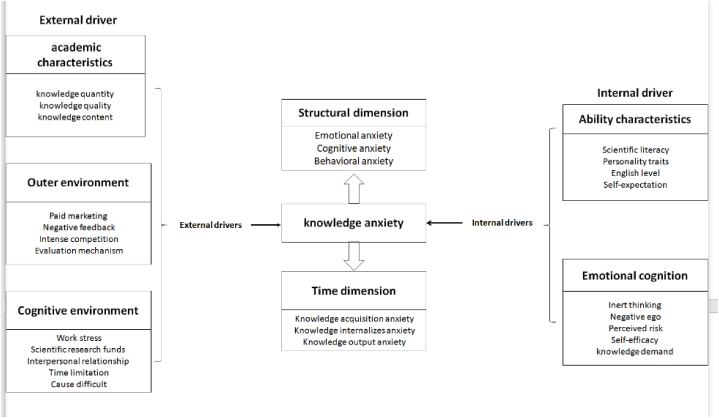
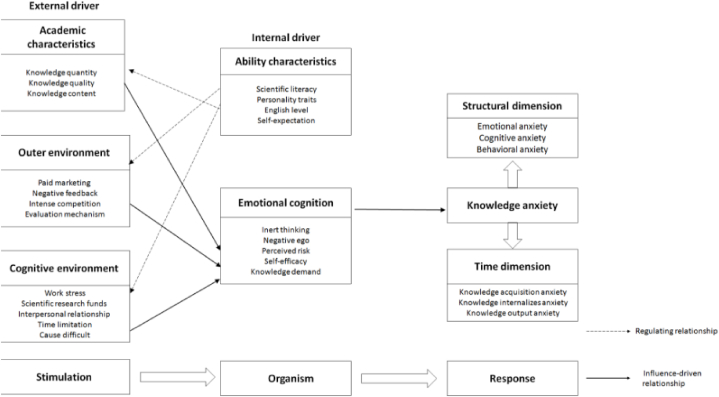
Based on a grounded theoretical analysis of interviews and open data, this study develops a model delineating the factors influencing Knowledge Anxiety, encompassing 5 primary categories and 20 subcategories. These categories encompass Academic Characteristics (knowledge quantity, knowledge quality, and knowledge content), Outer Environment (paid marketing, negative feedback, intense competition, and evaluation mechanism), and Cognitive Environment (work stress, scientific research funding, interpersonal relationships, Time limitation, and Cause difficult) which have been identified as external drivers influencing researchers' Knowledge Anxiety. Conversely, Ability Characteristics (scientific literacy, personality traits, English proficiency, and self-expectations) and Emotional Cognition (inertia thinking, negative self-concept, perceived risks, self-efficacy, and knowledge demand) have been recognized as internal drivers impacting researchers' Knowledge Anxiety. Findings reveal that external factors such as Academic Characteristics, Outer Environment, and Cognitive Environment directly impact researchers' susceptibility to Knowledge Anxiety. Internal factors, represented by Individual Competencies and Emotional Perception, also wield significant influence. Furthermore, external forces can affect Knowledge Anxiety either directly or indirectly by interfacing with internal determinants. This study underscores that researchers' Knowledge Anxiety emerges from intricate interactions among diverse factors, rather than stemming from a solitary cause. These insights furnish valuable comprehension and prospective strategies for mitigating Knowledge Anxiety among researchers, ultimately contributing to the advancement of research in this domain.
Overview
The claims and statistics of this paper haven’t been checked yet.
Run the check — free, no account needed. It reads the open-access text and checks the sources it cites.
Integrity signals
Registry
Cites
Statistics
Figures
Verification
Claims the paper makes
The claims and statistics of this paper haven’t been checked yet.
Run the check — free, no account needed. It reads the open-access text and checks the sources it cites.
Claims other papers make about this one
Each is checked against this paper’s own text: does it say what the citing paper says it does?
The cited source says what the claim attributes to it.
In the citing paper
“From the perspective of grounded theory’s conceptual framework, it is particularly suitable for research in relatively underexplored areas (34).”
From Caring alone: older adult care burdens, practices, and structural imbalances among China's one-child generation (2025) · cites this paper as [34]
Self-check
Percentages, sums and reported differences re-computed from the paper’s own numbers.
The self-check needs the paper’s full text.
Citations
Cites
The Discovery of Grounded Theory; Strategies for Qualitative Research
Glaser, B. G., Strauss, A. L., & Strutzel, E. (1968) · Nursing Research · doi:10.1097/00006199-196807000-00014 · Cited by 39,449
The Discovery of Grounded Theory: Strategies for Qualitative Research
Glaser, B. G., & Strauss, A. L. (2017) · Aldine (Routledge reprint) · doi:10.4324/9780203793206 · Cited by 25,789
(1998) · Cited by 18,576
(1974) · Medical Entomology and Zoology · Cited by 7,295
Kamboj, S., Sarmah, B., Gupta, S., & Dwivedi, Y. (2018) · International Journal of Information Management · doi:10.1016/j.ijinfomgt.2017.12.001 · Cited by 591
Research works printed but not linked: 13
- Liu, 2010, "Freudian" analysis of information anxiety in the network environment, Library Science Research, 244, 11
- Girard, 2008, Information anxiety: fact, fable or fallacy, Electron. J. Knowl. Manag., 6, 111
- Li, 2011, Conceptual definition of information anxiety, Library Science Research, 28, 2
- Cao, 2010, Research on influencing factors and intervention model of user information anxiety, Inf. Sci., 28
- Kuang, 2019, Why does 'knowledge anxiety' arise?, People's Forum., 127
- Sun, 2021, The impact of knowledge anxiety on platform users' willingness to pay for knowledge from the perspective of perceived value, Modern Information, 41, 129
- Wu, 2022, Does knowledge payment help alleviate knowledge anxiety? Empirical evidence from a mixed study, Library and Information Knowledge, 39, 103
- Shen, 2022, A system for measuring anxiety in dealing with scientific data, Inf. Stud.: Theory & Application, 45, 148
- Fei, 2008, Methodology of grounded theory: elements, research procedures, and evaluation criteria, Publ. Adm. Rev., 23
- Zhang, 2022, Entrepreneurial anxiety: scale development and its predictive role in entrepreneurial efforts, Econ. Manag., 44, 88
- Liu, 2019, Research on information literacy action of college students from the perspective of "search is learning", Inf. Stud.: Theor. Pract., 42, 97
- Hu, 2001, New poverty in the new century: knowledge poverty, Soc. Sci. China, 70
- Sun, 2016, Theoretical and research status of self-efficacy, Latest Medical Information Abstracts, 16, 36
Cited by
Sorted by citations
Fire risk assessment of electric ships on inland waterway based on GT-FFTA: A case study of China
Liu, Y., Yang, J., Fan, A., Zhou, R., & Wang, L. (2025) · Ocean Engineering · doi:10.1016/j.oceaneng.2025.121329 · Cited by 9
Zheng, C., Ling, S., Huang, Y., & Li, X. (2025) · Behavioral Sciences · doi:10.3390/bs15081140 · Cited by 10
Xiang, S., Xiang, H., Ren, Q., & Deng, Q. (2025) · Frontiers in Public Health · doi:10.3389/fpubh.2025.1694636 · Cited by 6
“From the perspective of grounded theory’s conceptual framework, it is particularly suitable for research in relatively underexplored areas (34).”
Yan, H., Dong, R., He, Y., Qi, J., & Li, L. (2025) · Sustainability · doi:10.3390/su17104475 · Cited by 5
Procrastination Trap: the Hidden Link between Stress, Anxiety, Amotivation and Academic Dishonesty
Jannat, T., Reza, M. N. H., Arefin, M. S., Uddin, M. A., Chuen Khee, E. P., & Pervez, N. (2026) · Journal of Academic Ethics · doi:10.1007/s10805-026-09722-7 · Cited by 5
Metadata
- Authors
- Zhenlei, Y., Boyuan, M., Lin, S., Chunxia, G., & Qiang, H.
- Affiliations
- Qilu University of Technology (CN)
- Beijing University of Chemical Technology (CN)
- Tianjin University of Traditional Chinese Medicine (CN)
- Corresponding author
- Zhenlei, Yu
- Boyuan, Ma
- Lin, Song
- Qiang, He
- ORCID
- Venue
- Heliyon
- Publisher
- Elsevier BV
- Published
- 2024-02
- Volume
- 10
- Issue
- 4
- Pages
- e25752
- ISSN
- 2405-8440 (ISSN-L)
- PMC
- PMC10900946
- OpenAlex
- W4391788352
- Cited by
- 7
- References
- 5
- Citations by year
- 2026: 2 · 2025: 4 · 2024: 1
- FWCI
- 5.45
- Type
- journal article
- Language
- en
- Open access
- gold
- doi.org
- Licence
- Locations
- Heliyon (publishedVersion, cc-by-nc-nd)
- Research Square (acceptedVersion, cc-by)
- PubMed Central (publishedVersion, cc-by-nc-nd)
- PubMed (publishedVersion)
- DOAJ (DOAJ: Directory of Open Access Journals) (submittedVersion)
- Topics
- Social Sciences › Psychology › Developmental and Educational Psychology › Student Stress and Coping
- Social Sciences › Education › Doctoral Education Challenges and Solutions
- Social Sciences › Psychology › Clinical Psychology › Perfectionism, Procrastination, Anxiety Studies
- Keywords
- researchers, academic stress, external factors, internal factors, self-efficacy, occupational stress, research funding, evaluation mechanisms, negative feedback, research competition, English proficiency, personality traits, anxiety reduction
About these checks
Registry, retraction, Cites and statistics results are computed, not judged, with one exception: a printed reference that no index lists is read once by a model before it counts as a citation error. Claims are extracted by a model and kept only when their quote appears verbatim in the text; each cited source is then checked, with a model’s help, for whether it says what the claim relies on. Those verdicts can be wrong — read the claim’s quote and the cited source before relying on one.
Statistics and arithmetic are recomputed, not judged.
Confidence bands are shown only for fields calibrated on our annotated test set. None is calibrated yet, so no band is shown.
What counts as a claim ›How we measure confidence ›How we check this ›
Are you an author, or do you see a problem with this page? Request a review
How to cite
Cite CoChat for the checks on this page, and the paper for its own findings.
- This page
- CoChat. (2026). Citation check: Identification of knowledge anxiety factors among researchers based on grounded theory. https://app.cochat.ai/papers/10.1016/j.heliyon.2024.e25752
- The paper
- Zhenlei, Y., Boyuan, M., Lin, S., Chunxia, G., & Qiang, H. (2024). Identification of knowledge anxiety factors among researchers based on grounded theory. Heliyon. https://doi.org/10.1016/j.heliyon.2024.e25752
