

The DOI matches its Crossref record; the references it cites are not checked yet.
Application of biomacromolecules encapsulation systems for the long-term storage of Lactobacillus plantarum F1 and Lactobacillus reuteri 182
Open accessAbstract
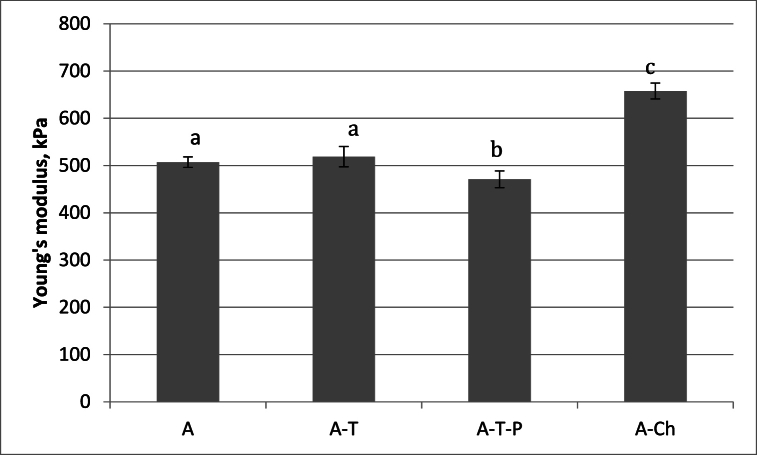
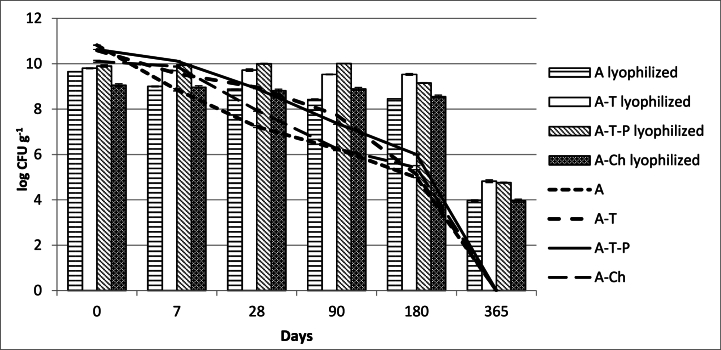
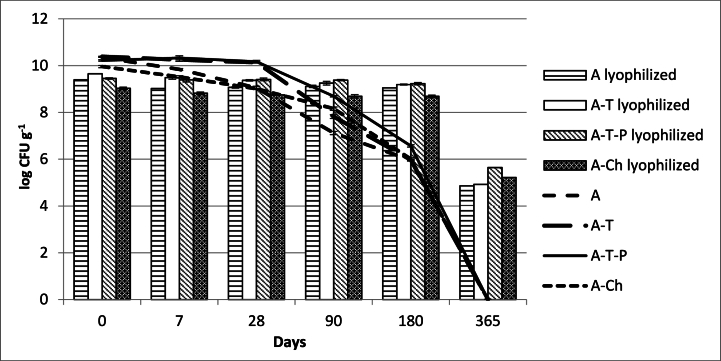
The aim of this study was to improve the viability of lactic acid bacteria (LAB) during extended storage of 1 year and mechanical characteristics of the calcium alginate beads with co-encapsulation of prebiotics and chitosan coating and subsequent freeze drying. The results revealed that the addition of trehalose to alginate matrix effectively protects the LAB cells during freeze drying, i.e., the survival rate has increased up to more than 92.5 %. Chitosan coating reinforced Ca-alginate beads, therefore the sphericity and mechanical strength of the beads improved. The findings also showed that bacteria encapsulation with the prebiotics resulted in more cells stability during the prolonged storage of 1 year and were 4.82±0.06 log CFU g-1 in the lyophilized alginate-trehalose beads for Lactobacillus plantarum and 5.64±0.08 log CFU g-1 in the lyophilized alginate-trehalose-inulin beads for Lactobacillus reuteri. No survival, however, was noted for the LAB cells in wet capsules after the same period. This study demonstrated that prebiotics had a significant impact on the viability of cells during freeze drying and storage. What is more, physical properties of the alginate beads were enhanced by coating beads with the chitosan.
Overview
The claims and statistics of this paper haven’t been checked yet.
Run the check — free, no account needed. It reads the open-access text and checks the sources it cites.
Integrity signals
Registry
Cites
Statistics
Figures
Verification
Claims the paper makes
The claims and statistics of this paper haven’t been checked yet.
Run the check — free, no account needed. It reads the open-access text and checks the sources it cites.
Self-check
Percentages, sums and reported differences re-computed from the paper’s own numbers.
The self-check needs the paper’s full text.
Citations
The citation lists haven’t been fetched yet
References 41 · Cited by 12
Research works printed but not linked: 38
- Habeebuddin, 2022, Topical probiotics: more than a skin deep, Pharmaceutics, 14, 557, 10.3390/pharmaceutics14030557 · DOI
- Krutmann, 2012, Pre- and probiotics for human skin, Clin. Plast. Surg., 39, 59, 10.1016/j.cps.2011.09.009 · DOI
- Oryan, 2018, The concurrent use of probiotic microorganism and collagen hydrogel/scaffold enhances burn wound healing: an in vivo evaluation, Burns, 44, 1775, 10.1016/j.burns.2018.05.016 · DOI · Paper page
- Puebla-Barragan, 2021, Probiotics in cosmetic and personal care products: trends and challenges, Molecules, 26, 1249, 10.3390/molecules26051249 · DOI · Paper page
- Tripathi, 2014, Probiotic functional foods: survival of probiotics during processing and storage, J. Funct.Foods, 9, 225, 10.1016/j.jff.2014.04.030 · DOI · Paper page
- Lu, 2013, Encapsulation of probiotic L. bulgaricus in alginate–milk microspheres and evaluation of the survival in simulated gastrointestinal conditions, J. Food Eng., 11, 99
- Dong, 2013, Alginate-based and protein-based materials for probiotics encapsulation: a review, Food Sci. Technol., 48, 1339
- Luca, 2021, Influence of different prebiotics on viability of Lactobacillus casei, Lactobacillus plantarum and Lactobacillus rhamnosus encapsulated in alginate microcapsules, Foods, 10, 710, 10.3390/foods10040710 · DOI
- Silva, 2018, Symbiotic microencapsulation to enhance Lactobacillus acidophilus survival, LWT--Food Sci. Technol., 89, 503, 10.1016/j.lwt.2017.11.026 · DOI
- Baldrick, 2010, The safety of chitosan as a pharmaceutical excipient, Regul. Toxicol. Pharmocol, 56, 290, 10.1016/j.yrtph.2009.09.015 · DOI
- Călinoiu, 2019, Chitosan coating applications in probiotic microencapsulation, Coatings, 194
- Obradović, 2015, Influence of chitosan coating on mechanical stability of biopolymer carriers with probiotic starter culture in fermented whey beverages, Int J Polym Sci, 8
- Sheu, 1993, Microentrapment of Lactobacilli in calcium alginate gels, J. Food Sci., 58, 557, 10.1111/j.1365-2621.1993.tb04323.x · DOI
- Petraitytė, 2019, Enhancing encapsulation efficiency of alginate capsules containing lactic acid bacteria by using different divalent cross-linkers sources, LWT--Food Sci. Technol., 110, 307, 10.1016/j.lwt.2019.01.065 · DOI
- Chan, 2011, Effects of starch filler on the physical properties of lyophilized calcium–alginate beads and the viability of encapsulated cells, Carbohydr. Polym., 83, 225, 10.1016/j.carbpol.2010.07.044 · DOI
- Hertz, 1882, Uber die Berührung fester elastischer Körper, J. fur Reine Angew. Math, 92, 156, 10.1515/crll.1882.92.156 · DOI
- Sheng, 2004, Compression of polymer bound alumina agglomerates at the micro deformation scale, Powder Technol., 140, 228, 10.1016/j.powtec.2004.01.016 · DOI
- Wang, 2005, High-speed compression of single alginate microspheres, Chem. Eng. Sci., 60, 6649, 10.1016/j.ces.2005.05.052 · DOI
- Voo, 2016, Calcium alginate hydrogel beads with high stiffness and extended dissolution behavior, Eur. Polym. J., 75, 343, 10.1016/j.eurpolymj.2015.12.029 · DOI
- Gandomi, 2016, Effect of chitosan-alginate encapsulation with inulin on survival of Lactobacillus rhamnosus GG during apple juice storage and under simulated gastrointestinal conditions, LWT--Food Sci. Technol., 69, 365, 10.1016/j.lwt.2016.01.064 · DOI
- Kim, 2017, Encapsulation of probiotic Lactobacillus acidophilus by ionic gelation with electrostatic extrusion for enhancement of survival under simulated gastric conditions and during refrigerated storage, Int. J. Food Sci. Technol., 52, 519, 10.1111/ijfs.13308 · DOI
- Ng, 2019, Microencapsulation of Lactobacillus plantarum 299v incorporated with oligofructose in chitosan coated alginate beads and its storage stability in ambarella juice, Malays J Microbiol, 15, 408
- Chan, 2020, Microencapsulation of Lactobacillus acidophilus 5 with isomalto-oligosaccharide, Carpathian J Food Sci Technol, 12, 26
- Iyer, 2005, Effect of co-encapsulation of probiotics with prebiotics on increasing the viability of encapsulated bacteria in simulated gastrointestinal conditions and in yoghurt, J. Food Sci., 70, 18, 10.1111/j.1365-2621.2005.tb09041.x · DOI
- Cook, 2011, Production and evaluation of dry alginate-chitosan microcapsules as an enteric delivery vehicle for probiotic bacteria, Biomacromolecules, 12, 2834, 10.1021/bm200576h · DOI
- Darjani, 2016, Influence of prebiotic and coating materials on morphology and survival of a probiotic strain of Lactobacillus casei exposed to simulated gastrointestinal conditions, LWT--Food Sci. Technol., 73, 162, 10.1016/j.lwt.2016.05.032 · DOI
- Zohar-Perez, 2004, Irregular textural features of dried alginate-filler beads, Food Hydrocolloids, 18, 249, 10.1016/S0268-005X(03)00081-X · DOI
- Balanč, 2016, Calcium–alginate–inulin microbeads as carriers for aqueous carqueja extract, J. Food Sci., 81, 65, 10.1111/1750-3841.13167 · DOI
- Ji R, Wu J, Zhang J, Wang T, Zhang X, Shao L, Chen D, Wang, J. Extending viability of Bifidobacterium longum in chitosan-coated alginate microcapsules using emulsification and internal gelation encapsulation technology. Front. Microbiol. 28 DOI: 10.3389/fmicb.2019.01389. · DOI
- Young, 2006, Encapsulation of plant growth-promoting bacteria in alginate beads enriched with humic acid, Biotechnol. Bioeng., 95, 76, 10.1002/bit.20957 · DOI
- Song, 2008, Microencapsulation of Lactobacillus casei YIT 9018 using a microporous glass membrane emulsification system, J. Food Sci., 68, 195, 10.1111/j.1365-2621.2003.tb14139.x · DOI
- Yeung, 2016, Microencapsulation of probiotics in hydrogel particles: enhancing Lactococcus lactis subsp. cremoris LM0230 viability using calcium alginate beads, Food Funct., 7, 1797, 10.1039/C5FO00801H · DOI
- Chan, 2011, Effect of formulation of alginate beads on their mechanical behavior and stiffness, Particuology, 9, 228, 10.1016/j.partic.2010.12.002 · DOI
- Kim, 2009, Investigation of mechanical properties of soft hydrogel microcapsules in relation to protein delivery using aMEMS force sensor, J. Biomed. Mater. Res., 92A, 103, 10.1002/jbm.a.32338 · DOI
- Lin, 2010, Modifications of alginate-based scaffolds and characterizations of their pentoxifylline release properties, Carbohydr. Polym., 80, 574, 10.1016/j.carbpol.2009.11.044 · DOI
- Lin, 2018, Three-dimensional plotted alginate fibers embedded with diclofenac and bone cells coated with chitosan for bone regeneration during inflammation, J. Biomed. Mater. Res., 106, 1511, 10.1002/jbm.a.36357 · DOI
- Tomović, 2015, Influence of compression speed and deformation percentage on mechanical properties of calcium alginate paricles, Chem. Ind. Chem. Eng. Q., 21, 411, 10.2298/CICEQ140228043T · DOI
- Nami, 2020, Alginate-Persian Gum-Prebiotics microencapsulation impacts on the survival rate of Lactococcus lactis ABRIINW-N19 in orange juice, LWT--Food Sci. Technol., 124, 10.1016/j.lwt.2020.109190 · DOI
Metadata
- Authors
- Jeznienė, S., Bružaitė, I., & Šipailienė, A.
- Affiliations
- Kaunas University of Technology (LT)
- Vilnius Gediminas Technical University (LT)
- Corresponding author
- Jeznienė, Sigita
- Venue
- Heliyon
- Publisher
- Elsevier BV
- Published
- 2024-03
- Volume
- 10
- Issue
- 5
- Pages
- e26566
- ISSN
- 2405-8440 (ISSN-L)
- PMC
- PMC10909665
- OpenAlex
- W4391899604
- Cited by
- 12
- References
- 41
- Citations by year
- 2026: 6 · 2025: 6
- FWCI
- 2.35
- Type
- journal article
- Language
- en
- Open access
- gold
- doi.org
- Licence
- Locations
- Heliyon (publishedVersion, cc-by-nc)
- SSRN Electronic Journal (acceptedVersion)
- PubMed Central (publishedVersion, cc-by-nc)
- PubMed (publishedVersion)
- KTUePubl (Repository of Kaunas University of Technology) (submittedVersion, other-oa)
- DOAJ (DOAJ: Directory of Open Access Journals) (submittedVersion, cc-by-sa)
- Funders
- Research Council of Lithuania
- Topics
- Life Sciences › Agricultural and Biological Sciences › Food Science › Microencapsulation and Drying Processes
- Life Sciences › Agricultural and Biological Sciences › Food Science › Probiotics and Fermented Foods
- Life Sciences › Agricultural and Biological Sciences › Food Science › Proteins in Food Systems
- Keywords
- Lactobacillus plantarum, Lactobacillus reuteri, lactic acid bacteria, calcium alginate beads, encapsulation, freeze-drying, long-term storage, trehalose, prebiotics, inulin, chitosan coating, bacterial viability, probiotics
About these checks
Registry, retraction, Cites and statistics results are computed, not judged, with one exception: a printed reference that no index lists is read once by a model before it counts as a citation error. Claims are extracted by a model and kept only when their quote appears verbatim in the text; each cited source is then checked, with a model’s help, for whether it says what the claim relies on. Those verdicts can be wrong — read the claim’s quote and the cited source before relying on one.
Statistics and arithmetic are recomputed, not judged.
Confidence bands are shown only for fields calibrated on our annotated test set. None is calibrated yet, so no band is shown.
What counts as a claim ›How we measure confidence ›How we check this ›
Are you an author, or do you see a problem with this page? Request a review
How to cite
Cite CoChat for the checks on this page, and the paper for its own findings.
- This page
- CoChat. (2026). Citation check: Application of biomacromolecules encapsulation systems for the long-term storage of Lactobacillus plantarum F1 and Lactobacillus reuteri 182. https://app.cochat.ai/papers/10.1016/j.heliyon.2024.e26566
- The paper
- Jeznienė, S., Bružaitė, I., & Šipailienė, A. (2024). Application of biomacromolecules encapsulation systems for the long-term storage of Lactobacillus plantarum F1 and Lactobacillus reuteri 182. Heliyon. https://doi.org/10.1016/j.heliyon.2024.e26566
