

The DOI matches its Crossref record; 11 of the 11 references it cites were found in a registry or an index.
Dental Students’ Learning Experience: Artificial Intelligence vs Human Feedback on Assignments
Open accessAbstract
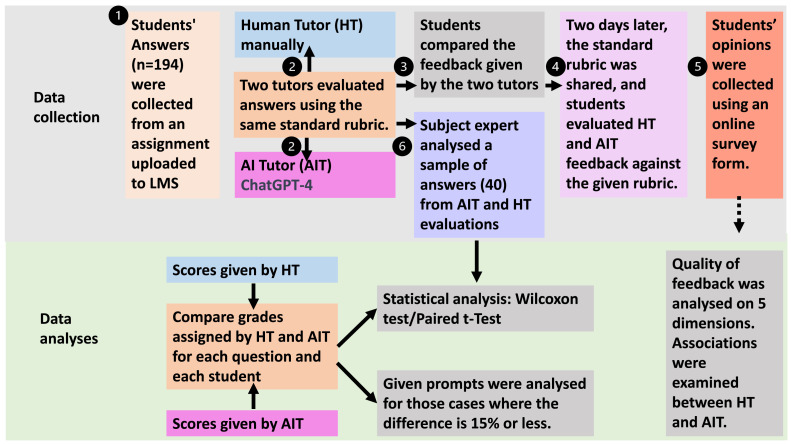
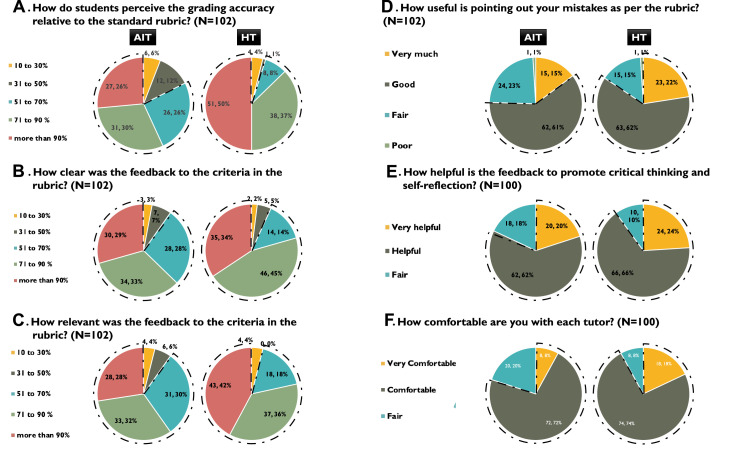
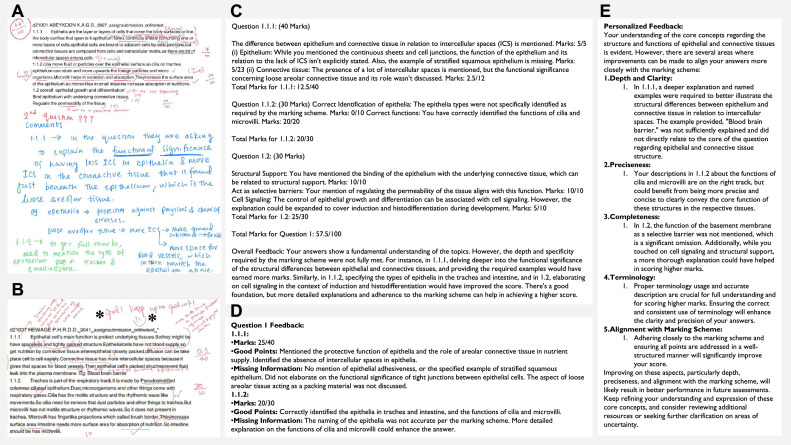
OBJECTIVE: This study evaluated the effectiveness of an AI-based tool (ChatGPT-4) (AIT) vs a human tutor (HT) in providing feedback on dental students' assignments. METHODS: A total of 194 answers to two histology questions were assessed by both tutors using the same rubric. Students compared feedback from both tutors and evaluated its accuracy against a standard rubric. Students' perceptions were collected on five dimensions of feedback quality. A subject expert also evaluated feedback provided by the two tutors for 40 randomly selected answers. RESULTS: = 9.01, P < .05). In contrast, expert evaluation highlighted that AIT scored higher in identifying mistakes, with significant differences in clarity (W = 40.5, P < .001) and suggestions for improvement (W = 96.5, P < .001). CONCLUSION: AIT demonstrates significant potential to complement HT by providing detailed feedback in a shorter timeframe. While students did not perceive differences in feedback quality, expert analysis identified AIT as superior in clarity and suggestions for improvement.
Overview
The claims and statistics of this paper haven’t been checked yet.
Run the check — free, no account needed. It reads the open-access text and checks the sources it cites.
Integrity signals
Registry
Cites
Statistics
Figures
Verification
Claims the paper makes
The claims and statistics of this paper haven’t been checked yet.
Run the check — free, no account needed. It reads the open-access text and checks the sources it cites.
Claims other papers make about this one
Each is checked against this paper’s own text: does it say what the citing paper says it does?
The source backs part of the claim, not all of it — or backs it for a different population, condition or comparison.
In the citing paper
“in dental histology assignments, AI feedback was longer and contained more improvement points than human feedback [20]”
From AI-Generated Versus Human Supervisor Feedback on Medical Students’ Clinical Clerkship Logs: Cross-Sectional Convergent Mixed Methods Study (2026) · cites this paper as [20]
Experimental — accuracy not yet measured
Self-check
Percentages, sums and reported differences re-computed from the paper’s own numbers.
The self-check needs the paper’s full text.
Citations
Cites
Hattie, J., & Timperley, H. (2007) · Review of Educational Research · doi:10.3102/003465430298487 · Cited by 12,905
ChatGPT for Good? On Opportunities and Challenges of Large Language Models for Education
Kasneci, E., Seßler, K., Küchemann, S., Bannert, M., Dementieva, D., Fischer, F., Gasser, U., Groh, G., Günnemann, S., Hüllermeier, E., et al. (2023) · doi:10.35542/osf.io/5er8f · Cited by 7,552
ChatGPT for good? On opportunities and challenges of large language models for education
Kasneci, E., Sessler, K., Küchemann, S., Bannert, M., Dementieva, D., Fischer, F., Gasser, U., Groh, G., Günnemann, S., Hüllermeier, E., et al. (2023) · Learning and Individual Differences · doi:10.1016/j.lindif.2023.102274 · Cited by 7,326
Zawacki-Richter, O., Marín, V. I., Bond, M., & Gouverneur, F. (2019) · International Journal of Educational Technology in Higher Education · doi:10.1186/s41239-019-0171-0 · Cited by 7,242
Shute, V. J. (2008) · Review of Educational Research · doi:10.3102/0034654307313795 · Cited by 4,631
Artificial Intelligence in Education: A Review
Chen, L., Chen, P., & Lin, Z. (2020) · IEEE Access · doi:10.1109/access.2020.2988510 · Cited by 4,133
Artificial intelligence for education: Knowledge and its assessment in AI-enabled learning ecologies
Cope, B., Kalantzis, M., & Searsmith, D. (2021) · Educational Philosophy and Theory · doi:10.1080/00131857.2020.1728732 · Cited by 518
Stevens, D. D., & Levi, A. J. (2004) · Cited by 465
Chang, D. H., Lin, M. P.-C., Hajian, S., & Wang, Q. Q. (2023) · Sustainability · doi:10.3390/su151712921 · Cited by 370
Proceedings of the 35th Annual ACM Symposium on Applied Computing
(2020) · doi:10.1145/3341105 · Cited by 139
Cited by
Kondo, T., Donkers, J., Nishigori, H., Rovers, S., & Heeneman, S. (2026) · JMIR Medical Education · doi:10.2196/90064 · Cited by 1
“However, even studies demonstrating that AI can generate high-quality feedback argue that AI feedback should complement rather than replace human feedback, citing student preferences and the responsibility that human instructors should maintain [20-22].”
Influential
Metadata
- Authors
- Jayawardena, C. K., Gunathilake, Y., & Ihalagedara, D.
- Affiliations
- University of Peradeniya (LK)
- Corresponding author
- Jayawardena, Chantha K.
- Venue
- International Dental Journal
- Publisher
- Elsevier BV
- Published
- 2025-02
- Volume
- 75
- Issue
- 1
- Pages
- 100-108
- ISSN
- 0020-6539 (ISSN-L)
- PMC
- PMC11806320
- OpenAlex
- W4406244152
- Cited by
- 26
- References
- 11
- Citations by year
- 2026: 19 · 2025: 7
- FWCI
- 6.26
- Type
- journal article
- Language
- en
- Open access
- gold
- doi.org
- Licence
- cc-by-nc-nd
- www.elsevier.com/tdm/userlicense/1.0/ (tdm)
- www.elsevier.com/legal/tdmrep-license (tdm)
- creativecommons.org/licenses/by-nc-nd/4.0/ (vor)
- Locations
- International Dental Journal (publishedVersion, cc-by-nc-nd)
- PubMed Central (publishedVersion, cc-by-nc-nd)
- PubMed (publishedVersion)
- DOAJ (DOAJ: Directory of Open Access Journals) (submittedVersion)
- Funders
- University of Peradeniya
- Topics
- Health Sciences › Medicine › Health Informatics › Artificial Intelligence in Healthcare and Education
- Social Sciences › Education › Artificial Intelligence in Education
- Social Sciences › Education › Student Assessment and Feedback
- Keywords
- ChatGPT-4, automated feedback, dental students, feedback quality, student perceptions, rubric-based assessment
- MeSH terms
- Formative Feedback, Artificial Intelligence, Education, Dental, Educational Measurement, Feedback, Female, Humans, Learning, Male, Students, Dental
About these checks
Registry, retraction, Cites and statistics results are computed, not judged, with one exception: a printed reference that no index lists is read once by a model before it counts as a citation error. Claims are extracted by a model and kept only when their quote appears verbatim in the text; each cited source is then checked, with a model’s help, for whether it says what the claim relies on. Those verdicts can be wrong — read the claim’s quote and the cited source before relying on one.
Statistics and arithmetic are recomputed, not judged.
Confidence bands are shown only for fields calibrated on our annotated test set. None is calibrated yet, so no band is shown.
What counts as a claim ›How we measure confidence ›How we check this ›
Are you an author, or do you see a problem with this page? Request a review
How to cite
Cite CoChat for the checks on this page, and the paper for its own findings.
- This page
- CoChat. (2026). Citation check: Dental Students’ Learning Experience: Artificial Intelligence vs Human Feedback on Assignments. https://app.cochat.ai/papers/10.1016/j.identj.2024.12.022
- The paper
- Jayawardena, C. K., Gunathilake, Y., & Ihalagedara, D. (2025). Dental Students’ Learning Experience: Artificial Intelligence vs Human Feedback on Assignments. International Dental Journal. https://doi.org/10.1016/j.identj.2024.12.022
Data sources
Bibliographic data: Semantic Scholar, OpenAlex, Crossref.
Contains information from the Semantic Scholar Academic Graph Datasets, made available under the ODC Attribution License (ODC-BY 1.0).
Semantic Scholar’s data is described in: Kinney, R., et al. (2023). The Semantic Scholar Open Data Platform. arXiv:2301.10140.
