

The DOI matches its Crossref record; 16 of the 16 references it cites were found in a registry or an index.
Association of the serum apelin, but not ghrelin, with the presence and severity of coronary artery disease
Open accessAbstract
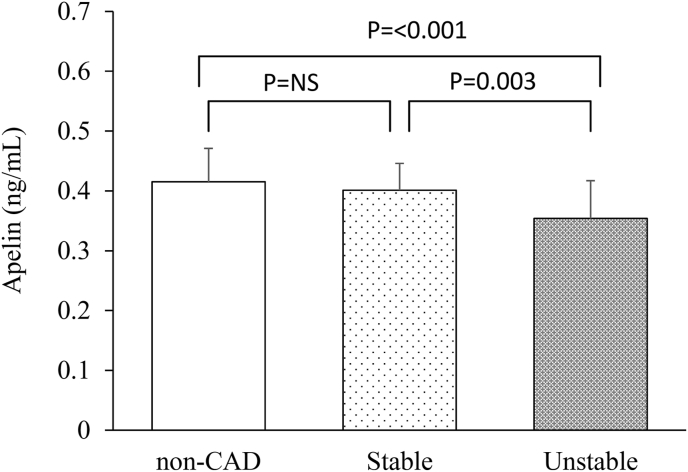
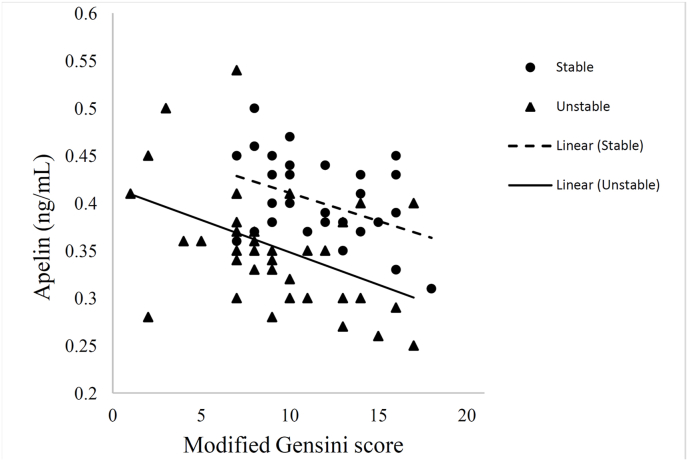
Increasing evidence suggests that apelin and ghrelin may participate in atherogenesis. We sought to investigate whether the serum levels of apelin and ghrelin are significantly different in patients with coronary artery disease (CAD) compared to patients with nonsignificant coronary stenosis and determine the correlation between these adipokines and the severity of coronary stenosis. The study population included 31 stable CAD patients, 38 unstable CAD patients, and 39 non-CAD subjects. Serum levels of apelin and ghrelin, fasting blood glucose, lipid parameters, hs-CRP and hematological indices were determined in all groups using routine standard laboratory procedures. Serum apelin levels were significantly lower in patient with unstable CAD (0.354 ± 0.063 ng/mL) compared to stable CAD patients (0.401 ± 0.045 ng/mL, p = 0.003) and non-CAD subjects (0.415 ± 0.055 ng/mL, p<0.001). In addition, serum apelin levels were inversely correlated with the severity of coronary stenosis in CAD patients (p<0.05). However, there was no significant difference in ghrelin levels among the 3 groups. This data may suggest that the presence of unstable CAD may be associated with lower serum apelin which may indicate the potential role of this peptide in the progression and destabilization of coronary plaques.
Overview
The claims and statistics of this paper haven’t been checked yet.
Run the check — free, no account needed. It reads the open-access text and checks the sources it cites.
Integrity signals
Registry
Cites
Statistics
Figures
Verification
Claims the paper makes
The claims and statistics of this paper haven’t been checked yet.
Run the check — free, no account needed. It reads the open-access text and checks the sources it cites.
Claims other papers make about this one
Each is checked against this paper’s own text: does it say what the citing paper says it does?
The cited source says what the claim attributes to it.
In the citing paper
“Clinical observations find that reduced circulating Apelin levels are associated with coronary artery disease, particularly more evident in patients with unstable angina, suggesting a role in plaque stabilization [26].”
From Exercise-Induced Myokines in Obesity-Related Metabolic Disorders and Cardiovascular Protection: A Narrative Review (2026) · cites this paper as [26]
Self-check
Percentages, sums and reported differences re-computed from the paper’s own numbers.
The self-check needs the paper’s full text.
Citations
Cites
Ghrelin is a growth-hormone-releasing acylated peptide from stomach
Kojima, M., Hosoda, H., Date, Y., Nakazato, M., Matsuo, H., & Kangawa, K. (1999) · Nature · doi:10.1038/45230 · Cited by 8,479
Ghrelin: Structure and Function
Kojima, M., & Kangawa, K. (2005) · Physiological Reviews · doi:10.1152/physrev.00012.2004 · Cited by 2,810
Lippi, G., Targher, G., Montagnana, M., Salvagno, G. L., Zoppini, G., & Guidi, G. C. (2009) · Archives of Pathology & Laboratory Medicine · doi:10.5858/133.4.628 · Cited by 1,095
The novel peptide apelin lowers blood pressure via a nitric oxide-dependent mechanism
Tatemoto, K., Takayama, K., Zou, M.-X., Kumaki, I., Zhang, W. Y., KUMANO, K., & Fujimiya, M. (2001) · Regulatory Peptides · doi:10.1016/s0167-0115(01)00236-1 · Cited by 640
Emerging roles of apelin in biology and medicine
Kleinz, M. J., & Davenport, A. P. (2005) · Pharmacology & Therapeutics · doi:10.1016/j.pharmthera.2005.04.001 · Cited by 413
Hypoxia inducible factor regulates the cardiac expression and secretion of apelin
Ronkainen, V., Ronkainen, J. J., Hänninen, S. L., Leskinen, H. K., Ruas, J. L., Pereira, T., Poellinger, L., Vuolteenaho, O. J., & Tavi, P. (2007) · The FASEB Journal · doi:10.1096/fj.06-7294com · Cited by 176
Apelin prevents aortic aneurysm formation by inhibiting macrophage inflammation
Leeper, N. J., Tedesco, M. M., Kojima, Y., et al. (2009) · American Journal of Physiology-Heart and Circulatory Physiology · doi:10.1152/ajpheart.01341.2008 · Cited by 161
Kadoglou, N. P. E., Lampropoulos, S., Kapelouzou, A., Gkontopoulos, A., Theofilogiannakos, E. K., Fotiadis, G., & Kottas, G. (2010) · Translational research · doi:10.1016/j.trsl.2010.01.004 · Cited by 118
Liu, X.-Y., Lu, Q., Ouyang, X.-P., Tang, S., Zhao, G., Lv, Y.-C., He, P., Kuang, H.-J., Tang, Y., Fu, Y., et al. (2012) · Atherosclerosis · doi:10.1016/j.atherosclerosis.2012.12.002 · Cited by 63
Nagula, P., Karumuri, S., Otikunta, A. N., & Yerrabandi, S. R. V. (2017) · Indian Heart Journal · doi:10.1016/j.ihj.2017.04.007 · Cited by 31
Zhang, M., Fang, W.-Y., Yuan, F., et al. (2012) · Acta Pharmacologica Sinica · doi:10.1038/aps.2011.196 · Cited by 29
Inhibition of proliferation and apoptosis of vascular smooth muscle cells by ghrelin
Zhang, M., Yuan, F., Liu, H., et al. (2008) · Acta Biochimica et Biophysica Sinica · doi:10.1111/j.1745-7270.2008.00457.x · Cited by 29
Biochemical and genetic role of apelin in essential hypertension and acute coronary syndrome
Gupta, M. D., Girish, M. P., Shah, D., Rain, M., Mehta, V., Tyagi, S., Trehan, V. K., & Pasha, Q. (2016) · International Journal of Cardiology · doi:10.1016/j.ijcard.2016.07.242 · Cited by 29
Li, Y., Li, M., Teng, Y., et al. (2017) · Coronary Artery Disease · doi:10.1097/mca.0000000000000554 · Cited by 20
Inhibition of proliferation and apoptosis of vascular smooth muscle cells by ghrelin
Zhang, M., Yuan, F., Liu, H., et al. (2008) · Acta Biochimica et Biophysica Sinica · doi:10.1093/abbs/40.9.769 · Cited by 14
Namazi, G., Pourfarzam, M., Rad, S. J., et al. (2014) · Cholesterol · doi:10.1155/2014/821686 · Cited by 12
Self-citation
Cited by
Sorted by citations
Zhang, Y., & Qiu, Y. (2026) · Sports · doi:10.3390/sports14050212 · Cited by 3
“Clinical observations find that reduced circulating Apelin levels are associated with coronary artery disease, particularly more evident in patients with unstable angina, suggesting a role in plaque stabilization [26].”
Metadata
- Authors
- Namazi, G., Salami, R., Pourfarzam, M., Asa, P., Mafi, A., & Raygan, F.
- Affiliations
- Kashan University of Medical Sciences (IR)
- Isfahan University of Medical Sciences (IR)
- Corresponding author
- Namazi, Gholamreza
- Venue
- Indian Heart Journal
- Publisher
- Elsevier BV
- Published
- 2021-03
- Volume
- 73
- Issue
- 2
- Pages
- 214-217
- ISSN
- 0019-4832 (ISSN-L)
- PMC
- PMC8065357
- OpenAlex
- W3125998842
- Cited by
- 6
- References
- 16
- Citations by year
- 2026: 3 · 2025: 2 · 2022: 1
- FWCI
- 0.15
- Type
- journal article
- Language
- en
- Open access
- gold
- doi.org
- Licence
- Locations
- Indian Heart Journal (publishedVersion, cc-by-nc-nd)
- PubMed Central (publishedVersion, cc-by-nc-nd)
- PubMed (publishedVersion)
- DOAJ (DOAJ: Directory of Open Access Journals) (submittedVersion, cc-by-sa)
- Funders
- Kashan University of Medical Sciences
- Topics
- Health Sciences › Medicine › Pharmacology (medical) › Apelin-related biomedical research
- Health Sciences › Medicine › Cardiology and Cardiovascular Medicine › Cardiovascular Disease and Adiposity
- Health Sciences › Medicine › Endocrinology, Diabetes and Metabolism › Adipokines, Inflammation, and Metabolic Diseases
- Keywords
- apelin, ghrelin, coronary artery disease, unstable coronary artery disease, stable coronary artery disease, coronary stenosis severity, adipokines, atherogenesis, serum biomarkers
- MeSH terms
- Apelin, C-Reactive Protein, Coronary Artery Disease, Humans, Coronary Stenosis, Ghrelin
About these checks
Registry, retraction, Cites and statistics results are computed, not judged, with one exception: a printed reference that no index lists is read once by a model before it counts as a citation error. Claims are extracted by a model and kept only when their quote appears verbatim in the text; each cited source is then checked, with a model’s help, for whether it says what the claim relies on. Those verdicts can be wrong — read the claim’s quote and the cited source before relying on one.
Statistics and arithmetic are recomputed, not judged.
Confidence bands are shown only for fields calibrated on our annotated test set. None is calibrated yet, so no band is shown.
What counts as a claim ›How we measure confidence ›How we check this ›
Are you an author, or do you see a problem with this page? Request a review
