

The timing and tempo of the Neolithic expansion across the Central Balkans in the light of the new radiocarbon evidence
Open accessThe DOI matches its Crossref record; 55 of the 56 references it cites were found in a registry or an index, and 1 are not checked yet; none of the 28 sources its claims cite is checked for support yet.
Abstract
The new set of radiocarbon dates was used to explore the timing and tempo of the Neolithic expansion across the Central Balkans. Our results suggest that the first farmers arrived in this region around or few decades before 6200 cal BC. The observed spatio-temporal pattern based on the radiocarbon data suggests that the general direction of the expansion was along the south-north axis. The regression analysis (arrival time vs. distance from the origin of expansion in northern Greece) was used to estimate the Neolithic front speed. The results of this analysis suggest that there is a moderate fit of the linear model. Most of the front speed estimates based on the Central Balkan data are between 1 and 2.5 km/year (depending on the data subset and the statistical technique) which is mostly above the expected range (around 1 km/year) for the standard wave of advance model and the empirically determined continental averages. We conclude that the spatio-temporal pattern of the Neolithic expansion in the Central Balkans is broadly consistent with the predictions of the wave of advance model, with the possibility of sporadic leapfrog migration events. The speed of the expansion seems to have been faster in the Central Balkans compared to the continental average.
Checked 2026-11-24 · 1 reference not checked yet
Overview
CoChat Summary
TL;DR
Using a new set of AMS radiocarbon dates combined with legacy dates, the paper estimates that the first farmers arrived in the Central Balkans around 6250–6200 cal BC and spread generally south-to-north along major river valleys. Front-speed estimates mostly fall between 1 and 2.5 km/year, broadly consistent with a wave-of-advance model but faster than continental averages, with possible sporadic leapfrog migration.
Key findings
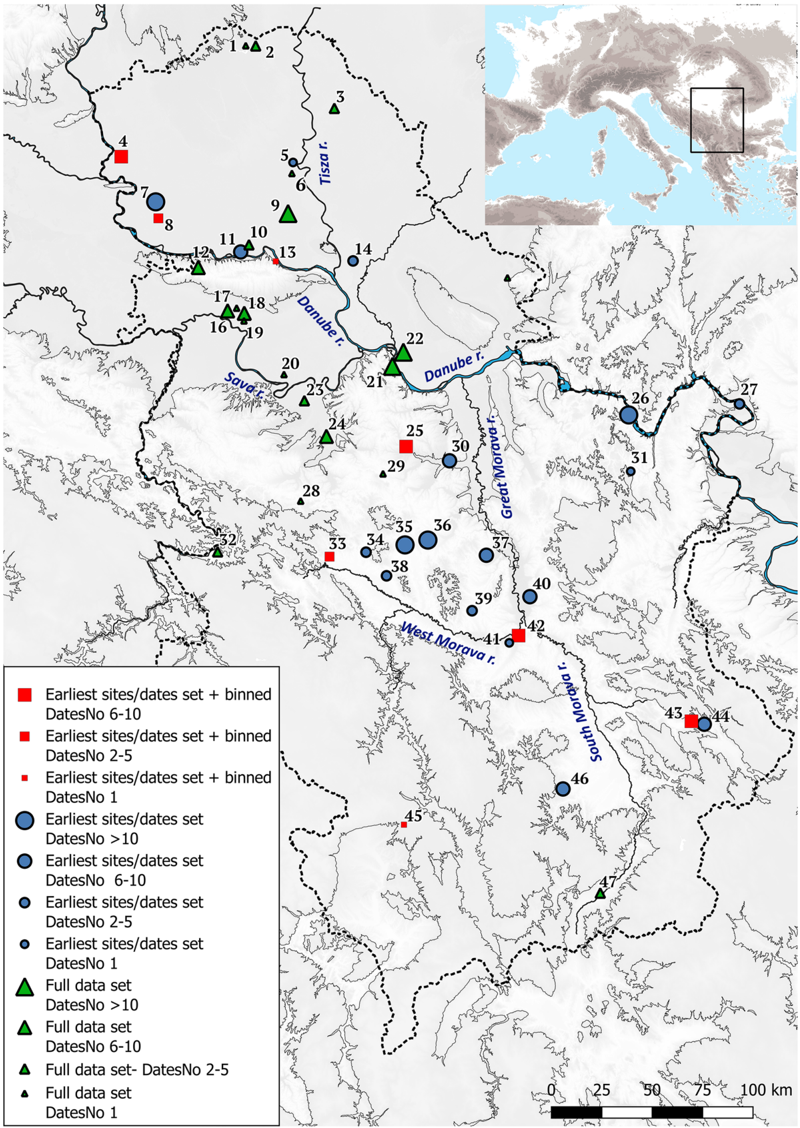
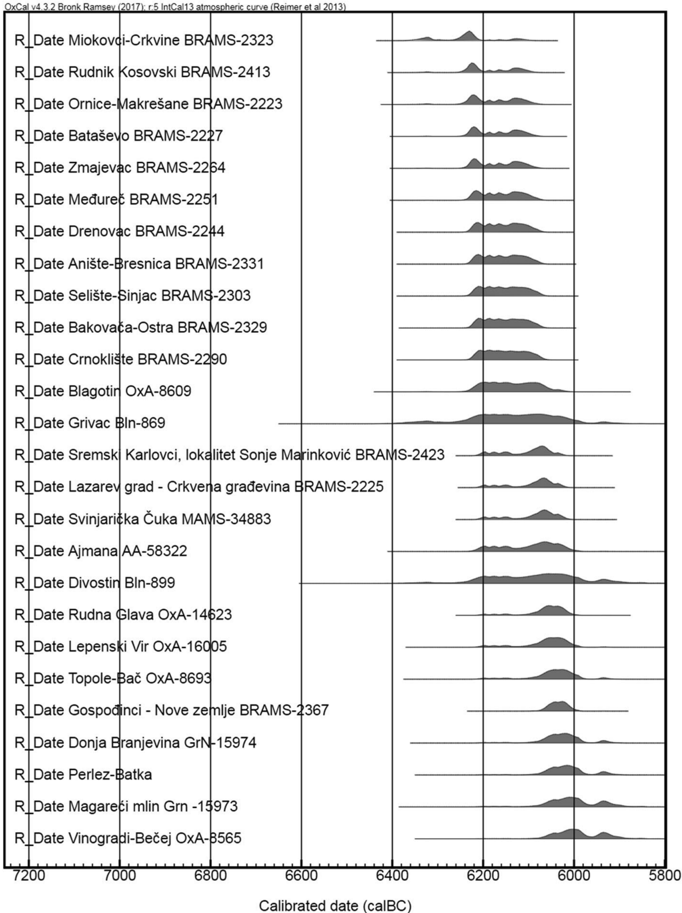
- The oldest date in the estimated earliest sites/dates set comes from Miokovci-Crkvine in Western Serbia (6362–6098 cal BC at 95%, expected value 6238 BCE), statistically indistinguishable (p = 0.572) from Rudnik Kosovski in Kosovo (6325–6088 cal BC at 95%, expected value 6185 cal BC); the authors conclude the Neolithic arrived in the Central Balkans between 6250 and 6200 cal BC and reached the Great Pannonian Plain by 6000 cal BC.
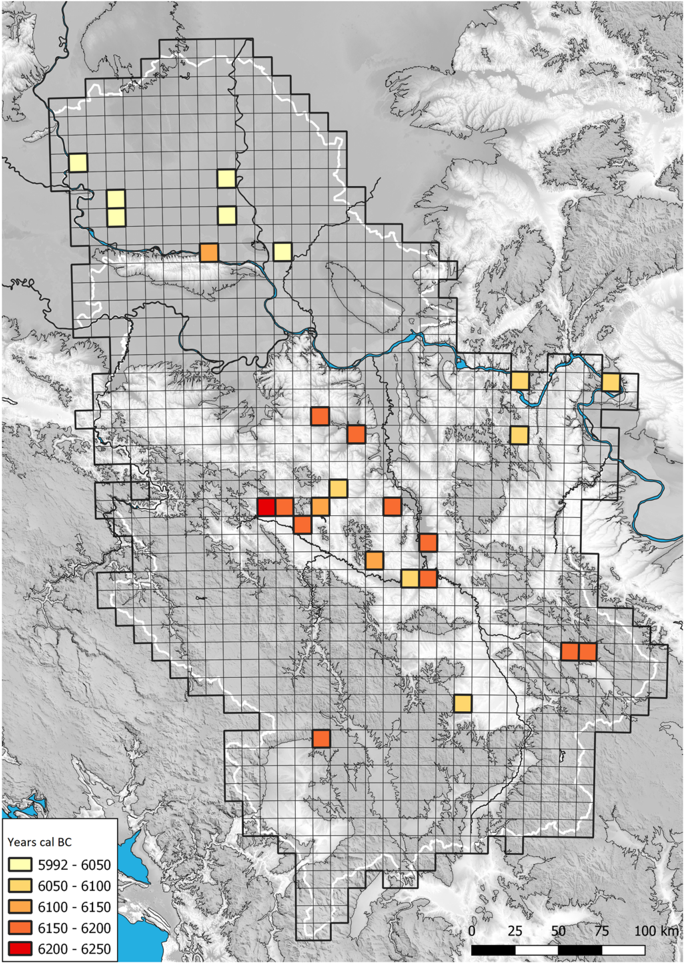
- The spatio-temporal pattern shows a general south-north gradient along the South Morava and Great Morava river valleys, but it is not perfect: there are sites to the north with earlier dates than sites to the south.
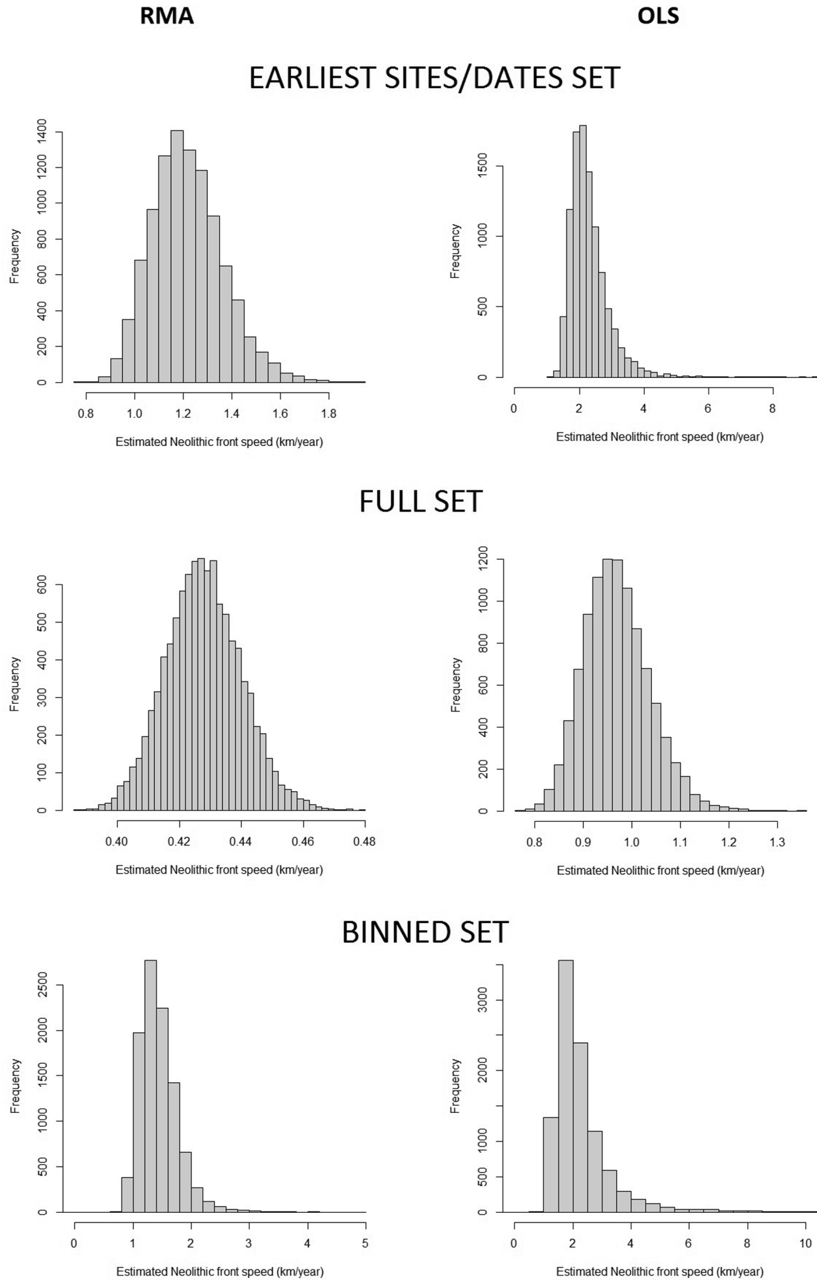
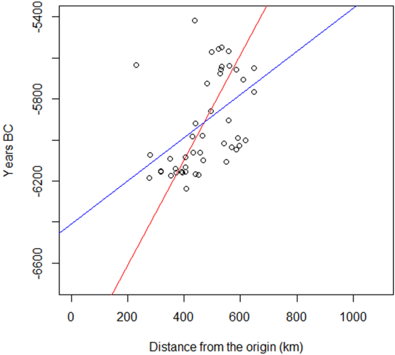
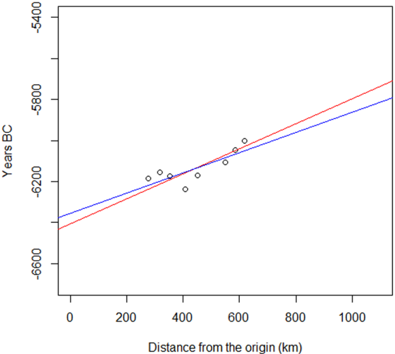
- Monte Carlo resampling front-speed estimates: RMA means of 1.22 km/year (estimated earliest set), 0.43 km/year (full set), and 1.43 km/year (binned set); OLS means of 2.18, 0.97, and 2.44 km/year, respectively. Point-estimate regressions give RMA speeds of 1.57, 0.39, and 1.64 km/year, and OLS speeds of 2.24, 0.95, and 2.04 km/year. Most Central Balkan estimates are between 1 and 2.5 km/year, above the expected ~1 km/year for the standard wave-of-advance model and continental averages; the full-set estimates are rejected as unrealistically low.
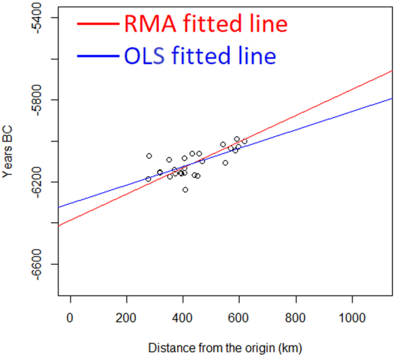
- Goodness of fit is moderate: mean Pearson’s r is highest for the binned set (r = 0.67), followed by the estimated earliest set (r = 0.55), and lowest for the full set (r = 0.44) under resampling; with point estimates, r = 0.81, 0.7, and 0.41, respectively. The authors conclude the pattern is broadly consistent with the wave-of-advance model, with the possibility of sporadic leapfrog migration events.
Methods
- The study area is limited to Serbia and Kosovo. The authors collected all existing radiocarbon dates from the literature plus new BIRTH project dates for Early Neolithic sites, then filtered out dates with standard error greater than 100 radiocarbon years. For timing and spatial pattern, the estimated earliest sites/dates set consists of 26 radiocarbon dates from 26 sites (14 new BIRTH dates, 12 from literature), included if the median calibrated earliest date is not later than 5999 cal BC (the earliest date in Hungary). Dates were calibrated in OxCal v4.3.2; the area was divided into a 10×10 km grid, each cell assigned its earliest date, and cells classified into 50-year intervals.
- For front speed, the authors regressed arrival time against great circle distance from the assumed origin at Mavropigi in Greek Macedonia. They used three data sets: the estimated earliest sites/dates set (26 dates/26 sites), the full set (47 dates/47 sites; 26 new BIRTH dates), and the binned set (8 earliest dates from 8 distance bins, using 50 km bins; 6 new BIRTH dates). They applied both Reduced Major Axis (RMA) and ordinary least squares (OLS) regression, with Monte Carlo resampling of calibrated dates (10,000 regressions) and point estimates using means of calibrated distributions; analyses were implemented in R with the lmodel2 package. RMA estimates are treated as the lower boundary and OLS as the upper boundary for speed.
Limitations
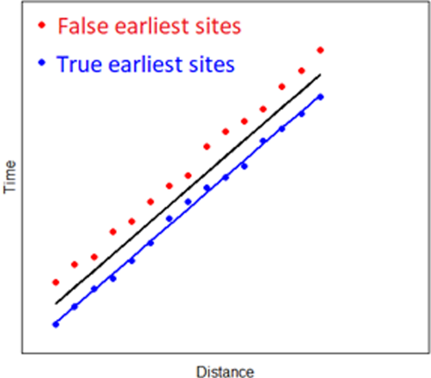
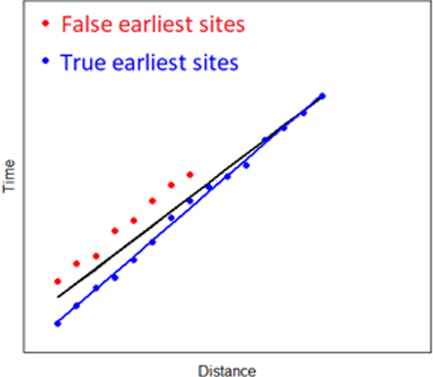
- The paper states that the selection criterion cannot guarantee a pure set of truly earliest sites; false earliest sites may be included, and the threshold only reduces that probability, so the set is an estimate. It also states that the earliest dates from sites are unlikely to be sampled a priori due to population dynamics, and that actual earliest dates are probably a few decades earlier than the sampled ones.
- The paper states that the full data set is biased because there are far more sites in the north than in the south, likely due to differential intensity of research and/or different regional demographic histories; front-speed estimates based on the full set are therefore rejected as unrealistically low. The binned approach reduces sample size and spatial resolution, may smooth the expansion pattern and increase linear fit, and can delete potential non-directional or leapfrog migration patterns; it also introduces arbitrariness in bin width.
- The paper states that North Macedonia has an extremely small number of Early Neolithic dates (N = 29 from N = 8 sites), and some pre-6250 cal BC dates there are conventional charcoal dates with standard errors over 150 radiocarbon years, so it cannot resolve whether the pattern reflects leapfrog migration or sampling. The text also makes evident that the moderate correlation fits and small samples (26, 47, and 8 dates across the three sets) limit precision, and that intercept-based checks were not pursued because they would require strong assumptions and become speculative.
Model-written summary. Check it against the paper before relying on it.
Integrity signals
Registry
Cites
Statistics
Figures
Verification
Claims the paper makes
0 Valid · 0 Not valid · 16 Not checked · 51 Own results and interpretations
A result the paper states — it cites no source for it, so there is none to check. The quote shows it is in the paper.
In the paper
“It is interesting to note that the oldest dates from Serbia are older than most of the radiocarbon dates for the Early Neolithic in the Republic of North Macedonia, which is immediately to the south of Serbia.”
§ The timing and tempo of the Neolithic expansion across the Central Balkans in the light of the new radiocarbon evidence > 4. Discussion
plain- Asserted: passes — The authors put it forward as true.
- Checkable: passes — It can be checked against evidence.
- Load-bearing: passes — The paper’s conclusions depend on it.
- Based: passes — The paper gives a reason why it holds.
- Rests on an assumption not shown here.
None of the sources cited for this claim could be matched to a paper, so there is nothing to check it against.
In the paper
“There are pre-6250 cal BC radiocarbon dates coming from the North Macedonian sites Amzabegovo and Čuka-Topolčani (Naumov, 2009;Fidanoski, 2009)”
§ The timing and tempo of the Neolithic expansion across the Central Balkans in the light of the new radiocarbon evidence > 4. Discussion
What the sources say
- Not matchedcites Naumov, 2009
An author–year citation the paper’s reference list doesn’t settle. We don’t search these by name.
- Not matchedcites Fidanoski, 2009
An author–year citation the paper’s reference list doesn’t settle. We don’t search these by name.
plain- Asserted: passes — The authors put it forward as true.
- Checkable: passes — It can be checked against evidence.
- Load-bearing: passes — The paper’s conclusions depend on it.
- Based: passes — The paper gives a reason why it holds.
- Rests on an assumption not shown here.
- Not matched
A result the paper reports from its own data — it cites no other source for it, so there is none to check. The quote shows it is in the paper.
In the paper
“and reached the Great Pannonian Plain by 6000 cal BC.”
§ The timing and tempo of the Neolithic expansion across the Central Balkans in the light of the new radiocarbon evidence > 5. Conclusion
plain- Asserted: passes — The authors put it forward as true.
- Checkable: passes — It can be checked against evidence.
- Load-bearing: passes — The paper’s conclusions depend on it.
- Based: passes — The paper gives a reason why it holds.
- Rests on an assumption not shown here.
A result the paper states — it cites no source for it, so there is none to check. The quote shows it is in the paper.
In the paper
“but the accuracy and precision of these dates are problematic as these are conventional radiocarbon dates made on charcoal with very large standard errors (over 150 radiocarbon years).”
§ The timing and tempo of the Neolithic expansion across the Central Balkans in the light of the new radiocarbon evidence > 4. Discussion
plainstates a cause- Asserted: passes — The authors put it forward as true.
- Checkable: passes — It can be checked against evidence.
- Load-bearing: passes — The paper’s conclusions depend on it.
- Based: passes — The paper gives a reason why it holds.
- Rests on an assumption not shown here.
In the paper
“but the problem with this interpretation is that there is no secure evidence of the Mesolithic presence in the Central Balkans outside the microregion of the Danube Gorges (Gurova and Bonsall, 2014).”
§ The timing and tempo of the Neolithic expansion across the Central Balkans in the light of the new radiocarbon evidence > 4. Discussion
What the sources say
- Not checked yetcites Gurova and Bonsall, 2014 matched to “‘Pre-Neolithic’ in Southeast Europe: a Bulgarian perspective” (2014) source
plain- Asserted: passes — The authors put it forward as true.
- Checkable: passes — It can be checked against evidence.
- Load-bearing: passes — The paper’s conclusions depend on it.
- Based: passes — The paper gives a reason why it holds.
34 more claims
Create a free account to see all 67 claims and to verify the 24 references still open.
- It may state two separate claims as one. 22
- Probably not a substantial claim. 8
- The quote only partly states this claim. 1
Self-check
Percentages, sums and reported differences re-computed from the paper’s own numbers.
Each contradiction between two passages listed here was confirmed by an independent check.
Rated minor: it would not touch a result — a value no result rests on, a p-value that stays on the same side of the significance level, or a conflict that is clerical, resolved elsewhere in the paper, or outside its own findings.
In the paper
§ The timing and tempo of the Neolithic expansion across the Central Balkans in the light of the new radiocarbon evidence > 2. Materials and methods
“The cells are classified into 50 years wide temporal intervals on a calendric timescale, based on the means of the calibrated distributions of the earliest dates from each cell.”
§ The timing and tempo of the Neolithic expansion across the Central Balkans in the light of the new radiocarbon evidence > 5. Conclusion
“The color of each grid cell depends on the median of the earliest Neolithic date in the cell.”
Rated minor: it would not touch a result — a value no result rests on, a p-value that stays on the same side of the significance level, or a conflict that is clerical, resolved elsewhere in the paper, or outside its own findings.
In the paper
§ The timing and tempo of the Neolithic expansion across the Central Balkans in the light of the new radiocarbon evidence > 4. Discussion
“5879 cal BC (the lower limit of the 95% CI of the oldest date in the earliest sites/dates set)”
§ The timing and tempo of the Neolithic expansion across the Central Balkans in the light of the new radiocarbon evidence > 5. Conclusion
“BRAMS-2323 7366 29 6340-6121 6362-6098 6235 6238 Porčić et al. (2020)”
Citations
Cites
R: A Language and Environment for Statistical Computing
R Core Team (2025) · doi:10.32614/r.manuals · Cited by 352,181
Bayesian Analysis of Radiocarbon Dates
Bronk Ramsey, C. (2009) · Radiocarbon · doi:10.1017/s0033822200033865 · Cited by 8,725
Legendre, P. (1998) · Thammasat University Digital Collections · Cited by 3,537
The Neolithic Transition and the Genetics of Populations in Europe
Ammerman, A. J., & Cavalli-Sforza, L. L. (1984) · Princeton University Press eBooks · doi:10.1515/9781400853113 · Cited by 969
The Neolithic Transition and the Genetics of Populations in Europe.
Roberts, D. F., Ammerman, A. J., & Cavalli-Sforza, L. L. (1986) · Man · doi:10.2307/2803105 · Cited by 760
Use and misuse of the reduced major axis for line‐fitting
Smith, R. J. (2009) · American Journal of Physical Anthropology · doi:10.1002/ajpa.21090 · Cited by 724 · cited 5×
“The RMA estimates can be considered as the lower boundary for the speed estimate, and the OLS as the upper boundary, as RMA best fitting lines have steeper slopes than OLS lines for the same data (we remind the reader that the speed is calculated as the reciprocal of the slope, therefore higher slopes translate into l…”
BackgroundInfluentialThe genomic history of southeastern Europe
Mathieson, I., Alpaslan-Roodenberg, S., Posth, C., Szécsényi-Nagy, A., Rohland, N., Mallick, S., Olalde, I., Broomandkhoshbacht, N., Candilio, F., Cheronet, O., et al. (2018) · Nature · doi:10.1038/nature25778 · Cited by 692
The Neolithic Demographic Transition and its Consequences
(2008) · Springer eBooks · doi:10.1007/978-1-4020-8539-0 · Cited by 559
Early farmers from across Europe directly descended from Neolithic Aegeans
Hofmanová, Z., Kreutzer, S., Hellenthal, G., Sell, C., Diekmann, Y., Díez-del-Molino, D., van Dorp, L., López, S., Kousathanas, A., Link, V., et al. (2016) · Proceedings of the National Academy of Sciences · doi:10.1073/pnas.1523951113 · Cited by 488
Measuring the Rate of Spread of Early Farming in Europe
Ammerman, A. J., & Cavalli-Sforza, L. L. (1971) · Man · doi:10.2307/2799190 · Cited by 450
Research works printed but not linked: 10
- Bogdanović, M., 1994. Prilog proučavanju apsolutne hronologije protostarčevačke i starčevačke kulture. Starinar 47, 187-192.
- Borić, D., Dimitrijević, V., 2009b. Apsolutna hronologija i stratigrafija Lepenskog Vira. Starinar LVII/2007, 9-55.
- Fidanoski, L., 2009. Periodization and chronology of the Neolithic cultures. In: Naumov, G., Fidanovski, L., Tolevski, I., Ivkovska, A. (Eds.), Neolithic Communities in the Republic of Macedonia. Dante, Skopje, pp. 31-34.
- Kotsakis, K., 2014. Domesticating the periphery. Pharos 20, 41-73.
- Luca, S.A., Suciu, C. (Eds.), 2011. Early Neolithic (Starčevo-Criş) Sites on the Territory of Romania. Archaeopress, Oxford.
- Maniatis, Y., 2014. Radiocarbon dating of the major cultural changes in Prehistoric Macedonia: recent developments. 1912-2012. A Century of Research in Prehistoric Macedonia. In: Stefani, E., Merousis, N., Dimoula, A. (Eds.), Proceedings of the International Conference, Archaeological Museum of Thessaloniki. Archaeological Museum of Thessaloniki, Thessaloniki, pp. 22-24.
- McPherron, A., Bucha, V., Aitken, M.J., 1988. Absolute dating of Divostin, Grivac-Barice and Banja. In: McPherron, A., Srejović, D. (Eds.), Divostin and the Neolithic of Central Serbia. University of Pittsburgh, Pittsburgh, pp. 379-387.
- Naumov, G., 2009. The process of Neolithization. In: Naumov, G., Fidanovski, L., Tolevski, I., Ivkovska, A. (Eds.), Neolithic communities in the Republic of Macedonia. Dante, Skopje, pp. 17-27.
- Tasić, N.N., 1993. Nekoliko novih radiokarbonskih datuma. Glasnik SAD 9, 99-102.
- Zilhão, J., 2003. The Neolithic transition in Portugal and the role of demic diffusion in the spread of agriculture across West Mediterranean Europe. In: Ammerman, A.J., Biagi, P. (Eds.), The Widening Harvest: The Neolithic Transition in Europe. Archaeological Institute of America, Boston, pp. 207-223.
Cited by
Crema, E. R., Stevens, C. J., & Shoda, S. (2022) · Science Advances · doi:10.1126/sciadv.adc9171 · Cited by 77
Population Genetics and Signatures of Selection in Early Neolithic European Farmers
Childebayeva, A., Rohrlach, A. B., Barquera, R., Rivollat, M., Aron, F., Szolek, A., Kohlbacher, O., Nicklisch, N., Alt, K. W., Gronenborn, D., et al. (2022) · Molecular Biology and Evolution · doi:10.1093/molbev/msac108 · Cited by 60
Genetic continuity, isolation, and gene flow in Stone Age Central and Eastern Europe
Mattila, T. M., Svensson, E., Juras, A., Günther, T., Kashuba, N., Ala‐Hulkko, T., Chyleński, M., McKenna, J., Pospieszny, Ł., Constantinescu, M., et al. (2023) · Communications Biology · doi:10.1038/s42003-023-05131-3 · Cited by 50
Reconstructing genetic histories and social organisation in Neolithic and Bronze Age Croatia
Freilich, S., Ringbauer, H., Los, D., Novak, M., Pavičić, D. T., Schiffels, S., & Pinhasi, R. (2021) · Scientific Reports · doi:10.1038/s41598-021-94932-9 · Cited by 41
Process and Dynamics of Mediterranean Neolithization (7000–5500 bc)
Leppard, T. P. (2021) · Journal of Archaeological Research · doi:10.1007/s10814-021-09161-5 · Cited by 35
Metadata
- Authors
- Porčić, M., Blagojević, T., Pendić, J., & Stefanović, S.
- Affiliations
- University of Novi Sad (RS)
- Corresponding author
- Porčić, Marko
- Venue
- Journal of Archaeological Science: Reports
- Publisher
- Elsevier BV
- Published
- 2020-10
- Volume
- 33
- Pages
- 102528
- ISSN
- 2352-409X (ISSN-L)
- OpenAlex
- W3081582030
- Cited by
- 41
- References
- 55
- Citations by year
- 2026: 4 · 2025: 7 · 2024: 8 · 2023: 6 · 2022: 10 · 2021: 5 · 2020: 1
- FWCI
- 5.67
- Type
- journal article
- Language
- en
- Open access
- hybrid
- doi.org
- Licence
- cc-by
- www.elsevier.com/tdm/userlicense/1.0/ (tdm)
- www.elsevier.com/legal/tdmrep-license (tdm)
- creativecommons.org/licenses/by/4.0/ (vor)
- Locations
- Journal of Archaeological Science Reports (publishedVersion, cc-by)
- Faculty of Philosophy (University of Belgrade) (publishedVersion, cc-by)
- Zenodo (CERN European Organization for Nuclear Research) (submittedVersion, cc-by)
- Zenodo (CERN European Organization for Nuclear Research) (cc-by)
- Funders
- European Research Council
- Topics
- Social Sciences › Archeology › Archaeology and ancient environmental studies
- Social Sciences › Arts and Humanities › Archeology (arts and humanities) › Archaeological and Geological Studies
- Life Sciences › Agricultural and Biological Sciences › Soil Science › Soil and Environmental Studies
- Keywords
- Neolithic expansion, Central Balkans, first farmers, radiocarbon chronology, spatiotemporal spread, migration timing, Northern Greece
About these checks
Registry, retraction, Cites and statistics results are computed, not judged, with one exception: a printed reference that no index lists is read once by a model before it counts as a citation error. Claims are extracted by a model and kept only when their quote appears verbatim in the text; each cited source is then checked, with a model’s help, for whether it says what the claim relies on. Those verdicts can be wrong — read the claim’s quote and the cited source before relying on one.
A language model drew the claims from the paper on 2026-11-24, under version 3 of the claim definition (model deepseek-v4.1-flash, prompt extract-v3).
A second model labelled each claim on 2026-11-24 (model jev-1.13-20260917, definition revision gold-guideline-v0.2).
Statistics and arithmetic are recomputed, not judged.
Confidence bands are shown only for fields calibrated on our annotated test set. None is calibrated yet, so no band is shown.
What counts as a claim ›How we measure confidence ›How we check this ›
Are you an author, or do you see a problem with this page? Request a review
How to cite
Cite CoChat for the checks on this page, and the paper for its own findings.
- This page
- CoChat. (2026). Citation check: The timing and tempo of the Neolithic expansion across the Central Balkans in the light of the new radiocarbon evidence. https://app.cochat.ai/papers/10.1016/j.jasrep.2020.102528
- The paper
- Porčić, M., Blagojević, T., Pendić, J., & Stefanović, S. (2020). The timing and tempo of the Neolithic expansion across the Central Balkans in the light of the new radiocarbon evidence. Journal of Archaeological Science: Reports. https://doi.org/10.1016/j.jasrep.2020.102528
Data sources
Bibliographic data: Semantic Scholar, OpenAlex, Crossref.
Contains information from the Semantic Scholar Academic Graph Datasets, made available under the ODC Attribution License (ODC-BY 1.0).
Semantic Scholar’s data is described in: Kinney, R., et al. (2023). The Semantic Scholar Open Data Platform. arXiv:2301.10140.
