

The DOI matches its Crossref record; 1 of the 1 references it cites were found in a registry or an index.
Safety and efficacy of autologous adipose-derived stem cells for knee osteoarthritis in the elderly population: A systematic review
Open accessAbstract
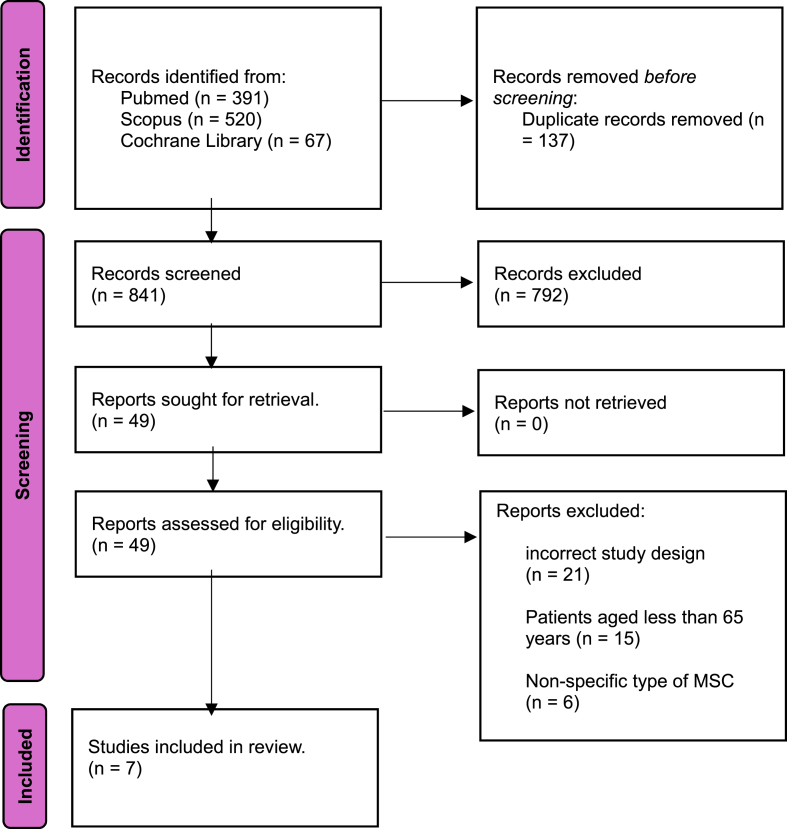
Introduction: Osteoarthritis (OA) is a progressive joint disease, and over 240 million people suffer from symptomatic OA, primarily in the knee, and mainly affects the elderly population over 65. A combination of different risk factors leads to biological changes in the microenvironments of the joints, causing cartilage overload and chondrocyte aging. Adipose-derived MSCs (ADSCs) are demonstrated to improve joint environments with an effective therapy for Knee OA. This review focused on patients over 65 years old to evaluate the effectiveness of ADSC therapies in treating KOA in elderly patients and demonstrate that complications are not higher in this cohort of patients. Materials and methods: We conducted a bibliography search through the PubMed, Scopus, and Cochrane databases for English-language and human clinical trials published until Feb 7, 2024. We extracted the following study characteristics: Authors, year of publication, type of study, number of patients, number of knees, sex, Kellgren-Lawrence classification, culture ADSC, Number of cells injected, mean follow-up, adverse events, significant complications, and clinical outcomes data were extracted recorded and analyzed. Results: According to inclusion criteria, seven clinical trials on autologous adipose-derived stem cells were considered. Four studies analyzed stem cells as a stromal vascular fraction (SVF), two as ADSC cultured, and 1 study investigated the MAT procedure. All studies reported improved clinical outcomes using autologous adipose-derived stem cells, on 339 knees. Post-treatment increased KOOS, WOMAC, IKS, VAS, and Lysholm knee scores were highlighted. All studies showed an improvement in all outcomes scores, and regarding complications, only 44 knees underwent adverse events, but no significant complications were found in all the studies reported. Conclusions: The current systematic review demonstrated that using autologous adipose-derived stem cells improved clinical outcomes and is effective and safe in elderly patients. Additionally, this study will encourage orthopedic surgeons not to consider surgery as the only solution in elderly patients who are refractory to treatment and do not show end-stage knee osteoarthritis. Level of evidence: Level IV, systematic review of level IV studies
Overview
The claims and statistics of this paper haven’t been checked yet.
Run the check — free, no account needed. It reads the open-access text and checks the sources it cites.
Integrity signals
Registry
Cites
Statistics
Figures
Verification
Claims the paper makes
The claims and statistics of this paper haven’t been checked yet.
Run the check — free, no account needed. It reads the open-access text and checks the sources it cites.
Claims other papers make about this one
Each is checked against this paper’s own text: does it say what the citing paper says it does?
The source backs part of the claim, not all of it — or backs it for a different population, condition or comparison.
In the citing paper
“Similarly, MSC-based therapies, particularly those utilizing MSCs derived from bone marrow, adipose tissue, or umbilical cord blood, offer substantial regenerative potential due to their ability to differentiate into various tissue types and modulate immune responses [17,18].”
From Advancements in Regenerative Therapies for Orthopedics: A Comprehensive Review of Platelet-Rich Plasma, Mesenchymal Stem Cells, Peptide Therapies, and Biomimetic Applications (2025) · cites this paper as [18]
Experimental — accuracy not yet measured
Self-check
Percentages, sums and reported differences re-computed from the paper’s own numbers.
The self-check needs the paper’s full text.
Citations
Cites
The PRISMA 2020 statement: an updated guideline for reporting systematic reviews
Page, M. J., McKenzie, J. E., Bossuyt, P. M., Boutron, I., Hoffmann, T. C., Mulrow, C. D., Shamseer, L., Tetzlaff, J. M., Akl, E. A., Brennan, S. E., et al. (2021) · Systematic Reviews · doi:10.1186/s13643-021-01626-4 · Cited by 13,874
Research works printed but not linked: 52
- Buzaboon, 2020, Clinical applicability of adult human mesenchymal stem cell therapy in the treatment of knee osteoarthritis, Stem Cells Cloning, 13, 117
- Hunter, 2019, Osteoarthritis, Lancet, 393, 1745, 10.1016/S0140-6736(19)30417-9 · DOI
- Previtali, 2022, High prevalence of pain sensitization in knee osteoarthritis: a meta-analysis with meta-regression, CARTILAGE, 13, 10.1177/19476035221087698 · DOI
- Long, 2022, Prevalence trends of site‐specific osteoarthritis from 1990 to 2019: findings from the global burden of disease study 2019, Arthritis Rheumatol, 74, 1172, 10.1002/art.42089 · DOI
- Zhang, 2019, Mesenchymal stem cell related therapies for cartilage lesions and osteoarthritis, Am J Transl Res, 11, 6275
- Allen, 2022, Epidemiology of osteoarthritis, Osteoarthritis Cartilage, 30, 184, 10.1016/j.joca.2021.04.020 · DOI
- Vina, 2018, Epidemiology of osteoarthritis: literature update, Curr Opin Rheumatol, 30, 160, 10.1097/BOR.0000000000000479 · DOI
- Felson, 1987, The prevalence of knee osteoarthritis in the elderly. the framingham osteoarthritis study, Arthritis Rheum, 30, 914, 10.1002/art.1780300811 · DOI
- Jordan, 2007, Prevalence of knee symptoms and radiographic and symptomatic knee osteoarthritis in african Americans and caucasians: the johnston county osteoarthritis project, J Rheumatol, 34, 172
- Losina, 2015, Lifetime medical costs of knee osteoarthritis management in the United States: impact of extending indications for total knee arthroplasty, Arthritis Care Res, 67, 203, 10.1002/acr.22412 · DOI
- Kim, 2015, Mesenchymal stem cell implantation in osteoarthritic knees: is fibrin glue effective as a scaffold?, Am J Sports Med, 43, 176, 10.1177/0363546514554190 · DOI
- Bunnell, 2008, Adipose-derived stem cells: isolation, expansion and differentiation, Methods, 45, 115, 10.1016/j.ymeth.2008.03.006 · DOI
- Shimozono, 2019, Adipose-based therapies for knee pain—fat or fiction, J Knee Surg, 32, 55, 10.1055/s-0038-1672155 · DOI
- Anandacoomarasamy, 2010, Current evidence for osteoarthritis treatments, Therapeutic Advances in Musculoskeletal, 2, 17, 10.1177/1759720X09359889 · DOI
- Ashkavand, 2013, The pathophysiology of osteoarthritis, J Pharm Res, 7, 132
- Caplan, 2017, Mesenchymal stem cells: time to change the name, Stem Cells Translational Medicine, 6, 1445, 10.1002/sctm.17-0051 · DOI
- Soler, 2016, Final results of a phase I–II trial using ex vivo expanded autologous Mesenchymal Stromal Cells for the treatment of osteoarthritis of the knee confirming safety and suggesting cartilage regeneration, Knee, 23, 647, 10.1016/j.knee.2015.08.013 · DOI
- Wang, 2017, Safety, tolerability, clinical, and joint structural outcomes of a single intra-articular injection of allogeneic mesenchymal precursor cells in patients following anterior cruciate ligament reconstruction: a controlled double-blind randomised trial, Arthritis Res Ther, 19, 180, 10.1186/s13075-017-1391-0 · DOI
- Tremolada, 2016, Adipose tissue and mesenchymal stem cells: state of the art and Lipogems® technology development, Curr Stem Cell Rep, 2, 304, 10.1007/s40778-016-0053-5 · DOI
- Emadedin, 2018, Intra-articular implantation of autologous bone marrow–derived mesenchymal stromal cells to treat knee osteoarthritis: a randomized, triple-blind, placebo-controlled phase 1/2 clinical trial, Cytotherapy, 20, 1238, 10.1016/j.jcyt.2018.08.005 · DOI
- Chen, 2008, Mesenchymal stem cells in arthritic diseases, Arthritis Res Ther, 10, 223, 10.1186/ar2514 · DOI
- Cicione, 2023, Micro-fragmented and nanofat adipose tissue derivatives: in vitro qualitative and quantitative analysis, Front Bioeng Biotechnol, 11, 10.3389/fbioe.2023.911600 · DOI
- Gupta, 2016, Efficacy and safety of adult human bone marrow-derived, cultured, pooled, allogeneic mesenchymal stromal cells (Stempeucel®): preclinical and clinical trial in osteoarthritis of the knee joint, Arthritis Res Ther, 18, 301, 10.1186/s13075-016-1195-7 · DOI
- Freitag, 2015, BMJ Open, 5, 10.1136/bmjopen-2015-009332 · DOI
- Bianchi, 2013, A new nonenzymatic method and device to obtain a fat tissue derivative highly enriched in pericyte-like elements by mild mechanical forces from human lipoaspirates, Cell Transplant, 22, 2063, 10.3727/096368912X657855 · DOI
- Papalia, 2020, Adipose-derived stromal vascular fraction processed with different systems for the treatment of knee osteoarthritis: a pilot study on cell proliferation and clinical results, J Biol Regul Homeost Agents, 34, 113
- Senesi, 2019, Mechanical and enzymatic procedures to isolate the stromal vascular fraction from adipose tissue: preliminary results, Front Cell Dev Biol, 7, 88, 10.3389/fcell.2019.00088 · DOI
- Nguyen, 2016, Stromal vascular fraction: a regenerative reality? Part 1: current concepts and review of the literature, J Plast Reconstr Aesthetic Surg, 69, 170, 10.1016/j.bjps.2015.10.015 · DOI
- Mashiko, 2017, Mechanical micronization of lipoaspirates: squeeze and emulsification techniques, Plast Reconstr Surg, 139, 79, 10.1097/PRS.0000000000002920 · DOI
- Ossendorff, 2023, A worldwide analysis of adipose-derived stem cells and stromal vascular fraction in orthopedics: current evidence and applications, JCM, 12, 4719, 10.3390/jcm12144719 · DOI
- Hurley, 2018, Limited evidence for adipose-derived stem cell therapy on the treatment of osteoarthritis, Knee Surg Sports Traumatol Arthrosc, 26, 3499, 10.1007/s00167-018-4955-x · DOI
- Filardo, 2013, Mesenchymal stem cells for the treatment of cartilage lesions: from preclinical findings to clinical application in orthopaedics, Knee Surg Sports Traumatol Arthrosc, 21, 1717, 10.1007/s00167-012-2329-3 · DOI
- Higuchi, 2020, Associations of clinical outcomes and MRI findings in intra-articular administration of autologous adipose-derived stem cells for knee osteoarthritis, Regen Ther, 14, 332, 10.1016/j.reth.2020.04.003 · DOI
- Koh, 2016, Adipose-derived mesenchymal stem cells with microfracture versus microfracture alone: 2-year follow-up of a prospective randomized trial, Arthroscopy, 32, 97, 10.1016/j.arthro.2015.09.010 · DOI
- Schiavone Panni, 2019, Preliminary results of autologous adipose-derived stem cells in early knee osteoarthritis: identification of a subpopulation with greater response, Int Orthop, 43, 7, 10.1007/s00264-018-4182-6 · DOI
- Tsubosaka, 2020, The influence of adipose-derived stromal vascular fraction cells on the treatment of knee osteoarthritis, BMC Muscoskel Disord, 21, 207, 10.1186/s12891-020-03231-3 · DOI
- Chen, 2021, Treatment of knee osteoarthritis with intra-articular injection of allogeneic adipose-derived stem cells (ADSCs) ELIXCYTE®: a phase I/II, randomized, active-control, single-blind, multiple-center clinical trial, Stem Cell Res Ther, 12, 562, 10.1186/s13287-021-02631-z · DOI
- Yokota, 2017, Clinical results following intra-articular injection of adipose-derived stromal vascular fraction cells in patients with osteoarthritis of the knee, Regen Ther, 6, 108, 10.1016/j.reth.2017.04.002 · DOI
- Tsubosaka, 2021, Comparison of clinical and imaging outcomes of different doses of adipose-derived stromal vascular fraction cell treatment for knee osteoarthritis, Cell Transplant, 30, 10.1177/09636897211067454 · DOI · Paper page
- Zhang, 2010, Epidemiology of osteoarthritis, Clin Geriatr Med, 26, 355, 10.1016/j.cger.2010.03.001 · DOI
- Lu, 2019, Treatment of knee osteoarthritis with intra-articular injection of autologous adipose-derived mesenchymal progenitor cells: a prospective, randomized, double-blind, active-controlled, phase IIb clinical trial, Stem Cell Res Ther, 10, 143, 10.1186/s13287-019-1248-3 · DOI
- Lee, 2019, Intra‐articular injection of autologous adipose tissue‐derived mesenchymal stem cells for the treatment of knee osteoarthritis: a phase IIb, randomized, placebo‐controlled clinical trial, Stem Cells Transl Med, 8, 504, 10.1002/sctm.18-0122 · DOI · Paper page
- Kim, 2022, Safety and efficacy of the intra-articular injection of mesenchymal stem cells for the treatment of osteoarthritic knee: a 5-year follow-up study, Stem Cells Transl Med, 11, 586, 10.1093/stcltm/szac024 · DOI
- Vasso, 2022, Intraarticular injection of microfragmented adipose tissue plus arthroscopy in isolated primary patellofemoral osteoarthritis is clinically effective and not affected by age, BMI, or stage of osteoarthritis, J Orthop Traumatol, 23, 7, 10.1186/s10195-022-00628-9 · DOI
- Onorato, 2024, Autologous microfragmented adipose tissue treatment of knee osteoarthritis demonstrates effectiveness in 68% of patients at 4-year follow-up, Arch Orthop Trauma Surg, 11
- Screpis, 2022, Autologous microfragmented adipose tissue for the treatment of knee osteoarthritis: real-world data at two years follow-up, J Clin Med, 11, 1268, 10.3390/jcm11051268 · DOI
- Sibbitt, 2012, Does ultrasound guidance improve the outcomes of arthrocentesis and corticosteroid injection of the knee?, Scand J Rheumatol, 41, 66, 10.3109/03009742.2011.599071 · DOI
- Sheth, 2021, Assessment of patient satisfaction, functionality, and quality of life after ultrasound-guided knee intervention: a prospective study, Clin Rheumatol, 40, 735, 10.1007/s10067-020-05254-6 · DOI
- Chagas-Neto, 2017, In-plane ultrasound-guided knee injection through a lateral suprapatellar approach: a safe technique, Ultrasound Q, 33, 139, 10.1097/RUQ.0000000000000288 · DOI
- Fang, 2021, Ultrasound-guided knee injections are more accurate than blind injections: a systematic review of randomized controlled trials, Arthroscopy, Sports Medicine, and Rehabilitation, 3, e1177, 10.1016/j.asmr.2021.01.028 · DOI
- Wiler, 2010, Comparison of ultrasound-guided and standard landmark techniques for knee arthrocentesis, J Emerg Med, 39, 76, 10.1016/j.jemermed.2008.05.012 · DOI
- Saha, 2023, Accuracy of intraarticular injections: blind vs. Image guided techniques—a review of literature, JFMK, 8, 93, 10.3390/jfmk8030093 · DOI
Cited by
Sorted by citations
Goulian, A. J., Goldstein, B., & Saad, M. A. (2025) · Journal of Clinical Medicine · doi:10.3390/jcm14062061 · Cited by 25
“Similarly, MSC-based therapies, particularly those utilizing MSCs derived from bone marrow, adipose tissue, or umbilical cord blood, offer substantial regenerative potential due to their ability to differentiate into various tissue types and modulate immune responses [17,18].”
Metadata
- Authors
- Zampogna, B., Parisi, F. R., Ferrini, A., Zampoli, A., Papalia, G. F., Shanmugasundaram, S., & Papalia, R.
- Affiliations
- University of Messina (IT)
- Università Campus Bio-Medico (IT)
- Corresponding author
- Papalia, Giuseppe Francesco
- ORCID
- Venue
- Journal of Clinical Orthopaedics and Trauma
- Publisher
- Elsevier BV
- Published
- 2024-12
- Volume
- 59
- Pages
- 102804
- ISSN
- 0976-5662 (ISSN-L)
- PMC
- PMC11609259
- OpenAlex
- W4404136098
- Cited by
- 10
- References
- 1
- Citations by year
- 2026: 5 · 2025: 5
- FWCI
- 0.74
- Type
- journal article
- Language
- en
- Update notices
- Open access
- hybrid
- doi.org
- Licence
- Locations
- Journal of Clinical Orthopaedics and Trauma (publishedVersion, cc-by)
- PubMed Central (publishedVersion, cc-by)
- Europe PMC (PubMed Central) (publishedVersion, cc-by)
- PubMed (publishedVersion)
- Topics
- Health Sciences › Medicine › Rheumatology › Osteoarthritis Treatment and Mechanisms
- Life Sciences › Biochemistry, Genetics and Molecular Biology › Cell Biology › Mesenchymal stem cell research
- Health Sciences › Dentistry › Periodontics › Periodontal Regeneration and Treatments
- Keywords
- knee osteoarthritis, autologous adipose-derived stem cells, elderly patients, stromal vascular fraction, cell therapy safety, treatment efficacy, cartilage repair, adverse events, Kellgren-Lawrence grade, KOOS, WOMAC, Lysholm score
About these checks
Registry, retraction, Cites and statistics results are computed, not judged, with one exception: a printed reference that no index lists is read once by a model before it counts as a citation error. Claims are extracted by a model and kept only when their quote appears verbatim in the text; each cited source is then checked, with a model’s help, for whether it says what the claim relies on. Those verdicts can be wrong — read the claim’s quote and the cited source before relying on one.
Statistics and arithmetic are recomputed, not judged.
Confidence bands are shown only for fields calibrated on our annotated test set. None is calibrated yet, so no band is shown.
What counts as a claim ›How we measure confidence ›How we check this ›
Are you an author, or do you see a problem with this page? Request a review
