

The DOI matches its Crossref record; 2 of the 2 references it cites were found in a registry or an index.
Evaluation of weather and environmental factors and their association with cutaneous melanoma incidence: A national ecological study
Open accessAbstract
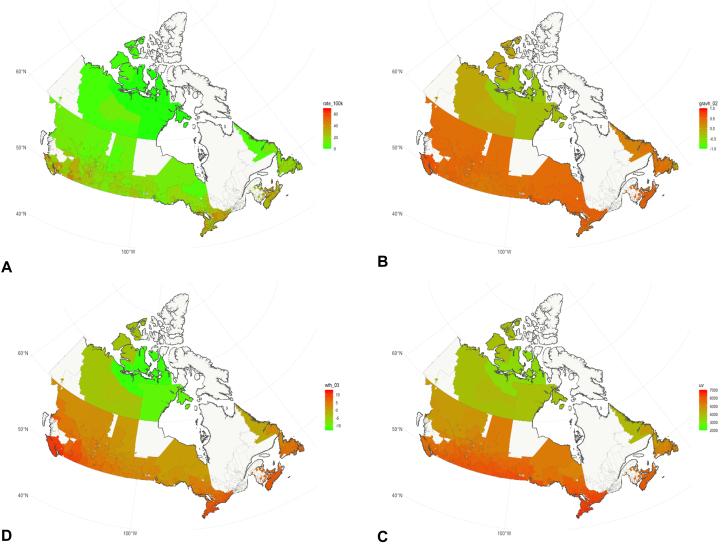
Background: Cutaneous melanoma (CM) is a significant contributor to skin cancer-related mortality globally and in Canada. Despite the well-established link between ultraviolet (UV) radiation exposure and skin cancer risk, there remains a gap in population-level interventions and persistent misconceptions about sun exposure and impact of environment on individual behavior. Objective: The current study provides an ecological analysis using latest available data (2011-2017) to define geographic/environmental contributors to the CM landscape in Canada. Methods: Utilizing Canadian Cancer Registry and Canadian Urban Environmental Health Research Consortium data, we analyzed 39,605 CM cases occurring in Canada from 2011 to 2017. Environmental data, including UV radiation, greenspace (normalized difference vegetation index), temperature, heat events, and precipitation was used to evaluate the effect of environment on CM incidence rates across Forward Sortation Area postal codes. Results: Forward Sortation Areas with increased CM incidence were associated with higher annual average temperature, snowfall, heat events, normalized difference vegetation index, and vitamin D-weighted UV exposure. Conversely, factors associated with decreased incidence included an increased annual highest temperature, rain precipitation, and a longer duration of heat events. Limitations: This study is subject to ecological bias and findings should be interpreted with caution. Conclusion: This study further substantiates associations between specific environmental factors and CM incidence.
Overview
The claims and statistics of this paper haven’t been checked yet.
Run the check — free, no account needed. It reads the open-access text and checks the sources it cites.
Integrity signals
Registry
Cites
Statistics
Figures
Verification
Claims the paper makes
The claims and statistics of this paper haven’t been checked yet.
Run the check — free, no account needed. It reads the open-access text and checks the sources it cites.
Claims other papers make about this one
Each is checked against this paper’s own text: does it say what the citing paper says it does?
The cited source says what the claim attributes to it.
In the citing paper
“There was a positive association between the incidence of melanoma and average temperature, average annual number of days with heat events, mean daily vitamin D-weighted UV-radiation in summer, and green space (average normalised difference in vegetation index).”
The cited source says what the claim attributes to it.
In the citing paper
“For example, a one standard deviation increment in average temperature (1.5 °C) was associated with a 26% increment in the expected number of melanoma cases for a region.”
The cited source says what the claim attributes to it.
In the citing paper
“Conversely, higher peak annual temperature, longer duration of heat events (in days), and greater annual total precipitation were associated with lower melanoma incidence.”
Self-check
Percentages, sums and reported differences re-computed from the paper’s own numbers.
The self-check needs the paper’s full text.
Citations
Cites
D'Orazio, J., Jarrett, S., Amaro-Ortiz, A., & Scott, T. (2013) · International Journal of Molecular Sciences · doi:10.3390/ijms140612222 · Cited by 1,984
Ozone depletion, ultraviolet radiation, climate change and prospects for a sustainable future
Barnes, P. W., Williamson, C. E., Lucas, R. M., Robinson, S. A., Madronich, S., Paul, N. D., Bornman, J. F., Bais, A. F., Sulzberger, B., Wilson, S. R., et al. (2019) · Nature Sustainability · doi:10.1038/s41893-019-0314-2 · Cited by 360
Research works printed but not linked: 28
- Arnold, 2022, Global burden of cutaneous melanoma in 2020 and projections to 2040, JAMA Dermatol, 158, 495, 10.1001/jamadermatol.2022.0160 · DOI
- Drucker, 2023, Top ten research priorities for psoriasis, atopic dermatitis and hidradenitis suppurativa: the SkIN Canada priority setting initiative, J Cutan Med Surg, 27, 133, 10.1177/12034754231156103 · DOI
- Darwich, 2019, Retinoblastoma incidence trends in Canada: a national comprehensive population-based study, J Pediatr Ophthalmol Strabismus, 56, 124, 10.3928/01913913-20190128-02 · DOI
- Litvinov, 2016, Investigating potential exogenous tumor initiating and promoting factors for Cutaneous T-Cell Lymphomas (CTCL), a rare skin malignancy, Oncoimmunology, 5, 10.1080/2162402X.2016.1175799 · DOI
- Ghazawi, 2019, Incidence, mortality, and spatiotemporal distribution of cutaneous malignant melanoma cases across Canada, J Cutan Med Surg, 23, 394, 10.1177/1203475419852048 · DOI
- Sample, 2018, Mechanisms and prevention of UV-induced melanoma, Photodermatol Photoimmunol Photomed, 34, 13, 10.1111/phpp.12329 · DOI · Paper page
- Alli, 2023, Understanding the perceived relationship between sun exposure and melanoma in Atlantic Canada: a consensual qualitative study highlighting a ‘sunscreen paradox’, Cancers, 15, 4726, 10.3390/cancers15194726 · DOI
- Conte, 2023, Skin cancer prevention across the G7, Australia and New Zealand: a review of legislation and guidelines, Curr Oncol, 30, 6019, 10.3390/curroncol30070450 · DOI
- Conte, 2022, Population-based study detailing cutaneous melanoma incidence and mortality trends in Canada, Front Med (Lausanne), 9
- Jeremian, 2024, Distinct signatures of mitotic age acceleration in cutaneous melanoma and acquired melanocytic nevi, J Invest Dermatol, 10.1016/j.jid.2024.01.012 · DOI
- Jeremian, 2023, Skin photoaging following sun exposure is associated with decreased epigenetic and biological age and correlates with basal cell carcinoma phenotype, Br J Dermatol, 22
- Jeremian, 2023, Gene-environment analyses in a UK biobank skin cancer cohort identifies important SNPs in DNA repair genes that may help prognosticate disease risk, Cancer Epidemiol Biomarkers Prev, 32, 1599, 10.1158/1055-9965.EPI-23-0545 · DOI
- Zhang, 2023, Comparison of the basal cell carcinoma (BCC) tumour microenvironment to other solid malignancies, Cancers (Basel), 15, 305, 10.3390/cancers15010305 · DOI
- Lee, 2007, Sun-related behavior after a diagnosis of cutaneous malignant melanoma, Melanoma Res, 17, 51, 10.1097/CMR.0b013e3280112b98 · DOI
- Banerjee, 2014, Quitting the “Cancer Tube”: a qualitative examination of the process of indoor tanning cessation, Transl Behav Med, 4, 209, 10.1007/s13142-014-0257-0 · DOI
- Glanz, 2019, Frequent indoor tanners' beliefs about indoor tanning and cessation, Am J Health Promot, 33, 293, 10.1177/0890117118784235 · DOI
- Shoveller, 2000, Canadian national survey on sun exposure & protective behaviours: outdoor workers, Can J Public Health, 91, 34, 10.1007/BF03404250 · DOI
- Ghazawi, 2019, Cutaneous malignant melanoma incidence and mortality trends in Canada: a comprehensive population-based study, J Am Acad Dermatol, 80, 448, 10.1016/j.jaad.2018.07.041 · DOI
- Berman-Rosa, 2022, Analysis of geographic and environmental factors and their association with cutaneous melanoma incidence in Canada, Dermatology, 238, 1006, 10.1159/000524949 · DOI
- Ghazawi, 2019, Trends in incidence of cutaneous malignant melanoma in Canada: 1992-2010 versus 2011-2015, J Am Acad Dermatol, 80, 1157, 10.1016/j.jaad.2018.10.055 · DOI
- Muntyanu, 2022, Risk factors and communities disproportionately affected by cervical cancer in the Russian Federation: a national population-based study, Lancet Reg Health Eur, 20
- Ghazawi, 2020, Incidence trends of conjunctival malignant melanoma in Canada, Br J Ophthalmol, 104, 23, 10.1136/bjophthalmol-2019-313977 · DOI
- Lagacé, 2019, Analysis of incidence, mortality trends, and geographic distribution of breast cancer patients in Canada, Breast Cancer Res Treat, 178, 683, 10.1007/s10549-019-05418-2 · DOI
- Lagacé, 2023, Assessing skin cancer risk factors, sun safety behaviors and melanoma concern in Atlantic Canada: a comprehensive survey study, Cancers, 15, 3753, 10.3390/cancers15153753 · DOI
- Hill, 1992, Melanoma prevention: behavioral and nonbehavioral factors in sunburn among an Australian urban population, Prev Med, 21, 654, 10.1016/0091-7435(92)90072-P · DOI
- Greenberg, 2003, Childhood cancer registries in Ontario, Canada: lessons learned from a comparison of two registries, Int J Cancer, 105, 88, 10.1002/ijc.11004 · DOI
- Gupta, 2016, The validity of pediatric cancer diagnoses in a population-based general cancer registry in Ontario, Canada, BMC Cancer, 16, 885, 10.1186/s12885-016-2931-8 · DOI
- Hall, 2006, Using cancer registry data for survival studies: the example of the Ontario Cancer Registry, J Clin Epidemiol, 59, 67, 10.1016/j.jclinepi.2005.05.001 · DOI
Cited by
Sorted by citations
Neale, P. J., Hylander, S., Banaszak, A. T., Häder, D.-P., Rose, K. C., Vione, D., Wängberg, S.-Å., Jansen, M. A. K., Busquets, R., Andersen, M. P. S., et al. (2025) · Photochemical & Photobiological Sciences · doi:10.1007/s43630-025-00687-x · Cited by 32
“A national study conducted in Canada examined the association between environmental factors and melanoma incidence, both averaged across the period 2011 to 2017, for each of ca 1000 administrative areas [250].”
Metadata
- Authors
- Moustaqim-Barrette, A., Conte, S., Kelly, A., Lebeau, J., Alli, S., Lagacé, F., & Litvinov, I. V.
- Affiliations
- McGill University (CA)
- University of Toronto (CA)
- Corresponding author
- Litvinov, Ivan V.
- Venue
- JAAD International
- Publisher
- Elsevier BV
- Published
- 2024-09
- Volume
- 16
- Pages
- 264-271
- ISSN
- 2666-3287 (ISSN-L)
- PMC
- PMC11320470
- OpenAlex
- W4399920333
- Cited by
- 11
- References
- 2
- Citations by year
- 2026: 2 · 2025: 3 · 2024: 6
- FWCI
- 1.88
- Type
- journal article
- Language
- en
- Open access
- gold
- doi.org
- Licence
- Locations
- JAAD International (publishedVersion, cc-by-nc-nd)
- PubMed Central (publishedVersion, cc-by-nc-nd)
- PubMed (publishedVersion)
- DOAJ (DOAJ: Directory of Open Access Journals) (submittedVersion)
- Funders
- CIHR
- Topics
- Health Sciences › Medicine › Oncology › Cutaneous Melanoma Detection and Management
- Health Sciences › Medicine › Dermatology › Skin Protection and Aging
- Health Sciences › Medicine › Oncology › Global Cancer Incidence and Screening
- Keywords
- cutaneous melanoma, melanoma incidence, UV exposure, environmental factors, temperature, heat events, snowfall, precipitation, green spaces, vegetation indices, vitamin D, sun exposure, geographic variation in cancer risk, Canada
About these checks
Registry, retraction, Cites and statistics results are computed, not judged, with one exception: a printed reference that no index lists is read once by a model before it counts as a citation error. Claims are extracted by a model and kept only when their quote appears verbatim in the text; each cited source is then checked, with a model’s help, for whether it says what the claim relies on. Those verdicts can be wrong — read the claim’s quote and the cited source before relying on one.
Statistics and arithmetic are recomputed, not judged.
Confidence bands are shown only for fields calibrated on our annotated test set. None is calibrated yet, so no band is shown.
What counts as a claim ›How we measure confidence ›How we check this ›
Are you an author, or do you see a problem with this page? Request a review
