

The DOI matches its Crossref record.
Modified QuEChERS method for 24 plant growth regulators in grapes using LC-MS/MS
Open accessAbstract
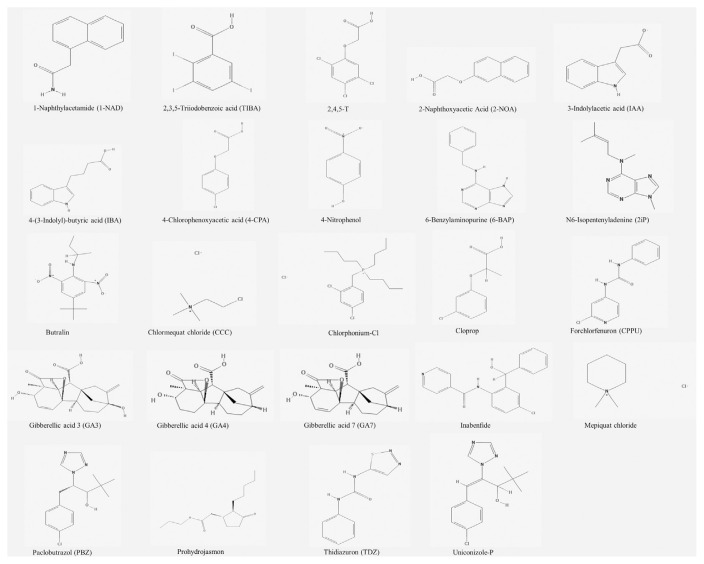
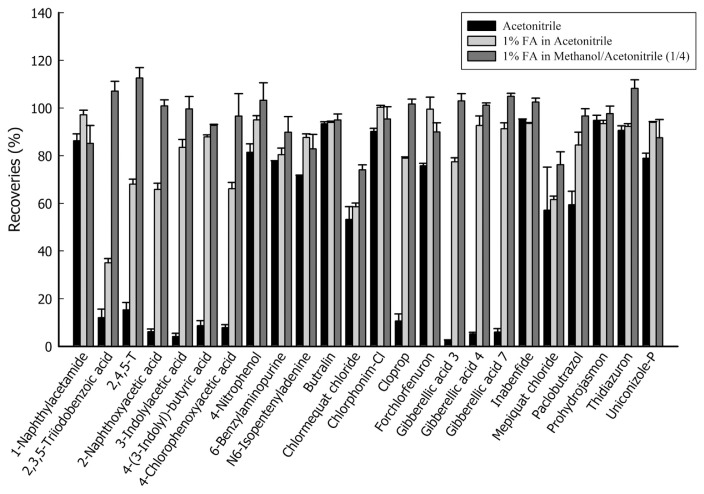
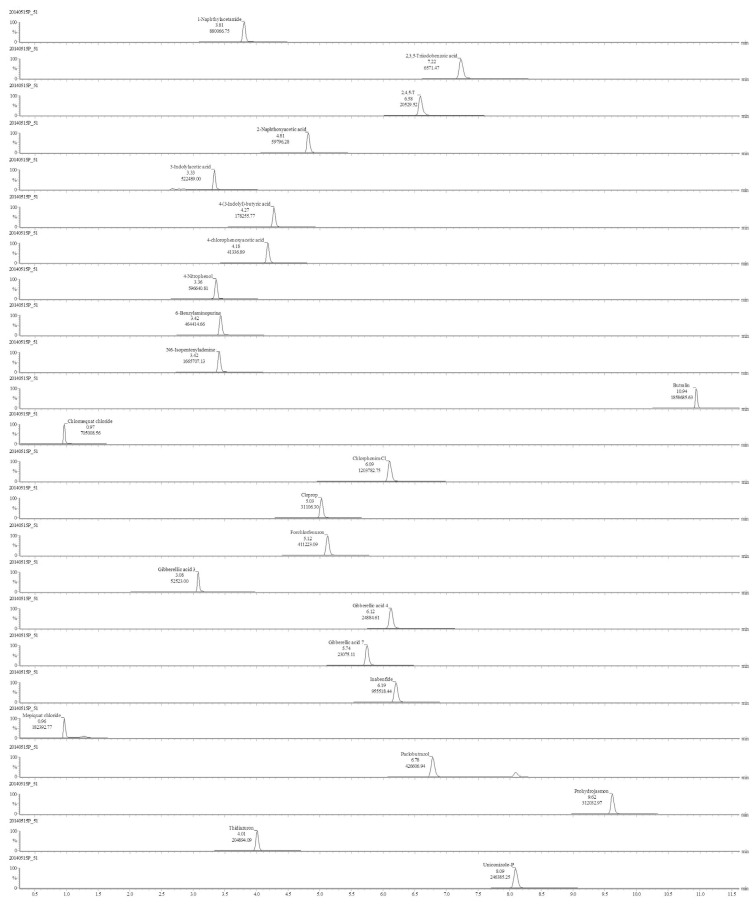
A multiresidue analytical method was developed for grapes for the following 24 plant growth regulators: 1-naphthylacetamide, 2,3,5-triiodobenzoic acid, 2,4,5-T, 2-naphthoxyacetic acid, 3-indolylacetic acid, 4-(3-indolyl)-butyric acid, 4-chlorophenoxyacetic acid, 4-nitrophenol, 6-benzylaminopurine, N6-isopentenyladenine, butralin, chlormequat chloride, chlorphonim-Cl, cloprop, forchlorfenuron, gibberellic acid 3, gibberellic acid 4, gibberellic acid 7, inabenfide, mepiquat chloride, paclobutrazol, prohydrojasmon, thidiazuron and uniconizole-P. The compounds were extracted from grape samples using an extraction method modified from the Quick, Easy, Cheap, Effective, Rugged and Safe (QuEChERS) method. Liquid chromatography – tandem mass spectrometry was used for the detection and quantification of the compounds. Validation of the method was performed by using recovery studies at both intra-day and inter-day intervals, as well as by evaluation of the matrix effect, limit of quantification, trueness and precision. We used matrix-matched calibrations for the quantification of the compounds, which all resulted in determination coefficients (r2) higher than 0.995. The limit of quantification ranged from 0.1 to 5 ng/mL. Recovery studies using three spiking concentrations at varying levels showed recoveries of 70.2–112.6% and 67.5–101.8% at intra-day and inter-day intervals, respectively. Relative standard deviations were below 20% for the recovery studies. The extraction method were further validated by performing recovery study and matrix effect test in six different grape varieties from Taiwan and the United States and all resulted in comparable results. Application of the established method to 50 grape samples, resulted in the detection of chlormequat chloride and forchlorfenuron residues in the tested grapes. The results of the method validation and real sample analysis shows the extraction method is therefore suitable for routine monitoring of residue in grapes.
Overview
The claims and statistics of this paper haven’t been checked yet.
Run the check — free, no account needed. It reads the open-access text and checks the sources it cites.
Integrity signals
Registry
Cites
Statistics
Figures
Verification
Claims the paper makes
The claims and statistics of this paper haven’t been checked yet.
Run the check — free, no account needed. It reads the open-access text and checks the sources it cites.
Self-check
Percentages, sums and reported differences re-computed from the paper’s own numbers.
The self-check needs the paper’s full text.
Citations
Cites
No references could be resolved yet.
Research works printed but not linked: 29
- Dokoozlian, 2000, Plant growth regulator use for table grape production in California, Proc 4th Int Symp Table Grape, 122
- Lin, 1988, The application of plant growth regulators on cultivation of grape, Appl Plant Growth Regul Hortic Crops, 12, 203
- Rademacher, 2000, Growth retardants: effects on gibberellin biosynthesis and other metabolic pathways, Annu Rev Plant Biol, 51, 501, 10.1146/annurev.arplant.51.1.501 · DOI
- Galston, 1947, The effect of 2,3,5-Triiodobenzoic acid on the growth and flowering of soybeans, Am J Bot, 34, 356, 10.1002/j.1537-2197.1947.tb13001.x · DOI
- Krause, 1968, Effects of 2,3,5-Triiodobenzoic acid on the structure of soybean leaves, Am J Bot, 55, 1074, 10.1002/j.1537-2197.1968.tb07472.x · DOI
- Suttle, 1988, Disruption of the polar auxin transport system in cotton seedlings following treatment with the defoliant thidiazuron, Plant Physiol, 86, 241, 10.1104/pp.86.1.241 · DOI
- Sørensen, 2006, Effects of the plant growth regulator, chlormequat, on mammalian fertility, Int J Androl, 29, 129, 10.1111/j.1365-2605.2005.00629.x · DOI
- Erin, 2008, Gibberellic acid, a plant growth regulator, increases mast cell recruitment and alters substance P levels, Toxicology, 254, 75, 10.1016/j.tox.2008.09.020 · DOI
- EFSA, 2008, Conclusion regarding the peer review of the pesticide risk assessment of the active substances sodium 5-nitroguaiacolate, sodium o-nitrophenolate and sodium p-nitrophenolate, EFSA Sci Rep, 191, 130
- Hill, 1995, Pesticide residues in urine of adults living in the United States: Reference range concentrations, Environ Res, 71, 99, 10.1006/enrs.1995.1071 · DOI
- Anastassiades, 2003, Fast and easy multiresidue method employing acetonitrile extraction/partitioning and “dispersive solid-phase extraction” for the determination of pesticide residues in produce, J AOAC Int, 86, 412, 10.1093/jaoac/86.2.412 · DOI · Paper page
- Choi, 2011, An analytical method for prohexadione in Chinese cabbage and apple, Biomed Chrom, 25, 493, 10.1002/bmc.1472 · DOI
- Lee, 2013, Detection of 6-benzylaminopurine plant growth regulator in bean sprouts using OFRR biosensor and QuEChERS method, Anal Meth, 5, 961, 10.1039/C2AY26136G · DOI
- Ma, 2013, Simultaneous determination of 15 plant growth regulators in bean sprout and tomato with liquid chromatography-triple quadrupole tandem mass spectrometry, Food Anal Meth, 6, 941, 10.1007/s12161-012-9505-4 · DOI
- Liu, 2013, Simultaneous determination of 24 or more acidic and alkaline phytohormones in femtomole quantities of plant tissues by high-performance liquid chromatography-electrospray ionization-ion trap mass spectrometry, Anal Bioanal Chem, 405, 1257, 10.1007/s00216-012-6509-2 · DOI
- Fan, 2011, Simultaneous determination of 13 phytohormones in oilseed rape tissues by liquid chromatography-electrospray tandem mass spectrometry and the evaluation of the matrix effect, J Sep Sci, 34, 640, 10.1002/jssc.201000541 · DOI
- Shi, 2011, Simultaneous determination of five plant growth regulators in fruits by modified quick, easy, cheap, effective, rugged, and safe (QuEChERS) extraction and liquid chromatography–tandem mass spectrometry, J Agric Food Chem, 60, 60, 10.1021/jf204183d · DOI
- Oulkar, 2011, Multiresidue analysis of plant growth regulators in grapes by triple quadrupole and quadrupole-time of flight-based liquid chromatography/mass spectrometry, J AOAC Int, 94, 1715, 10.5740/jaoacint.SGEOulkar · DOI
- Yang, 2014, Analysis of 118 pesticides in tobacco after extraction with the modified QuEChRS Method by LC–MS-MS, J Chromatogr Sci, 52, 788, 10.1093/chromsci/bmt112 · DOI
- Esparza, 2013, Determination of naphthalene-derived compounds in apples by ultra-high performance liquid chromatography-tandem mass spectrometry, Anal Chim Acta, 782, 28, 10.1016/j.aca.2013.03.067 · DOI
- Flores, 2011, QuEChERS-based extraction procedure for multifamily analysis of phytohormones in vegetables by UHPLC-MS/MS, J Sep Sci, 34, 1517, 10.1002/jssc.201100093 · DOI
- EFSA, 2011, Conclusion on the peer review of the pesticide risk assessment of the active substance 2-(1-naphthyl)acetamide (notified as 1-naphthylacetamide), EFSA J, 9, 58
- Lehotay, 2007, Determination of pesticide residues in foods by acetonitrile extraction and partitioning with magnesium sulfate: collaborative study, J AOAC Int, 90, 485, 10.1093/jaoac/90.2.485 · DOI
- Taylor, 2005, Matrix effects: the Achilles heel of quantitative high-performance liquid chromatography–electrospray–tandem mass spectrometry, Clin Biochem, 38, 328, 10.1016/j.clinbiochem.2004.11.007 · DOI
- Ross, 2001, New interactions between classical plant hormones, Trends Plant Sci, 6, 2, 10.1016/S1360-1385(00)01795-7 · DOI
- Coenen, 1997, Auxin—cytokinin interactions in higher plants: old problems and new tools, Trends Plant Sci, 2, 351, 10.1016/S1360-1385(97)84623-7 · DOI
- Sheldrake, 1973, The production of hormones in higher plants, Biol Rev Camb Philos Soc, 48, 509, 10.1111/j.1469-185X.1973.tb01568.x · DOI
- EFSA, 2014, Reasoned opinion on the review of the existing maximum residue levels (MRLs) for indolylacetic acid according to Article 12 of Regulation (EC) No 396/2005, EFSA Journal, 12, 8
- Bolton, 2008, Chapter 12 PubChem: integrated platform of small molecules and biological activities, vol. 4, 217
Cited by
Sorted by citations
Metadata
- Authors
- Pu, C.-H., Lin, S.-K., Chuang, W.-C., & Shyu, T.-H.
- Affiliations
- Taiwan Agricultural Chemicals and Toxic Substances Research Institute (TW)
- Corresponding author
- Shyu, Tsyr-Horng
- ORCID
- Chuang, Wei-Chen
- Venue
- Journal of Food and Drug Analysis
- Published
- 2018-04
- Volume
- 26
- Issue
- 2
- Pages
- 637-648
- ISSN
- 1021-9498 (ISSN-L)
- PMC
- PMC9322231
- OpenAlex
- W2759786679
- Cited by
- 48
- References
- 0
- Citations by year
- 2026: 6 · 2025: 5 · 2024: 7 · 2023: 6 · 2022: 9 · 2021: 8 · 2020: 5 · 2019: 2
- FWCI
- 2.04
- Type
- journal article
- Language
- en
- Open access
- hybrid
- doi.org
- Licence
- Locations
- Journal of Food and Drug Analysis (publishedVersion, cc-by-nc-nd)
- PubMed Central (publishedVersion, cc-by-nc-nd)
- PubMed (publishedVersion)
- DOAJ (DOAJ: Directory of Open Access Journals) (submittedVersion, cc-by-sa)
- Topics
- Life Sciences › Agricultural and Biological Sciences › Food Science › Pesticide Residue Analysis and Safety
- Physical Sciences › Chemistry › Analytical Chemistry › Analytical chemistry methods development
- Life Sciences › Agricultural and Biological Sciences › Food Science › Agricultural safety and regulations
- Keywords
- plant growth regulators, grape residues, QuEChERS, multiresidue analysis, chlormequat chloride, CPPU, gibberellic acid, benzyladenine, pesticide residues, residue monitoring, LC-MS/MS
- MeSH terms
- Chromatography, High Pressure Liquid, Food Contamination, Fruit, Plant Growth Regulators, Taiwan, Vitis, Solid Phase Extraction, Tandem Mass Spectrometry, Limit of Detection
About these checks
Registry, retraction, Cites and statistics results are computed, not judged, with one exception: a printed reference that no index lists is read once by a model before it counts as a citation error. Claims are extracted by a model and kept only when their quote appears verbatim in the text; each cited source is then checked, with a model’s help, for whether it says what the claim relies on. Those verdicts can be wrong — read the claim’s quote and the cited source before relying on one.
Statistics and arithmetic are recomputed, not judged.
Confidence bands are shown only for fields calibrated on our annotated test set. None is calibrated yet, so no band is shown.
What counts as a claim ›How we measure confidence ›How we check this ›
Are you an author, or do you see a problem with this page? Request a review
How to cite
Cite CoChat for the checks on this page, and the paper for its own findings.
- This page
- CoChat. (2026). Citation check: Modified QuEChERS method for 24 plant growth regulators in grapes using LC-MS/MS. https://app.cochat.ai/papers/10.1016/j.jfda.2017.08.001
- The paper
- Pu, C.-H., Lin, S.-K., Chuang, W.-C., & Shyu, T.-H. (2018). Modified QuEChERS method for 24 plant growth regulators in grapes using LC-MS/MS. Journal of Food and Drug Analysis. https://doi.org/10.1016/j.jfda.2017.08.001
