

The DOI matches its Crossref record; 103 of the 106 references it cites were found in a registry or an index.
Organoids to model liver disease
Open accessAbstract
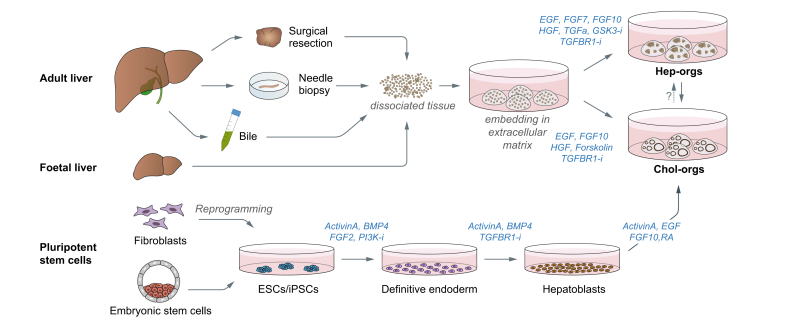
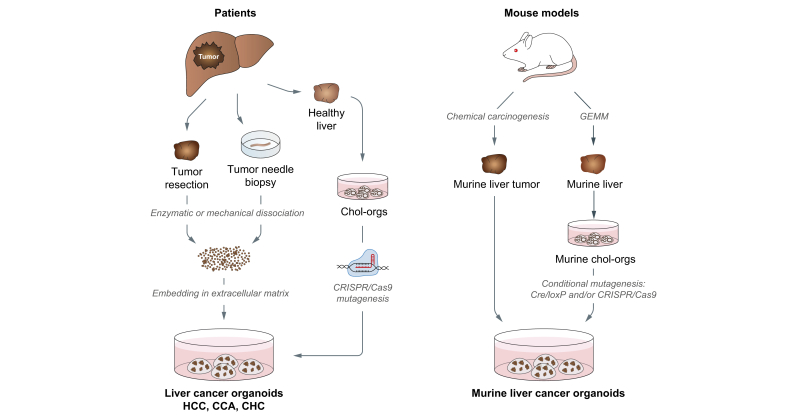
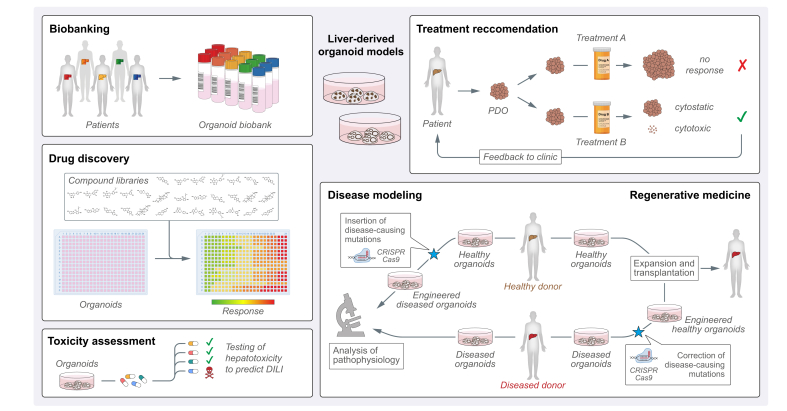
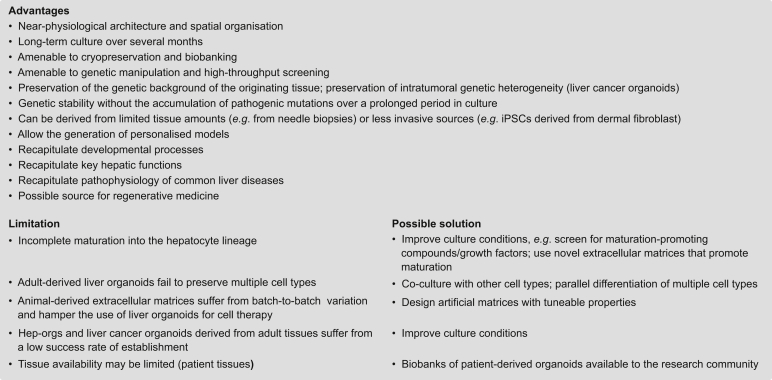
The organoid model represents a major breakthrough in cell biology that has revolutionised biomedical research. Organoids are 3D physiological in vitro structures that recapitulate morphological and functional features of in vivo tissues and offer significant advantages over traditional cell culture methods. Liver organoids are of particular interest because of the pleiotropy of functions exerted by the human liver, their utility to model different liver diseases, and their potential application as cell-based therapies in regenerative medicine. Moreover, because they can be derived from patient tissues, organoid models offer new perspectives in personalised medicine and drug discovery. In this review, we discuss the current liver organoid models for the study of liver disease.
Overview
The claims and statistics of this paper haven’t been checked yet.
Run the check — free, no account needed. It reads the open-access text and checks the sources it cites.
Integrity signals
Registry
Cites
Statistics
Figures
Verification
Claims the paper makes
The claims and statistics of this paper haven’t been checked yet.
Run the check — free, no account needed. It reads the open-access text and checks the sources it cites.
Claims other papers make about this one
Each is checked against this paper’s own text: does it say what the citing paper says it does?
The source backs part of the claim, not all of it — or backs it for a different population, condition or comparison.
In the citing paper
“Among the most impactful advances has been the rise of 3D liver organoid systems, which better preserve cell identity and enable longer-term propagation compared with traditional 2D models while also supporting patient-specific disease modeling and drug testing approaches [40,41].”
From The Hepatocyte Expansion Paradox: A Review of In Vitro Challenges and Advances (2026) · cites this paper as [40]
Experimental — accuracy not yet measuredThe cited source says what the claim attributes to it.
In the citing paper
“PSC-derived hepatocyte-like cells illustrate this well; they generally show lower functional recapitulation than PHs, and most fail to self-renew post-differentiation, requiring repeated rounds of de novo differentiation that constrain their direct substitutability with adult hepatocyte systems [40].”
From The Hepatocyte Expansion Paradox: A Review of In Vitro Challenges and Advances (2026) · cites this paper as [40]
Self-check
Percentages, sums and reported differences re-computed from the paper’s own numbers.
The self-check needs the paper’s full text.
Citations
Cites
Single Lgr5 stem cells build crypt-villus structures in vitro without a mesenchymal niche
Sato, T., Vries, R. G., Snippert, H. J., van de Wetering, M., Barker, N., Stange, D. E., van Es, J. H., Abo, A., Kujala, P., Peters, P. J., et al. (2009) · Nature · doi:10.1038/nature07935 · Cited by 7,204
Fitzmaurice, C., Allen, C., Barber, R. M., Barregård, L., Bhutta, Z. A., Brenner, H., Dicker, D., Chimed‐Ochir, O., Dandona, R., Dandona, L., et al. (2016) · JAMA Oncology · doi:10.1001/jamaoncol.2016.5688 · Cited by 6,318
Identification of stem cells in small intestine and colon by marker gene Lgr5
Barker, N., van Es, J. H., Kuipers, J., Kujala, P., van den Born, M., Cozijnsen, M., Haegebarth, A., Korving, J., Begthel, H., Peters, P. J., et al. (2007) · Nature · doi:10.1038/nature06196 · Cited by 5,687
Villanueva, A. (2019) · New England Journal of Medicine · doi:10.1056/nejmra1713263 · Cited by 4,508
Mechanisms of NAFLD development and therapeutic strategies
Friedman, S. L., Neuschwander-Tetri, B. A., Rinella, M., & Sanyal, A. J. (2018) · Nature Medicine · doi:10.1038/s41591-018-0104-9 · Cited by 4,354
Organoid Models and Applications in Biomedical Research
Xinaris, C., Brizi, V., & Remuzzi, G. (2015) · The Nephron journals/Nephron journals · doi:10.1159/000433566 · Cited by 3,519
Organogenesis in a dish: Modeling development and disease using organoid technologies
Lancaster, M. A., & Knoblich, J. A. (2014) · Science · doi:10.1126/science.1247125 · Cited by 2,931
Primary carcinoma of the liver.A study of 100 cases among 48,900 necropsies
Edmondson, H. A., & Steiner, P. E. (1954) · Cancer · doi:10.1002/1097-0142(195405)7:3 · Cited by 2,789
Distinct populations of inflammatory fibroblasts and myofibroblasts in pancreatic cancer
Öhlund, D., Handly-Santana, A., Biffi, G., Elyada, E., Almeida, A. S., Ponz-Sarvise, M., Corbo, V., Oni, T. E., Hearn, S. A., Lee, E. J., et al. (2017) · Journal of Experimental Medicine · doi:10.1084/jem.20162024 · Cited by 2,590
Vascularized and functional human liver from an iPSC-derived organ bud transplant
Takebe, T., Sekine, K., Enomura, M., Koike, H., Kimura, M., Ogaeri, T., Zhang, R.-R., Ueno, Y., Zheng, Y.-W., Koike, N., et al. (2013) · Nature · doi:10.1038/nature12271 · Cited by 2,170
Cited by
Sorted by citations
Exploring the promising potential of induced pluripotent stem cells in cancer research and therapy
Chehelgerdi, M., Dehkordi, F. B., Chehelgerdi, M., Kabiri, H., Salehian-Dehkordi, H., Abdolvand, M. A., Salmanizadeh, S., Rashidi, M., Niazmand, A., Ahmadi, S., et al. (2023) · Molecular Cancer · doi:10.1186/s12943-023-01873-0 · Cited by 189
Cardoso, B. D., Castanheira, E. M. S., Lanceros-Méndez, S., & Cardoso, V. F. (2023) · Advanced Healthcare Materials · doi:10.1002/adhm.202202936 · Cited by 171
Liver Organoids: Recent Developments, Limitations and Potential
Harrison, S. P., Baumgarten, S., Verma, R., Lunov, O., Dejneka, A., & Sullivan, G. J. (2021) · Frontiers in Medicine · doi:10.3389/fmed.2021.574047 · Cited by 152
In Vitro Models for Non-Alcoholic Fatty Liver Disease: Emerging Platforms and Their Applications
Ramos, M. J., Bandiera, L., Menolascina, F., & Fallowfield, J. A. (2022) · iScience · doi:10.1016/j.isci.2021.103549 · Cited by 127
Immune microenvironment in hepatocellular carcinoma: from pathogenesis to immunotherapy
Seyhan, D., Allaire, M., Fu, Y., Conti, F., Wang, X. W., Gao, B., & Lafdil, F. (2025) · Cellular and Molecular Immunology · doi:10.1038/s41423-025-01308-4 · Cited by 138
Metadata
- Authors
- Nuciforo, S., & Heim, M. H.
- Affiliations
- University of Basel (CH)
- Corresponding author
- Heim, Markus H.
- Venue
- JHEP Reports
- Publisher
- Elsevier BV
- Published
- 2021-02
- Volume
- 3
- Issue
- 1
- Pages
- 100198
- ISSN
- 2589-5559 (ISSN-L)
- PMC
- PMC7672322
- OpenAlex
- W3094299399
- Cited by
- 164
- References
- 106
- Citations by year
- 2026: 16 · 2025: 30 · 2024: 40 · 2023: 31 · 2022: 27 · 2021: 19
- FWCI
- 2.57
- Type
- journal article
- Language
- en
- Open access
- gold
- doi.org
- Licence
- Locations
- JHEP Reports (publishedVersion, cc-by)
- PubMed Central (publishedVersion, cc-by)
- PubMed (publishedVersion)
- DOAJ (DOAJ: Directory of Open Access Journals) (submittedVersion, cc-by-sa)
- Funders
- SystemsX.ch
- Schweizerischer Nationalfonds zur Förderung der Wissenschaftlichen Forschung
- European Research Council
- Topics
- Health Sciences › Medicine › Hepatology › Liver physiology and pathology
- Health Sciences › Medicine › Surgery › Tissue Engineering and Regenerative Medicine
- Physical Sciences › Engineering › Biomedical Engineering › 3D Printing in Biomedical Research
- Keywords
- liver organoids, liver disease modeling, organoid culture, regenerative medicine, cell therapy, personalized medicine, drug discovery, patient-derived tissue
About these checks
Registry, retraction, Cites and statistics results are computed, not judged, with one exception: a printed reference that no index lists is read once by a model before it counts as a citation error. Claims are extracted by a model and kept only when their quote appears verbatim in the text; each cited source is then checked, with a model’s help, for whether it says what the claim relies on. Those verdicts can be wrong — read the claim’s quote and the cited source before relying on one.
Statistics and arithmetic are recomputed, not judged.
Confidence bands are shown only for fields calibrated on our annotated test set. None is calibrated yet, so no band is shown.
What counts as a claim ›How we measure confidence ›How we check this ›
Are you an author, or do you see a problem with this page? Request a review
