

The Utilization of Recycled Aggregate in High Performance Concrete: A Review
Open accessThe DOI matches its Crossref record; 108 of the 108 references it cites were found in a registry or an index; none of the 112 sources its claims cite is checked for support yet.
Abstract
This paper reviews the use of Recycled Aggregate (RA) that is collected from construction demolition waste in the production of concrete. The paper primarily focuses on the possibility of using RA in High Performance Concrete (HPC). By analytically reviewing previous work, this study reports the mechanical and physical properties of HPC prepared using RA. The study summarizes the results of workability, water absorption, dry density, compressive strength, tensile strength, and flexural strength of HPC prepared with RA as reported in previous works. The paper also addresses the microstructure and durability performance of this concrete. Using RA in concrete production is an environmentally friendly solution to the continuous depletion of natural aggregates. RA could improve the cement matrix mechanical properties. Due to the porosity of RA, they have lower unit weigh than natural aggregates. For the same reason, RA can significantly decrease the workability of concrete. It is reported that using RA increases compressive strength of HPC. Both splitting and flexural strengths are increased with RA, however, they are decreased when the ratios of replacement are increased. The use of RA in the production of HPC seems to be promising. This paper presents some recommendations to further study this topic.
Overview
CoChat Summary
TL;DR
This review analyzes previous studies on using recycled aggregate (RA) from construction and demolition waste in high-performance concrete (HPC), focusing on workability, physical properties, mechanical performance, durability, and microstructure. It concludes that RA use in HPC is promising but reduces workability and chloride/sulfate resistance, while generally increasing compressive strength and improving the interfacial transition zone.
Key findings
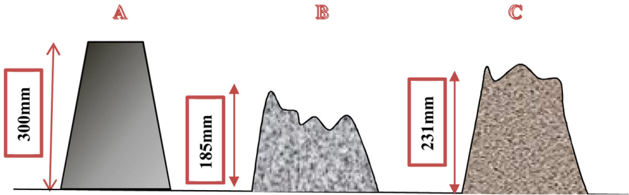
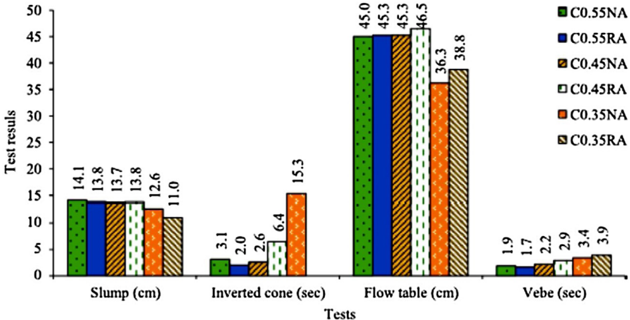
- RA is more porous and lighter than natural aggregate: complete replacement can reduce slump by approximately 40%, while the maximum slump without RA was 185 mm. RA water absorption was 7.65% versus 1.42% for crushed gravel; oven-dry density was 2158 kg/m³ versus 2470 kg/m³ (12.6% lower), and saturated surface-dry density was 2323 kg/m³ versus 2505 kg/m³ (7.3% lower).
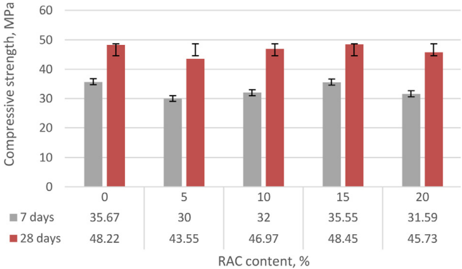
- Compressive strength generally increases with RA content and can meet HPC requirements, sometimes exceeding ∼100 MPa; with silica fume and fly ash, strength can reach 11% higher than natural-aggregate HPC at 28 days. However, compressive strength can drop by 5% when the replacement ratio reaches 20%.
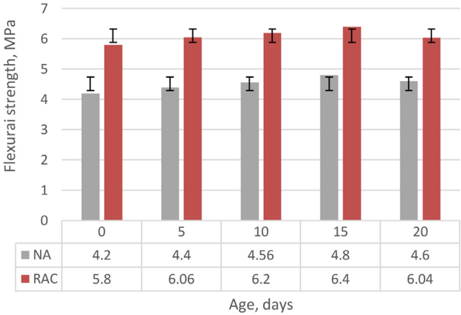
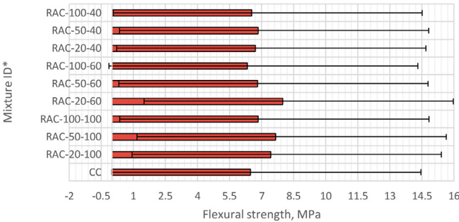
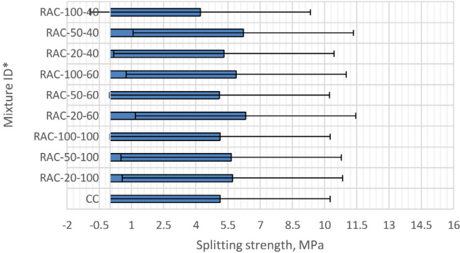
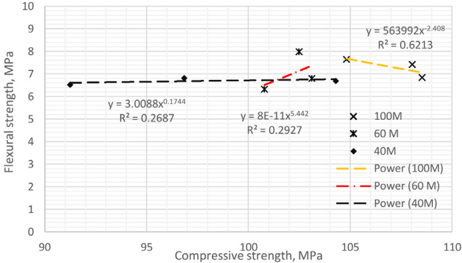
- Splitting tensile strength increased by approximately 11% and 9.9% with 20% and 50% RA replacements, respectively, while 100% RA achieved almost the same tensile strength as the control. Flexural strength was greater than or similar to conventional HPC; 50% RA with a 100 MPa target increased flexural strength by approximately 10–20%, and total replacement at a 40 MPa target gave similar values.
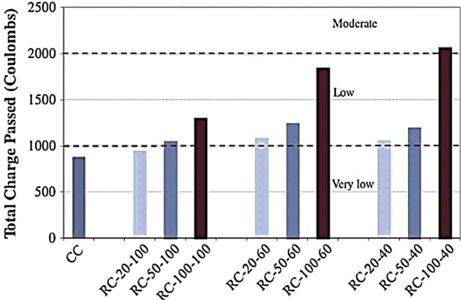
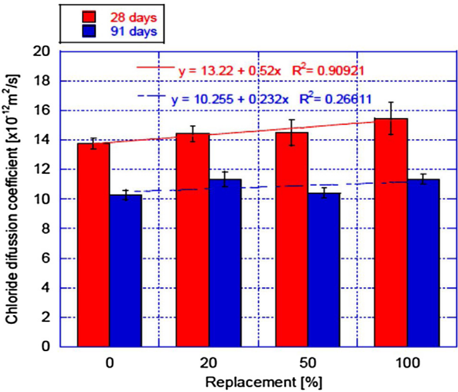
- Durability results are mixed: RA generally improves durability in HPC composites, likely due to silica fume filling micro-voids, and RA can act as an internal curing agent that improves the ITZ and decreases pore size. However, sulfate resistance is negatively affected, chloride-ion resistance decreases as RA content increases, and one shotcrete study found RAC reduced chloride penetration resistance by about 47%; carbonation resistance requires more supplementary cementitious materials.
Methods
- This is a review paper that analytically examines previous work on RA collected from construction demolition waste for HPC production.
- It synthesizes reported results on workability, water absorption, dry density, compressive strength, tensile strength, flexural strength, microstructure, and durability performance.
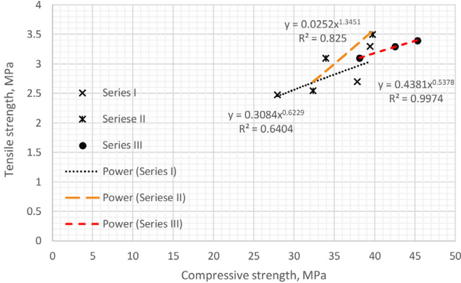
- The main analysis includes comparative summaries of prior studies (e.g., Table 2) and empirical equations formulated through nonlinear regression using test data from a comprehensive database to relate compressive, splitting, and direct tensile strengths.
Limitations
- The paper states future work should examine how RA particles of various shapes interface with bonding mortar, how water absorption during mixing is consumed and whether it increases w/c and lowers compressive strength, and abrasion resistance, which was not discussed in previous studies; it also recommends studying RA in geopolymer and precast concrete.
- The paper states that obtaining a high R² for HPRAC correlations was occasionally challenging because data were collected from various sources with different mixing and curing methods and dissimilar test setups.
- Evident from the text: as a review, it presents no new experimental data, so its conclusions depend on the heterogeneous prior studies summarized.
Model-written summary. Check it against the paper before relying on it.
Integrity signals
Registry
Cites
Statistics
Figures
Verification
Claims the paper makes
0 Valid · 2 Not valid · 56 Not checked · 16 Own results and interpretations
A result the paper states — it cites no source for it, so there is none to check. The quote shows it is in the paper.
In the paper
“In some cases, strength values exceed ∼100 MPa.”
§ The utilization of recycled aggregate in high performance concrete: a review > 4.1. Compressive performance assessment
plain- Asserted: passes — The authors put it forward as true.
- Checkable: passes — It can be checked against evidence.
- Load-bearing: unclear — It is unclear whether the paper’s conclusions depend on it.
- Based: passes — The paper gives a reason why it holds.
In the paper
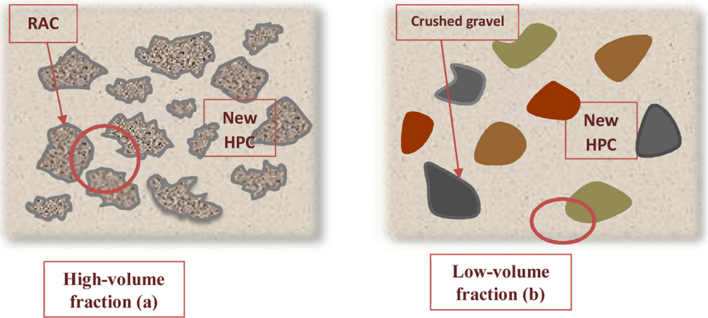
“A recently investigation recycled aggregate coarse (RAC) in shotcrete concrete by Lavado et al. [24] conducted that the using RAC led to loss the workability of concrete with the use of various w/c as shown in Fig. 2.”
§ The utilization of recycled aggregate in high performance concrete: a review > Assessment of the effect of RA on HPC workability
What the sources say
- Not matchedcites [24]
The reference list we hold has no entry [24].
plainstates a cause- Asserted: passes — The authors put it forward as true.
- Checkable: passes — It can be checked against evidence.
- Load-bearing: unclear — It is unclear whether the paper’s conclusions depend on it.
- Based: passes — The paper gives a reason why it holds.
- Not matched
None of the sources cited for this claim could be matched to a paper, so there is nothing to check it against.
In the paper
“Previous studies indicated that all HPC prepared with RA achieved flexural strength values that are greater than or similar to HPC prepared with natural aggregates [53,61,67].”
§ The utilization of recycled aggregate in high performance concrete: a review > 4.2. Flexural performance assessment
What the sources say
- Not matchedcites [53]
The reference list we hold has no entry [53].
- Not matchedcites [61]
The reference list we hold has no entry [61].
- Not matchedcites [67]
The reference list we hold has no entry [67].
hedged- Asserted: passes — The authors put it forward as true.
- Checkable: passes — It can be checked against evidence.
- Load-bearing: unclear — It is unclear whether the paper’s conclusions depend on it.
- Based: passes — The paper gives a reason why it holds.
- Not matched
In the paper
“Therefore, specimens containing high amounts of RA show low enhancement after 14 days [49,[56][57][58][59][60].”
§ The utilization of recycled aggregate in high performance concrete: a review > 4.1.1. Strength improvement at early time of hydration
What the sources say
- Not matchedcites [49,[56][57][58][59][60]
This doesn’t read as a citation we can look up.
plainstates a cause- Asserted: passes — The authors put it forward as true.
- Checkable: passes — It can be checked against evidence.
- Load-bearing: unclear — It is unclear whether the paper’s conclusions depend on it.
- Based: passes — The paper gives a reason why it holds.
- Not matched
In the paper
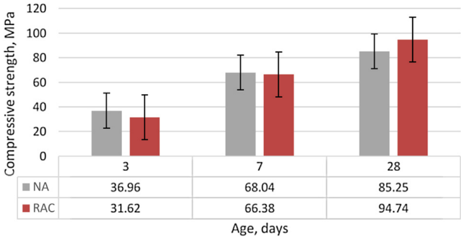
“However, the effect was less significant at 7 days, as shown Fig. 5.”
§ The utilization of recycled aggregate in high performance concrete: a review > 4.1.4. RA percentage in the mix
What the sources say
- Not matchedcites [54]
The reference list we hold has no entry [54].
plain- Asserted: passes — The authors put it forward as true.
- Checkable: passes — It can be checked against evidence.
- Load-bearing: unclear — It is unclear whether the paper’s conclusions depend on it.
- Based: passes — The paper gives a reason why it holds.
- Not matched
39 more claims
Create a free account to see all 74 claims and every source verdict.
- It may state two separate claims as one. 22
- The quote only partly states this claim. 1
- Probably not a substantial claim. 9
Self-check
Percentages, sums and reported differences re-computed from the paper’s own numbers.
Each contradiction between two passages listed here was confirmed by an independent check.
Rated minor: it would not touch a result — a value no result rests on, a p-value that stays on the same side of the significance level, or a conflict that is clerical, resolved elsewhere in the paper, or outside its own findings.
In the paper
§ The utilization of recycled aggregate in high performance concrete: a review > Conclusions and recommendations
“Irrespective of the period of concrete, an increase in the percentage of RA diminishes tensile and flexural strength.”
§ The utilization of recycled aggregate in high performance concrete: a review > Conclusions and recommendations
“| Zareei [115] | 20 40 | - | √ | - | - | 77.3 80.5 | 5.09 5.41 | 6.15 6.31 |”
Rated minor: it would not touch a result — a value no result rests on, a p-value that stays on the same side of the significance level, or a conflict that is clerical, resolved elsewhere in the paper, or outside its own findings.
In the paper
§ The utilization of recycled aggregate in high performance concrete: a review > 4.2. Flexural performance assessment
“According to ASTM C29 [65], flexural strength is approximately 10 to 20% of the compressive strength value.”
§ The utilization of recycled aggregate in high performance concrete: a review > References
“65. ASTM C. 78. Standard test method for flexural strength of concrete (using simple beam with third-point loading). American Society for Testing and Materials; 2010.”
Cited works that were retracted
Works this paper cites that were later retracted, from the retraction notices publishers deposit. Major when the notice came out before this paper was published.
A note, not an issue: for example, a cited work that was retracted only after this paper was published, which its authors could not have known.
Cited work 10.1680/jmacr.19.00146 · retracted 2022-08-09 · notice 10.1680/jmacr.2022.74.18.972 · this paper published 2020-07
Citations
Cites
1 retracted
Anvari, A., Ghalehnovi, M., de Brito, J., & Karimipour, A. (2019) · Magazine of Concrete Research · doi:10.1680/jmacr.19.00146 · Cited by 38
RetractedEtxeberria, M., Vázquez, E., Marí, A., & Barra, M. (2007) · Cement and Concrete Research · doi:10.1016/j.cemconres.2007.02.002 · Cited by 1,774
The greening of the concrete industry
Meyer, C. (2009) · Cement and Concrete Composites · doi:10.1016/j.cemconcomp.2008.12.010 · Cited by 1,548
Critical chloride content in reinforced concrete — A review
Angst, U., Elsener, B., Larsen, C. K., & Vennesland, Ø. (2009) · Cement and Concrete Research · doi:10.1016/j.cemconres.2009.08.006 · Cited by 1,420
Behera, M., Bhattacharyya, S. K., Minocha, A. K., Deoliya, R., & Maiti, S. (2014) · Construction and Building Materials · doi:10.1016/j.conbuildmat.2014.07.003 · Cited by 1,188
Mechanical properties of recycled aggregate concrete under uniaxial loading
Xiao, J., Li, J., & Zhang, C. (2005) · Cement and Concrete Research · doi:10.1016/j.cemconres.2004.09.020 · Cited by 1,175
An overview of study on recycled aggregate concrete in China (1996–2011)
Xiao, J., Li, W., Fan, Y., & Huang, X. (2012) · Construction and Building Materials · doi:10.1016/j.conbuildmat.2011.12.074 · Cited by 1,101
Poon, C. S., Shui, Z. H., & Lam, L. (2004) · Construction and Building Materials · doi:10.1016/j.conbuildmat.2004.03.005 · Cited by 1,053
Properties of concrete made with recycled aggregate from partially hydrated old concrete
Katz, A. (2003) · Cement and Concrete Research · doi:10.1016/s0008-8846(02)01033-5 · Cited by 865
Influence of recycled concrete aggregates on strength properties of concrete
Tabsh, S. W., & Abdelfatah, A. S. (2009) · Construction and Building Materials · doi:10.1016/j.conbuildmat.2008.06.007 · Cited by 830
Research works printed but not linked: 6
- Mehta PKM, Paulo JM. Concrete microstructure, properties, and materials; 2006.
- Xiao J. Recycled aggregate concrete. In: Recycled aggregate concrete structures. Springer; 2018. p. 65-98.
- Hansen TC. Recycling of demolished concrete and masonry, vol. 6. CRC Press; 2004.
- Aïtcin P-C. High performance concrete. CRC Press; 2011.
- Limbachiya MC, Koulouris A, Roberts JJ, Fried AN. Performance of recycled aggregate concrete. Proceeding of RILEM international symposium on environment-conscious materials and systems for sustainable development 2004.
- Shakor P, Nejadi S, Paul G, Sanjayan J, Nazari A. Mechanical properties of cement-based materials and effect of elevated temperature on three-dimensional (3-D) printed mortar specimens in inkjet 3-D printing. ACI Mater J 2019;116(2):55-67.
Cited by
Potential applications of geopolymer concrete in construction: A review
Almutairi, A. L., Tayeh, B. A., Adesina, A., Isleem, H. F., & Zeyad, A. M. (2021) · Case Studies in Construction Materials · doi:10.1016/j.cscm.2021.e00733 · Cited by 481
Self-citationShehata, N., Mohamed, O. A., Sayed, E. T., Abdelkareem, M. A., & Olabi, A. G. (2022) · Science of The Total Environment · doi:10.1016/j.scitotenv.2022.155577 · Cited by 371
Qaidi, S. M. A., Dinkha, Y. Z., Haido, J. H., Ali, M. H., & Tayeh, B. A. (2021) · Journal of Cleaner Production · doi:10.1016/j.jclepro.2021.129251 · Cited by 302
Self-citationRecent advances in artificial aggregate production
Ren, P., Ling, T.-C., & Mo, K. H. (2021) · Journal of Cleaner Production · doi:10.1016/j.jclepro.2020.125215 · Cited by 206
Wu, L., Sun, Z., & Cao, Y. P. (2024) · Construction and Building Materials · doi:10.1016/j.conbuildmat.2024.136567 · Cited by 190
Metadata
- Authors
- Tayeh, B. A., Saffar, D. M. A., & Alyousef, R.
- Affiliations
- Islamic University of Gaza (PS)
- Al Mansour University College (IQ)
- Prince Sattam Bin Abdulaziz University (SA)
- Corresponding author
- Tayeh, Bassam A.
- Venue
- Journal of Materials Research and Technology
- Publisher
- Elsevier BV
- Published
- 2020-07
- Volume
- 9
- Issue
- 4
- Pages
- 8469-8481
- ISSN
- 2238-7854 (ISSN-L)
- OpenAlex
- W3034242245
- Semantic Scholar
- fe3faca9360fd552cbd224f023512ef8035afc9c
- Cited by
- 168
- References
- 107
- Citations by year
- 2026: 23 · 2025: 28 · 2024: 34 · 2023: 27 · 2022: 22 · 2021: 30 · 2020: 4
- FWCI
- 10.27
- Type
- journal article
- Language
- en
- Open access
- gold
- doi.org
- Licence
- cc-by-nc-nd
- www.elsevier.com/tdm/userlicense/1.0/ (tdm)
- www.elsevier.com/legal/tdmrep-license (tdm)
- creativecommons.org/licenses/by-nc-nd/4.0/ (vor)
- Locations
- Journal of Materials Research and Technology (publishedVersion, cc-by-nc-nd)
- DOAJ (DOAJ: Directory of Open Access Journals) (submittedVersion)
- Topics
- Physical Sciences › Engineering › Building and Construction › Recycled Aggregate Concrete Performance
- Physical Sciences › Engineering › Building and Construction › Materials Engineering and Processing
- Physical Sciences › Engineering › Civil and Structural Engineering › Concrete and Cement Materials Research
- Keywords
- recycled aggregate, high-performance concrete, construction and demolition waste, aggregate replacement, compressive strength, flexural strength, tensile strength, workability, water absorption, dry density, concrete microstructure, concrete durability
About these checks
Registry, retraction, Cites and statistics results are computed, not judged, with one exception: a printed reference that no index lists is read once by a model before it counts as a citation error. Claims are extracted by a model and kept only when their quote appears verbatim in the text; each cited source is then checked, with a model’s help, for whether it says what the claim relies on. Those verdicts can be wrong — read the claim’s quote and the cited source before relying on one.
A language model drew the claims from the paper on 2026-11-27, under version 3 of the claim definition (model deepseek-v4.1-flash, prompt extract-v3).
A second model labelled each claim on 2026-11-27 (model jev-1.13-20260917, definition revision gold-guideline-v0.2).
Statistics and arithmetic are recomputed, not judged.
Confidence bands are shown only for fields calibrated on our annotated test set. None is calibrated yet, so no band is shown.
What counts as a claim ›How we measure confidence ›How we check this ›
Are you an author, or do you see a problem with this page? Request a review
How to cite
Cite CoChat for the checks on this page, and the paper for its own findings.
- This page
- CoChat. (2026). Citation check: The Utilization of Recycled Aggregate in High Performance Concrete: A Review. https://app.cochat.ai/papers/10.1016/j.jmrt.2020.05.126
- The paper
- Tayeh, B. A., Saffar, D. M. A., & Alyousef, R. (2020). The Utilization of Recycled Aggregate in High Performance Concrete: A Review. Journal of Materials Research and Technology. https://doi.org/10.1016/j.jmrt.2020.05.126
Data sources
Bibliographic data: Semantic Scholar, OpenAlex, Crossref.
Contains information from the Semantic Scholar Academic Graph Datasets, made available under the ODC Attribution License (ODC-BY 1.0).
Semantic Scholar’s data is described in: Kinney, R., et al. (2023). The Semantic Scholar Open Data Platform. arXiv:2301.10140.
