

The DOI matches its Crossref record; 33 of the 34 references it cites were found in a registry or an index; none of the 19 sources its claims cite is checked for support yet.
Maternal education level and low birth weight: a meta-analysis
Open accessAbstract
To assess the association between maternal education level and birth weight, considering the circumstances in which the excess use of technology in healthcare, as well as the scarcity of these resources, may result in similar outcomes. A meta-analysis of cohort and cross-sectional studies was performed; the studies were selected by systematic review in the MEDLINE database using the following Key**words socioeconomic factors, infant, low birth weight, cohort studies, cross-sectional studies. The summary measures of effect were obtained by random effect model, and its results were obtained through forest plot graphs. The publication bias was assessed by Egger's test, and the Newcastle-Ottawa scale was used to assess study quality. The initial search found 729 articles. Of these, 594 were excluded after reading the title and abstract; 21, after consensus meetings among the three reviewers; 102, after reading the full text; and three for not having the proper outcome. Of the nine final articles, 88.8% had quality ≥ six stars (Newcastle-Ottawa Scale), showing good quality studies. The heterogeneity of the articles was considered moderate. High maternal education showed a 33% protective effect against low birth weight, whereas medium degree of education showed no significant protection when compared to low maternal education. The hypothesis of similarity between the extreme degrees of social distribution, translated by maternal education level in relation to the proportion of low birth weight, was not confirmed. Analisar a associação entre grau de escolaridade materna e peso de nascimento, considerando-se a hipótese de que a utilização em excesso das tecnologias na área da saúde, assim como a escassez de recursos, pode produzir desfechos similares. Realizou-se uma meta-análise com estudos transversais e de coorte, selecionados por revisão sistemática na base de dados bibliográficos MEDLINE com os descritores: socioeconomic factors; infant, low birth weight; cohort studies; cross-sectional studies. As medidas de sumário de efeito foram obtidas pelo modelo de efeito aleatório, e os seus resultados apresentados por intermédio dos gráficos Forest Plot. O viés de publicação foi analisado pelo Teste de Egger, e a avaliação da qualidade dos estudos utilizou a Escala de Newcastle-Ottawa. A busca inicial encontrou 729 artigos. Destes, foram excluídos 594, após a leitura do título e do resumo; 21, após reuniões de consenso entre os três revisores; 102, após leitura do texto completo; e três, por não possuírem o desfecho adequado. Dos nove artigos finais, 88,8% apresentavam uma qualidade igual ou superior a seis estrelas (Escala de Newcastle-Ottawa), configurando boa qualidade aos estudos. A heterogeneidade dos artigos foi considerada moderada. A escolaridade materna elevada mostrou um efeito protetor de 33% sobre o baixo peso ao nascer, enquanto que o grau médio não apresentou proteção significativa, quando comparados à escolaridade materna baixa. A hipótese de similaridade entre os graus extremos da distribuição social, traduzidas pelo nível de escolaridade materna, em relação à proporção de baixo peso ao nascer, não foi confirmada.
Overview
CoChat Summary
TL;DR
This meta-analysis tested whether low birth weight (LBW) is similarly elevated at both extremes of maternal education (“similarity in inequality”). It found that high maternal education was protective against LBW, while medium education showed no significant protection compared with low education, so the similarity hypothesis was not confirmed.
Key findings
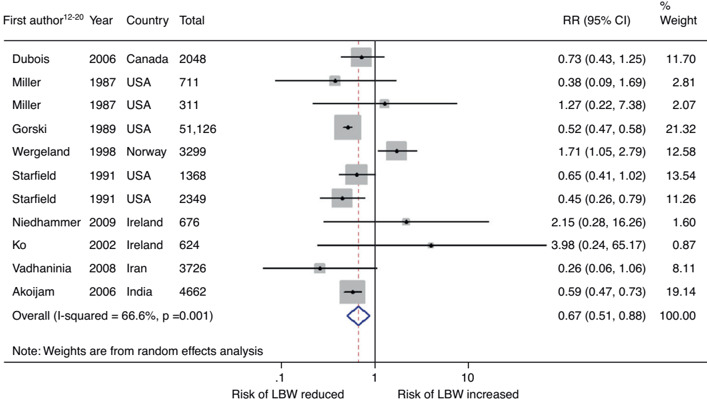
- High maternal education vs low education was associated with a 33% lower risk of LBW: summary RR 0.67 (95% CI 0.51–0.88), with moderate heterogeneity (I² = 66.6%) and no evidence of publication bias by Egger’s test (p = 0.148).
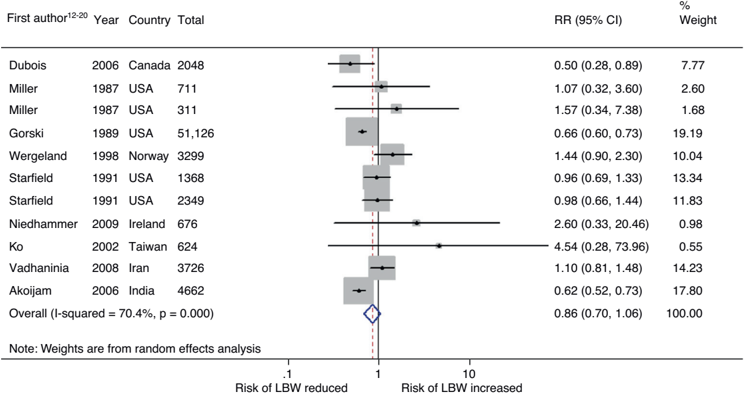
- Medium maternal education vs low education showed no significant protective effect: summary RR 0.86 (95% CI 0.70–1.06), with moderate heterogeneity (I² = 70.4%) and evidence of publication bias (Egger’s p = 0.027); after trim-and-fill estimated five missing studies, the corrected summary effect was 0.71 (95% CI 0.56–0.88).
- Nine articles were included, covering 70,900 mother-child pairs; 88.8% had Newcastle-Ottawa quality ≥6 stars. LBW proportions did not show a similar distribution across education levels or a higher prevalence at both extremes.
- The authors’ “similarity in inequality” hypothesis was not confirmed.
Methods
- Systematic review of MEDLINE until November 2011 using MeSH terms for socioeconomic factors, infant low birth weight, and cohort or cross-sectional studies; inclusion required LBW (<2,500 g) as outcome and maternal schooling divided into low, medium, and high strata. Two independent reviewers selected articles, with a third resolving disagreements.
- Nine cross-sectional or cohort studies were meta-analyzed. Data were analyzed in absolute numbers using low maternal education as the reference, comparing high and medium education separately with low education.
- Summary effects used a random-effects model; heterogeneity was assessed with I²; publication bias was assessed by funnel plot and Egger’s test, with trim-and-fill used to adjust for possible bias. Study quality was assessed with the Newcastle-Ottawa scale.
Limitations
- The paper states that many included articles had additional social variables and little information on individual maternal characteristics, and that maternal education was often classified in more than three strata or without clear high/medium/low definitions, which could influence findings.
- The paper also states that many studies had small or medium samples, that larger studies could influence final results, and that the included articles span almost three decades.
- Evident from the text: only nine observational studies were included, heterogeneity was moderate in both meta-analyses, and the medium-education analysis showed publication bias requiring trim-and-fill correction.
Model-written summary. Check it against the paper before relying on it.
Integrity signals
Registry
Cites
Statistics
Figures
Verification
Claims the paper makes
0 Valid · 0 Not valid · 17 Not checked · 12 Own results and interpretations
A result the paper reports from its own data — it cites no other source for it, so there is none to check. The quote shows it is in the paper.
In the paper
“The heterogeneity (I 2 ) of 66.6% is considered moderate.”
§ Maternal education level and low birth weight: a meta-analysis ଝ > Meta-analysis of high maternal education effect on LBW
plain- Asserted: passes — The authors put it forward as true.
- Checkable: passes — It can be checked against evidence.
- Load-bearing: unclear — It is unclear whether the paper’s conclusions depend on it.
- Based: passes — The paper gives a reason why it holds.
A result the paper reports from its own data — it cites no other source for it, so there is none to check. The quote shows it is in the paper.
In the paper
“To recalculate the size of the effect in each insert until the funnel plot becomes symmetrical, the trim-and-fill method was used, which estimated a loss of five studies.Subsequent to this correction, the summary of effect was 0.71 (95% CI: 0.56-0.88).”
§ Maternal education level and low birth weight: a meta-analysis ଝ > Meta-analysis of the effect of medium maternal education on LBW
plainstates an association- Asserted: passes — The authors put it forward as true.
- Checkable: passes — It can be checked against evidence.
- Load-bearing: passes — The paper’s conclusions depend on it.
- Based: passes — The paper gives a reason why it holds.
A result the paper reports from its own data — it cites no other source for it, so there is none to check. The quote shows it is in the paper.
In the paper
“Egger's test, unlike the previous analysis, showed the presence of bias (p = 0.027).”
§ Maternal education level and low birth weight: a meta-analysis ଝ > Meta-analysis of the effect of medium maternal education on LBW
plain- Asserted: passes — The authors put it forward as true.
- Checkable: passes — It can be checked against evidence.
- Load-bearing: passes — The paper’s conclusions depend on it.
- Based: passes — The paper gives a reason why it holds.
A result the paper reports from its own data — it cites no other source for it, so there is none to check. The quote shows it is in the paper.
In the paper
“High maternal education showed a 33% protective effect against low birth weight, whereas medium degree of education showed no significant protection when compared to low maternal education.”
- Also stated in: § Meta-analysis of the effect of medium maternal education on LBW · boosted
“Fig. 3 shows the results of the summary effect of the metaanalysis, which was 0.86 (95% CI: 0.70-1.06),demonstrating no significant protective effect for LBW in the group with medium maternal education, when compared to low.”
- Also stated in: § Discussion · plain
“In contrast, when assessing the risk of LBW in mothers with medium level of schooling, when compared those with low education level, there were no significant results.”
§ Maternal education level and low birth weight: a meta-analysis ଝ > Abstract
boosted- Asserted: passes — The authors put it forward as true.
- Checkable: passes — It can be checked against evidence.
- Load-bearing: passes — The paper’s conclusions depend on it.
- Based: passes — The paper gives a reason why it holds.
- Also stated in: § Meta-analysis of the effect of medium maternal education on LBW · boosted
A result the paper reports from its own data — it cites no other source for it, so there is none to check. The quote shows it is in the paper.
In the paper
“The heterogeneity (I 2 ) of 70.4% was considered moderate”
§ Maternal education level and low birth weight: a meta-analysis ଝ > Meta-analysis of the effect of medium maternal education on LBW
plain- Asserted: passes — The authors put it forward as true.
- Checkable: passes — It can be checked against evidence.
- Load-bearing: unclear — It is unclear whether the paper’s conclusions depend on it.
- Based: passes — The paper gives a reason why it holds.
7 more claims
Create a free account to see all 29 claims and every source verdict.
- It may state two separate claims as one. 14
- Probably not a substantial claim. 8
Self-check
Percentages, sums and reported differences re-computed from the paper’s own numbers.
Each contradiction between two passages listed here was confirmed by an independent check.
Rated minor: it would not touch a result — a value no result rests on, a p-value that stays on the same side of the significance level, or a conflict that is clerical, resolved elsewhere in the paper, or outside its own findings.
In the paper
“Of this total, 97 articles were excluded due to the following reasons: lack of the variables proposed in the study (23); designs that were different from those established for the study (7); result presentation using a format that did not follow the three proposed social stratifications -high, medium, and low (35); and those with insufficient or inadequate information (40).”
§ Maternal education level and low birth weight: a meta-analysis ଝ > Results
Reported 97 · recomputed 105
Rated minor: it would not touch a result — a value no result rests on, a p-value that stays on the same side of the significance level, or a conflict that is clerical, resolved elsewhere in the paper, or outside its own findings.
In the paper
§ Maternal education level and low birth weight: a meta-analysis ଝ > Meta-analysis of high maternal education effect on LBW
“Ko 2002 624 Ireland”
§ Maternal education level and low birth weight: a meta-analysis ଝ > Discussion
“| Ko et al. 15 | Cohort | Taiwan | 6 stars | 624 | 0.0 | 5.8 | 5.0 |”
Rated minor: it would not touch a result — a value no result rests on, a p-value that stays on the same side of the significance level, or a conflict that is clerical, resolved elsewhere in the paper, or outside its own findings.
In the paper
§ Maternal education level and low birth weight: a meta-analysis ଝ > Results
“Lower rates of LBW were observed in the groups with low education level in three studies, which were conducted in developed countries (United States, Ireland, and Norway)”
§ Maternal education level and low birth weight: a meta-analysis ଝ > Discussion
“| Ko et al. 15 | Cohort | Taiwan | 6 stars | 624 | 0.0 | 5.8 | 5.0 |”
Citations
Cites
Quantifying heterogeneity in a meta‐analysis
Higgins, J. P. T., & Thompson, S. G. (2002) · Statistics in Medicine · doi:10.1002/sim.1186 · Cited by 36,763
(2014) · Medical Entomology and Zoology · Cited by 17,633
Grote, N. K., Bridge, J. A., Gavin, A. R., Melville, J. L., Iyengar, S., & Katon, W. J. (2010) · Archives of General Psychiatry · doi:10.1001/archgenpsychiatry.2010.111 · Cited by 1,882 · cited 1×
“It checks the asymmetry of the funnel plot, inputs a supposed number of lost studies, and recalculates the summary of effect on results, which can be used to analyze the extent of publication bias that may affect the estimate.(11)”
MethodMetan: fixed- and random-effects meta-analysis
Harris, R. J., Deeks, J. J., Altman, D. G., Bradburn, M. J., Harbord, R. M., & Sterne, J. A. C. (2008) · The Stata Journal: Promoting communications on statistics and Stata · doi:10.1177/1536867x0800800102 · Cited by 1,027
Braveman, P., Cubbin, C., Marchi, K., Egerter, S., & Chavez, G. (2001) · Public Health Reports · doi:10.1093/phr/116.5.449 · Cited by 230
Primary care, infant mortality, and low birth weight in the states of the USA
Shi, L., Macinko, J. A., Starfield, B. H., Xu, J., Regan, J., Politzer, R. M., & Wulu, J. T. (2004) · Journal of Epidemiology & Community Health · doi:10.1136/jech.2003.013078 · Cited by 203
Epidemiologia clínica: Elementos essenciais
Fletcher, R. H., Fletcher, S. W., & Wagner, E. H. (1996) · Cited by 196
Race, Family Income, and Low Birth Weight
Starfield, B. H., Shapiro, S., Weiß, J., Liang, K., Ra, K., Paige, D. M., & Wang, X. (1991) · American Journal of Epidemiology · doi:10.1093/oxfordjournals.aje.a116020 · Cited by 147
Howard, D. L., Marshall, S., Kaufman, J. S., & Savitz, D. A. (2006) · PEDIATRICS · doi:10.1542/peds.2006-0665 · Cited by 111
Escolaridade materna: correlação com os indicadores obstétricos
Haidar, F. H., Oliveira, U. F., & Nascimento, L. F. C. (2001) · Cadernos de Saúde Pública · doi:10.1590/s0102-311x2001000400037 · Cited by 101
Research works printed but not linked: 1
- Goldani, 2012, The impact of demographic and epidemiological transition in the health of children and adolescents in Brazil, Rev HCPA & Fac Med Univ Fed Rio Gd do Sul, 32, 49
Cited by
A Review of the Relationship Between Socioeconomic Position and the Early-Life Predictors of Obesity
Cameron, A. J., Spence, A. C., Laws, R., Hesketh, K. D., Lioret, S., & Campbell, K. J. (2015) · Current Obesity Reports · doi:10.1007/s13679-015-0168-5 · Cited by 144
Vilanova, C. S., Hirakata, V. N., Buriol, V. C. D. S., Nunes, M., Goldani, M. Z., & da Silva, C. H. (2019) · Population Health Metrics · doi:10.1186/s12963-019-0195-7 · Cited by 126
Self-citationNeve, J. D., & Kawachi, I. I. (2017) · Social Science & Medicine · doi:10.1016/j.socscimed.2017.04.010 · Cited by 82
Ngandu, C. B., Momberg, D. J., Magan, A., Chola, L., Norris, S. A., & Mohamed, R. S. (2019) · Journal of Developmental Origins of Health and Disease · doi:10.1017/s2040174419000680 · Cited by 70
Daly, M. P., Kipping, R., Tinner, L., Sanders, J., & White, J. (2021) · Paediatric and Perinatal Epidemiology · doi:10.1111/ppe.12855 · Cited by 64
Metadata
- Authors
- Silvestrin, S., da Silva, C. H., Hirakata, V. N., Goldani, A. A. S., Silveira, P. P., & Goldani, M. Z.
- Affiliations
- Universidade Federal do Rio Grande do Sul (BR)
- Hospital de Clínicas de Porto Alegre (BR)
- Corresponding author
- Silvestrin, Sonia
- ORCID
- Venue
- Jornal de Pediatria
- Publisher
- Elsevier BV
- Published
- 2013-07
- Volume
- 89
- Issue
- 4
- Pages
- 339-345
- ISSN
- 0021-7557 (ISSN-L)
- OpenAlex
- W1605258932
- Semantic Scholar
- 7d046d6a6e41bb1cadbcadca64cbc309da50326e
- Cited by
- 155
- References
- 34
- Citations by year
- 2026: 11 · 2025: 12 · 2024: 10 · 2023: 14 · 2022: 16 · 2021: 24 · 2020: 17 · 2019: 12 · 2018: 11 · 2017: 13 · 2016: 6 · 2015: 6 · 2014: 3
- FWCI
- 0.69
- Type
- journal article
- Language
- en
- Open access
- gold
- doi.org
- Licence
- Locations
- Jornal de Pediatria (publishedVersion, cc-by-nc-nd)
- PubMed (publishedVersion)
- Americanae (AECID Library) (publishedVersion, other-oa)
- LA Referencia (Red Federada de Repositorios Institucionales de Publicaciones Científicas) (publishedVersion, other-oa)
- Lume (Universidade Federal do Rio Grande do Sul) (submittedVersion, cc-by-nc-sa)
- Americanae (AECID Library) (submittedVersion, cc-by-nc-nd)
- DOAJ (DOAJ: Directory of Open Access Journals) (submittedVersion, cc-by-sa)
- DOAJ (DOAJ: Directory of Open Access Journals) (submittedVersion)
- Redalyc (Universidad Autónoma del Estado de México) (submittedVersion)
- Topics
- Health Sciences › Medicine › Pediatrics, Perinatology and Child Health › Maternal and Neonatal Healthcare
- Health Sciences › Medicine › Pediatrics, Perinatology and Child Health › Birth, Development, and Health
- Health Sciences › Medicine › Obstetrics and Gynecology › Maternal and Perinatal Health Interventions
- Keywords
- maternal education, low birth weight, socioeconomic factors, maternal education level, birth weight
- MeSH terms
- Cross-Sectional Studies, Educational Status, Female, Humans, Infant, Low Birth Weight, Infant, Newborn, Mothers, Social Class, Models, Statistical, Cohort Studies, Publication Bias, Biomedical Research
About these checks
Registry, retraction, Cites and statistics results are computed, not judged, with one exception: a printed reference that no index lists is read once by a model before it counts as a citation error. Claims are extracted by a model and kept only when their quote appears verbatim in the text; each cited source is then checked, with a model’s help, for whether it says what the claim relies on. Those verdicts can be wrong — read the claim’s quote and the cited source before relying on one.
A language model drew the claims from the paper on 2026-11-13, under version 3 of the claim definition (model deepseek-v4.1-flash, prompt extract-v3).
A second model labelled each claim on 2026-11-13 (model jev-1.13-20260917, definition revision gold-guideline-v0.2).
Statistics and arithmetic are recomputed, not judged.
Confidence bands are shown only for fields calibrated on our annotated test set. None is calibrated yet, so no band is shown.
What counts as a claim ›How we measure confidence ›How we check this ›
Are you an author, or do you see a problem with this page? Request a review
How to cite
Cite CoChat for the checks on this page, and the paper for its own findings.
- This page
- CoChat. (2026). Citation check: Maternal education level and low birth weight: a meta-analysis. https://app.cochat.ai/papers/10.1016/j.jped.2013.01.003
- The paper
- Silvestrin, S., da Silva, C. H., Hirakata, V. N., Goldani, A. A. S., Silveira, P. P., & Goldani, M. Z. (2013). Maternal education level and low birth weight: a meta-analysis. Jornal de Pediatria. https://doi.org/10.1016/j.jped.2013.01.003
Data sources
Bibliographic data: Semantic Scholar, OpenAlex, Crossref.
Contains information from the Semantic Scholar Academic Graph Datasets, made available under the ODC Attribution License (ODC-BY 1.0).
Semantic Scholar’s data is described in: Kinney, R., et al. (2023). The Semantic Scholar Open Data Platform. arXiv:2301.10140.
