

The DOI matches its Crossref record.
Screening for Motor Dysgraphia in Public Schools
Open accessAbstract
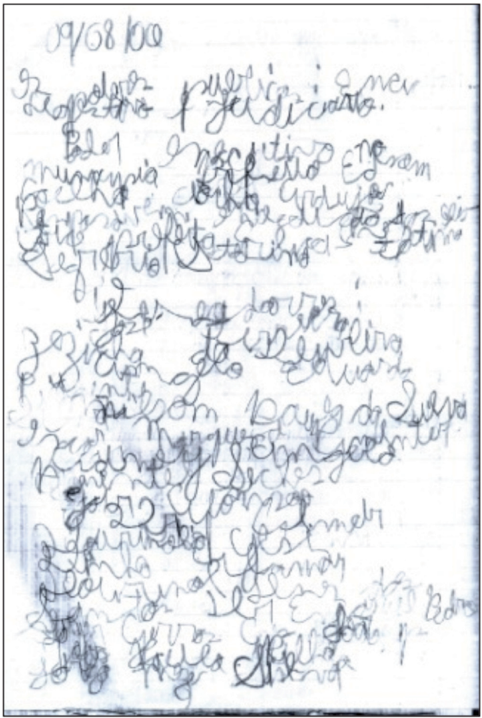
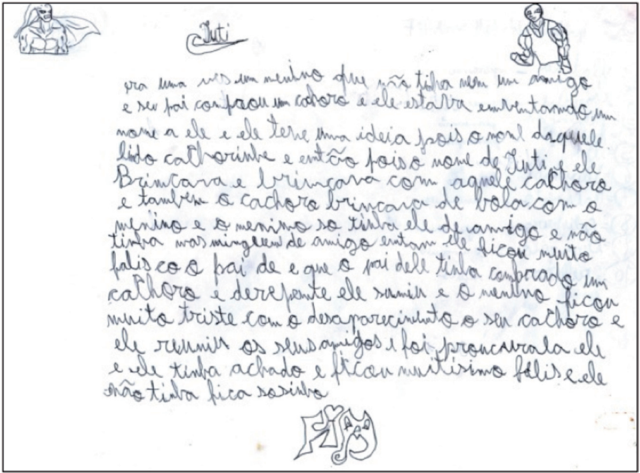
To screen for warning signs of dysgraphia in schoolchildren at the sixth grade of elementary school. This was a descriptive, exploratory, cross-sectional cohort study performed with 630 schoolchildren assessed through the (adapted) Analytical Dysgraphia Inventory, which recognizes difficulties in writing through the tracing the graphics. A total of 22% (n = 138) of the sample presented all indications of dysgraphia; the most prevalent indicator was ascending/descending/fluctuating lines (53.6%). When the indicators were correlated to gender, males showed a significant difference (p < 0.05) in most of them. Among the warning signs of co-occurrences, dyslexia was the most prevalent indicator (22%). Given the large number of warning signs of dysgraphia observed in schoolchildren, it is advisable to screen for these signs, in order to implement early interventions. Rastrear sinais de alerta para a disgrafia em escolares do 6° ano do ensino fundamental. Trata-se de um estudo descritivo, exploratório, de coorte transversal realizado com 630 escolares avaliados através do Inventário Disgráfico Analítico (adaptado), que reconhece as dificuldades da escrita através do traçado dos grafismos. Em 22% (n = 138) da amostra apareceram todos os indicativos de disgrafia, sendo que o indicador mais prevalente foi o de linha ascendente/descendente/flutuante (53,6%). Se correlacionados os indicadores ao gênero,os meninos apresentaram diferença significativa (p < 0,05) na maioria deles. Dentre os sinais de alerta de co-ocorrências, a dislexia foi a que obteve maior indicador (22%). Considerando o grande número de sinais de alerta para disgrafia encontrados nos escolares, torna-se pertinente o rastreio para que uma intervenção precoce seja realizada.
Overview
The claims and statistics of this paper haven’t been checked yet.
Run the check — free, no account needed. It reads the open-access text and checks the sources it cites.
Integrity signals
Registry
Cites
Statistics
Figures


Verification
Claims the paper makes
The claims and statistics of this paper haven’t been checked yet.
Run the check — free, no account needed. It reads the open-access text and checks the sources it cites.
Claims other papers make about this one
Each is checked against this paper’s own text: does it say what the citing paper says it does?
In the citing paper
“Research demonstrates that 90–98% of children with these disorders struggle with writing (29-32).”
From Disorder of written expression and dysgraphia: definition, diagnosis, and management (2020) · cites this paper as [31]
Self-check
Percentages, sums and reported differences re-computed from the paper’s own numbers.
The self-check needs the paper’s full text.
Citations
Cites
No references could be resolved yet.
Research works printed but not linked: 16
- Torres RM, Fernandez PF. Dislexia, disortografia e disgrafia. Lisboa: McGraw-Hill; 2001. p. 188.
- Overvelde, 2011, Handwriting development in grade 2 and grade 3 primary school children with normal, at risk, or dysgraphic characteristics, Res Dev Disabil., 32, 540, 10.1016/j.ridd.2010.12.027 · DOI
- Jarzebska, 2007, The influence of emotions related to the disease on writing disorders in brain damaged patients, Pol Merkur Lekarski., 22, 283
- Adi-Japha, 2007, ADHD and dysgraphia: underlying mechanisms, Cortex., 43, 700, 10.1016/S0010-9452(08)70499-4 · DOI
- Feder, 2007, Handwriting development, competency, and intervention, Dev Med Child Neurol., 49, 312, 10.1111/j.1469-8749.2007.00312.x · DOI · Paper page
- Hipolito, 2008, Multidisciplinary view of the inconvenience of learning, Psicol Esc Educ., 12, 463
- Karande, 2011, Managing specific learning disability in schools in India, Indian Pediatr., 48, 515, 10.1007/s13312-011-0090-1 · DOI
- Rodrigues, 2009, Correlation between indication of disgraphy and scholarship performance, Rev CEFAC., 11, 221, 10.1590/S1516-18462008005000005 · DOI
- Berninger, 2008, Gender differences in severity of writing and reading disabilities, J Sch Psychol., 46, 151, 10.1016/j.jsp.2007.02.007 · DOI
- Schirmer, 2004, Distúrbios da aquisição da linguagem e da aprendizagem, J Pediatr (Rio J)., 80, S95, 10.2223/JPED.1173 · DOI
- Asher, 2006, Handwriting instruction in elementary schools, Am J Occup Ther., 60, 461, 10.5014/ajot.60.4.461 · DOI
- Okuda, 2011, Fine motor, sensory and perceptive function of students with attention deficit disorder with hyperactivity, J Soc Bras Fonoaudiol., 23, 351, 10.1590/S2179-64912011000400010 · DOI
- Siqueira, 2011, Poor school performance: an updated review, Rev Assoc Med Bras., 57, 78
- Rosenblum, 2010, Relationships between handwriting performance and organizational abilities among children with and without dysgraphia: a preliminary study, Res Dev Disabil., 31, 502, 10.1016/j.ridd.2009.10.016 · DOI
- Mogasale, 2012, Prevalence of specific learning disabilities among primary school children in a South Indian city, Indian J Pediatr., 79, 342, 10.1007/s12098-011-0553-3 · DOI
- Capellini, 2010, Fine motor function of school-aged children with dyslexia, learning disability and learning difficulties, Pro Fono., 22, 201, 10.1590/S0104-56872010000300008 · DOI
Cited by
Disorder of written expression and dysgraphia: definition, diagnosis, and management
Chung, P. J., Patel, D. R., & Nizami, I. (2020) · Translational Pediatrics · doi:10.21037/tp.2019.11.01 · Cited by 175
“Research demonstrates that 90–98% of children with these disorders struggle with writing (29-32).”
Background
Metadata
- Authors
- Martins, M. R. I., Bastos, J. A., Cecato, A. T., Araujo, M. D. L. S., Magro, R. R., & Alaminos, V.
- Affiliations
- Faculdade de Medicina de São José do Rio Preto (BR)
- Corresponding author
- Martins, Marielza Regina Ismael
- Venue
- Jornal de Pediatria
- Publisher
- Elsevier BV
- Published
- 2013-01
- Volume
- 89
- Issue
- 1
- Pages
- 70-74
- ISSN
- 0021-7557 (ISSN-L)
- OpenAlex
- W1882247700
- Cited by
- 47
- References
- 0
- Citations by year
- 2026: 5 · 2025: 3 · 2024: 1 · 2023: 5 · 2022: 4 · 2021: 4 · 2020: 5 · 2019: 5 · 2018: 3 · 2017: 3 · 2016: 3 · 2015: 3 · 2014: 3
- FWCI
- 14.52
- Type
- journal article
- Language
- en
- Open access
- gold
- doi.org
- Licence
- Locations
- Jornal de Pediatria (publishedVersion, cc-by-nc-nd)
- PubMed (publishedVersion)
- LA Referencia (Red Federada de Repositorios Institucionales de Publicaciones Científicas) (publishedVersion, other-oa)
- Americanae (AECID Library) (submittedVersion, cc-by-nc-nd)
- DOAJ (DOAJ: Directory of Open Access Journals) (submittedVersion, cc-by-sa)
- Topics
- Social Sciences › Education › Writing and Handwriting Education
- Social Sciences › Psychology › Neuropsychology and Physiological Psychology › Developmental and Educational Neuropsychology
- Social Sciences › Psychology › Developmental and Educational Psychology › Children's Physical and Motor Development
- Keywords
- elementary school students, handwriting difficulties, gender differences, early intervention, sixth grade
- MeSH terms
- Adolescent, Agraphia, Brazil, Child, Dyslexia, Epidemiologic Methods, Female, Handwriting, Humans, Learning Disabilities, Male, Mass Screening, Psychomotor Performance, Sex Factors, Sex Distribution
About these checks
Registry, retraction, Cites and statistics results are computed, not judged, with one exception: a printed reference that no index lists is read once by a model before it counts as a citation error. Claims are extracted by a model and kept only when their quote appears verbatim in the text; each cited source is then checked, with a model’s help, for whether it says what the claim relies on. Those verdicts can be wrong — read the claim’s quote and the cited source before relying on one.
Statistics and arithmetic are recomputed, not judged.
Confidence bands are shown only for fields calibrated on our annotated test set. None is calibrated yet, so no band is shown.
What counts as a claim ›How we measure confidence ›How we check this ›
Are you an author, or do you see a problem with this page? Request a review
