

The DOI matches its Crossref record; 77 of the 78 references it cites were found in a registry or an index.
Collegiate athletes' mental health services utilization: A systematic review of conceptualizations, operationalizations, facilitators, and barriers
Open accessAbstract
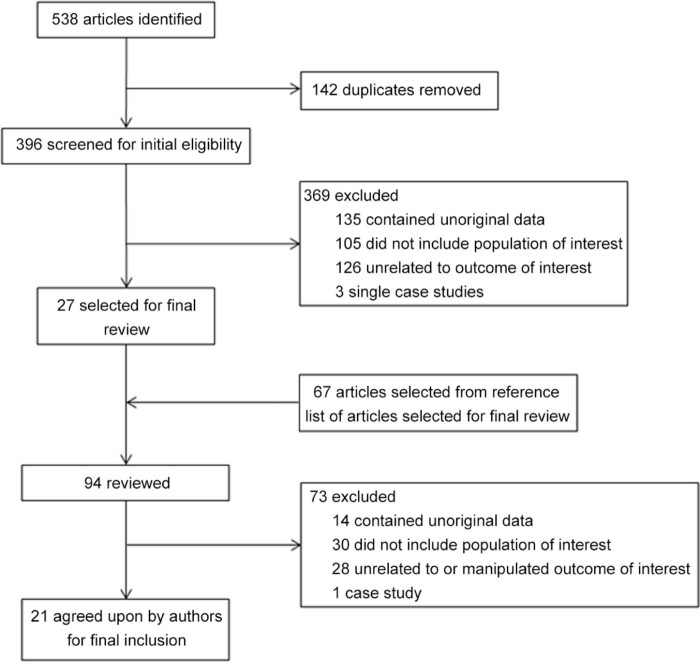
BACKGROUND: While mental health among collegiate athletes is receiving increased attention, research on factors surrounding collegiate athletes' decision to seek mental health services is limited. The goal of the present review was to analyze and synthesize the current literature concerning collegiate athletes' utilization of mental health services, including the facilitators of and barriers to use of these services. METHODS: The analysis was guided and organized using a socio-ecological framework, which considered the unique context in which collegiate athletes study and perform. A total of 21 articles, published between 2005 and 2016, which concern U.S. collegiate athletes' mental health services utilization (MHSU) were selected and included for the final analysis. Conceptualizations and operationalizations of MHSU were compared and contrasted. Facilitators of and barriers to athletes MHSU were examined and summarized while appropriately considering the proximity of each factor (facilitator or barrier) to the athletes. RESULTS: Results showed variations in conceptualizations and operationalizations of MHSU in the articles analyzed, which made interpretation and cross comparison difficult. Collegiate athletes are willing to utilize mental health services, but gender, perceived stigma, peer norms-for athletes and coaches-plus service availability impact their MHSU. CONCLUSION: Key stakeholders, administrators, and public health officials should partner to eliminate MHSU barriers, support facilitators, and generally empower collegiate athletes to actively manage their mental health.
Overview
The claims and statistics of this paper haven’t been checked yet.
Run the check — free, no account needed. It reads the open-access text and checks the sources it cites.
Integrity signals
Registry
Cites
Statistics
Figures
Verification
Claims the paper makes
The claims and statistics of this paper haven’t been checked yet.
Run the check — free, no account needed. It reads the open-access text and checks the sources it cites.
Claims other papers make about this one
Each is checked against this paper’s own text: does it say what the citing paper says it does?
The cited source says what the claim attributes to it.
In the citing paper
“Common challenges for college athletes attempting to use mental health resources include perceived stigma associated with seeking mental health care [4] and service availability [5]”
From Mobile-Delivered Mindfulness Intervention on Anxiety Level Among College Athletes: Randomized Controlled Trial (2024) · cites this paper as [5]
Self-check
Percentages, sums and reported differences re-computed from the paper’s own numbers.
The self-check needs the paper’s full text.
Citations
Cites
Ferrari, A. J., Charlson, F. J., Norman, R. E., Patten, S. B., Freedman, G., Murray, C. J. L., Vos, T., & Whiteford, H. A. (2013) · PLoS Medicine · doi:10.1371/journal.pmed.1001547 · Cited by 3,115
Translating Social Ecological Theory into Guidelines for Community Health Promotion
Stokols, D. (1996) · American Journal of Health Promotion · doi:10.4278/0890-1171-10.4.282 · Cited by 2,763
Eime, R. M., Young, J. A., Harvey, J. T., Charity, M. J., & Payne, W. R. (2013) · International Journal of Behavioral Nutrition and Physical Activity · doi:10.1186/1479-5868-10-98 · Cited by 2,366 · cited 1×
“Those affecting the athletes’ health decision-making are considered stakeholders and include the athletes’ social groups and the cultural environment around the athlete.(12,13) In the case of the collegiate student athlete, the sociocultural views on mental health held by teammates, friends, family members, athletic t…”
BackgroundMental health problems and help-seeking behavior among college students
Hunt, J., & Eisenberg, D. (2010) · Journal of Adolescent Health · doi:10.1016/j.jadohealth.2009.08.008 · Cited by 1,949
Link, B. G. (1987) · American Sociological Review · doi:10.2307/2095395 · Cited by 1,588
Stigma and Help Seeking for Mental Health Among College Students
Eisenberg, D., Downs, M. F., Golberstein, E., & Zivin, K. (2009) · Medical Care Research and Review · doi:10.1177/1077558709335173 · Cited by 1,193
Measuring the self-stigma associated with seeking psychological help
Vogel, D. L., Wade, N. G., & Haake, S. (2006) · Journal of Counseling Psychology · doi:10.1037/0022-0167.53.3.325 · Cited by 1,190
Help-Seeking and Access to Mental Health Care in a University Student Population
Eisenberg, D., Golberstein, E., & Gollust, S. E. (2007) · Medical Care · doi:10.1097/mlr.0b013e31803bb4c1 · Cited by 1,131
Orientations to seeking professional help: development and research utility of an attitude scale
Fischer, E. H., & Turner, J. I. (1970) · Journal of Consulting and Clinical Psychology · doi:10.1037/h0029636 · Cited by 973
Gender-role conflict scale: College men's fear of femininity
O’Neil, J. M., Helms, B. J., Gable, R., David, L., & Wrightsman, L. S. (1986) · Sex Roles · doi:10.1007/bf00287583 · Cited by 813
Research works printed but not linked: 1
- Brewer, 2001, Norms and factorial invariance of the Athletic Identity Measurement Scale, Acad Athl J, 15, 103
Cited by
Sorted by citations
Items 201–205 of 205
Sporcuların Gözünden Psikoloji: Bir Metafor Çalışması
Buse, S. U. L. U., & ÇAKALOĞLU, E. (2026) · Sportive · doi:10.53025/sportive.1963809
Pankow, K., & Vella, S. A. (2026) · Journal of American College Health · doi:10.1080/07448481.2026.2731250
Tsalafos, A., Donohue, B. C., Kraus, S. W., Ullman, J., Mercer, J., Allen, D., & Goto, A. (2026) · Sport Social Work Journal · doi:10.33043/xgjkg7xwg4e
Mental Health Considerations for Athlete Injury and Psychological Readiness to Return to Play
Houle, J. L. W., & Worley, J. T. (2026) · Operative Techniques in Sports Medicine · doi:10.1053/j.otsm.2026.151290
Psychometric properties of a Psychological Safety Scale for Competitive Sports (PSSCS)
MATSUBARA, A., & Takai, H. (2026) · International Journal of Sport and Exercise Psychology · doi:10.1080/1612197x.2026.2740795
Metadata
- Authors
- Moreland, J. J., Coxe, K. A., & Yang, J.
- Affiliations
- Nationwide Children's Hospital (US)
- Ohio Department of Mental Health & Addiction Services (US)
- Corresponding author
- Yang, Jingzhen
- Venue
- Journal of Sport and Health Science
- Publisher
- Elsevier BV
- Published
- 2018-01
- Volume
- 7
- Issue
- 1
- Pages
- 58-69
- ISSN
- 2213-2961 (ISSN-L)
- 2095-2546
- PMC
- PMC6180550
- OpenAlex
- W2609537729
- Cited by
- 206
- References
- 78
- Citations by year
- 2026: 19 · 2025: 27 · 2024: 27 · 2023: 28 · 2022: 24 · 2021: 35 · 2020: 23 · 2019: 12 · 2018: 11
- FWCI
- 1.98
- Type
- journal article
- Language
- en
- Open access
- diamond
- doi.org
- Licence
- Locations
- Journal of sport and health science/Journal of Sport and Health Science (publishedVersion, cc-by-nc-nd)
- Europe PMC (PubMed Central) (publishedVersion, cc-by-nc-nd)
- PubMed Central (publishedVersion, cc-by-nc-nd)
- PubMed (publishedVersion)
- DOAJ (DOAJ: Directory of Open Access Journals) (submittedVersion, cc-by-sa)
- Topics
- Health Sciences › Medicine › Psychiatry and Mental health › Mental Health Treatment and Access
- Social Sciences › Psychology › Clinical Psychology › Psychological Treatments and Assessments
- Social Sciences › Psychology › Developmental and Educational Psychology › Sport Psychology and Performance
- Keywords
- collegiate athletes, mental health service utilization, help-seeking, barriers to mental health care, help-seeking facilitators, perceived stigma, gender differences, peer norms, coaches, service availability, socio-ecological framework, athlete mental health
About these checks
Registry, retraction, Cites and statistics results are computed, not judged, with one exception: a printed reference that no index lists is read once by a model before it counts as a citation error. Claims are extracted by a model and kept only when their quote appears verbatim in the text; each cited source is then checked, with a model’s help, for whether it says what the claim relies on. Those verdicts can be wrong — read the claim’s quote and the cited source before relying on one.
Statistics and arithmetic are recomputed, not judged.
Confidence bands are shown only for fields calibrated on our annotated test set. None is calibrated yet, so no band is shown.
What counts as a claim ›How we measure confidence ›How we check this ›
Are you an author, or do you see a problem with this page? Request a review
