

The DOI matches its Crossref record; 51 of the 51 references it cites were found in a registry or an index.
Ghrelin transport across the blood–brain barrier can occur independently of the growth hormone secretagogue receptor
Open accessAbstract
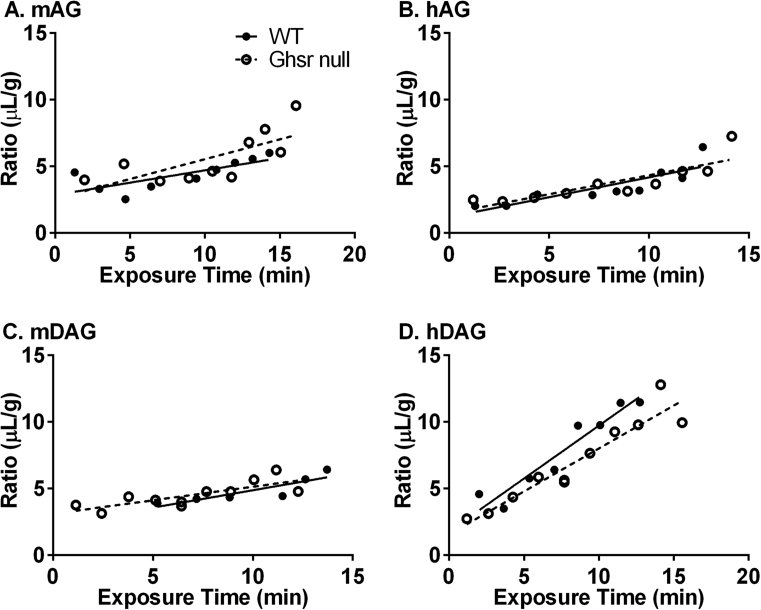
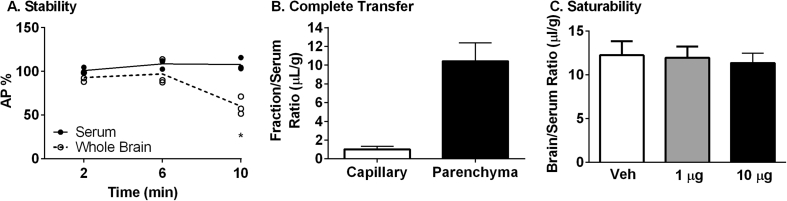
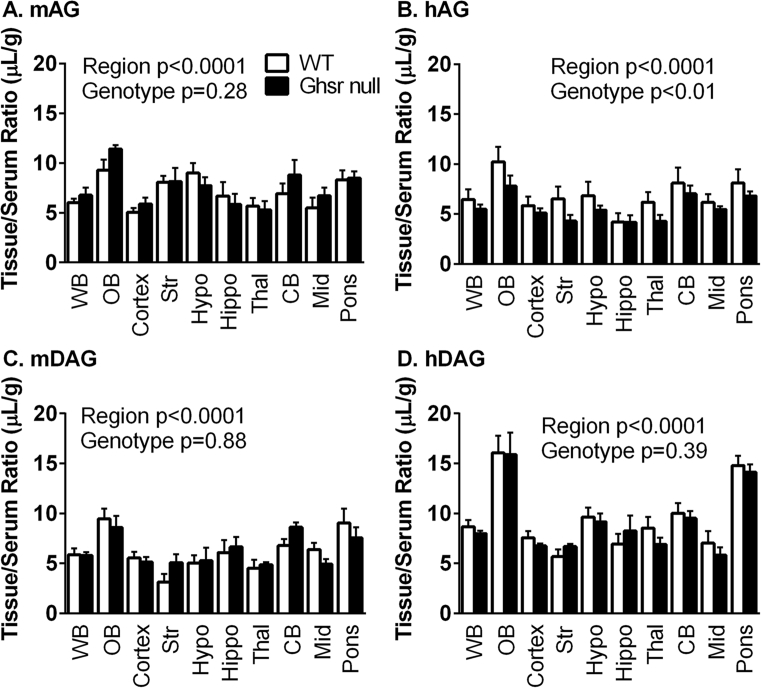
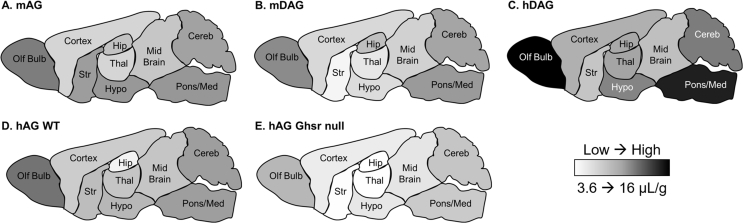
OBJECTIVE: The blood-brain barrier (BBB) regulates the entry of substrates and peptides into the brain. Ghrelin is mainly produced in the stomach but exerts its actions in the central nervous system (CNS) by crossing the BBB. Once present in the CNS, ghrelin can act in the hypothalamus to regulate food intake, in the hippocampus to regulate neurogenesis, and in the olfactory bulb to regulate food-seeking behavior. The goal of this study was to determine whether the primary signaling receptor for ghrelin, the growth hormone secretagogue receptor (GHSR), mediates the transport of ghrelin from blood to brain. METHODS: We utilized the sensitive and quantitative multiple-time regression analysis technique to determine the transport rate of mouse and human acyl ghrelin (AG) and desacyl ghrelin (DAG) in wildtype and Ghsr null mice. We also measured the regional distribution of these ghrelin peptides throughout the brain. Lastly, we characterized the transport characteristics of human DAG by measuring the stability in serum and brain, saturability of transport, and the complete transfer across the brain endothelial cell. RESULTS: We found the transport rate across the BBB of both forms of ghrelin, AG, and DAG, were not affected by the loss of GHSR. We did find differences in the transport rate between the two isoforms, with DAG being faster than AG; this was dependent on the species of ghrelin, human being faster than mouse. Lastly, based on the ubiquitous properties of ghrelin throughout the CNS, we looked at regional distribution of ghrelin uptake and found the highest levels of uptake in the olfactory bulb. CONCLUSIONS: The data presented here suggest that ghrelin transport can occur independently of the GHSR, and ghrelin uptake varies regionally throughout the brain. These findings better our understanding of the gut-brain communication and may lead to new understandings of ghrelin physiology.
Overview
The claims and statistics of this paper haven’t been checked yet.
Run the check — free, no account needed. It reads the open-access text and checks the sources it cites.
Integrity signals
Registry
Cites
Statistics
Figures
Verification
Claims the paper makes
The claims and statistics of this paper haven’t been checked yet.
Run the check — free, no account needed. It reads the open-access text and checks the sources it cites.
Claims other papers make about this one
Each is checked against this paper’s own text: does it say what the citing paper says it does?
The source backs part of the claim, not all of it — or backs it for a different population, condition or comparison.
In the citing paper
“It binds to growth hormone secretagogue receptor (GHSR), and it has been shown to protect neurons from β-amyloid-induced toxicity, reduce tau phosphorylation, and enhance synaptic plasticity [20, 44–46].”
From Protective PLCG2 variants associate with a delayed onset of Alzheimer’s disease among heterozygous APOE ε4 carriers (2026) · cites this paper as [46]
Experimental — accuracy not yet measuredThe cited source says what the claim attributes to it.
In the citing paper
“It has been shown that ghrelin can pass through the blood–brain barrier, directly affecting brain cells [46, 48–50].”
From Protective PLCG2 variants associate with a delayed onset of Alzheimer’s disease among heterozygous APOE ε4 carriers (2026) · cites this paper as [46]
The cited source says what the claim attributes to it.
In the citing paper
“It binds to growth hormone secretagogue receptor (GHSR), and it has been shown to protect neurons from β-amyloid-induced toxicity, reduce tau phosphorylation, and enhance synaptic plasticity [20, 44–46].”
From Protective PLCG2 variants associate with a delayed onset of Alzheimer’s disease among heterozygous APOE ε4 carriers (2026) · cites this paper as [46]
The check wasn’t confident either way, so it gives no verdict — never disputed.
In the citing paper
“It binds to growth hormone secretagogue receptor (GHSR), and it has been shown to protect neurons from β-amyloid-induced toxicity, reduce tau phosphorylation, and enhance synaptic plasticity [20, 44–46].”
From Protective PLCG2 variants associate with a delayed onset of Alzheimer’s disease among heterozygous APOE ε4 carriers (2026) · cites this paper as [46]
Experimental — accuracy not yet measuredThe check wasn’t confident either way, so it gives no verdict — never disputed.
In the citing paper
“It binds to growth hormone secretagogue receptor (GHSR), and it has been shown to protect neurons from β-amyloid-induced toxicity, reduce tau phosphorylation, and enhance synaptic plasticity [20, 44–46].”
From Protective PLCG2 variants associate with a delayed onset of Alzheimer’s disease among heterozygous APOE ε4 carriers (2026) · cites this paper as [46]
Experimental — accuracy not yet measured
Self-check
Percentages, sums and reported differences re-computed from the paper’s own numbers.
The self-check needs the paper’s full text.
Citations
Cites
Ghrelin is a growth-hormone-releasing acylated peptide from stomach
Kojima, M., Hosoda, H., Date, Y., Nakazato, M., Matsuo, H., & Kangawa, K. (1999) · Nature · doi:10.1038/45230 · Cited by 8,479
REGIONAL STUDIES OF CATECHOLAMINES IN THE RAT BRAIN‐I
Glowinski, J., & Iversen, L. L. (1966) · Journal of Neurochemistry · doi:10.1111/j.1471-4159.1966.tb09873.x · Cited by 5,436
Graphical Evaluation of Blood-to-Brain Transfer Constants from Multiple-Time Uptake Data
Patlak, C. S., Blasberg, R. G., & Fenstermacher, J. D. (1983) · Journal of Cerebral Blood Flow & Metabolism · doi:10.1038/jcbfm.1983.1 · Cited by 3,565
A role for ghrelin in the central regulation of feeding
Nakazato, M., Murakami, N., Date, Y., Kojima, M., Matsuo, H., Kangawa, K., & Matsukura, S. (2001) · Nature · doi:10.1038/35051587 · Cited by 3,443
Ghrelin: Structure and Function
Kojima, M., & Kangawa, K. (2005) · Physiological Reviews · doi:10.1152/physrev.00012.2004 · Cited by 2,810
Ouchi, N., Kihara, S., Arita, Y., Okamoto, Y., Maeda, K., Kuriyama, H., Hotta, K., Nishida, M., Takahashi, M., Muraguchi, M., et al. (2000) · Circulation · doi:10.1161/01.cir.102.11.1296 · Cited by 1,730
Cowley, M. A., Smith, R. G., Diano, S., Tschöp, M., Pronchuk, N., Grove, K. L., Strasburger, C. J., Bidlingmaier, M., Esterman, M., Heiman, M. L., et al. (2003) · Neuron · doi:10.1016/s0896-6273(03)00063-1 · Cited by 1,679
Leptin enters the brain by a saturable system independent of insulin
Banks, W. A., Kastin, A. J., Huang, W., Jaspan, J. B., & Maness, L. M. (1996) · Peptides · doi:10.1016/0196-9781(96)00025-3 · Cited by 1,222
Self-citationExpression of ghrelin receptor mRNA in the rat and the mouse brain
Zigman, J. M., Jones, J. E., Lee, C. E., Saper, C. B., & Elmquist, J. K. (2006) · The Journal of Comparative Neurology · doi:10.1002/cne.20823 · Cited by 1,074
Müller, T. D., Nogueiras, R., Andermann, M. L., Andrews, Z. B., Anker, S. D., Argente, J., Batterham, R. L., Benoit, S. C., Bowers, C. Y., Broglio, F., et al. (2015) · Molecular Metabolism · doi:10.1016/j.molmet.2015.03.005 · Cited by 1,034
Self-citation
Cited by
Sorted by citations
Salameh, T. S., Rhea, E. M., Talbot, K., & Banks, W. A. (2020) · Biochemical Pharmacology · doi:10.1016/j.bcp.2020.114187 · Cited by 188
Self-citationBalasubramanian, R., Schneider, E., Gunnigle, E., Cotter, P. D., & Cryan, J. F. (2024) · Neuroscience & Biobehavioral Reviews · doi:10.1016/j.neubiorev.2024.105562 · Cited by 143
Liver-expressed antimicrobial peptide 2 antagonizes the effect of ghrelin in rodents
Islam, M. N., Mita, Y., Maruyama, K., Tanida, R., Zhang, W., Sakoda, H., & Nakazato, M. (2019) · Journal of Endocrinology · doi:10.1530/joe-19-0102 · Cited by 109
Porniece, M., Cremer, A. L., Klemm, P., Steuernagel, L., Sundaram, S. M., Jaïs, A., Hausen, A. C., Tao, J., Secher, A., Pedersen, T. Å., et al. (2021) · Nature Metabolism · doi:10.1038/s42255-021-00499-0 · Cited by 109
Ghrelin Signaling Affects Feeding Behavior, Metabolism, and Memory through the Vagus Nerve
Davis, E. A., Wald, H. S., Suarez, A. N., Zubcevic, J. A., Liu, C. M., Cortella, A. M., Kamitakahara, A. K., Polson, J. W., Arnold, M., Grill, H. J., et al. (2020) · Current Biology · doi:10.1016/j.cub.2020.08.069 · Cited by 85
Metadata
- Authors
- Rhea, E. M., Salameh, T. S., Gray, S., Niu, J., Banks, W. A., & Tong, J.
- Affiliations
- University of Washington (US)
- Duke University (US)
- Corresponding author
- Tong, Jenny
- Venue
- Molecular Metabolism
- Publisher
- Elsevier BV
- Published
- 2018-12
- Volume
- 18
- Pages
- 88-96
- ISSN
- 2212-8778 (ISSN-L)
- PMC
- PMC6308033
- OpenAlex
- W2894219590
- Cited by
- 114
- References
- 51
- Citations by year
- 2026: 13 · 2025: 12 · 2024: 26 · 2023: 13 · 2022: 12 · 2021: 18 · 2020: 10 · 2019: 8 · 2018: 2
- FWCI
- 5.35
- Type
- journal article
- Language
- en
- Open access
- gold
- doi.org
- Licence
- Locations
- Molecular Metabolism (publishedVersion, cc-by-nc-nd)
- Europe PMC (PubMed Central) (publishedVersion, cc-by-nc-nd)
- PubMed Central (publishedVersion, cc-by-nc-nd)
- PubMed (publishedVersion)
- DOAJ (DOAJ: Directory of Open Access Journals) (submittedVersion)
- Funders
- National Institutes of Health (T32AG000057, RO1DK097550, T32DK007012, RO1AG046619)
- Topics
- Life Sciences › Neuroscience › Endocrine and Autonomic Systems › Regulation of Appetite and Obesity
- Life Sciences › Neuroscience › Neurology › Barrier Structure and Function Studies
- Health Sciences › Medicine › Oncology › Drug Transport and Resistance Mechanisms
- Keywords
- ghrelin, blood-brain barrier, growth hormone secretagogue receptor, acylated ghrelin, des-acyl ghrelin, brain regional distribution, olfactory bulb, gut-brain signaling, brain endothelial cells
- MeSH terms
- Animals, Blood-Brain Barrier, Capillary Permeability, Mice, Ghrelin, Receptors, Ghrelin
About these checks
Registry, retraction, Cites and statistics results are computed, not judged, with one exception: a printed reference that no index lists is read once by a model before it counts as a citation error. Claims are extracted by a model and kept only when their quote appears verbatim in the text; each cited source is then checked, with a model’s help, for whether it says what the claim relies on. Those verdicts can be wrong — read the claim’s quote and the cited source before relying on one.
Statistics and arithmetic are recomputed, not judged.
Confidence bands are shown only for fields calibrated on our annotated test set. None is calibrated yet, so no band is shown.
What counts as a claim ›How we measure confidence ›How we check this ›
Are you an author, or do you see a problem with this page? Request a review
