

Evidence against solar influence on nuclear decay constants
Open accessThe DOI matches its Crossref record; 42 of the 43 references it cites were found in a registry or an index; none of the 16 sources its claims cite is checked for support yet.
Abstract
The hypothesis that proximity to the Sun causes variation of decay constants at permille level has been tested and disproved. Repeated activity measurements of mono-radionuclide sources were performed over periods from 200 days up to four decades at 14 laboratories across the globe. Residuals from the exponential nuclear decay curves were inspected for annual oscillations. Systematic deviations from a purely exponential decay curve differ from one data set to another and are attributable to instabilities in the instrumentation and measurement conditions. The most stable activity measurements of alpha, beta-minus, electron capture, and beta-plus decaying sources set an upper limit of 0.0006% to 0.008% to the amplitude of annual oscillations in the decay rate. Oscillations in phase with Earth's orbital distance to the Sun could not be observed within a 10−6 to 10−5 range of precision. There are also no apparent modulations over periods of weeks or months. Consequently, there is no indication of a natural impediment against sub-permille accuracy in half-life determinations, renormalisation of activity to a distant reference date, application of nuclear dating for archaeology, geo- and cosmochronology, nor in establishing the SI unit becquerel and seeking international equivalence of activity standards.
Overview
CoChat Summary
TL;DR
Repeated activity measurements of mono-radionuclide sources at 14 laboratories over 200 days to four decades found no evidence that solar proximity modulates nuclear decay constants. Residual annual oscillations were attributable to instrumental instabilities, with upper limits of 0.0006%–0.008% for the most stable alpha, beta-minus, electron-capture, and beta-plus sources.
Key findings
- The most stable activity measurements set an upper limit of 0.0006% to 0.008% on the amplitude of annual oscillations in decay rate; oscillations in phase with Earth–Sun orbital distance were not observed within a 10^-6 to 10^-5 range of precision.
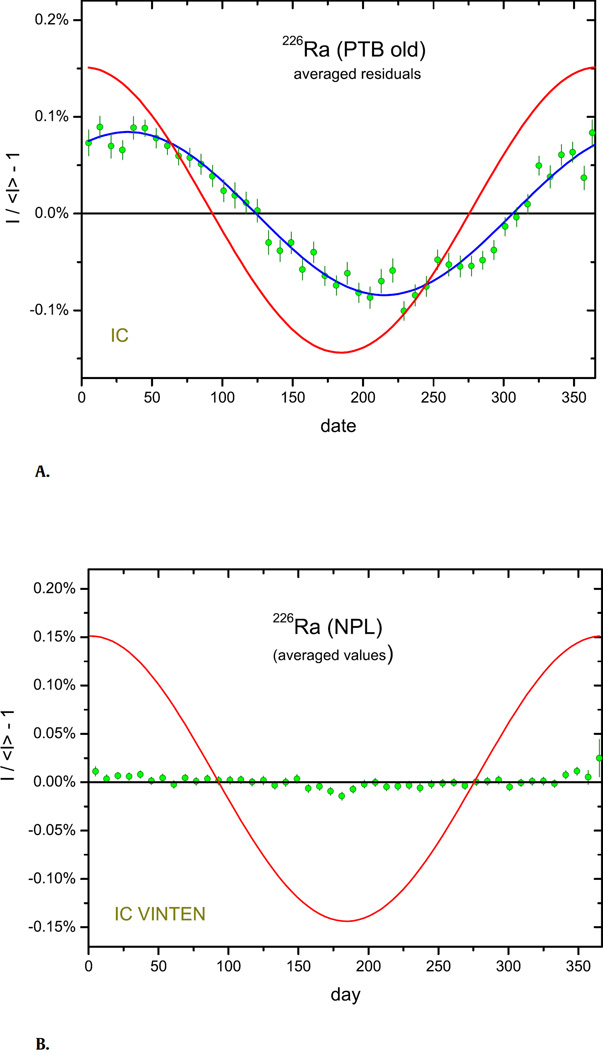
- For 226Ra at PTB (1983–1998), averaged residuals had A = 0.083(2)% and phase a = 59 days, out of phase with 1/R²; modulations were reduced after changing the ionisation chamber electrometer, and correlated with laboratory radon concentration (A = 16(2)%, a = 57 days), though causality was not proven.
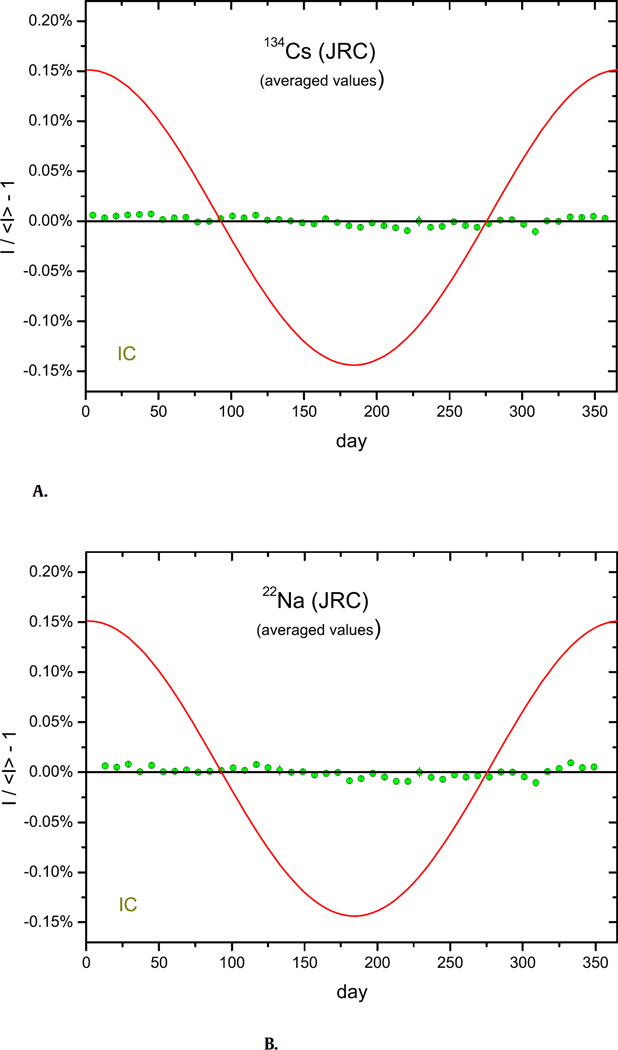
- Stable 226Ra measurements at NPL (4000 ionisation current measurements over 22 years) proved invariability within 0.0025% to 0.005%; alpha emitters 209Po, 226Ra, 230U, and 241Am were confirmed within 10^-5. Beta-minus stability reached 10^-5 for 60Co, 90Sr, 124Sb, 134Cs, and 137Cs and 10^-4 for 3H, 14C, and 85Kr, contradicting permille-level oscillations reported for 3H, 60Co, 90Sr, and 137Cs.
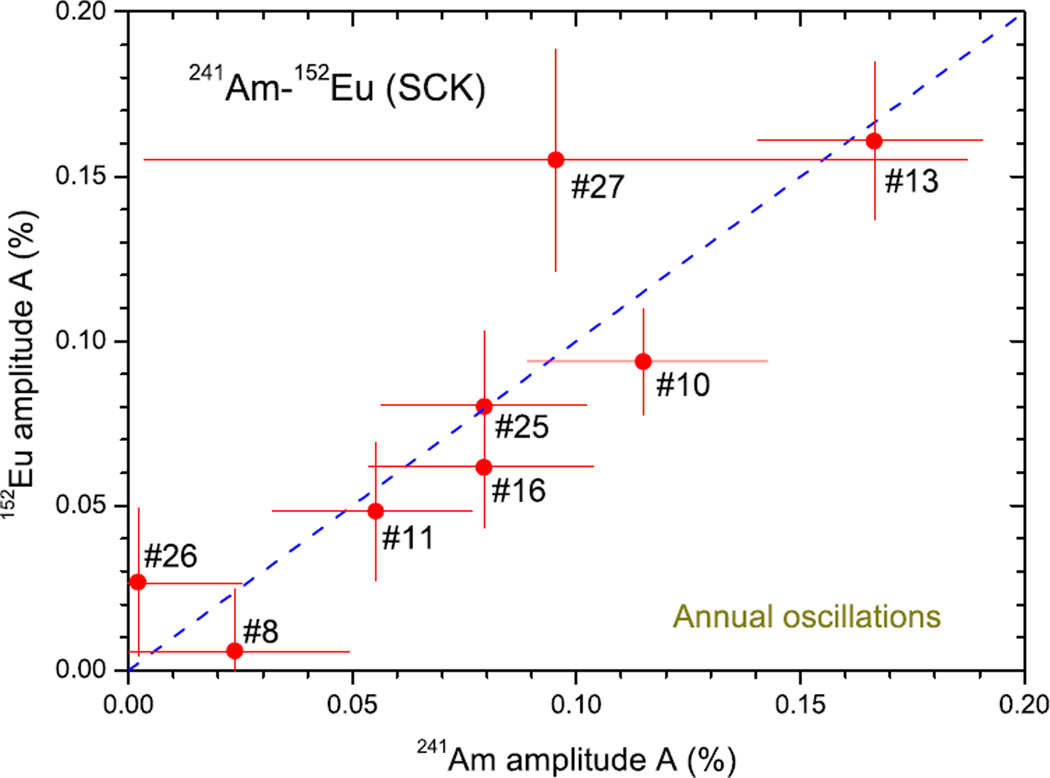
- EC/β+ nuclides showed stability within 10^-5 to 10^-4 in most cases; HPGe measurements at SCK showed highly correlated modulations for 241Am and 152Eu but amplitudes differing from detector to detector, indicating instrumental origin. Overall data were typically 50 times more stable than measurements behind recent solar-influence claims.
Methods
- Repeated activity measurements of mono-radionuclide sources were performed over periods from 200 days up to four decades at 14 laboratories across the globe; more than 60 data sets covered alpha (209Po, 226Ra series, 228Th, 230U, 241Am), beta-minus (3H, 14C, 60Co, 85Kr, 90Sr, 124Sb, 134Cs, 137Cs), electron capture (54Mn, 55Fe, 57Co, 82,85Sr, 109Cd, 133Ba), mixed EC/positron (22Na, 65Zn, 207Bi), and mixed EC and beta-minus/plus (152Eu) decay.
- Techniques included ionisation chambers, hospital calibrators, HPGe gamma-ray spectrometry, PIPS alpha spectrometry, proportional counters, live-timed β–γ anti-coincidence counting, TDCR, liquid scintillation counting, CsI(Tl) spectrometry, internal gas counting, and α-particle counting at a defined solid angle.
- Exponential decay curves were fitted and residuals inspected for annual modulations after compensating for outliers, abrupt detector-response changes, and drift over >1 year. Residuals were binned into 8-day periods (max 46 per year) and fitted with A sin(2π(t+a)/365), where A is amplitude, t days since New Year, and a phase shift in days; amplitudes comparable to their standard uncertainty were considered insignificant.
Limitations
- The paper states that causality between the 226Ra modulation and laboratory radon concentration has not been proven.
- The paper notes that some data sets reveal vulnerability of measurement techniques to external conditions and that observed seasonal modulations are instrumental, varying by instrument and laboratory; such auto-correlated variability should be considered alongside statistical variations in quality-control alarm levels.
- Text makes evident: the study is a retrospective analysis of existing measurement series rather than a controlled experiment, and no formal limitations section is provided; the analysis depends on compensating for outliers, abrupt changes, and long-term drift, which could affect residual interpretation.
Model-written summary. Check it against the paper before relying on it.
Integrity signals
Registry
Cites
Statistics
Figures
Verification
Claims the paper makes
0 Valid · 1 Not valid · 6 Not checked · 31 Own results and interpretations
A result the paper reports from its own data — it cites no other source for it, so there is none to check. The quote shows it is in the paper.
In the paper
“The most stable activity measurements of alpha, beta-minus, electron capture, and beta-plus decaying sources set an upper limit of 0.0006% to 0.008% to the amplitude of annual oscillations in the decay rate.”
§ Evidence against solar influence on nuclear decay constants > Abstract
plain- Asserted: passes — The authors put it forward as true.
- Checkable: passes — It can be checked against evidence.
- Load-bearing: passes — The paper’s conclusions depend on it.
- Based: passes — The paper gives a reason why it holds.
A result the paper reports from its own data — it cites no other source for it, so there is none to check. The quote shows it is in the paper.
In the paper
“Systematic deviations from a purely exponential decay curve differ from one data set to another and are attributable to instabilities in the instrumentation and measurement conditions.”
§ Evidence against solar influence on nuclear decay constants > Abstract
plain- Asserted: passes — The authors put it forward as true.
- Checkable: passes — It can be checked against evidence.
- Load-bearing: passes — The paper’s conclusions depend on it.
- Based: passes — The paper gives a reason why it holds.
A result the paper reports from its own data — it cites no other source for it, so there is none to check. The quote shows it is in the paper.
In the paper
“There are also no apparent modulations over periods of weeks or months.”
§ Evidence against solar influence on nuclear decay constants > Abstract
hedged- Asserted: passes — The authors put it forward as true.
- Checkable: passes — It can be checked against evidence.
- Load-bearing: passes — The paper’s conclusions depend on it.
- Based: passes — The paper gives a reason why it holds.
A result the paper reports from its own data — it cites no other source for it, so there is none to check. The quote shows it is in the paper.
In the paper
“Oscillations in phase with Earth’s orbital distance to the Sun could not be observed within a 10−6 to 10−5 range of precision.”
§ Evidence against solar influence on nuclear decay constants > Abstract
hedged- Asserted: passes — The authors put it forward as true.
- Checkable: passes — It can be checked against evidence.
- Load-bearing: passes — The paper’s conclusions depend on it.
- Based: passes — The paper gives a reason why it holds.
A result the paper states — it cites no source for it, so there is none to check. The quote shows it is in the paper.
In the paper
“The experimental data in this work are typically 50 times more stable than the measurements on which recent claims for solar influence on the decay constants were based.”
§ Evidence against solar influence on nuclear decay constants > 4. Conclusions
plain- Asserted: passes — The authors put it forward as true.
- Checkable: passes — It can be checked against evidence.
- Load-bearing: passes — The paper’s conclusions depend on it.
- Based: passes — The paper gives a reason why it holds.
15 more claims
Create a free account to see all 38 claims and to verify the 16 references still open.
- Probably not a substantial claim. 7
- It may state two separate claims as one. 14
Citations
Cites
Perturbation of Nuclear Decay Rates
Emery, G. T. (1972) · Annual Review of Nuclear Science · doi:10.1146/annurev.ns.22.120172.001121 · Cited by 208
Evidence of correlations between nuclear decay rates and Earth–Sun distance
Jenkins, J. H., Fischbach, E., Buncher, J. B., Gruenwald, J. T., Krause, D. E., & Mattes, J. J. (2009) · Astroparticle Physics · doi:10.1016/j.astropartphys.2009.05.004 · Cited by 171
I. A radio-active substance emitted from thorium compounds
Rutherford, E. (1900) · The London Edinburgh and Dublin Philosophical Magazine and Journal of Science · doi:10.1080/14786440009463821 · Cited by 144
Perturbation of nuclear decay rates during the solar flare of 2006 December 13
Jenkins, J. H., & Fischbach, E. (2009) · Astroparticle Physics · doi:10.1016/j.astropartphys.2009.04.005 · Cited by 126
The uncertainty of the half-life
Pommé, S. G. (2015) · Metrologia · doi:10.1088/0026-1394/52/3/s51 · Cited by 120
Self-citationTime-Dependent Nuclear Decay Parameters: New Evidence for New Forces?
Fischbach, E., Buncher, J. B., Gruenwald, J. T., Jenkins, J. H., Krause, D. E., Mattes, J. J., & Newport, J. R. (2009) · Space Science Reviews · doi:10.1007/s11214-009-9518-5 · Cited by 117
Methods for primary standardization of activity
Pommé, S. G. (2007) · Metrologia · doi:10.1088/0026-1394/44/4/s03 · Cited by 98
Self-citationUncertainties in gamma-ray spectrometry
Lépy, M., Pearce, A. K., & Sima, O. (2015) · Metrologia · doi:10.1088/0026-1394/52/3/s123 · Cited by 96
The Système International de Référence and its application in key comparisons
Ratel, G. (2007) · Metrologia · doi:10.1088/0026-1394/44/4/s02 · Cited by 91
Evidence against correlations between nuclear decay rates and Earth–Sun distance
NORMAN, E. B., Browne, E., Shugart, H. A., Joshi, T. H. Y., & Firestone, R. B. (2008) · Astroparticle Physics · doi:10.1016/j.astropartphys.2008.12.004 · Cited by 89
Research works printed but not linked: 1
- Pommé S Sibbens G Alpha-particle counting and spectrometry in a primary standardisation laboratory Acta Chim. Slov 2008 55 111 119
Cited by
Pommé, S., Stroh, H., Altzitzoglou, T., Paepen, J., Van Ammel, R., Kossert, K., Nähle, O., Keightley, J. D., Ferreira, K. M., Verheyen, L., et al. (2018) · Applied Radiation and Isotopes · doi:10.1016/j.apradiso.2017.09.002 · Cited by 38
Self-citationOn decay constants and orbital distance to the Sun—part I: alpha decay
Pommé, S., Stroh, H., Paepen, J., Van Ammel, R., Marouli, M., Altzitzoglou, T., Hult, M., Kossert, K., Nähle, O., Schrader, H., et al. (2017) · Metrologia · doi:10.1088/1681-7575/54/1/1 · Cited by 41
Self-citationOn decay constants and orbital distance to the Sun—part III: beta plus and electron capture decay
Pommé, S. G., Stroh, H., Paepen, J., Ammel, R. V., Marouli, M., Altzitzoglou, T., Hult, M., Kossert, K., Nähle, O. J., Schrader, H., et al. (2016) · Metrologia · doi:10.1088/1681-7575/54/1/36 · Cited by 40
Self-citationOn decay constants and orbital distance to the Sun—part II: beta minus decay
Pommé, S., Stroh, H., Paepen, J., Van Ammel, R., Marouli, M., Altzitzoglou, T., Hult, M., Kossert, K., Nähle, O., Schrader, H., et al. (2017) · Metrologia · doi:10.1088/1681-7575/54/1/19 · Cited by 37
Self-citationRadionuclide metrology: confidence in radioactivity measurements
Pommé, S. G. (2022) · Journal of Radioanalytical and Nuclear Chemistry · doi:10.1007/s10967-022-08494-9 · Cited by 38
Self-citation
Metadata
- Authors
- Pommé, S., Stroh, H., Paepen, J., Van Ammel, R., Marouli, M., Altzitzoglou, T., Hult, M., Kossert, K., Nähle, O., Schrader, H., Juget, F., Bailat, C., Nedjadi, Y., Bochud, F., Buchillier, T., Michotte, C., Courte, S., van Rooy, M. W., van Staden, M. J., Lubbe, J., Simpson, B. R. S., Fazio, A., De Felice, P., Jackson, T. W., Van Wyngaardt, W. M., Reinhard, M. I., Golya, J., Bourke, S., Roy, T., Galea, R., Keightley, J. D., Ferreira, K. M., Collins, S. M., Ceccatelli, A., Unterweger, M., Fitzgerald, R., Bergeron, D. E., Pibida, L., Verheyen, L., Bruggeman, M., Vodenik, B., Korun, M., Chisté, V., & Amiot, M.-N.
- Affiliations
- European Commission (BE)
- Physikalisch-Technische Bundesanstalt (DE)
- Institute of Radiation Physics (CH)
- Bureau international des poids et mesures (FR)
- National Metrology Institute of South Africa (ZA)
- National Agency for New Technologies, Energy and Sustainable Economic Development (IT)
- Australian Nuclear Science and Technology Organisation (AU)
- National Research Council Canada (CA)
- National Physical Laboratory (GB)
- International Atomic Energy Agency (AT)
- National Institute of Standards and Technology (US)
- Belgian Nuclear Research Centre (BE)
- Jožef Stefan Institute (SI)
- Commissariat à l'Énergie Atomique et aux Énergies Alternatives (FR)
- Corresponding author
- Pommé, S.
- ORCID
- Venue
- Physics Letters B
- Publisher
- Elsevier BV
- Published
- 2016-10
- Volume
- 761
- Pages
- 281-286
- ISSN
- 0370-2693 (ISSN-L)
- PMC
- PMC5207040
- OpenAlex
- W2508886421
- Cited by
- 67
- References
- 43
- Citations by year
- 2026: 1 · 2025: 1 · 2024: 4 · 2023: 4 · 2022: 8 · 2021: 7 · 2020: 17 · 2019: 6 · 2018: 6 · 2017: 10 · 2016: 3
- FWCI
- 6.84
- Type
- journal article
- Language
- en
- Open access
- diamond
- doi.org
- Licence
- cc-by
- www.elsevier.com/tdm/userlicense/1.0/ (tdm)
- creativecommons.org/licenses/by/4.0/ (vor)
- Locations
- Physics Letters B (publishedVersion, cc-by)
- PubMed (publishedVersion)
- SERVAL (Université de Lausanne) (publishedVersion, other-oa)
- PubMed Central (acceptedVersion, cc-by)
- The Australian Nuclear Science and Technology Organisation Institutional Repository (The Australian Nuclear Science and Technology Organisation) (submittedVersion)
- NPARC (submittedVersion)
- IRIS (submittedVersion)
- HAL (submittedVersion)
- HAL (submittedVersion, other-oa)
- DOAJ (DOAJ: Directory of Open Access Journals) (submittedVersion)
- ENEA Open Archive (National Agency for New Technologies, Energy and Sustainable Economic Development) (submittedVersion)
- Joint Research Centre (European Commission) (submittedVersion)
- Topics
- Physical Sciences › Physics and Astronomy › Radiation › Radioactive Decay and Measurement Techniques
- Physical Sciences › Physics and Astronomy › Nuclear and High Energy Physics › Nuclear physics research studies
- Physical Sciences › Physics and Astronomy › Nuclear and High Energy Physics › Neutrino Physics Research
- Keywords
- half-life determination, activity measurement, heliocentric distance, Becquerel, activity standards
About these checks
Registry, retraction, Cites and statistics results are computed, not judged, with one exception: a printed reference that no index lists is read once by a model before it counts as a citation error. Claims are extracted by a model and kept only when their quote appears verbatim in the text; each cited source is then checked, with a model’s help, for whether it says what the claim relies on. Those verdicts can be wrong — read the claim’s quote and the cited source before relying on one.
A language model drew the claims from the paper on 2026-11-23, under version 3 of the claim definition (model deepseek-v4.1-flash, prompt extract-v3).
A second model labelled each claim on 2026-11-23 (model jev-1.13-20260917, definition revision gold-guideline-v0.2).
Statistics and arithmetic are recomputed, not judged.
Confidence bands are shown only for fields calibrated on our annotated test set. None is calibrated yet, so no band is shown.
What counts as a claim ›How we measure confidence ›How we check this ›
Are you an author, or do you see a problem with this page? Request a review
Data sources
Bibliographic data: Semantic Scholar, OpenAlex, Crossref.
Contains information from the Semantic Scholar Academic Graph Datasets, made available under the ODC Attribution License (ODC-BY 1.0).
Semantic Scholar’s data is described in: Kinney, R., et al. (2023). The Semantic Scholar Open Data Platform. arXiv:2301.10140.
