

The DOI matches its Crossref record; 41 of the 42 references it cites were found in a registry or an index; none of the 6 sources its claims cite is checked for support yet.
Memory effects in Kundt wave spacetimes
Open accessAbstract
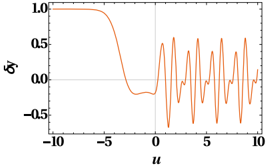
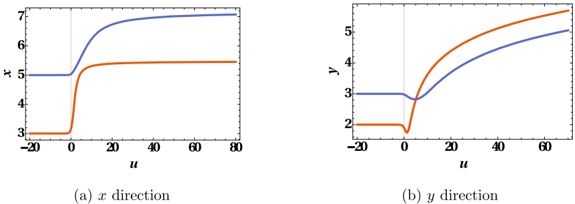
Memory effects in the exact Kundt wave spacetimes are shown to arise in the behaviour of geodesics in such spacetimes. The types of Kundt spacetimes we consider here are direct products of the form H2×M(1,1) and S2×M(1,1). Both geometries have constant scalar curvature. We consider a scenario in which initial velocities of the transverse geodesic coordinates are set to zero (before the arrival of the pulse) in a spacetime with non-vanishing background curvature. We look for changes in the separation between pairs of geodesics caused by the pulse. Any relative change observed in the position and velocity profiles of geodesics, after the burst, can be solely attributed to the wave (hence, a memory effect). For constant negative curvature, we find there is permanent change in the separation of geodesics after the pulse has departed. Thus, there is displacement memory, though no velocity memory is found. In the case of constant positive scalar curvature (Plebański–Hacyan spacetimes), we find both displacement and velocity memory along one direction. In the other direction, a new kind of memory (which we term as frequency memory effect) is observed where the separation between the geodesics shows periodic oscillations once the pulse has left. We also carry out similar analyses for spacetimes with a non-constant scalar curvature, which may be positive or negative. The results here seem to qualitatively agree with those for constant scalar curvature, thereby suggesting a link between the nature of memory and curvature.
Overview
CoChat Summary
TL;DR
The paper studies memory effects for geodesics in exact Kundt wave spacetimes with non-flat constant- and variable-curvature transverse surfaces. It finds displacement memory for negative curvature, displacement plus velocity memory along \(x\) and a new frequency memory along \(y\) for positive curvature, with qualitatively similar behavior under variable curvature.
Key findings
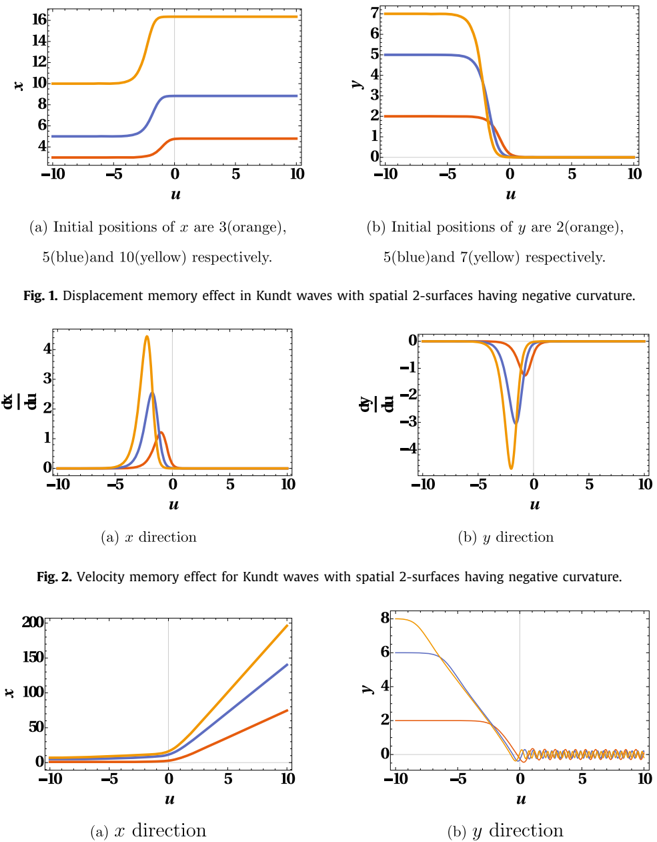
- In \(H^2 \times M(1,1)\) (constant negative curvature), there is displacement memory along both \(x\) and \(y\): separation increases along \(x\) and decreases along \(y\), while no velocity memory is found because the velocity vanishes after the pulse departs.
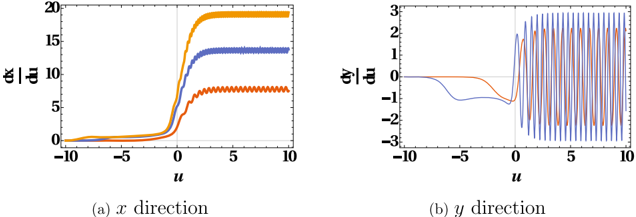
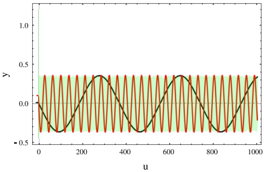
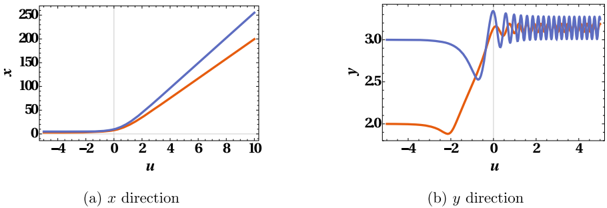
- In \(S^2 \times M(1,1)\) (Plebański-Hacyan, constant positive curvature), there is displacement and velocity memory along \(x\); along \(y\), the separation shows periodic oscillations after the pulse, which the authors call a new “frequency memory effect.”
- Frequency memory is quantified in Table 1 for three initial configurations: \((x,y)=(2.0,3.0)\) gives troughs at \(5.98\) and \(7.13\), frequency \(0.869565\,u^{-1}\), wavelength \(1.15\,u\); \((0.1,0.1)\) gives \(28.82\), \(65.67\), frequency \(0.027137\,u^{-1}\), wavelength \(36.85\,u\); \((0.01,0.01)\) gives \(278.5\), \(647.9\), frequency \(0.002707\,u^{-1}\), wavelength \(369.4\,u\). Higher initial \(y\)-coordinate yields higher frequency and lower wavelength.
- For variable curvature, negative curvature (\(P=\operatorname{sech} y\), \(R=-2\operatorname{sech}^4 y\)) produces only displacement memory, while positive curvature (\(P=\sec y\), \(R=2\sec^4 y>0\)) produces monotonic displacement along \(x\) and oscillatory/frequency memory along \(y\), qualitatively agreeing with the constant-curvature cases.
Methods
- The authors use exact Kundt wave metrics of the form \(ds^2 = 2du\,dv + H\,du^2 + \frac{1}{P^2}(dx^2+dy^2)\), with \(H=\operatorname{sech}^2(u)(x^2-y^2)\), \(W_i=0\), and \(H\) independent of \(v\); they choose \(P\) to realize \(H^2 \times M(1,1)\), \(S^2 \times M(1,1)\), and variable-curvature backgrounds.
- They solve the geodesic equations for the transverse coordinates \(x(u), y(u)\) numerically using Mathematica 10, with \(u\) acting as an affine parameter, because the equations cannot be solved analytically.
- Initial transverse geodesic velocities are set to zero before the pulse; the authors compare geodesic separation and velocity before and after the pulse to identify memory effects, using a \(\operatorname{sech}^2\) pulse profile and checking a Gaussian profile as well.
Limitations
- Stated in the paper: the geodesic equations cannot be solved analytically and are solved numerically with Mathematica 10; for the \(S^2 \times M(1,1)\) case the authors explicitly state they were unable to find analytical solutions. The Gaussian pulse was checked but not shown.
- Evident from the text: the conclusions rely on numerical plots and selected initial conditions, and the frequency memory is quantified only for three initial configurations in Table 1; no analytic proof of the curvature-memory link or observational detection is provided.
- Stated model assumptions: gyratonic matter is excluded (\(W_i=0\)), \(H\) is independent of \(v\), and only the outside region containing gravitational radiation is considered.
Model-written summary. Check it against the paper before relying on it.
Integrity signals
Registry
Cites
Statistics
Figures
Verification
Claims the paper makes
0 Valid · 0 Not valid · 4 Not checked · 30 Own results and interpretations
A result the paper reports from its own data — it cites no other source for it, so there is none to check. The quote shows it is in the paper.
In the paper
“Memory effects in the exact Kundt wave spacetimes are shown to arise in the behaviour of geodesics in such spacetimes.”
§ Memory effects in Kundt wave spacetimes > Abstract
boostedstates a cause- Asserted: passes — The authors put it forward as true.
- Checkable: passes — It can be checked against evidence.
- Load-bearing: passes — The paper’s conclusions depend on it.
- Based: passes — The paper gives a reason why it holds.
- Rests on an assumption not shown here.
A result the paper reports from its own data — it cites no other source for it, so there is none to check. The quote shows it is in the paper.
In the paper
“While in y direction, there is periodical fluctuation owing to the frequency memory effect.”
§ Memory effects in Kundt wave spacetimes > 4. Kundt waves in S 2 × M(1, 1)
plainstates a cause- Asserted: passes — The authors put it forward as true.
- Checkable: passes — It can be checked against evidence.
- Load-bearing: passes — The paper’s conclusions depend on it.
- Based: passes — The paper gives a reason why it holds.
- Rests on an assumption not shown here.
A result the paper reports from its own data — it cites no other source for it, so there is none to check. The quote shows it is in the paper.
In the paper
“The change in position before and after is dependent on the initial position of the pulse.”
§ Memory effects in Kundt wave spacetimes > 3. Kundt waves in H 2 × M(1, 1)
plainstates a cause- Asserted: passes — The authors put it forward as true.
- Checkable: passes — It can be checked against evidence.
- Load-bearing: passes — The paper’s conclusions depend on it.
- Based: passes — The paper gives a reason why it holds.
- Rests on an assumption not shown here.
A result the paper reports from its own data — it cites no other source for it, so there is none to check. The quote shows it is in the paper.
In the paper
“In Fig. 6a we see that initially parallel geodesics, after the passage of the pulse, undergoes a change in separation along x, which is almost constant.”
§ Memory effects in Kundt wave spacetimes > 7. Variable curvature
plainstates a cause- Asserted: passes — The authors put it forward as true.
- Checkable: passes — It can be checked against evidence.
- Load-bearing: passes — The paper’s conclusions depend on it.
- Based: passes — The paper gives a reason why it holds.
- Rests on an assumption not shown here.
A result the paper reports from its own data — it cites no other source for it, so there is none to check. The quote shows it is in the paper.
In the paper
“Moreover, we find difference in amplitudes because the geodesics which seem to oscillate more frequently have higher magnitudes of velocity.”
§ Memory effects in Kundt wave spacetimes > 4. Kundt waves in S 2 × M(1, 1)
hedgedstates an association- Asserted: passes — The authors put it forward as true.
- Checkable: passes — It can be checked against evidence.
- Load-bearing: unclear — It is unclear whether the paper’s conclusions depend on it.
- Based: passes — The paper gives a reason why it holds.
- Rests on an assumption not shown here.
16 more claims
Create a free account to see all 34 claims and every source verdict.
- It may state two separate claims as one. 8
- The quote only partly states this claim. 1
- Probably not a substantial claim. 4
Self-check
Percentages, sums and reported differences re-computed from the paper’s own numbers.
Each contradiction between two passages listed here was confirmed by an independent check.
Rated minor: it would not touch a result — a value no result rests on, a p-value that stays on the same side of the significance level, or a conflict that is clerical, resolved elsewhere in the paper, or outside its own findings.
In the paper
§ Memory effects in Kundt wave spacetimes > 7. Variable curvature
“d 2 x du 2 -2 tanh( y) dx du dy du -x sech 2 (u) cos 2 (y) = 0 (14”
§ Memory effects in Kundt wave spacetimes > 7. Variable curvature
“we take P = sec y (scalar curvature, R = 2 sec 4 y > 0).”
Citations
Cites
Gravitational waves in general relativity, VII. Waves from axi-symmetric isolated system
Bondi, H., Van der Burg, M. G. J., & Metzner, A. W. K. (1962) · Proceedings of the Royal Society of London. Series A. Mathematical and Physical Sciences · doi:10.1098/rspa.1962.0161 · Cited by 2,426
Exact Solutions of Einstein's Field Equations
Stephani, H., Kramer, D., MacCallum, M., Hoenselaers, C., & Herlt, E. (2003) · doi:10.1017/cbo9780511535185 · Cited by 2,184
Exact Space-Times in Einstein's General Relativity
Griffiths, J. B., & Podolský, J. (2009) · doi:10.1017/cbo9780511635397 · Cited by 872
Gravitational memory, BMS supertranslations and soft theorems
Strominger, A., & Zhiboedov, A. (2016) · Journal of High Energy Physics · doi:10.1007/jhep01(2016)086 · Cited by 728
Nonlinear nature of gravitation and gravitational-wave experiments
Christodoulou, D. (1991) · Physical Review Letters · doi:10.1103/physrevlett.67.1486 · Cited by 638
Einstein spaces which are mapped conformally on each other
Brinkmann, H.-B. (1925) · Mathematische Annalen · doi:10.1007/bf01208647 · Cited by 504
Gravitational-wave bursts with memory: The Christodoulou effect
Thorne, K. S. (1992) · Physical review. D. Particles, fields, gravitation, and cosmology/Physical review. D. Particles and fields · doi:10.1103/physrevd.45.520 · Cited by 374
The gravitational-wave memory effect
Favata, M. (2010) · Classical and Quantum Gravity · doi:10.1088/0264-9381/27/8/084036 · Cited by 272
The plane-fronted gravitational waves
Kundt, W. (1961) · Zeitschrift f�r Physik · doi:10.1007/bf01328918 · Cited by 248
Detecting Gravitational-Wave Memory with LIGO: Implications of GW150914
Lasky, P. D., Thrane, E., Levin, Y., Blackman, J., & Chen, Y. (2016) · Physical Review Letters · doi:10.1103/physrevlett.117.061102 · Cited by 221
Research works printed but not linked: 17
- Strominger, 2016, J. High Energy Phys., 01
- Zel'dovich, 1974, Sov. Astron., 18, 17
- Braginsky, 1985, Sov. Phys. JETP, 62, 427
- Du, 2016, Phys. Rev. D, 94
- Zhang, 2017, Phys. Rev. D, 96
- Zhang, 2018, Class. Quantum Gravity, 35
- Chu, 2019, Phys. Rev. D, 100
- Rosen, 1937, Phys. Z. Sowjetunion, 12, 366
- Coley, 2009, Class. Quantum Gravity, 26
- Podolský, 2013, Class. Quantum Gravity, 30
- Frolov, 2005, Phys. Rev. D, 71
- Frolov, 2005, Phys. Rev. D, 72
- Chakraborty, 2020, Phys. Rev. D, 101
- Bini, 2018, Phys. Rev. D, 97
- Firouzjahi, 2019, Phys. Rev. D, 100
- Bini, 2018, Phys. Rev. D, 98
- O'Loughlin, 2019, Phys. Rev. D, 99
Cited by
A simple analytic example of the gravitational wave memory effect
Chakraborty, I., & Kar, S. (2022) · The European Physical Journal Plus · doi:10.1140/epjp/s13360-022-02593-y · Cited by 22
Self-citationFirst-order velocity memory effect from compact binary coalescing sources
Divakarla, A. K., & WHITING, B. F. (2021) · Physical review. D/Physical review. D. · doi:10.1103/physrevd.104.064001 · Cited by 22
Kundt geometries and memory effects in the Brans–Dicke theory of gravity
Siddhant, S., Chakraborty, I., & Kar, S. (2021) · The European Physical Journal C · doi:10.1140/epjc/s10052-021-09118-4 · Cited by 19
Self-citationEntanglement harvesting for different gravitational wave burst profiles with and without memory
Barman, S., Chakraborty, I., & Mukherjee, S. (2023) · Journal of High Energy Physics · doi:10.1007/jhep09(2023)180 · Cited by 18
Self-citationDisplacement versus velocity memory effects from a gravitational plane wave
Achour, J. B., & Uzan, J. (2024) · Journal of Cosmology and Astroparticle Physics · doi:10.1088/1475-7516/2024/08/004 · Cited by 17
Metadata
- Authors
- Chakraborty, I., & Kar, S.
- Affiliations
- Indian Institute of Technology Kharagpur (IN)
- Corresponding author
- Chakraborty, Indranil
- Venue
- Physics Letters B
- Publisher
- Elsevier BV
- Published
- 2020-09
- Volume
- 808
- Pages
- 135611
- ISSN
- 0370-2693 (ISSN-L)
- OpenAlex
- W3021284152
- Semantic Scholar
- ab4fe350b7a6e11f54e8103ff794bff5859be66c
- Cited by
- 17
- References
- 42
- Citations by year
- 2026: 2 · 2025: 1 · 2024: 7 · 2023: 1 · 2022: 4 · 2021: 2
- FWCI
- 0.64
- Type
- journal article
- Language
- en
- Open access
- diamond
- doi.org
- Licence
- Locations
- Physics Letters B (publishedVersion, cc-by)
- arXiv (Cornell University) (submittedVersion)
- DOAJ (DOAJ: Directory of Open Access Journals) (submittedVersion, cc-by-sa)
- arXiv (Cornell University)
- Funders
- University Grants Commission
- Topics
- Physical Sciences › Physics and Astronomy › Astronomy and Astrophysics › Relativity and Gravitational Theory
- Physical Sciences › Physics and Astronomy › Astronomy and Astrophysics › Pulsars and Gravitational Waves Research
- Physical Sciences › Physics and Astronomy › Astronomy and Astrophysics › Cosmology and Gravitation Theories
- Keywords
- gravitational memory, geodesic deviation, displacement memory, constant scalar curvature, gravitational waves, non-constant curvature
About these checks
Registry, retraction, Cites and statistics results are computed, not judged, with one exception: a printed reference that no index lists is read once by a model before it counts as a citation error. Claims are extracted by a model and kept only when their quote appears verbatim in the text; each cited source is then checked, with a model’s help, for whether it says what the claim relies on. Those verdicts can be wrong — read the claim’s quote and the cited source before relying on one.
A language model drew the claims from the paper on 2026-11-12, under version 3 of the claim definition (model deepseek-v4.1-flash, prompt extract-v3).
A second model labelled each claim on 2026-11-12 (model jev-1.13-20260917, definition revision gold-guideline-v0.2).
Statistics and arithmetic are recomputed, not judged.
Confidence bands are shown only for fields calibrated on our annotated test set. None is calibrated yet, so no band is shown.
What counts as a claim ›How we measure confidence ›How we check this ›
Are you an author, or do you see a problem with this page? Request a review
Data sources
Bibliographic data: Semantic Scholar, OpenAlex, Crossref.
Contains information from the Semantic Scholar Academic Graph Datasets, made available under the ODC Attribution License (ODC-BY 1.0).
Semantic Scholar’s data is described in: Kinney, R., et al. (2023). The Semantic Scholar Open Data Platform. arXiv:2301.10140.
