

The DOI matches its Crossref record; 5 of the 5 references it cites were found in a registry or an index.
Modeling and Characterization of a Curved Piezoelectric Energy Harvester for Smart Paver Tiles
Open accessAbstract
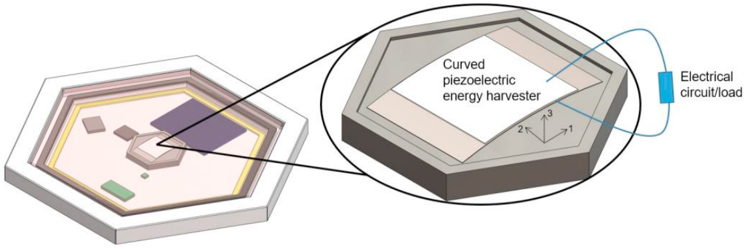
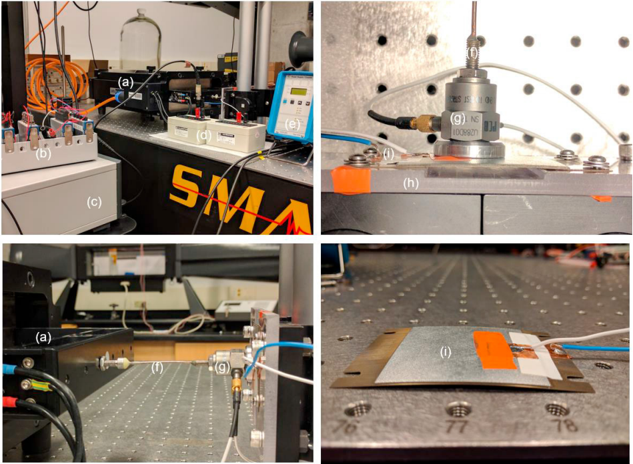
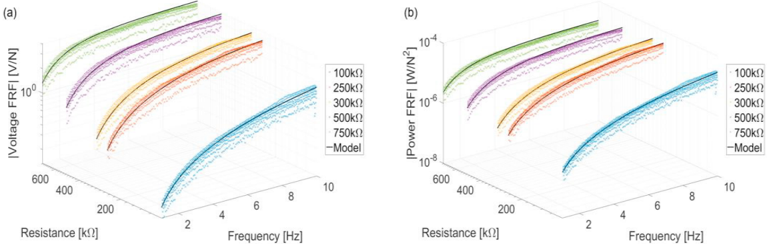
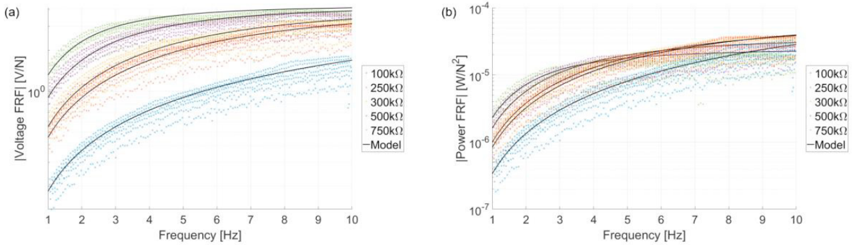
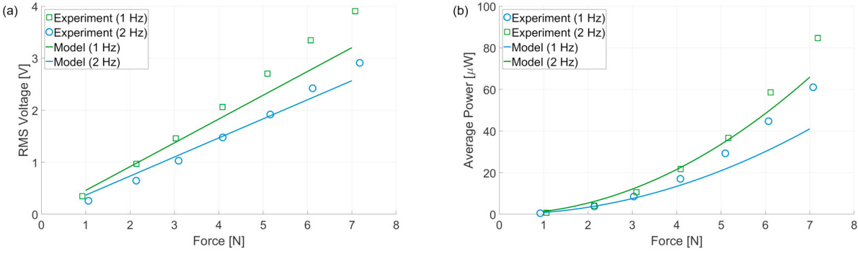
: The transformation of vibrations into low-power electricity has received growing attention over the past couple of decades. The goal in this research field is to power wireless sensors and other small electronic components by harvesting ambient mechanical energy. Piezoelectricity is arguably the most popular transduction mechanism for converting mechanical vibrations into electrical energy. As a promising concept of piezoelectric energy conversion, smart paver tiles are proposed to harness human steps for energy harvesting and a wide range of critical sensing applications ranging from security to healthcare. In this work, we explore the use of a curved piezoelectric transducer (specifically a THUNDER® configuration) for smart paver tiles both analytically and experimentally. Following the description of the smart paver tiles developed, an analytical model is developed and closed-form electromechanical frequency response functions are obtained. Experiments are performed for a range of excitation frequencies (1-10 Hz ), electrical load resistance values, and low force levels. It is shown that the first-order electromechanical model successfully represents the governing dynamics.
Overview
The claims and statistics of this paper haven’t been checked yet.
Run the check — free, no account needed. It reads the open-access text and checks the sources it cites.
Integrity signals
Registry
Cites
Statistics
Figures
Verification
Claims the paper makes
The claims and statistics of this paper haven’t been checked yet.
Run the check — free, no account needed. It reads the open-access text and checks the sources it cites.
Self-check
Percentages, sums and reported differences re-computed from the paper’s own numbers.
The self-check needs the paper’s full text.
Citations
Cites
Piezoelectric Energy Harvesting
Ertürk, A., & Inman, D. J. (2011) · Wiley eBooks · doi:10.1002/9781119991151 · Cited by 1,912
Cook-Chennault, K. A., Thambi, N., & Sastry, A. M. (2008) · Smart Materials and Structures · doi:10.1088/0964-1726/17/4/043001 · Cited by 1,250
Piezoelectric energy harvesting: State-of-the-art and challenges
Toprak, A., & Tigli, O. (2014) · Applied Physics Reviews · doi:10.1063/1.4896166 · Cited by 421
Advances in Energy Harvesting Methods
Elvin, N. G., & Ertürk, A. (2013) · Springer eBooks · doi:10.1007/978-1-4614-5705-3 · Cited by 376
Zhao, S., & Ertürk, A. (2014) · Sensors and Actuators A Physical · doi:10.1016/j.sna.2014.04.019 · Cited by 85
Research works printed but not linked: 1
- ANSI/IEEE Standard on Piezoelectricity 176-1987, 1-66 (1984).
Cited by
Sorted by citations
A review of piezoelectric energy harvesting tiles: Available designs and future perspective
Sharma, S., Kiran, R., Azad, P., & Vaish, R. (2022) · Energy Conversion and Management · doi:10.1016/j.enconman.2022.115272 · Cited by 194
Piezoelectric Sensors Pressed by Human Footsteps for Energy Harvesting
Selim, K. K., Smaili, I. H., Yehia, H. M., Ahmed, M. M. R., & Saleeb, D. A. (2024) · Energies · doi:10.3390/en17102297 · Cited by 28
Metadata
- Authors
- Kathpalia, B., Tan, D., Stern, I., Valdes, F., Kim, S., & Erturk, A.
- Affiliations
- Georgia Institute of Technology (US)
- Georgia Tech Research Institute (US)
- Georgia Southern University (US)
- Venue
- Procedia Computer Science
- Publisher
- Elsevier BV
- Published
- 2017
- Volume
- 109
- Pages
- 1060-1066
- ISSN
- 1877-0509 (ISSN-L)
- OpenAlex
- W2626056553
- Cited by
- 16
- References
- 5
- Citations by year
- 2025: 3 · 2024: 3 · 2023: 1 · 2022: 4 · 2021: 1 · 2018: 4
- FWCI
- 2.57
- Type
- conference paper
- Language
- en
- Open access
- diamond
- doi.org
- Licence
- Locations
- Procedia Computer Science (publishedVersion, cc-by-nc-nd)
- Funders
- National Aeronautics and Space Administration
- Wells Fargo
- Research Institute, Georgia Institute of Technology
- Georgia Institute of Technology
- Kennedy Space Center
- Topics
- Physical Sciences › Engineering › Mechanical Engineering › Innovative Energy Harvesting Technologies
- Physical Sciences › Engineering › Biomedical Engineering › Advanced Sensor and Energy Harvesting Materials
- Physical Sciences › Engineering › Mechanics of Materials › Ultrasonics and Acoustic Wave Propagation
- Keywords
- piezoelectric energy harvesting, electromechanical modeling, frequency response function, wireless sensor power supply
About these checks
Registry, retraction, Cites and statistics results are computed, not judged, with one exception: a printed reference that no index lists is read once by a model before it counts as a citation error. Claims are extracted by a model and kept only when their quote appears verbatim in the text; each cited source is then checked, with a model’s help, for whether it says what the claim relies on. Those verdicts can be wrong — read the claim’s quote and the cited source before relying on one.
Statistics and arithmetic are recomputed, not judged.
Confidence bands are shown only for fields calibrated on our annotated test set. None is calibrated yet, so no band is shown.
What counts as a claim ›How we measure confidence ›How we check this ›
Are you an author, or do you see a problem with this page? Request a review
