

The DOI matches its Crossref record; 1 of the 1 references it cites were found in a registry or an index.
Simulation of automated transport offers for the city of Brunswick
Open accessAbstract
The introduction of automated vehicles in the transport system is widely expected to have significant impact on traffic flow and safety, mobility behavior, car ownership and modal usage. Not only the replacement of conventional passenger cars by automated ones but also other forms of mobility offers are being discussed, such as the introduction of vehicle-on-demand fleets. When investigating the effects of such systems, the changes in the perceived travel time have to be regarded. Within this paper, the effects of introducing automated vehicles as well as vehicle-on-demand and shared vehicle-on-demand offers are presented. Eight different simulation settings with different fleet sizes and shares of private automated vehicles were evaluated using an agent-based demand model. The factors for value of time were obtained from a stated preference user survey. The results show only minor changes in the modal split and the amount of rides for the city of Brunswick due to the relatively small travel distances prevailing.
Overview
The claims and statistics of this paper haven’t been checked yet.
Run the check — free, no account needed. It reads the open-access text and checks the sources it cites.
Integrity signals
Registry
Cites
Statistics
Figures
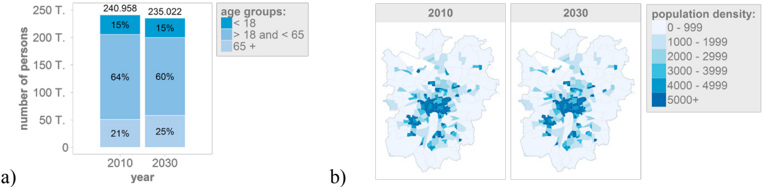
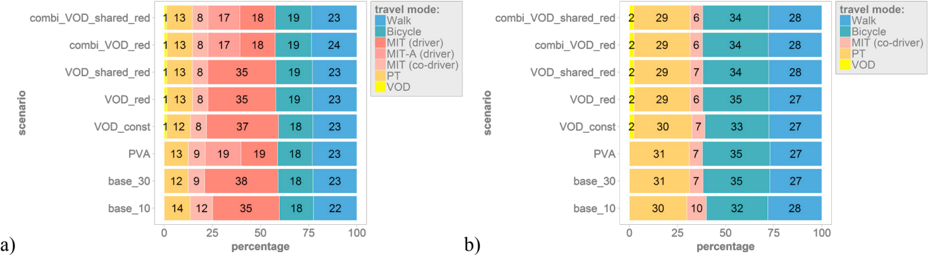
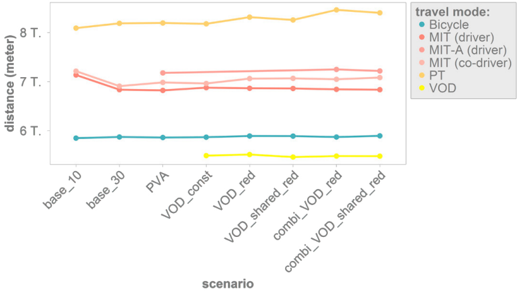
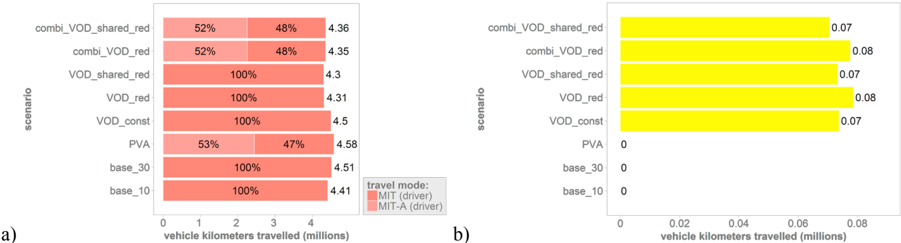
Verification
Claims the paper makes
The claims and statistics of this paper haven’t been checked yet.
Run the check — free, no account needed. It reads the open-access text and checks the sources it cites.
Claims other papers make about this one
Each is checked against this paper’s own text: does it say what the citing paper says it does?
The cited source says what the claim attributes to it.
In the citing paper
“Though many positive impacts from autonomous ride-sharing services are expected, Cyganski et al. (2018) observe a lower acceptance for ride-sharing, compared to autonomous taxi-based services in Brunswick (Germany).”
From Shared autonomous vehicle services: A comprehensive review (2020) · cites this paper as Cyganski et al. (2018)
Self-check
Percentages, sums and reported differences re-computed from the paper’s own numbers.
The self-check needs the paper’s full text.
Citations
Cites
Milakis, D., van Arem, B., & van Wee, B. (2017) · Journal of Intelligent Transportation Systems · doi:10.1080/15472450.2017.1291351 · Cited by 963
Research works printed but not linked: 9
- Trommer, 2016, Autonomous Driving - The Impact of Vehicle Automation on Mobility Behaviour
- Fagnant, DJ, Kockelman KM.The travel and environmental implications of shared autonomous vehicles, using agent-based model scenarios. In: Transportation Research Board 93th Annual Meeting. No. 15-1962. 2014. · DOI · Paper page
- Meyer, 2017, Autonomous vehicles: The next jump in accessibilities?, Research in Transportation Economics, 62, 80, 10.1016/j.retrec.2017.03.005 · DOI · Paper page
- Bischoff, 2015, Simulation of City-wide Replacement of Private Cars with Autonomous Taxis in Berlin, Procedia Computer Science, Vol.83, 2016, pp. 237-244.7. Fagnant, DJ, Kockelman, KM. Dynamic ride-sharing and optimal fleet sizing for a system of shared autonomous vehicles in Austin, Texas. In: Transportation Research Board 94th Annual Meeting. No., 15-1962
- Bienzeisler, 2017, Verkehrliche Auswirkungen einer autonomen Carsharingflotte, ATZ-Automobiltechnische Zeitschrift, 119, 66, 10.1007/s35148-017-0064-2 · DOI
- Kolarova, V, Steck, F, Cyganski, R, Trommer, S. Estimation of value of time for autonomous driving using revealed and stated preference method. In: European Transport Conference, 2017. · DOI
- Heinrichs M, Krajzewicz D, Cyganski R, von Schmidt A. Introduction of car sharing into existing car fleets in microscopic travel demand modelling. In: Personal and Ubiquitous Computing, 2017. · DOI
- Steck F, Kolarova V, Bahamonde-Birke F, Trommer S, Lenz B. How autonomous driving may affect the value of travel time savings for commuting. In: Proceedings of the 97th Annual Meeting of the TRB, 2008.
- Zimmer W, Blanck R, Bergmann T, Mottschall M, von Waldenfels R, Cyganski R, Wolfermann A, Winkler C, Heinrichs M, Dünnebeil F, Fehrenbach H, Kämper C, Biemann K, Kräck J, Peter M, Zandonella R, Bertschmann D. Endbericht RENEWBILITY III - Optionen einer Dekarbonisierung des Verkehrssektors. 2016. · DOI
Cited by
Shared autonomous vehicle services: A comprehensive review
Narayanan, S., Chaniotakis, E., & Antoniou, C. (2020) · Transportation Research Part C: Emerging Technologies · doi:10.1016/j.trc.2019.12.008 · Cited by 691
Metadata
- Authors
- Cyganski, R., Heinrichs, M., von Schmidt, A., & Krajzewicz, D.
- Affiliations
- Deutsches Zentrum für Luft- und Raumfahrt e. V. (DLR) (DE)
- Corresponding author
- Cyganski, Rita
- Venue
- Procedia Computer Science
- Publisher
- Elsevier BV
- Published
- 2018
- Volume
- 130
- Pages
- 872-879
- ISSN
- 1877-0509 (ISSN-L)
- OpenAlex
- W2801663809
- Cited by
- 29
- References
- 1
- Citations by year
- 2026: 2 · 2025: 4 · 2024: 5 · 2023: 6 · 2022: 2 · 2021: 4 · 2020: 4 · 2019: 1 · 2018: 1
- FWCI
- 2.56
- Type
- conference paper
- Language
- en
- Open access
- diamond
- doi.org
- Licence
- Locations
- Procedia Computer Science (publishedVersion, cc-by-nc-nd)
- elib (German Aerospace Center) (acceptedVersion)
- Topics
- Social Sciences › Transportation › Transportation and Mobility Innovations
- Social Sciences › Transportation › Transportation Planning and Optimization
- Physical Sciences › Engineering › Control and Systems Engineering › Traffic control and management
- Keywords
- autonomous vehicles, modal split, travel time perception, value of time, stated preference, fleet size, car ownership, mobility behavior, Braunschweig
About these checks
Registry, retraction, Cites and statistics results are computed, not judged, with one exception: a printed reference that no index lists is read once by a model before it counts as a citation error. Claims are extracted by a model and kept only when their quote appears verbatim in the text; each cited source is then checked, with a model’s help, for whether it says what the claim relies on. Those verdicts can be wrong — read the claim’s quote and the cited source before relying on one.
Statistics and arithmetic are recomputed, not judged.
Confidence bands are shown only for fields calibrated on our annotated test set. None is calibrated yet, so no band is shown.
What counts as a claim ›How we measure confidence ›How we check this ›
Are you an author, or do you see a problem with this page? Request a review
