

A stratigraphic framework for abrupt climatic changes during the Last Glacial period based on three synchronized Greenland ice-core records: refining and extending the INTIMATE event stratigraphy
Open accessThe DOI matches its Crossref record; 91 of the 91 references it cites were found in a registry or an index; none of the 54 sources its claims cite is checked for support yet.
Abstract
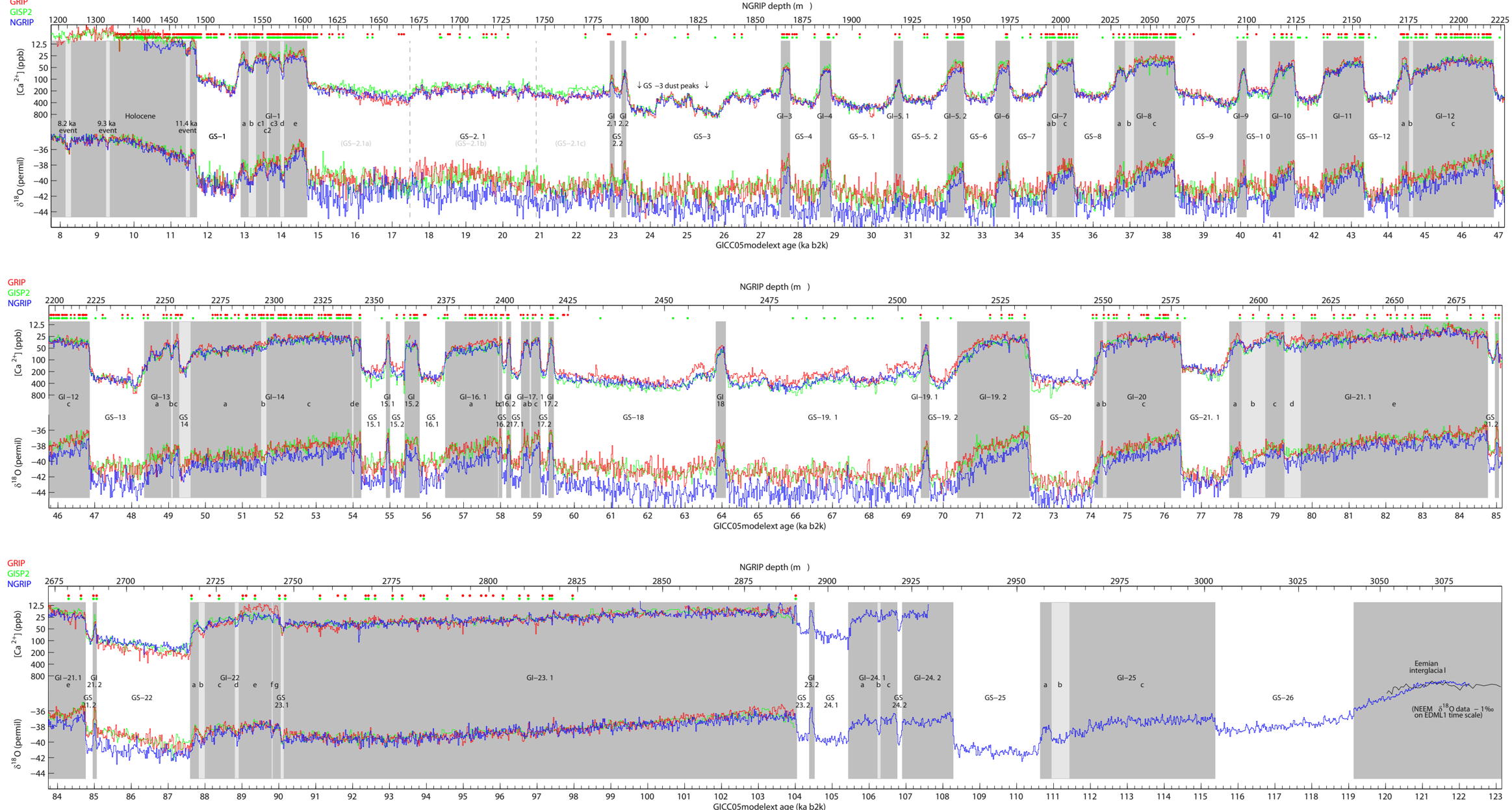
Due to their outstanding resolution and well-constrained chronologies, Greenland ice-core records provide a master record of past climatic changes throughout the Last Interglacial–Glacial cycle in the North Atlantic region. As part of the INTIMATE (INTegration of Ice-core, MArine and TErrestrial records) project, protocols have been proposed to ensure consistent and robust correlation between different records of past climate. A key element of these protocols has been the formal definition and ordinal numbering of the sequence of Greenland Stadials (GS) and Greenland Interstadials (GI) within the most recent glacial period. The GS and GI periods are the Greenland expressions of the characteristic Dansgaard–Oeschger events that represent cold and warm phases of the North Atlantic region, respectively. We present here a more detailed and extended GS/GI template for the whole of the Last Glacial period. It is based on a synchronization of the NGRIP, GRIP, and GISP2 ice-core records that allows the parallel analysis of all three records on a common time scale. The boundaries of the GS and GI periods are defined based on a combination of stable-oxygen isotope ratios of the ice (δ18O, reflecting mainly local temperature) and calcium ion concentrations (reflecting mainly atmospheric dust loading) measured in the ice. The data not only resolve the well-known sequence of Dansgaard–Oeschger events that were first defined and numbered in the ice-core records more than two decades ago, but also better resolve a number of short-lived climatic oscillations, some defined here for the first time. Using this revised scheme, we propose a consistent approach for discriminating and naming all the significant abrupt climatic events of the Last Glacial period that are represented in the Greenland ice records. The final product constitutes an extended and better resolved Greenland stratotype sequence, against which other proxy records can be compared and correlated. It also provides a more secure basis for investigating the dynamics and fundamental causes of these climatic perturbations.
Overview
CoChat Summary
TL;DR
This paper presents a revised and extended INTIMATE event stratigraphy for Greenland stadials (GS) and interstadials (GI) during the Last Glacial, based on synchronized NGRIP, GRIP, and GISP2 ice-core records on the GICC05modelext time scale. It refines and extends the GS/GI numbering, resolves additional short-lived events and sub-events, and provides a stratotype for correlating other proxy records.
Key findings
- The synchronized three-core template defines GS/GI boundaries using both δ¹⁸O and calcium ion concentration ([Ca²⁺]) at 20-year resolution; it covers 104–8 ka b2k with three cores and extends to c. 120 ka b2k using NGRIP supported by preliminary NEEM data.
- New or revised events include GI-5.1 at c. 30.7 ka b2k within the former GS-5, splitting it into GS-5.1, GI-5.1, and GS-5.2 and renaming former GI-5 to GI-5.2; GI-2 is split into GI-2.1 and GI-2.2 bracketing GS-2.2; GI-1c is subdivided into GI-1c1, GI-1c2, and GI-1c3; GI-7, GI-8, and GI-12 are subdivided; and additional short events include GI-15.1, GI-16.2, GI-17.1/17.2, GI-19.1, and GI-21.1/21.2.
- Sub-events are defined by the criteria that they register in all three cores for at least two consecutive 20-year data points (≥40 years) and involve a δ¹⁸O shift of 1‰ and a factor 2 change in [Ca²⁺]; interstadial onsets typically show δ¹⁸O changing by about 4‰ over one or two 20-year data points and [Ca²⁺] changing by up to an order of magnitude.
- Some intervals are treated as quasi-stadial or super-interstadial: GS-14 is regarded as quasi-stadial between GI-13 and GI-14, GS-23.1 as quasi-stadial, and the period 104–87.6 ka b2k as one super-interstadial of 16.5 kyr; the 11.4 ka event is defined at 11.40–11.52 ka b2k.
Methods
- Data: δ¹⁸O and [Ca²⁺] records from NGRIP, GRIP, and GISP2 on the common GICC05modelext time scale; GICC05 is annual-layer counted in NGRIP to 60 ka b2k and extended by an ice-flow model below, then transferred to GRIP and GISP2 using volcanic reference horizons; all records are resampled to 20-year resolution.
- Event definition: visual inspection by several investigators of the 20-year dataset, with onsets placed at the first clear mark of a transition; δ¹⁸O and [Ca²⁺] are used together, and uncertainties are estimated from transition steepness and agreement between proxies; preliminary NEEM data support definitions between GS-24.1 and GS-25.
- Analysis: event numbering and naming follow principles of meaningfulness, completeness, conservatism/uniqueness, and consistency; a Bayesian statistical classification method has been initiated but is not yet applied in this paper.
Limitations
- Stated: below 104 ka b2k, GRIP and GISP2 cannot be synchronized to GICC05modelext; below 107.6 ka b2k only NGRIP δ¹⁸O data are available, so event classification becomes less certain; GI-25 sub-events are tentative because the NEEM core lacks ice from 110–116 ka b2k.
- Stated: the GS-2 subdivision is only marginally supported and may reflect site differences between Summit (GRIP/GISP2) and NGRIP rather than a regional signal; GS-3 dust peaks show decoupled δ¹⁸O and [Ca²⁺] and provide no basis for subdivision; some existing definitions are retained for compatibility even where [Ca²⁺] supports older onsets.
- Evident: event boundaries depend on visual inspection and somewhat arbitrary sub-event thresholds; relative dating precision is better than 20 years over most of the combined records but varies with match-point spacing; the Bayesian classification approach is not yet applied, and independent dating for other archives remains a broader challenge.
Model-written summary. Check it against the paper before relying on it.
Integrity signals
Registry
Cites
Statistics
Figures
Verification
Claims the paper makes
0 Valid · 2 Not valid · 37 Not checked · 71 Own results and interpretations
A result the paper reports from its own data — it cites no other source for it, so there is none to check. The quote shows it is in the paper.
In the paper
“This apparent decoupling of d 18 O and [Ca 2þ ] is not observed elsewhere in the record.”
§ A stratigraphic framework for abrupt climatic changes during the Last Glacial period based on three synchronized Greenland ice-core records: refining and extending the INTIMATE event stratigraphy > 4.3. Stadial substructure
plain- Asserted: passes — The authors put it forward as true.
- Checkable: passes — It can be checked against evidence.
- Load-bearing: passes — The paper’s conclusions depend on it.
- Based: passes — The paper gives a reason why it holds.
A result the paper reports from its own data — it cites no other source for it, so there is none to check. The quote shows it is in the paper.
In the paper
“although GS-2b (designated GS-2.1b in Fig. 1) is characterized by slightly lower [Ca 2þ ] values than GS-2a and GS-2c”
§ A stratigraphic framework for abrupt climatic changes during the Last Glacial period based on three synchronized Greenland ice-core records: refining and extending the INTIMATE event stratigraphy > 4.3. Stadial substructure
plain- Asserted: passes — The authors put it forward as true.
- Checkable: passes — It can be checked against evidence.
- Load-bearing: unclear — It is unclear whether the paper’s conclusions depend on it.
- Based: passes — The paper gives a reason why it holds.
A result the paper reports from its own data — it cites no other source for it, so there is none to check. The quote shows it is in the paper.
In the paper
“It is now clear that several interstadials show internal structure that resembles that of GI-1.”
§ A stratigraphic framework for abrupt climatic changes during the Last Glacial period based on three synchronized Greenland ice-core records: refining and extending the INTIMATE event stratigraphy > 1. Introduction
boostedstates an association- Asserted: passes — The authors put it forward as true.
- Checkable: passes — It can be checked against evidence.
- Load-bearing: passes — The paper’s conclusions depend on it.
- Based: passes — The paper gives a reason why it holds.
A check of a cited source is scheduled, or we don’t hold its full text yet; the claim is checked once it runs.
In the paper
“In addition, beyond 48 ka b2k, the DeO variability reflected in the Greenland records includes a number of short-lived events of similar amplitude to those recognized in the initial schemes of Johnsen et al. (1992) and Dansgaard et al. (1993).”
§ A stratigraphic framework for abrupt climatic changes during the Last Glacial period based on three synchronized Greenland ice-core records: refining and extending the INTIMATE event stratigraphy > 1. Introduction
What the sources say
- Not checked yetcites Johnsen et al., 1992 matched to “Irregular glacial interstadials recorded in a new Greenland ice core” (1992) source
A check is scheduled.
- Not checked yetcites Dansgaard et al., 1993 matched to “Evidence for general instability of past climate from a 250-kyr ice-core record” (1993) source
A check is scheduled.
plainstates an association- Asserted: passes — The authors put it forward as true.
- Checkable: passes — It can be checked against evidence.
- Load-bearing: unclear — It is unclear whether the paper’s conclusions depend on it.
- Based: passes — The paper gives a reason why it holds.
- Not checked yet
A result the paper reports from its own data — it cites no other source for it, so there is none to check. The quote shows it is in the paper.
In the paper
“we find that no other stadials exhibit structures that would warrant formal sub-divisions”
§ A stratigraphic framework for abrupt climatic changes during the Last Glacial period based on three synchronized Greenland ice-core records: refining and extending the INTIMATE event stratigraphy > 4.3. Stadial substructure
plain- Asserted: passes — The authors put it forward as true.
- Checkable: passes — It can be checked against evidence.
- Load-bearing: passes — The paper’s conclusions depend on it.
- Based: passes — The paper gives a reason why it holds.
37 more claims
Create a free account to see all 110 claims and to verify the 47 references still open.
- It may state two separate claims as one. 51
- Probably not a substantial claim. 33
- The quote only partly states this claim. 1
Claims other papers make about this one
Each is checked against this paper’s own text: does it say what the citing paper says it does?
In the citing paper
“In Greenland ice cores, the water stable isotope data (e.g.δ 18 O ice ) record two unusually short and small Greenland interstadials, GI-2.1 and GI-2.2 (Rasmussen et al., 2014), briefly interrupting the long cold period formed by the two Greenland stadials GS-2 and GS-3 (Fig. 1a).”
From Synchronizing ice-core and U ∕ Th timescales in the Last Glacial Maximum using Hulu Cave 14 C and new 10 Be measurements from Greenland and Antarctica (2023) · cites this paper as Rasmussen et al., 2014
In the citing paper
“While δ 18 O ice does not show a clear imprint of the Heinrich events, Greenland ice-core calcium data show two periods of heightened concentration during GS-3 (Fig. 1a; Rasmussen et al., 2014) that could be related to atmospheric reorganization around HE-2 (Adolphi et al., 2018), although there is debate about this attribution (Hughes and Gibbard, 2015).”
From Synchronizing ice-core and U ∕ Th timescales in the Last Glacial Maximum using Hulu Cave 14 C and new 10 Be measurements from Greenland and Antarctica (2023) · cites this paper as Rasmussen et al., 2014
In the citing paper
“The shift in IntCal20 now moves absolute calendar dates older by about 50 years and in the direction of the Holocene boundary as observed in Greenland ice, dated at 11,653 ± 99 cal BP (maximum counting error (MCE), equivalent to 2-σ, Rasmussen et al. 2014).”
From Recent Developments in Calibration for Archaeological and Environmental Samples (2020) · cites this paper as Rasmussen et al. 2014
In the citing paper
“With the development of the Greenland Ice Core Chronology 2005 (GICC05) that placed the GRIP, NGRIP, and GISP2 ice cores on a common time scale (Rasmussen et al., 2006(Rasmussen et al., , 2014)), the age of the onset of the last stadial (Fig. 1), termed the Greenland Stadial 1 (GS-1), was established as 12,846 ± 4 yr [BP 1950, GICC05 or 12,896 ± 4 yr [b2k, GICC05].”
From Comprehensive refutation of the Younger Dryas Impact Hypothesis (YDIH) (2023) · cites this paper as Rasmussen et al., 2014
In the citing paper
“The calibrated ages of the tree samples are consistent with sharp increase in Greenland δ 18 O values between the cooler GI-1b (the IACP, see Sections 3.3 and 9.2) and the warmer GI-1a interval (Rasmussen et al., 2014).”
From Comprehensive refutation of the Younger Dryas Impact Hypothesis (YDIH) (2023) · cites this paper as Rasmussen et al., 2014
4 more claims about this paper
Create a free account to see every claim other papers make about this one.
Self-check
Percentages, sums and reported differences re-computed from the paper’s own numbers.
Each contradiction between two passages listed here was confirmed by an independent check.
Rated minor: it would not touch a result — a value no result rests on, a p-value that stays on the same side of the significance level, or a conflict that is clerical, resolved elsewhere in the paper, or outside its own findings.
In the paper
§ A stratigraphic framework for abrupt climatic changes during the Last Glacial period based on three synchronized Greenland ice-core records: refining and extending the INTIMATE event stratigraphy > 5.1. Adjusting the existing event stratigraphy (8e48 ka b2k)
“The 8.2 ka and 9.2 ka events have been subject to detailed investigations based on data from several ice cores (Rasmussen et al., 2007), and we recommend no changes to the previously published definitions.”
§ A stratigraphic framework for abrupt climatic changes during the Last Glacial period based on three synchronized Greenland ice-core records: refining and extending the INTIMATE event stratigraphy > 5.1. Adjusting the existing event stratigraphy (8e48 ka b2k)
“In line with the naming of the 8.2 ka and 9.3 ka events, we refer to this event as the '11.4 ka event'.”
Rated minor: it would not touch a result — a value no result rests on, a p-value that stays on the same side of the significance level, or a conflict that is clerical, resolved elsewhere in the paper, or outside its own findings.
In the paper
§ A stratigraphic framework for abrupt climatic changes during the Last Glacial period based on three synchronized Greenland ice-core records: refining and extending the INTIMATE event stratigraphy > 5.1. Adjusting the existing event stratigraphy (8e48 ka b2k)
“However, the cold episode at 13.60e13.64ka b2k within GI-1c fulfils the criteria for classification as a sub-event”
§ A stratigraphic framework for abrupt climatic changes during the Last Glacial period based on three synchronized Greenland ice-core records: refining and extending the INTIMATE event stratigraphy > 6. Discussion and final remarks
“Start of GI-1c1 | 1554.75 13,600 b | 156 | 13 | | | Start of GI-1c2 | 1557.08 13,660 b | 158 | 13 | |”
Rated minor: it would not touch a result — a value no result rests on, a p-value that stays on the same side of the significance level, or a conflict that is clerical, resolved elsewhere in the paper, or outside its own findings.
In the paper
§ A stratigraphic framework for abrupt climatic changes during the Last Glacial period based on three synchronized Greenland ice-core records: refining and extending the INTIMATE event stratigraphy > 2. The INTIMATE approach
“(NEEM δ 18 O data -1‰ on EDML1 time scale)”
§ A stratigraphic framework for abrupt climatic changes during the Last Glacial period based on three synchronized Greenland ice-core records: refining and extending the INTIMATE event stratigraphy > 2. The INTIMATE approach
“In the Eemian interglacial, NGRIP data are extended by NEEM d 18 O data offset by 2‰ (NEEM community members, 2013).”
Citations
Cites
Evidence for general instability of past climate from a 250-kyr ice-core record
Dansgaard, W., Johnsen, S. J., Clausen, H. B., Dahl-Jensen, D., Gundestrup, N. S., Hammer, C. U., Hvidberg, C. S., Steffensen, J. P., Sveinbjörnsdottir, A. E., Jouzel, J., et al. (1993) · Nature · doi:10.1038/364218a0 · Cited by 4,762
Self-citationHigh-resolution record of Northern Hemisphere climate extending into the last interglacial period
North Greenland Ice Core Project members (2004) · Nature · doi:10.1038/nature02805 · Cited by 3,170
Heinrich, H. (1988) · Quaternary Research · doi:10.1016/0033-5894(88)90057-9 · Cited by 2,459
A new Greenland ice core chronology for the last glacial termination
Rasmussen, S. O., Andersen, K. K., Svensson, A. M., Steffensen, J. P., Vinther, B. M., Clausen, H. B., Siggaard‐Andersen, M. ‐., Johnsen, S. J., Larsen, L. B., Dahl‐Jensen, D., et al. (2006) · Journal of Geophysical Research: Atmospheres · doi:10.1029/2005jd006079 · Cited by 2,304
Self-citationSea-level fluctuations during the last glacial cycle
Siddall, M., Rohling, E. J., Almogi-Labin, A., Hemleben, C., Meischner, D., Schmelzer, I., & Smeed, D. A. (2003) · Nature · doi:10.1038/nature01690 · Cited by 1,626 · cited 2×
“Another feature of the 68 e 48 ka b2k period is that sea level was rising at the highest rate around 60 e 55 ka b2k, at the time where ‘ fl ickering ’ behaviour is most prevalent in the Greenland records (Siddall et al., 2003).”
Bond, G., Heinrich, H., Broecker, W., Labeyrie, L., McManus, J., Andrews, J., Huon, S., Jantschik, R., Clasen, S., Simet, C., et al. (1992) · Nature · doi:10.1038/360245a0 · Cited by 1,603
Hemming, S. R. (2004) · Reviews of Geophysics · doi:10.1029/2003rg000128 · Cited by 1,526
Irregular glacial interstadials recorded in a new Greenland ice core
Johnsen, S. J., Clausen, H. B., Dansgaard, W., Fuhrer, K., Gundestrup, N., Hammer, C. U., Iversen, P., Jouzel, J., Stauffer, B., & steffensen, J. P. (1992) · Nature · doi:10.1038/359311a0 · Cited by 1,466
Self-citationOne-to-one coupling of glacial climate variability in Greenland and Antarctica
Members, E. C. (2006) · Nature · doi:10.1038/nature05301 · Cited by 1,305
Abrupt increase in Greenland snow accumulation at the end of the Younger Dryas event
Alley, R. B., Meese, D. A., Shuman, C. A., Gow, A. J., Taylor, K. C., Grootes, P. M., White, J. W. C., Ram, M., Waddington, E. D., Mayewski, P. A., et al. (1993) · Nature · doi:10.1038/362527a0 · Cited by 1,206
Cited by
Items 2,401–2,483 of 2,483
Artemova, A. V., Горбаренко, С. А., Ковалева, Г. В., & Кузьмина, В. А. (2024) · doi:10.35735/9785604968338_488
Зарецкая, Н. Е., Vashkov, A., Рыбалко, А. Е., Баранов, Д. В., & Ruchkin, M. V. (2024) · doi:10.35735/9785604968338_531
Vonhof, H. (2024) · Climate of the past · doi:10.5194/cp-2024-27-ac1
Vonhof, H. (2024) · Climate of the past · doi:10.5194/cp-2024-27-ac2
Quand NOUS serons la Préhistoire… Ou comment l'archéologie peut renseigner le futur
Cheval, C. (2024) · HAL
Modern issues in lithology and marine geology – 2024. Science. Training. Practice
(2024) · LCC MAKS Press eBooks · doi:10.29003/m4194.978-5-317-07258-2
GÜNEY KAHRAMANMARAŞ’IN HOLOSEN DÖNEM PALEOİKLİMİ: MAKROFİZİKSEL İKLİM MODELİ ÖN SONUÇLARI
Tekin, A. (2025) · Dicle Üniversitesi Sosyal Bilimler Enstitüsü Dergisi · doi:10.15182/diclesosbed.1604474
Bioindicators as a tool for reconstructing climate change
Rychel, J., Obremska, M., Niska, M., Płóciennik, M., & Sieradz, D. (2025) · Przegląd Geologiczny · doi:10.7306/2025.16
Putting the recent 100-year of Asian summer monsoon weakening into context
Zhao, J., Cheng, H., Pan, L., Wang, K., Cui, J., Liang, M.-Q., Dong, X., Lu, J., Li, Q., & Yang, Y. (2025) · Science Bulletin · doi:10.1016/j.scib.2025.05.006
CLIMATIC EVENTS OF THE END- LATE GLACIAL ON THE MIDDLE AMUR LOWLAND
Базарова, В. Б., Климин, М. А., Сергеевна, Л. М., & Makarova, T. R. (2025) · doi:10.35735/9785605278788_376
Palaeolithic people returned north earlier than expected
(2025) · Nature Ecology & Evolution · doi:10.1038/s41559-025-02722-7
Andersen, J. L., Egholm, D. L., Knudsen, M. F., Linge, H. C., Jansen, J. D., Olsen, J., & Tikhomirov, D. (2016)
Andersen, J. L., Egholm, D. L., Knudsen, M. F., Linge, H. C., Jansen, J. D., Olsen, J., & Tikhomirov, D. (2016)
Quaternary Stratigraphy and Geomorphology of the Bavarian Alpine Foreland
Lempe, B., & Mayr, C. (2025) · World geomorphological landscapes · doi:10.1007/978-3-031-77876-6_25
The Asian summer monsoon evolution from the late Younger Dryas to the early Holocene
Zhao, B., He, C., Zhao, K., Wang, Y., Wu, J., Wang, Q., Cheng, H., & Liang, Y. (2025) · Palaeogeography Palaeoclimatology Palaeoecology · doi:10.1016/j.palaeo.2025.113436
Callapez, P. M., Pimentel, R. J., Brandão, J. M., Mendes, M. M., Simões, L. R. D. O., & Lopes, F. C. (2025) · Thalassas An International Journal of Marine Sciences · doi:10.1007/s41208-025-00997-y
Oinonen, M., Arppe, L., Uusitalo, J., Helama, S., Nöjd, P., Mäkinen, H. H., Saranpää, P., & Mizohata, K. (2025) · Quaternary Geochronology · doi:10.1016/j.quageo.2025.101712
COMPOSITIONAL REGRESSION-BASED METHODS FOR SST RECONSTRUCTION
Donato, V. D., Jamka, J. M., & Fernández, J. A. M. (2020) · DUGiDocs (Universitat de Girona) · doi:10.26382/amq.2020.02
Rousseau, D., Bagniewski, W., & Ghil, M. (2022) · Publishing Network for Geoscientific and Environmental Data (PANGAEA) (Alfred Wegener Institute for Polar and Marine Research) · doi:10.1594/pangaea.942620
Alexander, B. (2021) · edoc (University of Basel) · doi:10.5451/unibas-ep84521
CREMONESI PLAJA, L. (2019) · Archivio Istituzionale della Ricerca (Universita Degli Studi Di Milano) · doi:10.13130/cremonesi-plaja-llorenc_phd2019-12-17
Bagniewski, W., Ghil, M., & Rousseau, D. (2021) · doi:10.1002/essoar.10506097.1
Vallée, A. (2025) · Archipel (Université du Québec à Montréal)
Mills, S., Mirea, P., Macklin, M., & Pannett, A. (2024) · ORCA Online Research @Cardiff (Cardiff University)
Branch, N., Montanari, C., Simmonds, M., Maggi, R., Negrino, F., & Hoyle, T. (2023) · CINECA IRIS Institutial Research Information System (University of Genoa)
Watson, S., Westaway, R., & Burnside, N. M. (2021) · Strathprints: The University of Strathclyde institutional repository (University of Strathclyde)
Campbell, J. W. (2022) · Durham e-Theses (Durham University)
Ownsworth, E. (2022) · Durham e-Theses (Durham University)
Le Magdalénien et le Creswellien
Noiret, P., & Léotard, J.-M. (2025) · ORBi (University of Liège)
Storme, A., Allemeersch, L., Cruz, F., Laloo, P., Vergauwe, R., Bourgeois, I., & Crombé, P. (2021) · Ghent University Academic Bibliography (Ghent University)
Response to the Technical Comment by Andrea Picin et al.
Cooper, A., Turney, C., Palmer, J., Hogg, A., McGlone, M., Wilmshurst, J., Lorrey, A., Heaton, T., Russell, J., McCracken, K., et al. (2021) · UNSWorks (UNSW Sydney)
Combe-Cullier (Lacave, Lot): An Exceptional Magdalenian Sequence on the Riverbanks of the Dordogne
Langlais, M., Sécher, A., Constans, G., Delvigne, V., Grubert, M., Laroulandie, V., Mallye, J., Pétillon, J., Renou, S., Rigaud, S., et al. (2025) · Gallia préhistoire · doi:10.4000/154ty
Sokołowski, R. J., Hrynowiecka, A., Czajkowska, M., & Moska, P. (2025) · Quaternary International · doi:10.1016/j.quaint.2025.110056
Meyer, M. V., Pedersen, J. B., Matzig, D. N., & Riede, F. (2025) · Journal of Lithic Studies · doi:10.2218/jls.10853
Ludwikowska‐Kędzia, M., Słodkowska, B., Woronko, B., & Szydłak, T. (2025) · Geological Quarterly · doi:10.7306/gq.1835
Wojcieszak, M., Leonard, H., Capuzzo, G., Snoeck, C., Groote, I. D., Pincé, P., Burlet, C., Verheyden, S., Deforce, K., Mulder, G. D., et al. (2025) · Ghent University Academic Bibliography (Ghent University)
de Jong, M. G. G., de nobel, J. S., Polman, E. M. N., Sterk, H. P., & Seijmonsbergen, A. C. (2024) · UvA-DARE (University of Amsterdam)
Fedorov, V. M. (2025) · Izvestiya Atmospheric and Oceanic Physics · doi:10.1134/s0001433825701610
Peer, P. V., Willems, M., Boudin, M., & Caes, W. (2026) · Heritage · doi:10.3390/heritage9040147
Moore, C. R., Larsson, S. A., Baalousha, M., Bizimis, M., Alam, M., West, A., LeCompte, M. A., Kennett, J. P., Kletetschka, G., Chouinard, J. E., et al. (2026) · doi:10.14293/pr2199.003441.v1
Paleoclimatic reconstruction from speleothem records in the dinaric karst caves
Quispe, G., & Flores, M. (2025) · International Journal of Geography Geology and Environment · doi:10.22271/27067483.2025.v7.i1b.617
Changing sea ice cover led to marine biodiversity shifts in the Late Quaternary
Schepper, S. D., Cordier, T., Skaar, K. S., Ray, J. L., Sadatzki, H., & Risebrobakken, B. (2026) · Communications Earth & Environment · doi:10.1038/s43247-026-03696-5
Baize, S., Antoine, P., & Locht, J. (2026) · Comptes Rendus Géoscience · doi:10.5802/crgeos.337
Massana, J. S., Rufí, I., & Soler, N. (2026) · L Anthropologie · doi:10.1016/j.anthro.2026.103487
Moore, C. R., Larsson, S. A., Baalousha, M., Bizimis, M., Alam, M., West, A., LeCompte, M. A., Kennett, J. P., Kletetschka, G., Chouinard, J. E., et al. (2026) · doi:10.14293/pr2199.003441.v2
Rodrigues, P. S., Bauer, W., Marques, G. T., & Kölling, M. (2026) · Marine Geology · doi:10.1016/j.margeo.2026.107860
Ohler, S., Lehmkuhl, F., Brill, D., Ageby, L., Händel, M., Römer, W., Fischer, P., Vött, A., & Schulte, P. (2026) · Quaternary Research · doi:10.1017/qua.2026.10097
Зыкин, В. С., Zykina, V. S., Kurbanov, R. N., Volvakh, A. O., Volvakh, N. E., & МАЛИКОВА, Е. Л. (2026) · Russian Geology and Geophysics · doi:10.2113/rgg20265008
Martínez‐Moreno, J., Valle, R. M., Sánchez‐Martínez, J., & Torcal, R. M. (2026) · Munibe Antropologia-Arkeologia · doi:10.21630/maa.2026.77.06
Fink, D. W. (2016) · The Australian Nuclear Science and Technology Organisation Institutional Repository (The Australian Nuclear Science and Technology Organisation)
Rate-induced Asian hydroclimate shifts at the onset of DO22
Zhang, Z., Wang, Y., Mu, Z., Lu, H., & Liu, D. (2026) · Climate Dynamics · doi:10.1007/s00382-026-08329-3
Coutard, S., Moine, O., Paris, C., Richter, C., & Horsák, M. (2026) · Quaternaire · doi:10.4000/16noo
Last glacial termination in Andorra, southeastern Pyrenees
Çiner, A., Turú, V., Oliva, M., Sarıkaya, M. A., Candaş, A., Altınay, O., Ventura, J., Yıldırım, C., Vidal-Romaní, J.-R., Carrasco, R. M., et al. (2026) · Quaternary Science Reviews · doi:10.1016/j.quascirev.2026.110199
Sirocko, F., Krebsbach, F., Forster, C., Dreher, F., Grosjean, M., Silva, L., Riechelmann, D. F. C., Seelos, K., & Schiebel, R. (2026) · Scientific Reports · doi:10.1038/s41598-026-64586-6
Сычева, С. А. (2026) · Stratigraphy and Geological Correlation · doi:10.1134/s0869593826700164
Nakamura, Y. (2023) · Institutional Repositories DataBase (IRDB) · doi:10.15083/0002012169
Silvani, F., Rita, F. D., Magri, D., Uda, L., Spadoni, G., Monaco, L., Giaccio, B., Mazzini, I., Porreca, M., Mirabella, F., et al. (2026) · Quaternary Science Reviews · doi:10.1016/j.quascirev.2026.110276
Time revisited: a revised chronology for the Robberg technocomplex in southern Africa
Arlt, S. (2026) · Quaternary Science Reviews · doi:10.1016/j.quascirev.2026.110285
Hidden Sea Level Effect on Mediterranean Outflow Proxies
Tarruella, J. P., & Sierro, F. J. (2026) · Quaternary · doi:10.3390/quat9050065
AIT-ETTAJER, A., Rizki, M., & Ouadrim, M. (2026) · Results in Earth Sciences · doi:10.1016/j.rines.2026.100182
Schenk, F., Bauersachs, T., Zander, P. D., Hezel, D. C., & Sirocko, F. (2026) · Quaternary · doi:10.3390/quat9050067
Islands of Stability, ice-age flips: pre-registration (r1)
Encarnacao, R. (2026) · Zenodo (CERN European Organization for Nuclear Research) · doi:10.5281/zenodo.23066234
Late Quaternary development of the River Thames, UK — a response to climate change
Green, C. P., Batchelor, C. R., & Young, D. S. (2026) · Proceedings of the Geologists Association · doi:10.1016/j.pgeola.2026.101238
Santaniello, F., Zambaldi, M., Pedrotti, G., Boschian, G., & Grimaldi, S. (2026) · Journal of Archaeological Science Reports · doi:10.1016/j.jasrep.2026.106131
Pérez-Rodríguez, N., Morales, J., Israde-Alcántara, I., Domínguez-Vázquez, G., Cervantes-Solano, M. Á., Goguitchaichvili, A., & Bautista, F. (2026) · Applied Geochemistry · doi:10.1016/j.apgeochem.2026.107141
de Montmollin, L., van Vugt, L., Schwörer, C., Gobet, E., Aregger, S. C., Paquet, V., Muhs, J., Damanik, A., Vogel, H., Anselmetti, F. S., et al. (2026) · Quaternary Science Reviews · doi:10.1016/j.quascirev.2026.110302
Delayed seasonal march of East Asian summer monsoonal rain belt during Heinrich Stadials
Zhang, J., Wei, T., Guo, C., & Yan, Q. Y. (2026) · Environmental Research Letters · doi:10.1088/1748-9326/aebcfb
Holocene Paleoenvironmental Evolution Recorded in Nearshore Deposits from the Zhejiang Coast
Xu, S., Zhang, Y., Zhao, D., Zhang, J., Chen, P., Zhu, Z., Yang, L., Xie, Y., & Jia, J. (2026) · Geosciences · doi:10.3390/geosciences16110461
Ro, S., Han, C., Han, Y., Hur, S. D., Ro, C., Steffensen, J. P., Svensson, A. M., Fischer, H., Burke, A., Lee, K., et al. (2026) · Proceedings of the National Academy of Sciences · doi:10.1073/pnas.2618898123
Self-citationLiu, Y., Hou, L., Liu, L., Sulaman, A., & Muhammad, F. (2023) · doi:10.3897/zookeys.1179.96015.figure5
Derkachev, A., Gorbarenko, S., Portnyagin, M., Zhong, Y., Nikolaeva, N., Shi, X., & Liu, Y. (2023) · doi:10.3389/feart.2022.971404.s002
Lomax, J., Wolf, D., Wolpert, U. T., Sahakyan, L., Hovakimyan, H., Faust, D., & Fuchs, M. (2021) · doi:10.3389/feart.2021.755084.s001
Multidecadal storage effects on the water-isotopic composition of ice coresPreprint
Rozmiarek, K. S., Morris, V., Chase, B. M., Wainright, S. P., Vaughn, B. H., Abel, R., Markle, B. R., & Jones, T. R. (2026) · doi:10.5194/egusphere-2026-6115
Luaces, S. C., de Castro, N. M. L., Riveiro, N. L., & Romero, E. G. (2026) · Investigo Institutional repository of UVigo (Universidade de Vigo)
Metadata
- Authors
- Rasmussen, S. O., Bigler, M., Blockley, S. P., Blunier, T., Buchardt, S. L., Clausen, H. B., Cvijanovic, I., Dahl-Jensen, D., Johnsen, S. J., Fischer, H., Gkinis, V., Guillevic, M., Hoek, W. Z., Lowe, J. J., Pedro, J. B., Popp, T., Seierstad, I. K., Steffensen, J. P., Svensson, A. M., Vallelonga, P., Vinther, B. M., Walker, M. J. C., Wheatley, J. J., & Winstrup, M.
- Affiliations
- University of Copenhagen (DK)
- University of Bern (CH)
- Royal Holloway University of London (GB)
- Utrecht University (NL)
- Aberystwyth University (GB)
- University of Sheffield (GB)
- Corresponding author
- Rasmussen, Sune O.
- ORCID
- Venue
- Quaternary Science Reviews
- Publisher
- Elsevier BV
- Published
- 2014-12
- Volume
- 106
- Pages
- 14-28
- ISSN
- 0277-3791 (ISSN-L)
- OpenAlex
- W2007331923
- Semantic Scholar
- 63a77c21038b7488e096aef634a22722ed8451b1
- Cited by
- 2,478
- References
- 91
- Citations by year
- 2026: 216 · 2025: 229 · 2024: 219 · 2023: 269 · 2022: 273 · 2021: 313 · 2020: 235 · 2019: 204 · 2018: 183 · 2017: 137 · 2016: 113 · 2015: 71 · 2014: 16
- FWCI
- 48.17
- Type
- journal article
- Language
- en
- Open access
- hybrid
- doi.org
- Licence
- cc-by-nc-sa
- www.elsevier.com/tdm/userlicense/1.0/ (tdm)
- www.elsevier.com/legal/tdmrep-license (tdm)
- creativecommons.org/licenses/by-nc-sa/3.0/ (vor)
- Locations
- Quaternary Science Reviews (publishedVersion, cc-by-nc-sa)
- Research at the University of Copenhagen (University of Copenhagen) (publishedVersion)
- Helmholtz Centre for Ocean Research Kiel (GEOMAR) (acceptedVersion, other-oa)
- HAL (submittedVersion, other-oa)
- Bern Open Repository and Information System (University of Bern) (submittedVersion, cc-by-nc-sa)
- Utrecht University Repository (Utrecht University) (submittedVersion, other-oa)
- Oskar-Bordeaux (Universite de Bordeaux) (submittedVersion)
- Funders
- Joint Institute for the Study of the Atmosphere and Ocean (JISAO)
- Topics
- Physical Sciences › Earth and Planetary Sciences › Atmospheric Science › Geology and Paleoclimatology Research
- Physical Sciences › Earth and Planetary Sciences › Atmospheric Science › Cryospheric studies and observations
- Physical Sciences › Environmental Science › Global and Planetary Change › Climate variability and models
- Keywords
- last glacial period, abrupt climate change, Dansgaard-Oeschger events, Greenland Stadials, Greenland Interstadials, NGRIP, grip, GISP2, stable oxygen isotopes, calcium ion concentration, atmospheric dust, North Atlantic climate
About these checks
Registry, retraction, Cites and statistics results are computed, not judged, with one exception: a printed reference that no index lists is read once by a model before it counts as a citation error. Claims are extracted by a model and kept only when their quote appears verbatim in the text; each cited source is then checked, with a model’s help, for whether it says what the claim relies on. Those verdicts can be wrong — read the claim’s quote and the cited source before relying on one.
A language model drew the claims from the paper on 2026-11-23, under version 3 of the claim definition (model deepseek-v4.1-flash, prompt extract-v3).
A second model labelled each claim on 2026-11-23 (model jev-1.13-20260917, definition revision gold-guideline-v0.2).
Statistics and arithmetic are recomputed, not judged.
Confidence bands are shown only for fields calibrated on our annotated test set. None is calibrated yet, so no band is shown.
What counts as a claim ›How we measure confidence ›How we check this ›
Are you an author, or do you see a problem with this page? Request a review
Data sources
Bibliographic data: Semantic Scholar, OpenAlex, Crossref.
Contains information from the Semantic Scholar Academic Graph Datasets, made available under the ODC Attribution License (ODC-BY 1.0).
Semantic Scholar’s data is described in: Kinney, R., et al. (2023). The Semantic Scholar Open Data Platform. arXiv:2301.10140.
