

Eastern Mediterranean hydroclimate over the late glacial and Holocene, reconstructed from the sediments of Nar lake, central Turkey, using stable isotopes and carbonate mineralogy
Open accessThe DOI matches its Crossref record; 147 of the 148 references it cites were found in a registry or an index, and 1 are not checked yet; 3 of the 139 sources its claims cite were checked for support.
Abstract
There is a lack of high-resolution records of hydroclimate variability in the Eastern Mediterranean from the late glacial and early Holocene. More knowledge of the speed of climate shifts and the degree to which they were synchronous with changes in the North Atlantic or elsewhere is required to understand better the controls on Eastern Mediterranean climate. Using endogenic carbonate from a sediment sequence from Nar Golu, a maar lake in central Turkey, dated by varve counting and uranium-thorium methods, we present high-resolution (∼25 years) oxygen (δ18O) and carbon isotope records, supported by carbonate mineralogy data, spanning the late glacial and Holocene. δ18Ocarbonate at Nar Golu has been shown previously to be a strong proxy for regional water balance. After a dry period (i.e. evaporation far exceeding precipitation) in the Younger Dryas, the data show a transition into the relatively wetter early Holocene. In the early Holocene there are two drier periods that appear to peak at ∼9.3 ka and ∼8.2 ka, coincident with cooling ‘events’ seen in North Atlantic records. After this, and as seen in other records from the Eastern Mediterranean, there is a millennial-scale drying trend through the Mid Holocene Transition. The relatively dry late Holocene is punctuated by centennial-scale drought intervals, at the times of 4.2 ka ‘event’ and Late Bronze Age societal ‘collapse’. Overall, we show that central Turkey is drier when the North Atlantic is cooler, throughout this record and at multiple timescales, thought to be due to a weakening of the westerly storm track resulting from reduced cyclogenesis in the North Atlantic. However, some features, such as the Mid Holocene Transition and the fact the early Holocene dry episodes at Nar Golu are of a longer duration than the more discrete ‘events’ seen in North Atlantic records, imply there are additional controls on Eastern Mediterranean hydroclimate.
Verified 2026-11-24 · 1 reference not checked yet
Overview
CoChat Summary
TL;DR
A high-resolution (~25-year) δ18O and δ13C carbonate record from Nar Gölü, central Turkey, reconstructs late glacial and Holocene hydroclimate and shows drier conditions when the North Atlantic was cooler. The record also indicates additional controls on Eastern Mediterranean hydroclimate, especially for the Mid Holocene Transition and the longer early Holocene dry anomalies.
Key findings
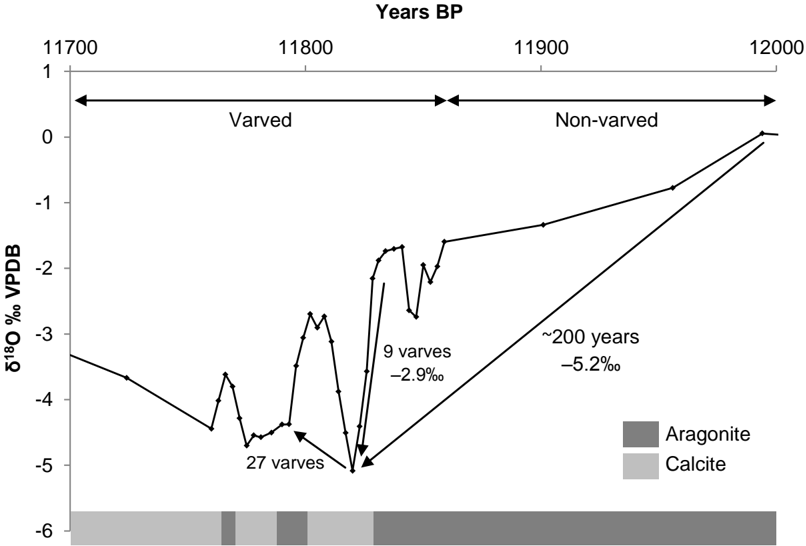
- After a dry Younger Dryas, the record transitions into a wetter early Holocene; the full δ18O transition is 5.2‰, with over half (2.9‰) occurring in just 9 varve years and an estimated duration of <200 years.
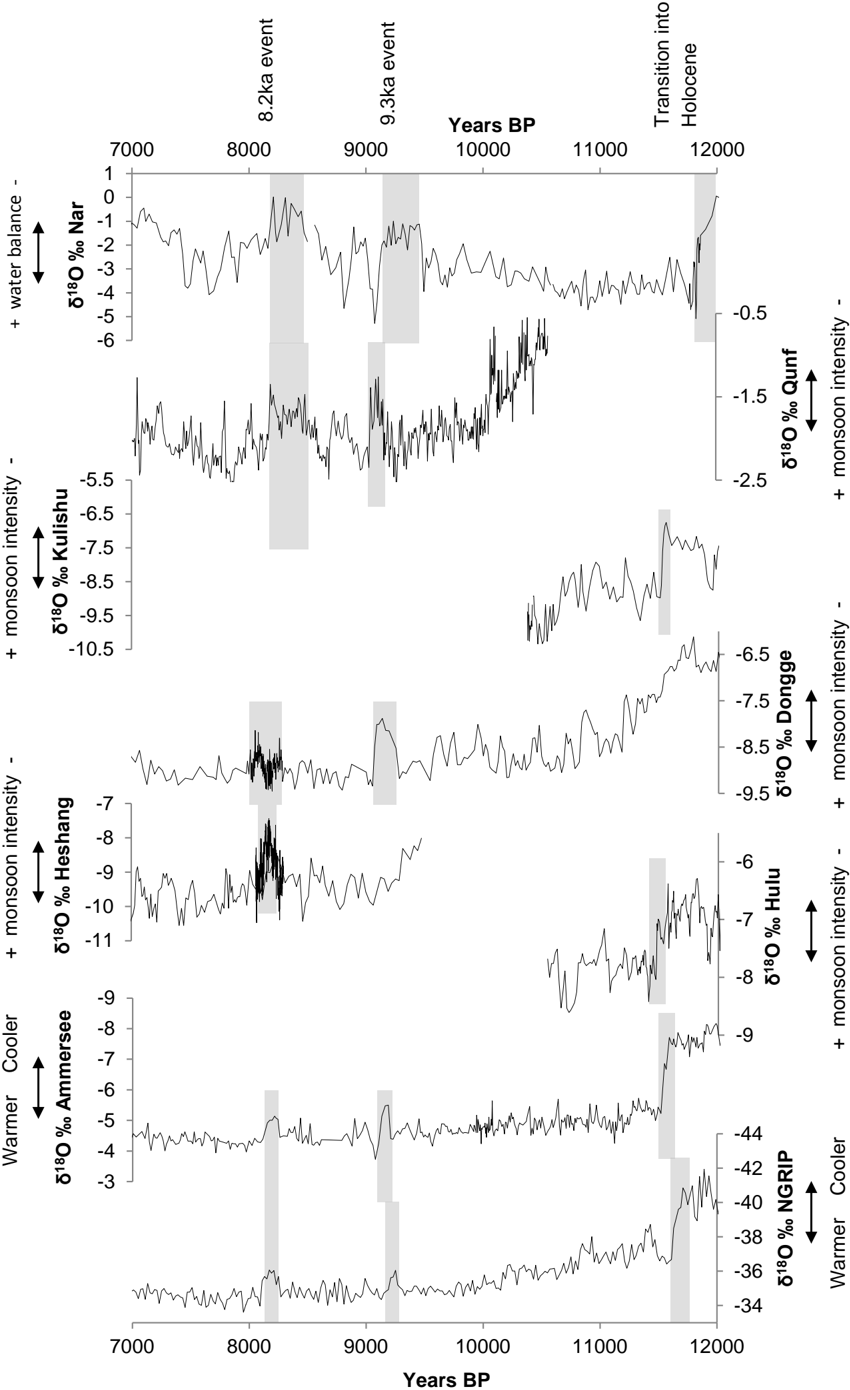
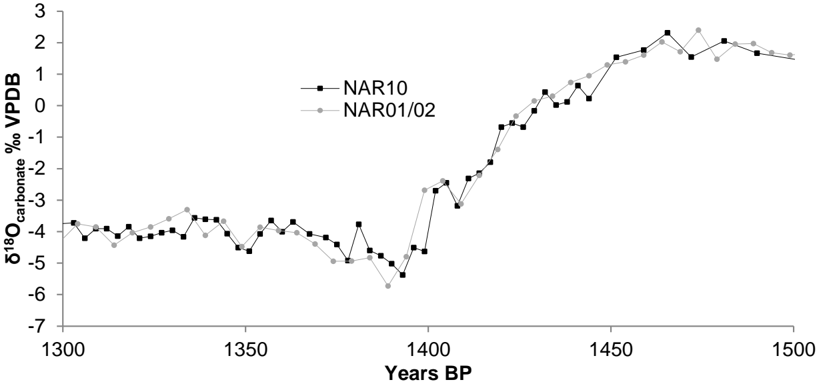
- Early Holocene drier periods peak at ~9.3 ka and ~8.2 ka, coincident with North Atlantic cooling events, but at Nar Gölü the ~9.3 ka excursion lasts ~300 years (vs ~100 years in NGRIP) and the ~8.2 ka peak is part of a ~300-year isotope trend, with a calcite-to-aragonite switch for ~400 years.
- A millennial-scale drying trend (Mid Holocene Transition) starts ~7,600 years BP and ends ~4,000 years BP; high δ18O persists until ~1,500 years BP.
- Late Holocene centennial droughts occur at ~4.2 ka and the Late Bronze Age (~3,150–2,550 years BP), with >20% dolomite ~4,300–4,150 years BP and highest δ18O at ~3,800 years BP; overall central Turkey is drier when the North Atlantic is cooler.
Methods
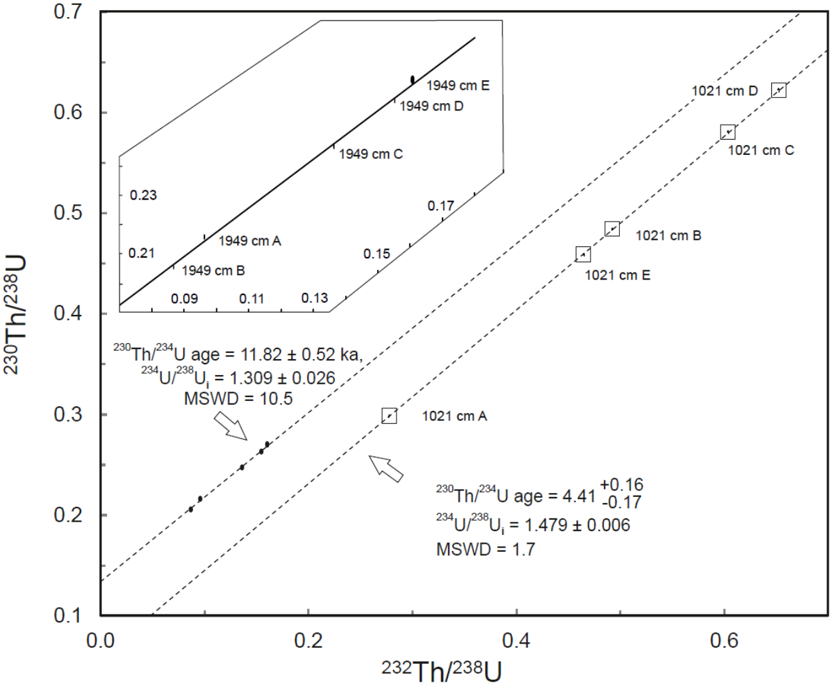
- Three parallel cores from deepest Nar Gölü (UWITEC hammer-piston, July 2010) were correlated into a 21.7 m master sequence (NAR10); chronology used varve counting (independent counts to within 5 varve years) and U-Th dating, including ages of 11.82 ± 0.52 ka at 1949 cm and 4.41 +0.16/−0.17 ka at 1021 cm, with linear interpolation for non-varved sections.
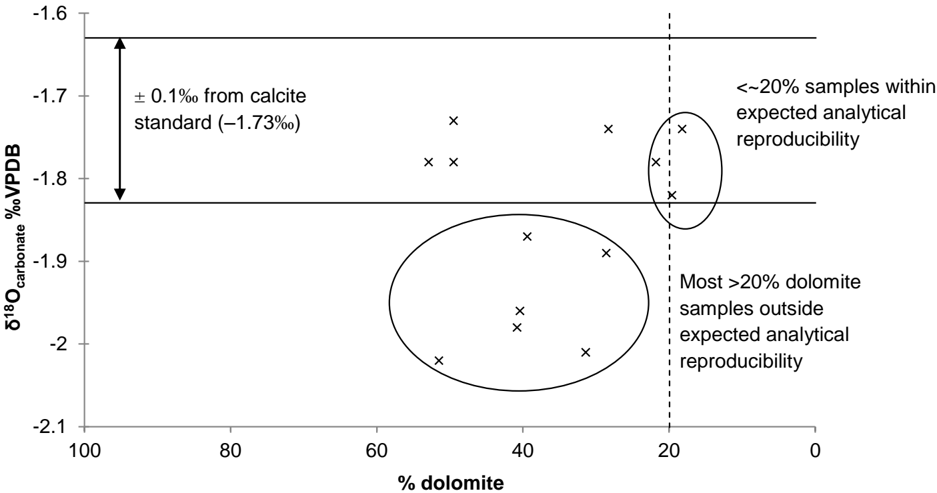
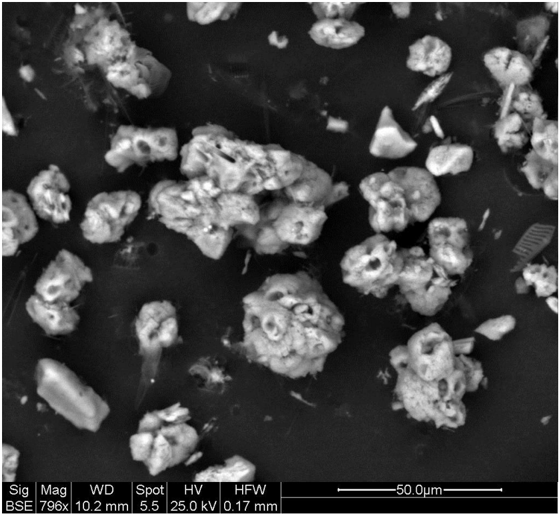
- Carbonate mineralogy was determined by XRD, SEM and EDS; δ18O and δ13C were measured on calcite/aragonite by phosphoric acid vacuum techniques, using a selective +16°C, 1-hour reaction for samples with <20% dolomite; samples with >20% dolomite were not analyzed; analytical reproducibility was 0.1‰.
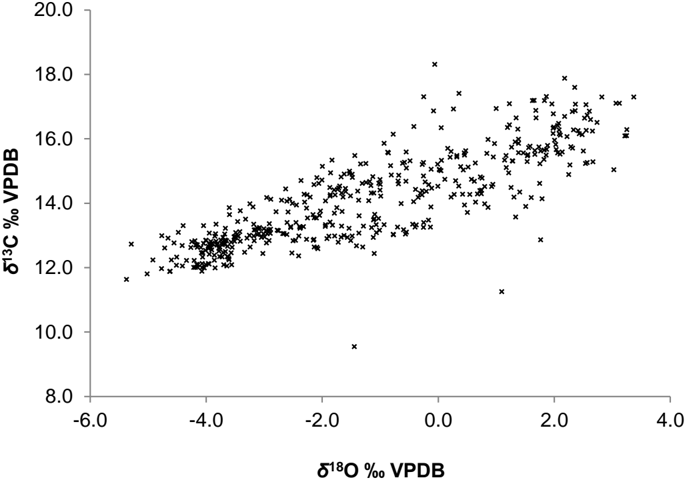
- Interpretation used δ18O as a regional water-balance proxy, supported by δ18O–δ13C covariance (r=0.84, p<0.001, n=1502 combined; r=0.83, n=465, p<0.001 for NAR10) and by mineralogical/lithological shifts.
Limitations
- Stated: chronological control below 1965 cm is lacking; U-Th ages are maximum ages because hydrogenous Th could not be quantified; no U-Th age for the basal section; the basal varved section was assigned 12,900 years BP by NGRIP correlation; data 1038–1141 cm were excluded due to deformation/coring loss and possible hiatus; >2,000 years of data are missing or not shown because of chronology, preventing investigation of a ~5,300–5,000 years BP drought.
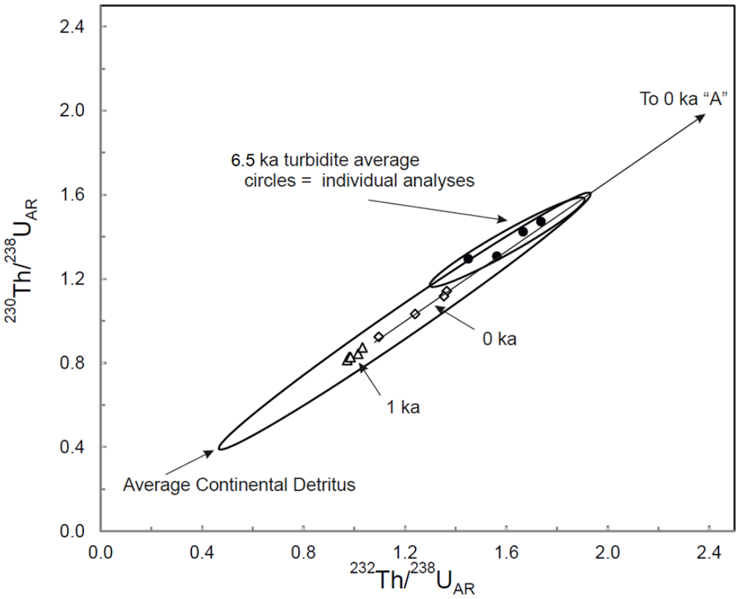
- Stated: samples with >20% dolomite were not analyzed for isotopes, and dolomite-bearing samples may have greater analytical reproducibility; the selective reaction method is a first pass with scope for refinement; U-Th scatter at 1949 cm (MSWD=10.5) could indicate detrital U/Th heterogeneity.
- Evident from text: non-varved sections rely on assumed constant deposition rates for linear interpolation; early Holocene event synchrony with NGRIP cannot be fully tested because of U-Th age uncertainty; dolomite formation mode remains uncertain (detrital input is discounted, but primary/authigenic/diagenetic/organogenic origin is not resolved).
Model-written summary. Check it against the paper before relying on it.
Integrity signals
Registry
Cites
Statistics
Figures
Verification
Claims the paper makes
2 Valid · 1 Not valid · 66 Not checked · 101 Own results and interpretations
The cited sources support only part of this claim — read each source’s verdict below.
In the paper
“We were not able to obtain a U-Th age constraint for the basal section of the core sequence, but the top of the basal varved section has been assigned an age of 12,900 years BP based on correlation with NGRIP (Rasmussen et al., 2006;Vinther et al., 2006).”
§ Eastern Mediterranean hydroclimate over the late glacial and Holocene, reconstructed from the sediments of Nar lake, central Turkey, using stable isotopes and carbonate mineralogy > 4.1 Lithology and chronology
What the sources say
- Supportedcites Rasmussen et al., 2006 matched to “A new Greenland ice core chronology for the last glacial termination” (2006) source
The part attributed to Rasmussen et al. [2006] is the NGRIP-based age anchor; our copy is the GICC05 NGRIP/GRIP chronology (Abstract; Section 1, Introduction). Table 4 lists the 'Onset of Younger Dryas' at NGRIP depth 1526.52 m as 12,896 b2k with a total maximum counting error of 138 years, i.e. the ~12,900-year age the citing authors read off the NGRIP correlation. The paper itself says nothing about varved sediment sections — that correlation is the citing authors' own interpretation, not attributed here — and it expresses ages in b2k rather than BP, a negligible offset relative to the rounding. (LLM, conf=0.80)
- Partly supportedcites Vinther et al., 2006 matched to “A synchronized dating of three Greenland ice cores throughout the Holocene” (2006) sourceExperimental — accuracy not yet measured
Vinther et al. [2006] constructs the synchronized GICC05 chronology for DYE-3, GRIP and NGRIP, so it is genuinely a source for the 'correlation with NGRIP' framework the citing sentence invokes (§3.5, §3.2–3.3 describe transferring the GRIP/NGRIP annual-layer count). However, our copy contains nothing about a 'basal varved section' and its timescale stops at the Younger Dryas termination: the Abstract states 'GICC05 dates the Younger Dryas termination, as defined from deuterium excess, to 11,703 years before A. D. 2000 (b2k)', and §3.5/Table 2 cover only 8314–11,703 b2k, i.e. roughly 11,650 cal yr BP — shallower than the 12,900 yr BP the citing sentence attributes. The specific 12,900-year figure therefore lies outside what this paper reports (searched: 'varved/varves', '12,900', 'Younger Dryas termination age', 'NGRIP timescale'). (LLM, conf=0.68)
plainstates an association- Asserted: passes — The authors put it forward as true.
- Checkable: passes — It can be checked against evidence.
- Load-bearing: passes — The paper’s conclusions depend on it.
- Based: passes — The paper gives a reason why it holds.
- Supported
The cited sources support only part of this claim — read each source’s verdict below.
In the paper
“The rapidity of the late glacial to Holocene transition at Nar Gölü is comparable to that seen in temperature records from the North Atlantic region (e.g.von Grafenstein et al., 1999;Rasmussen et al., 2006).”
§ Eastern Mediterranean hydroclimate over the late glacial and Holocene, reconstructed from the sediments of Nar lake, central Turkey, using stable isotopes and carbonate mineralogy > 5.3 Drivers of Eastern Mediterranean hydroclimate
What the sources say
- Check pendingcites von Grafenstein et al., 1999 matched to “A Mid-European Decadal Isotope-Climate Record from 15,500 to 5000 Years B.P.” (1999) source
- Partly supportedcites Rasmussen et al., 2006 matched to “A new Greenland ice core chronology for the last glacial termination” (2006) sourceExperimental — accuracy not yet measured
Our copy of Rasmussen et al. [2006] is a chronology paper: the Abstract and Section 7 date the Younger Dryas–Preboreal transition to 11,703 ± 99 b2k and the Bølling onset to 14,692 b2k on the annually resolved GICC05 time scale for NGRIP/GRIP, so it does anchor the late glacial–Holocene transition in the North Atlantic region (Greenland) at annual resolution. However, it does not report the rapidity of a temperature change: the Introduction (Section 1) states that the abrupt shifts are in deuterium excess, indicating 'dramatic reorganizations of the atmospheric circulation... followed by more gradual changes in temperature and ice core impurity content', and explicitly says a discussion of the implications 'is beyond the scope of this work'. The part of the claim attributed to this source — rapidity seen in North Atlantic temperature records — is therefore not supported by our copy; the paper's contribution is the dating, not a rate of warming. (LLM, conf=0.70)
plainstates an association- Asserted: passes — The authors put it forward as true.
- Checkable: passes — It can be checked against evidence.
- Load-bearing: passes — The paper’s conclusions depend on it.
- Based: passes — The paper gives a reason why it holds.
A result the paper states — it cites no source for it, so there is none to check. The quote shows it is in the paper.
In the paper
“There are also deformed sediments 1038-1141 cm.”
§ Eastern Mediterranean hydroclimate over the late glacial and Holocene, reconstructed from the sediments of Nar lake, central Turkey, using stable isotopes and carbonate mineralogy > 4.1 Lithology and chronology
plain- Asserted: passes — The authors put it forward as true.
- Checkable: passes — It can be checked against evidence.
- Load-bearing: unclear — It is unclear whether the paper’s conclusions depend on it.
- Based: passes — The paper gives a reason why it holds.
A result the paper reports from its own data — it cites no other source for it, so there is none to check. The quote shows it is in the paper.
In the paper
“Firstly, there is a strong co-variation between δ 18 O carbonate and δ 13 C carbonate (r=0.84,p=<0.001,n=1502, combining the NAR01/02 and NAR10 sequences; or r=0.83, n=465, p=<0.001 for just the NAR10 sequence) (Figures 3 and A .5).”
§ Eastern Mediterranean hydroclimate over the late glacial and Holocene, reconstructed from the sediments of Nar lake, central Turkey, using stable isotopes and carbonate mineralogy > 5.1 Drivers of δ 18 O carbonate at Nar Gölü
boostedstates an associationn = 1,502- Asserted: passes — The authors put it forward as true.
- Checkable: passes — It can be checked against evidence.
- Load-bearing: passes — The paper’s conclusions depend on it.
- Based: passes — The paper gives a reason why it holds.
A result the paper reports from its own data — it cites no other source for it, so there is none to check. The quote shows it is in the paper.
In the paper
“It is possible to use varve counting to provide a chronology for the sediments from the top of the sequence (AD2010) through to 2,557 years BP (598 cm).”
§ Eastern Mediterranean hydroclimate over the late glacial and Holocene, reconstructed from the sediments of Nar lake, central Turkey, using stable isotopes and carbonate mineralogy > 4.1 Lithology and chronology
hedgedstates a cause- Asserted: passes — The authors put it forward as true.
- Checkable: passes — It can be checked against evidence.
- Load-bearing: passes — The paper’s conclusions depend on it.
- Based: passes — The paper gives a reason why it holds.
82 more claims
Create a free account to see all 170 claims and to verify the 121 references still open.
- It may state two separate claims as one. 70
- Probably not a substantial claim. 22
Self-check
Percentages, sums and reported differences re-computed from the paper’s own numbers.
Each contradiction between two passages listed here was confirmed by an independent check.
Rated minor: it would not touch a result — a value no result rests on, a p-value that stays on the same side of the significance level, or a conflict that is clerical, resolved elsewhere in the paper, or outside its own findings.
In the paper
§ Eastern Mediterranean hydroclimate over the late glacial and Holocene, reconstructed from the sediments of Nar lake, central Turkey, using stable isotopes and carbonate mineralogy > 4.1 Lithology and chronology
“the top of the basal varved section has been assigned an age of 12,900 years BP”
§ Eastern Mediterranean hydroclimate over the late glacial and Holocene, reconstructed from the sediments of Nar lake, central Turkey, using stable isotopes and carbonate mineralogy > 4.1 Lithology and chronology
“1965 to 2053 cm (dated 11,859-12,840 years BP)”
Citations
Cites
Craig, H. (1957) · Geochimica et Cosmochimica Acta · doi:10.1016/0016-7037(57)90024-8 · Cited by 4,170
On the Isotopic Chemistry of Carbonates and a Paleotemperature Scale
McCrea, J. M. (1950) · The Journal of Chemical Physics · doi:10.1063/1.1747785 · Cited by 3,742
(1973) · Earth-Science Reviews · doi:10.1016/0012-8252(73)90028-7 · Cited by 3,317
A High-Resolution Absolute-Dated Late Pleistocene Monsoon Record from Hulu Cave, China
Wang, Y. J., Cheng, H., Edwards, R. L., An, Z. S., Wu, J. Y., Shen, C.-C., & Dorale, J. A. (2001) · Science · doi:10.1126/science.1064618 · Cited by 3,208
A Pervasive Millennial-Scale Cycle in North Atlantic Holocene and Glacial Climates
Bond, G., Showers, W., Cheseby, M., Lotti, R., Almasi, P., deMenocal, P., Priore, P., Cullen, H., Hajdas, I., & Bonani, G. (1997) · Science · doi:10.1126/science.278.5341.1257 · Cited by 2,720
A new Greenland ice core chronology for the last glacial termination
Rasmussen, S. O., Andersen, K. K., Svensson, A. M., Steffensen, J. P., Vinther, B. M., Clausen, H. B., Siggaard‐Andersen, M. ‐., Johnsen, S. J., Larsen, L. B., Dahl‐Jensen, D., et al. (2006) · Journal of Geophysical Research: Atmospheres · doi:10.1029/2005jd006079 · Cited by 2,304
DYKOSKI, C., EDWARDS, R., CHENG, H., YUAN, D., CAI, Y., ZHANG, M., LIN, Y., QING, J., AN, Z., & REVENAUGH, J. (2005) · Earth and Planetary Science Letters · doi:10.1016/j.epsl.2005.01.036 · Cited by 1,988
Abrupt onset and termination of the African Humid Period:
deMenocal, P., Ortiz, J., Guilderson, T., Adkins, J., Sarnthein, M., Baker, L., & Yarusinsky, M. (2000) · Quaternary Science Reviews · doi:10.1016/s0277-3791(99)00081-5 · Cited by 1,708
Holocene Forcing of the Indian Monsoon Recorded in a Stalagmite from Southern Oman
Fleitmann, D., Burns, S. J., Mudelsee, M., Neff, U., Kramers, J., Mangini, A., & Matter, A. (2003) · Science · doi:10.1126/science.1083130 · Cited by 1,690
Cheng, H., Lawrence Edwards, R., Shen, C.-C., Polyak, V. J., Asmerom, Y., Woodhead, J., Hellstrom, J., Wang, Y., Kong, X., Spötl, C., et al. (2013) · Earth and Planetary Science Letters · doi:10.1016/j.epsl.2013.04.006 · Cited by 1,568
Research works printed but not linked: 3
- Alley, R.B., Mayewski, P.A., Sowers, T., Stuiver, M., Taylor, K.C., Clark, P.U., 1997. Holocene climatic instability: a prominent, widespread event 8200 yr ago. Geology 25, 483-486. · DOI · Paper page
- Bartov, Y., Goldstein, S.L., Stein, M., Enzel, Y., 2003. Catastrophic arid episodes in the Eastern Mediterranean linked with the North Atlantic Heinrich events. Geology 31, 439-442. · DOI · Paper page
- Rosen, A., 2007. Civilizing Climate. AltaMira Press, Plymouth.
Cited by
The 4.2 ka BP Event in the Mediterranean region: an overview
Bini, M., Zanchetta, G., Perşoiu, A., Cartier, R., Català, A., Cacho, I., Dean, J. R., Di Rita, F., Drysdale, R. N., Finnè, M., et al. (2019) · Climate of the Past · doi:10.5194/cp-15-555-2019 · Cited by 259
Self-citationLate Bronze Age climate change and the destruction of the Mycenaean Palace of Nestor at Pylos
Finné, M., Holmgren, K., Shen, C., Hu, H., Boyd, M., & Stocker, S. R. (2017) · PLoS ONE · doi:10.1371/journal.pone.0189447 · Cited by 172
Roberts, C. N., Woodbridge, J., Palmisano, A., Bevan, A., Fyfe, R., & Shennan, S. (2019) · The Holocene · doi:10.1177/0959683619826697 · Cited by 163
“However, after 9500 Cal yr BP there was a climatic drying trend whose latter part coincided with a significant westward extension in Neolithic populations (Weninger et al., 2014) and which culminated in drought at the time of the 8.2 ka climate event (Dean et al. 2015; Roffet-Salque et al., 2018).”
BackgroundInfluentialPalmisano, A., Lawrence, D., de Gruchy, M., Bevan, A., & Shennan, S. J. (2020) · Quaternary Science Reviews · doi:10.1016/j.quascirev.2020.106739 · Cited by 144
Roberts, N., Woodbridge, J., Bevan, A., Palmisano, A., Shennan, S. J., & Asouti, E. (2017) · Quaternary Science Reviews · doi:10.1016/j.quascirev.2017.09.011 · Cited by 142
Atlantic forcing of Western Mediterranean winter rain minima during the last 12,000 years
Zielhofer, C., Fletcher, W. J., Mischke, S., Batist, M. D., Campbell, J. F. E., Joannin, S., Tjallingii, R., Hamouti, N. E., Junginger, A., Stele, A., et al. (2016) · Quaternary Science Reviews · doi:10.1016/j.quascirev.2016.11.037 · Cited by 132
The 4.2 ka BP event in the Levant
Kaniewski, D., Marriner, N., Cheddadi, R., Guiot, J., & Campo, E. V. (2018) · Climate of the past · doi:10.5194/cp-14-1529-2018 · Cited by 119
Long Term Population, City Size and Climate Trends in the Fertile Crescent: A First Approximation
Lawrence, D., Philip, G., Hunt, H., Snape-Kennedy, L., & Wilkinson, T. J. (2016) · PLOS ONE · doi:10.1371/journal.pone.0152563 · Cited by 109
Not the End of the World? Post-Classical Decline and Recovery in Rural Anatolia
Roberts, N., Cassis, M., Doonan, O. P., Eastwood, W. J., Elton, H., Haldon, J., Izdebski, A., & Newhard, J. M. L. (2018) · Human Ecology · doi:10.1007/s10745-018-9973-2 · Cited by 105
Self-citationEvidence for the impact of the 8.2-kyBP climate event on Near Eastern early farmers
Roffet‐Salque, M., Marciniak, A., Valdes, P. J., Pawłowska, K., Pyzel, J., Czerniak, L., Krüger, M., Roberts, N., Pitter, S., & Evershed, R. P. (2018) · Proceedings of the National Academy of Sciences · doi:10.1073/pnas.1803607115 · Cited by 103
Longman, J., Vereş, D., Finsinger, W., & Ersek, V. (2018) · Proceedings of the National Academy of Sciences · doi:10.1073/pnas.1721546115 · Cited by 98
Roberts, N., Allcock, S. L., Arnaud, F., Dean, J. R., Eastwood, W. J., Jones, M. D., Leng, M. J., Metcalfe, S. E., Malet, E., Woodbridge, J., et al. (2016) · Journal of Quaternary Science · doi:10.1002/jqs.2852 · Cited by 101
Self-citationBogaard, A., Filipović, D., Fairbairn, A., Green, L., Stroud, E., Fuller, D. Q., & Charles, M. (2017) · Anatolian Studies · doi:10.1017/s0066154617000072 · Cited by 91
Modelling the freshwater supply of cisterns in ancient Greece
Klingborg, P., & Finné, M. (2018) · Water History · doi:10.1007/s12685-017-0209-y · Cited by 83
Morellón, M., Anselmetti, F. S., Arizteguí, D., Brushulli, B., Sinopoli, G., Wagner, B., Sadori, L., Gilli, A., & Pambuku, A. (2015) · Quaternary Science Reviews · doi:10.1016/j.quascirev.2015.10.043 · Cited by 78
Berger, J., Lespez, L., Kuzucuoğlu, C., Glais, A., Hourani, F., Barra, A., & Guilaine, J. (2016) · Climate of the past · doi:10.5194/cp-12-1847-2016 · Cited by 79
20,000 years of societal vulnerability and adaptation to climate change in southwest Asia
Jones, M. D., Abu‐Jaber, N., AlShdaifat, A., Baird, D., Cook, B. I., Cuthbert, M. O., Dean, J. R., Djamali, M., Eastwood, W., Fleitmann, D., et al. (2019) · WIREs Water · doi:10.1002/wat2.1330 · Cited by 48
Self-citationYılmaz, G., Çolak, M. A., Özgencil, İ. K., Metin, M., Korkmaz, M., Ertuğrul, S., Soyluer, M., Bucak, T., Tavşanoğlu, Ü. N., Özkan, K., et al. (2021) · Inland Waters · doi:10.1080/20442041.2021.1924034 · Cited by 72
Schäbitz, F., Asrat, A., Lamb, H. F., Cohen, A. S., Foerster, V., Duesing, W., Kaboth‐Bahr, S., Opitz, S., Viehberg, F., Vogelsang, R., et al. (2021) · Communications Earth & Environment · doi:10.1038/s43247-021-00195-7 · Cited by 69
Self-citationWoodbridge, J., Roberts, N., Palmisano, A., Bevan, A., Shennan, S. J., Fyfe, R., Eastwood, W. J., Izdebski, A., Çakırlar, C., Woldring, H., et al. (2019) · The Holocene · doi:10.1177/0959683619826635 · Cited by 70
Self-citationBroom-Fendley, S., Heaton, T., Wall, F., & Gunn, G. (2016) · Chemical Geology · doi:10.1016/j.chemgeo.2016.07.023 · Cited by 62
Long-term socio-environmental dynamics and adaptive cycles in Cappadocia, Turkey during the Holocene
Allcock, S. L. (2017) · Quaternary International · doi:10.1016/j.quaint.2017.06.065 · Cited by 60
Katrantsiotis, C., Kylander, M. E., Smittenberg, R. H., Yamoah, K. A., Hättestrand, M., Avramidis, P., Strandberg, N. A., & Norström, E. (2018) · Quaternary Science Reviews · doi:10.1016/j.quascirev.2018.07.008 · Cited by 56
Rohling, E. J., Marino, G., Grant, K., Mayewski, P. A., & Weninger, B. (2019) · Quaternary Science Reviews · doi:10.1016/j.quascirev.2019.02.009 · Cited by 56
Controls on Cyclic Formation of Quaternary Early Diagenetic Dolomite
McCormack, J., Bontognali, T. R. R., Immenhauser, A., & Kwiecien, O. (2018) · Geophysical Research Letters · doi:10.1002/2018gl077344 · Cited by 52
Katrantsiotis, C., Norström, E., Smittenberg, R. H., Finné, M., Weiberg, E. L., Hättestrand, M., Avramidis, P., & Wastegård, S. (2019) · Global and Planetary Change · doi:10.1016/j.gloplacha.2019.02.001 · Cited by 52
Jacobson, M. J., Flohr, P., Gascoigne, A. L., Leng, M. J., Sadekov, A., Cheng, H., Edwards, R. L., Tüysüz, O., & Fleitmann, D. (2021) · Geophysical Research Letters · doi:10.1029/2021gl094733 · Cited by 52
Self-citationScientific drilling projects in ancient lakes: Integrating geological and biological histories
Wilke, T., Wagner, B., Bocxlaer, B. V., Albrecht, C., Arizteguí, D., Delicado, D., Francke, A., Harzhauser, M., Hauffe, T., Holtvoeth, J., et al. (2016) · Global and Planetary Change · doi:10.1016/j.gloplacha.2016.05.005 · Cited by 50
Self-citationMcCormack, J., Nehrke, G., Jöns, N., Immenhauser, A., & Kwiecien, O. (2019) · Chemical Geology · doi:10.1016/j.chemgeo.2019.03.014 · Cited by 49
“Still, even in the absence of early diagenetic carbonate minerals, aragonite and calcite, both calcium carbonate (CaCO3) polymorphs are commonly believed to form simultaneously within the epilimnion, particularly in many closed lakes (e.g.; Yu and Kelts, 2002; Dean et al., 2015), and are often present within the same…”
BackgroundÜnal‐İmer, E., Shulmeister, J., Zhao, J., Uysal, İ. T., & Feng, Y. (2016) · Palaeogeography Palaeoclimatology Palaeoecology · doi:10.1016/j.palaeo.2016.04.015 · Cited by 49
Climate change and water management in the biblical city of Dan
Kaniewski, D., Marriner, N., Ilan, D., Morhange, C., Thareani, Y., & Campo, E. V. (2017) · Science Advances · doi:10.1126/sciadv.1700954 · Cited by 48
Walas, Ł., Sobierajska, K., Ok, T., Dönmez, A. A., Kanoğlu, S. S., Kharrat, M. B. D., Douaihy, B., Romo, A. M., Stephan, J., Jasiñska, A. K., et al. (2019) · Regional Environmental Change · doi:10.1007/s10113-019-01489-5 · Cited by 48
Late Pleistocene to Holocene paleoenvironmental evolution of Lake Hazar, Eastern Anatolia, Turkey
Eriş, K. K., Ön, S. A., Çağatay, M. N., Ülgen, U. B., Ön, Z. B., Gürocak, Z., Arslan, T. N., Akkoca, D. B., Damcı, E., İnceöz, M., et al. (2017) · Quaternary International · doi:10.1016/j.quaint.2017.09.027 · Cited by 47
Loo, M. V., Dusar, B., Verstraeten, G., Renssen, H., Notebaert, B., D’Haen, K., & Bakker, J. (2016) · CATENA · doi:10.1016/j.catena.2016.08.023 · Cited by 47
Roberts, N., Allcock, S. L., Barnett, H., Mather, A. E., Eastwood, W. J., Jones, M. D., Primmer, N., Yiğitbaşıoğlu, H., & Vannière, B. (2018) · Geomorphology · doi:10.1016/j.geomorph.2018.11.016 · Cited by 47
Self-citationJouffroy‐Bapicot, I., Pedrotta, T., Debret, M., Field, S., Sulpizio, R., Zanchetta, G., Sabatier, P., Roberts, N., Tinner, W., Walsh, K., et al. (2021) · Quaternary Science Reviews · doi:10.1016/j.quascirev.2021.107072 · Cited by 44
Nan, Q., Chen, S., Liu, X., Ma, S., Sun, Y., Huang, L., Chen, J., Luterbacher, J., Meadows, M. E., & Chen, F. (2025) · Earth-Science Reviews · doi:10.1016/j.earscirev.2025.105128 · Cited by 43
Messager, E., Nomade, S., Wilhelm, B., Joannin, S., Scao, V., von Grafenstein, U., Martkoplishvili, I., Ollivier, V., Mgeladze, A., Dumoulin, J., et al. (2017) · Quaternary Research · doi:10.1017/qua.2016.3 · Cited by 44
Ön, Z. B., Ön, S. A., Özeren, M. S., Eriş, K. K., Greaves, A. M., & Çağatay, M. N. (2017) · Quaternary International · doi:10.1016/j.quaint.2017.08.066 · Cited by 42
Sobierajska, K., Boratyńska, K., Jasiñska, A. K., Dering, M., Ok, T., Douaihy, B., Kharrat, M. B. D., Romo, A. M., & Boratyński, A. (2016) · Botanical Journal of the Linnean Society · doi:10.1111/boj.12377 · Cited by 42
Viehberg, F., Just, J., Dean, J. R., Wagner, B., Franz, S. O., Klasen, N., Kleinen, T., Ludwig, P., Asrat, A., Lamb, H. F., et al. (2018) · Quaternary Science Reviews · doi:10.1016/j.quascirev.2018.09.008 · Cited by 41
Self-citation2000 Years of Grazing History and the Making of the Cretan Mountain Landscape, Greece
Jouffroy‐Bapicot, I., Vannière, B., Iglesias, V., Debret, M., & Delarras, J.-F. (2016) · PLoS ONE · doi:10.1371/journal.pone.0156875 · Cited by 40
Meijers, M. J. M., Brocard, G., Whitney, D. L., & Mulch, A. (2020) · Geosphere · doi:10.1130/ges02135.1 · Cited by 40
Caputo, R., Helly, B., Rapti, D., & Valkaniotis, S. (2021) · Quaternary International · doi:10.1016/j.quaint.2021.02.013 · Cited by 39
Dean, J. R., Jones, M. D., Leng, M. J., Metcalfe, S. E., Sloane, H. J., Eastwood, W. J., & Roberts, N. (2017) · The Holocene · doi:10.1177/0959683617721326 · Cited by 38
Self-citationKoutsodendris, A., Kousis, I., Peyron, O., Wagner, B., & Pross, J. (2019) · Quaternary Science Reviews · doi:10.1016/j.quascirev.2019.105873 · Cited by 38
Andersen, N., Lauterbach, S., Erlenkeuser, H., Danielopol, D. L., Namiotko, T., Hüls, M., Belmecheri, S., Dulski, P., Nantke, C., Meyer, H., et al. (2017) · Quaternary Science Reviews · doi:10.1016/j.quascirev.2017.08.001 · Cited by 35
The environmental setting of Epipalaeolithic aggregation site Kharaneh IV
Jones, M. D., Maher, L., Macdonald, D. A., Ryan, C., Rambeau, C. M. C., Black, S., & Richter, T. (2015) · Quaternary International · doi:10.1016/j.quaint.2015.08.092 · Cited by 33
Self-citationTemporal metal concentration in coastal sediment at the north region of Persian Gulf
Maghrebi, M., Karbassi, A., Lak, R., Noori, R., & Sadrinasab, M. (2018) · Marine Pollution Bulletin · doi:10.1016/j.marpolbul.2018.08.017 · Cited by 31
Dibble, F., & Finné, M. (2021) · Quaternary International · doi:10.1016/j.quaint.2021.04.024 · Cited by 32
Vignola, C., Masi, A., Restelli, F. B., Frangipane, M., Marzaioli, F., Passariello, I., Stellato, L., Terrasi, F., & Sadori, L. (2017) · Review of Palaeobotany and Palynology · doi:10.1016/j.revpalbo.2017.09.001 · Cited by 31
Liu, W., Zhang, P., Zhao, C., Wang, H., An, Z., & Liu, H. (2018) · Quaternary International · doi:10.1016/j.quaint.2018.03.038 · Cited by 30
Cartier, R., Sylvestre, F., Paillès, C., Sonzogni, C., Couapel, M. J. J., Alexandre, A., Mazur, J.-C., Brisset, É., Miramont, C., & Guiter, F. (2019) · Climate of the past · doi:10.5194/cp-15-253-2019 · Cited by 30
Jacobson, M. J., Pickett, J., Gascoigne, A. L., Fleitmann, D., & Elton, H. (2022) · PLoS ONE · doi:10.1371/journal.pone.0270295 · Cited by 28
Knitter, D., Braun, R., Clare, L., Nykamp, M., & Schütt, B. (2019) · Land · doi:10.3390/land8040072 · Cited by 27
Vignola, C., Hättestrand, M., Bonnier, A., Finné, M., Izdebski, A., Katrantsiotis, C., Kouli, K., Liakopoulos, G. C., Norström, E., Papadaki, M., et al. (2022) · PLoS ONE · doi:10.1371/journal.pone.0271548 · Cited by 26
Mid- to late-Holocene archaeology, environment and climate in the northeast Kurdistan region of Iraq
Marsh, A., Fleitmann, D., Al-Manmi, D. A. M., Altaweel, M., Wengrow, D., & Carter, R. (2018) · The Holocene · doi:10.1177/0959683617752843 · Cited by 26
Jardine, P. E., Fraser, W. T., Gosling, W. D., Roberts, N., Eastwood, W. J., & Lomax, B. H. (2019) · The Holocene · doi:10.1177/0959683619875798 · Cited by 27
Self-citationKabukcu, C. (2017) · Quaternary Science Reviews · doi:10.1016/j.quascirev.2017.10.001 · Cited by 27
A Fascinating Gift from Volcanoes: The Fairy Chimneys and Underground Cities of Cappadocia
Çiner, A., & Aydar, E. (2019) · World geomorphological landscapes · doi:10.1007/978-3-030-03515-0_31 · Cited by 26
Pollen-based reconstructions of Holocene climate trends in the eastern Mediterranean region
Cruz‐Silva, E., Harrison, S. P., Prentice, I. C., Marinova, E., Bartlein, P. J., Renssen, H., & Zhang, Y. (2023) · Climate of the past · doi:10.5194/cp-19-2093-2023 · Cited by 26
Mischke, S., Lee, M. K., & Lee, Y. I. (2020) · Frontiers in Earth Science · doi:10.3389/feart.2020.00221 · Cited by 25
Sękiewicz, K., Dering, M., Romo, A. M., Kharrat, M. B. D., Boratyńska, K., Ok, T., & Boratyński, A. (2018) · Botanical Journal of the Linnean Society · doi:10.1093/botlinnean/boy049 · Cited by 24
Lewis, J. P., Leng, M. J., Dean, J. R., Marciniak, A., Mayer, D. E. B., & Wu, X. (2016) · Environmental Archaeology · doi:10.1080/14614103.2015.1116216 · Cited by 24
Self-citationOcakoğlu, F., Çilingiroğlu, Ç., Erkara, İ. P., Ünan, S., Dinçer, B., & Akkiraz, M. S. (2019) · Quaternary Science Reviews · doi:10.1016/j.quascirev.2019.04.016 · Cited by 23
Chen, S., Chen, J., Ding, G., Ma, S., Ji, P., Zhou, A., Wu, D., Khormali, F., Hou, J., & Chen, F. (2024) · Journal of Geophysical Research Atmospheres · doi:10.1029/2023jd039413 · Cited by 21
Neolithic hydroclimatic change and water resources exploitation in the Fertile Crescent
Regattieri, E., Forti, L., Drysdale, R. N., Mannella, G., Hellström, J., Barbaro, C. C., Bonacossi, D. M., & Zerboni, A. (2023) · Scientific Reports · doi:10.1038/s41598-022-27166-y · Cited by 21
Zanchetta, G., Baneschi, I., Magny, M., Sadori, L., Termine, R., Bini, M., Vannière, B., Desmet, M., Natali, S., Luppichini, M., et al. (2022) · Journal of Quaternary Science · doi:10.1002/jqs.3435 · Cited by 21
Climate stability in central Anatolia during the Messinian Salinity Crisis
Meijers, M. J. M., Peynircioğlu, A. A., Cosca, M. A., Brocard, G., Whitney, D. L., Langereis, C. G., & Mulch, A. (2018) · Palaeogeography Palaeoclimatology Palaeoecology · doi:10.1016/j.palaeo.2018.03.001 · Cited by 20
Lacey, J. H., & Jones, M. D. (2018) · Quaternary Science Reviews · doi:10.1016/j.quascirev.2018.09.007 · Cited by 20
Self-citationKAMAR, G. (2017) · Quaternary International · doi:10.1016/j.quaint.2017.05.020 · Cited by 19
Comparing pollen and archaeobotanical data for Chalcolithic cereal agriculture at Çatalhöyük, Turkey
Eastwood, W. J., Fairbairn, A., Stroud, E., Roberts, N., Lamb, H. F., Yiğitbaşıoğlu, H., Şenkul, Ç., Moss, A., Turner, R., & Boyer, P. (2018) · Quaternary Science Reviews · doi:10.1016/j.quascirev.2018.11.012 · Cited by 18
Self-citationVignola, C., Masi, A., Restelli, F. B., Frangipane, M., Marzaioli, F., Passariello, I., Rubino, M., Terrasi, F., & Sadori, L. (2018) · Rapid Communications in Mass Spectrometry · doi:10.1002/rcm.8137 · Cited by 17
Şimşek, F. B., & Çağatay, M. N. (2018) · Quaternary International · doi:10.1016/j.quaint.2017.12.043 · Cited by 17
Erkan, G., Bayarı, C. S., Fleitmann, D., Cheng, H., Edwards, L., & Özbakir, M. (2021) · Journal of Quaternary Science · doi:10.1002/jqs.3401 · Cited by 17
Late Holocene geomorphodynamics in the vicinity of Göbekli Tepe, SE Turkey
Nykamp, M., Knitter, D., & Schütt, B. (2020) · CATENA · doi:10.1016/j.catena.2020.104759 · Cited by 16
Paravani, a puzzling lake in the South Caucasus
Messager, E., Poulenard, J., Sabatier, P., Develle, A., Wilhelm, B., Nomade, S., Scao, V., Giguet‐Covex, C., von Grafenstein, U., Arnaud, F., et al. (2020) · Quaternary International · doi:10.1016/j.quaint.2020.04.005 · Cited by 16
Hydrochemical mixing‐zones trigger dolomite formation in an alkaline lake
McCormack, J., Baldermann, A., Bontognali, T. R. R., Wolf, A., & Kwiecien, O. (2023) · Sedimentology · doi:10.1111/sed.13155 · Cited by 15
Biogeochemical Approaches to Bioarchaeological Research in Turkey: A Review
Irvine, B., & Özdemir, K. (2020) · Journal of Eastern Mediterranean Archaeology & Heritage Studies · doi:10.5325/jeasmedarcherstu.8.2.0174 · Cited by 14
Şenkul, Ç., Gürboğa, Ş., Doğan, M., & Doğan, T. (2021) · Quaternary International · doi:10.1016/j.quaint.2021.08.010 · Cited by 13
Ma, S., Chen, S., Chen, J., Chen, J., Cao, D., Xoplaki, E., Luterbacher, J., Chen, F., & Huang, W. (2024) · Quaternary Science Reviews · doi:10.1016/j.quascirev.2024.109091 · Cited by 13
Şekeryapan, C., Streurman, H. J., van der Plicht, J., Woldring, H., van der Veen, Y., & Boomer, I. (2019) · CATENA · doi:10.1016/j.catena.2019.104437 · Cited by 12
Liu, X., Deng, W., & Wei, G. (2019) · Rapid Communications in Mass Spectrometry · doi:10.1002/rcm.8365 · Cited by 11
Giraud, J., Baldi, J. S., Bonilauri, S., Mashkour, M., Lemée, M., Pichon, F., Mura, M., Pot, M.-A., Jamialahmadi, M., Biglari, F., et al. (2019) · Paléorient · doi:10.4000/paleorient.702 · Cited by 12
Greenlandian Stage (Early Holocene, 11.7–8.2 ka)
Fletcher, W. J., Goñi, M. F. S., Naughton, F., & Seppä, H. (2023) · Elsevier eBooks · doi:10.1016/b978-0-323-99712-6.00029-5 · Cited by 11
Rodríguez‐Salgado, P., Oms, O., Ibáñez, J., Anadón, P., de Soler, B. G., Campeny, G., & Agustí, J. (2021) · Sedimentary Geology · doi:10.1016/j.sedgeo.2021.105910 · Cited by 11
Daems, D., Vandam, R., Cleymans, S., Broothaerts, N., Boogers, S., Matsuo, H., & Mirhanoğlu, A. (2021) · Palgrave studies in ancient economies · doi:10.1007/978-3-030-81103-7_20 · Cited by 11
Nykamp, M., Becker, F., Braun, R., Pöllath, N., Knitter, D., Peters, J., & Schütt, B. (2021) · Earth Surface Processes and Landforms · doi:10.1002/esp.5035 · Cited by 10
Moutsiou, T. (2020) · Quaternary International · doi:10.1016/j.quaint.2020.09.012 · Cited by 10
Hashemi, A., Sarıkaya, M. A., Görüm, T., Wilcken, K. M., Çiner, A., Žebre, M., Stepišnik, U., & Yıldırım, C. (2022) · Geomorphology · doi:10.1016/j.geomorph.2022.108261 · Cited by 10
How's Life? Living Conditions in the 2nd and 1st Millennia BCE
Zanon, M. (2019) · Scales of transformation in prehistoric and archaic societies/Scales of transformation · doi:10.59641/e7245hq · Cited by 10
Kirsten, F., Dallmeyer, A., Bernbeck, R., Böhmer, T., Busch, R. D., Hessari, M., Pollock, S., & Schütt, B. (2023) · PLoS ONE · doi:10.1371/journal.pone.0290181 · Cited by 9
Cruz‐Silva, E., Harrison, S. P., Prentice, I. C., & Marinova, E. (2023) · Journal of Biogeography · doi:10.1111/jbi.14749 · Cited by 10
Baykara, M. O., Özkul, M., Shen, C., Ünal‐İmer, E., Mii, H., Hu, H., Chung‐Che, W., Kele, S., & Demény, A. (2025) · Journal of Quaternary Science · doi:10.1002/jqs.70027 · Cited by 8
Daems, D., & Vandam, R. (2024) · The Holocene · doi:10.1177/09596836241259771 · Cited by 8
Spatiotemporal pattern of inorganic carbon sequestration in Lake Hulun since 1850
Fengju, Z., Bin, X., & Shuchun, Y. (2019) · Journal of Lake Sciences · doi:10.18307/2019.0617 · Cited by 7
Expression of the “4.2 ka event” in the southern Rocky Mountains, USA
Liefert, D., & Shuman, B. N. (2022) · Climate of the past · doi:10.5194/cp-18-1109-2022 · Cited by 7
Evaluating hydrological influences on mid-latitude δ18Op in the Middle East
Reuter, J., Buenning, N. H., & Yoshimura, K. (2017) · Climate Dynamics · doi:10.1007/s00382-017-3798-3 · Cited by 7
KAMAR, G. (2021) · Türkiye Jeoloji Bülteni / Geological Bulletin of Turkey · doi:10.25288/tjb.927117 · Cited by 7
Kukla, T., Rugenstein, J. K. C., Driscoll, E., Ibarra, D. E., & Chamberlain, C. P. (2022) · American Journal of Science · doi:10.2475/10.2022.02 · Cited by 6
Metadata
- Authors
- Dean, J. R., Jones, M. D., Leng, M. J., Noble, S. R., Metcalfe, S. E., Sloane, H. J., Sahy, D., Eastwood, W. J., & Roberts, C. N.
- Affiliations
- British Geological Survey (GB)
- University of Nottingham (GB)
- University of Birmingham (GB)
- Corresponding author
- Dean, Jonathan R.
- ORCID
- Venue
- Quaternary Science Reviews
- Publisher
- Elsevier BV
- Published
- 2015-09
- Volume
- 124
- Pages
- 162-174
- ISSN
- 0277-3791 (ISSN-L)
- OpenAlex
- W1039442084
- Semantic Scholar
- 0dbca802f3cbb3a00bf03a8f9581d5ce32f56c56
- Cited by
- 189
- References
- 148
- Citations by year
- 2026: 17 · 2025: 14 · 2024: 15 · 2023: 23 · 2022: 17 · 2021: 16 · 2020: 9 · 2019: 28 · 2018: 20 · 2017: 15 · 2016: 13 · 2015: 2
- FWCI
- 6.43
- Type
- journal article
- Language
- en
- Open access
- Licence
- cc-by-nc-nd
- www.elsevier.com/tdm/userlicense/1.0/ (tdm)
- Locations
- Quaternary Science Reviews (publishedVersion)
- Repository@Nottingham (University of Nottingham) (acceptedVersion, cc-by-nc-nd)
- NERC Open Research Archive (Natural Environment Research Council) (acceptedVersion)
- Repository@Nottingham (University of Nottingham) (acceptedVersion, other-oa)
- PEARL (University of Plymouth) (submittedVersion)
- Nottingham ePrints (University of Nottingham) (submittedVersion)
- Repository@Hull (Worktribe) (University of Hull) (submittedVersion)
- University of Birmingham Research Portal (University of Birmingham) (submittedVersion)
- Funders
- NERC (NE/I528477/1)
- NIGFSC (IP/1198/1110, IP/1237/0511)
- Topics
- Physical Sciences › Earth and Planetary Sciences › Atmospheric Science › Geology and Paleoclimatology Research
- Physical Sciences › Earth and Planetary Sciences › Oceanography › Marine and environmental studies
- Physical Sciences › Environmental Science › Global and Planetary Change › Climate variability and models
- Keywords
- Late Glacial, Holocene, maar lakes, oxygen isotopes, carbon isotopes, carbonate mineralogy, Younger Dryas, 8.2 ka event, 4.2 ka event, North Atlantic cooling, cyclogenesis, drought, water balance, paleoclimate
About these checks
Registry, retraction, Cites and statistics results are computed, not judged, with one exception: a printed reference that no index lists is read once by a model before it counts as a citation error. Claims are extracted by a model and kept only when their quote appears verbatim in the text; each cited source is then checked, with a model’s help, for whether it says what the claim relies on. Those verdicts can be wrong — read the claim’s quote and the cited source before relying on one.
The claim verdicts this report counts are experimental: their accuracy is not yet measured.
A language model drew the claims from the paper on 2026-11-24, under version 3 of the claim definition (model deepseek-v4.1-flash, prompt extract-v3).
A second model labelled each claim on 2026-11-24 (model jev-1.13-20260917, definition revision gold-guideline-v0.2).
Cited sources are checked with a language model’s help (qwen3.8-omni-flash).
Statistics and arithmetic are recomputed, not judged.
Confidence bands are shown only for fields calibrated on our annotated test set. None is calibrated yet, so no band is shown.
What counts as a claim ›How we measure confidence ›How we check this ›
Are you an author, or do you see a problem with this page? Request a review
Data sources
Bibliographic data: Semantic Scholar, OpenAlex, Crossref.
Contains information from the Semantic Scholar Academic Graph Datasets, made available under the ODC Attribution License (ODC-BY 1.0).
Semantic Scholar’s data is described in: Kinney, R., et al. (2023). The Semantic Scholar Open Data Platform. arXiv:2301.10140.
