

The DOI matches its Crossref record.
The diffusion behaviors at the Cu-Al solid-liquid interface: A molecular dynamics study
Open accessAbstract
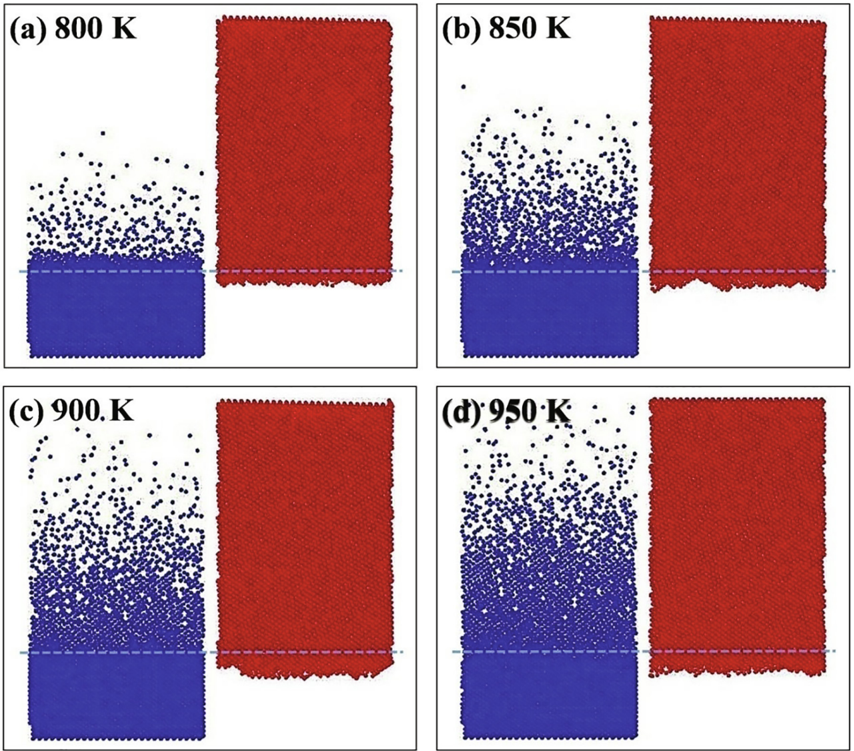
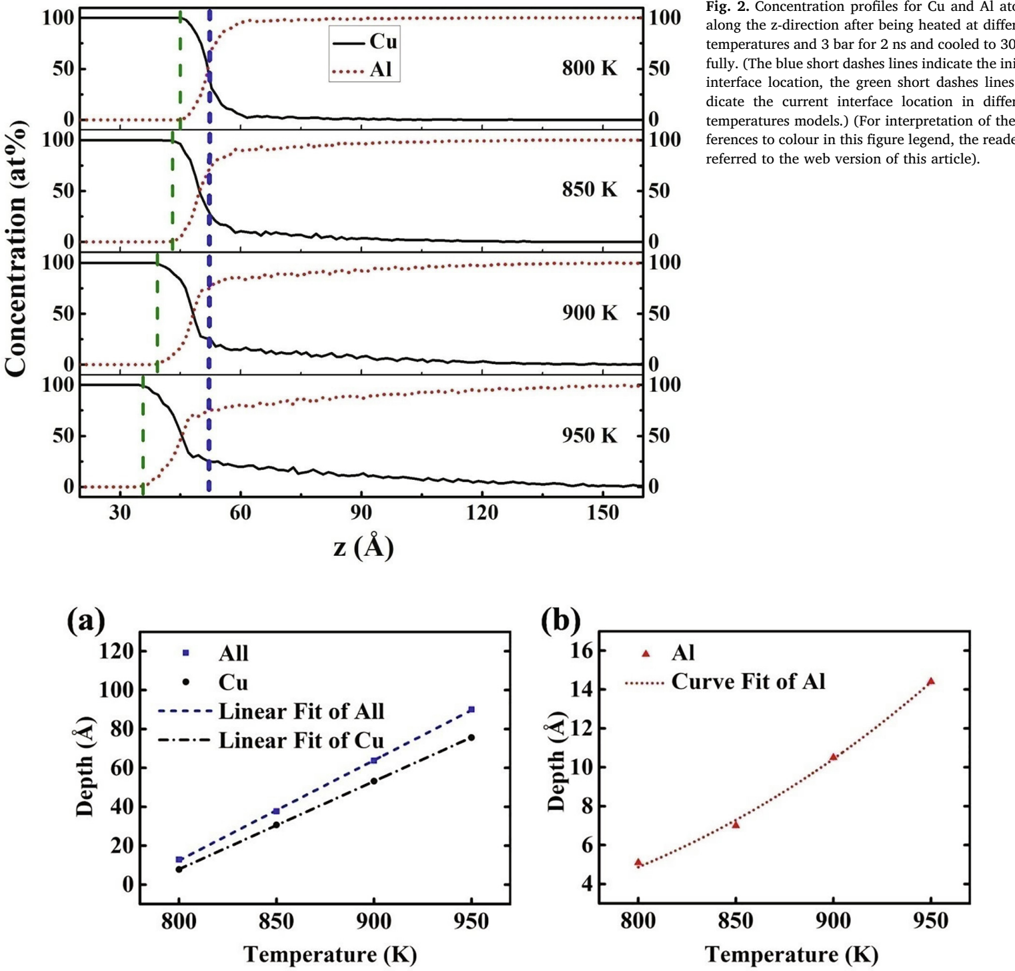
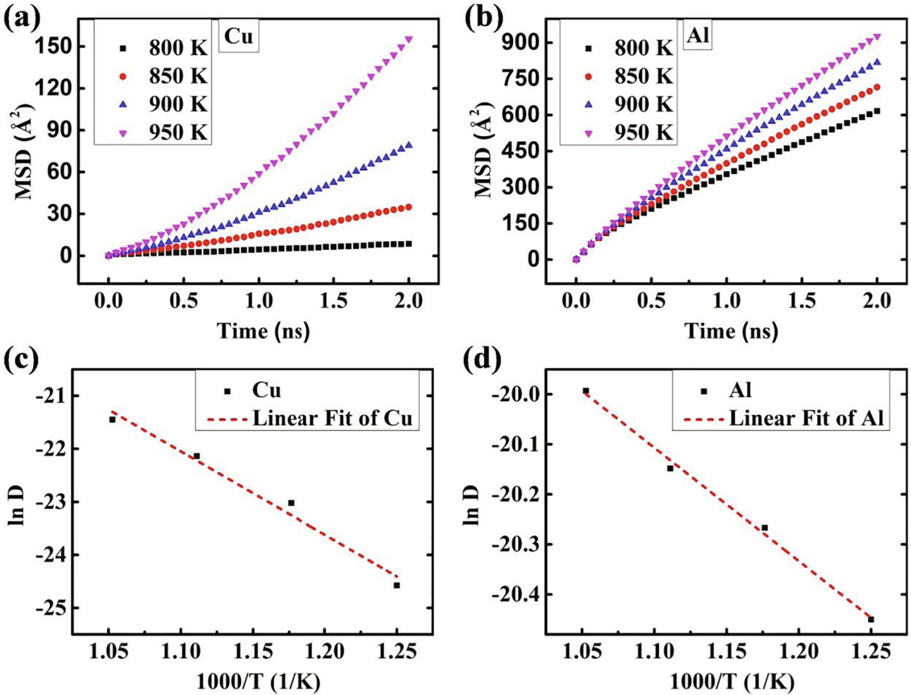
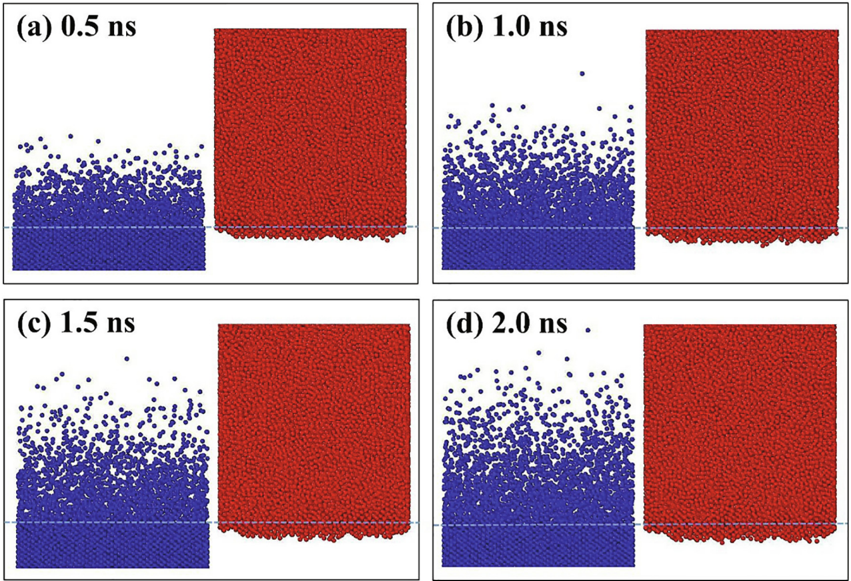
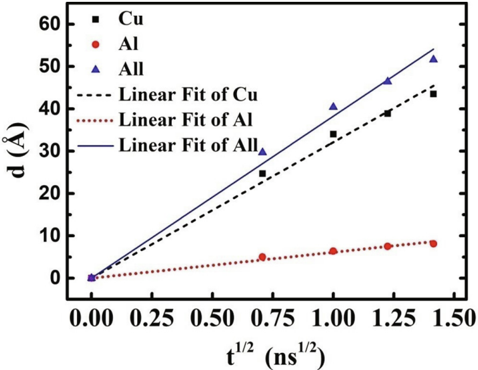
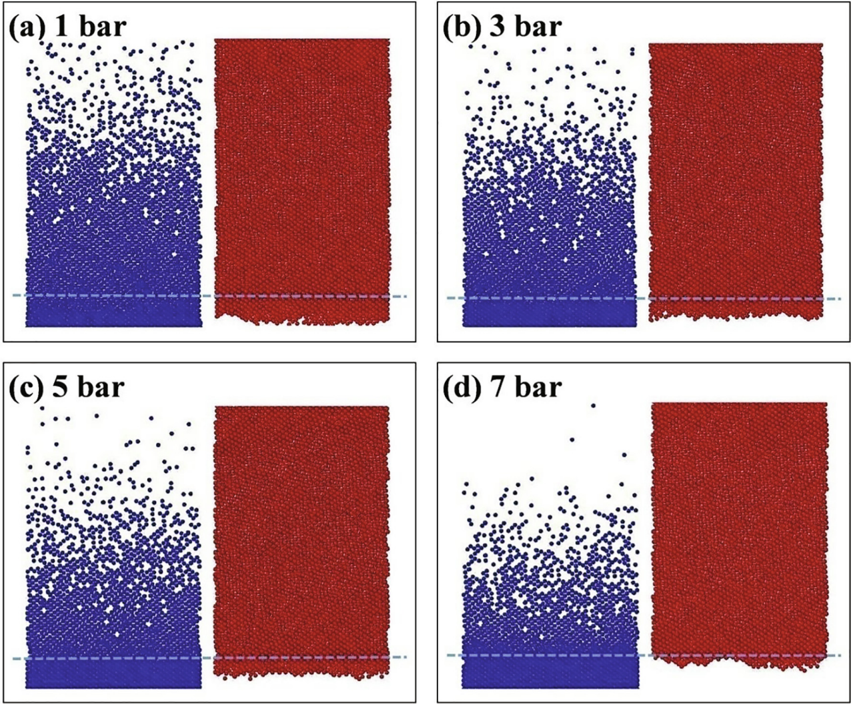
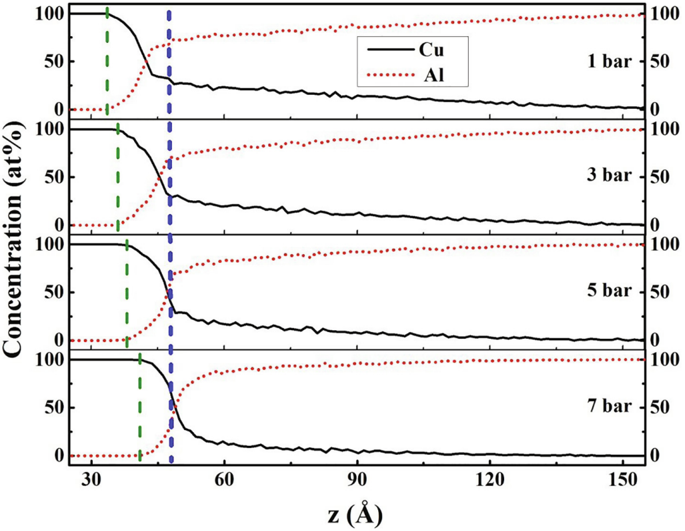
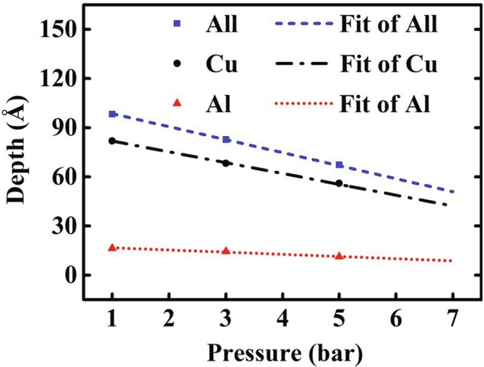
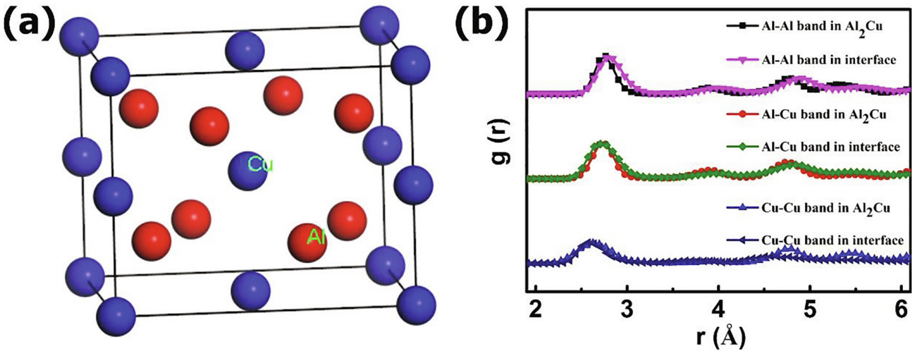
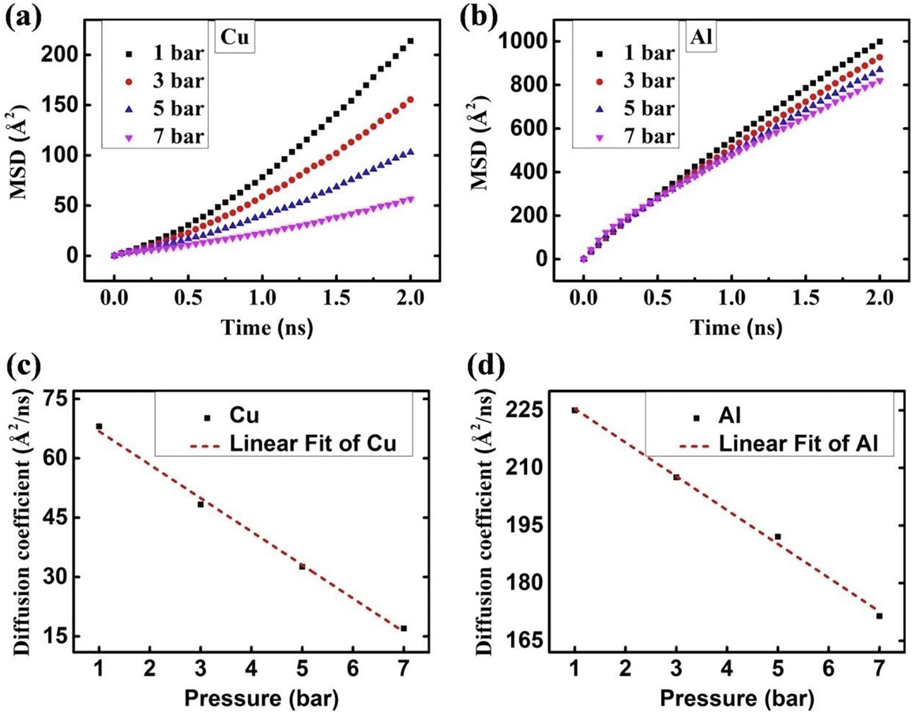
The Cu-Al composite material possesses a large potential value in practical application due to its excellent properties. Whereas the Cu/Al interface is an inevitable issue to be solved both experimentally and theoretically. Thus, the effects of temperature, pressure on atomic interdiffusion along the direction perpendicular to the Cu(1 1 0)/Al solid-liquid interface have been investigated by using a molecular dynamics (MD) method with the embedded atomic method (EAM) potentials. The results indicate that the diffusion coefficients of both Cu and Al atoms layers, as well as the diffusion depth of Al atoms, satisfy Arrhenius formula with the system temperature. The diffusion depth of Cu atoms presents a linear relationship with system temperatures. While the thickness of diffusion layer presents a parabolic relation with diffusion time, which is also in good agreement with the experimental results. In addition, we show that the diffusion rate of Cu atoms diffusion in Al liquid is more than 5 times that of Al atoms diffusion in Cu layers, and sequentially the alloy layers are mainly formed by the diffusion of Cu atoms in the Al liquid. Finally, the intermetallic in alloy layers is mainly identified as θ-Al2Cu once solidification by annealing. These findings have useful in designing Cu/Al interface in practices.
Overview
The claims and statistics of this paper haven’t been checked yet.
Run the check — free, no account needed. It reads the open-access text and checks the sources it cites.
Integrity signals
Registry
Cites
Statistics
Figures
Verification
Claims the paper makes
The claims and statistics of this paper haven’t been checked yet.
Run the check — free, no account needed. It reads the open-access text and checks the sources it cites.
Claims other papers make about this one
Each is checked against this paper’s own text: does it say what the citing paper says it does?
The cited source says what the claim attributes to it.
In the citing paper
“According to earlier research, the diffusion depth and time have a parabolic relationship, as shown in Eq. (2) 31,41:”
From Microstructural and mechanical characterization of Al/Cu interface in a bimetallic composite produced by compound casting (2024) · cites this paper as [31]
The cited source says what the claim attributes to it.
In the citing paper
“According to former studies, the diffusion depth of Cu atoms is more sensitive to time than Al atoms.”
From Microstructural and mechanical characterization of Al/Cu interface in a bimetallic composite produced by compound casting (2024) · cites this paper as [31]
The cited source says what the claim attributes to it.
In the citing paper
“Hence, the diffusion layer growth is controlled by Cu atom diffusion in liquid Al31.”
From Microstructural and mechanical characterization of Al/Cu interface in a bimetallic composite produced by compound casting (2024) · cites this paper as [31]
Self-check
Percentages, sums and reported differences re-computed from the paper’s own numbers.
The self-check needs the paper’s full text.
Citations
Cites
No references could be resolved yet.
Research works printed but not linked: 26
- LaCaze, 2005, Study of the microstructure resulting from brazed aluminium materials used in heat exchangers, Mater Sci Eng A, 413–414, 317, 10.1016/j.msea.2005.08.187 · DOI
- Asta, 2002, Calculation of alloy solid-liquid interfacial free energies from atomic-scale simulations, Phys Rev B, 66, 100101(R), 10.1103/PhysRevB.66.100101 · DOI
- Ramalingam, 2002, Interface Sci., 10, 149, 10.1023/A:1015889313170 · DOI
- Webb, 2003, Precursor film controlled wetting of Pb on Cu, Phys Rev Lett, 91, 10.1103/PhysRevLett.91.236102 · DOI
- Hoyt, 2007, Molecular dynamics study of equilibrium concentration profiles and the gradient energy coefficient in Cu-Pb nanodroplets, Phys Rev B, 76, 10.1103/PhysRevB.76.094102 · DOI
- Pablo, 2011, Atomistic characterization of the Cu–Pb solid–liquid interface, Acta Mater, 59, 3137, 10.1016/j.actamat.2011.01.053 · DOI
- Li, 2017, Morphology and mechanical properties of nanocrystalline Cu/Ag alloy, J Mater Sci, 52, 4555, 10.1007/s10853-016-0700-3 · DOI
- Levchenko Elena, 2010, Molecular dynamics simulation of the alloying reaction in Al-coated Ni nanoparticle, Comp Mater Sci, 47, 712, 10.1016/j.commatsci.2009.10.014 · DOI
- Scott, 2011, A molecular dynamics study of the role of relative melting temperatures in reactive Ni/Al nanolaminates, J Phys Condens Matter, 23
- Sundaram, 2013, Thermochemical behavior of nickel-coated nanoaluminum particles, J Phys Chem, 117, 7858
- Levchenko, 2013, Molecular dynamics simulation of alloying in an Al-coated Ti nanoparticle, Comp Mater Sci, 79, 316, 10.1016/j.commatsci.2013.06.005 · DOI
- Kiselev, 2014, Molecular-dynamics simulation of the synthesis of intermetallic Ti-Al, Intermetallics, 49, 106, 10.1016/j.intermet.2014.01.008 · DOI
- Meguro, 2012, Growth behavior of compounds due to solid-state reactive diffusion between Cu and Al, J Mater Sci, 47, 4955, 10.1007/s10853-012-6370-x · DOI
- Tanaka, 2007, Growth behavior of compound layers during reactive diffusion between solid Cu and liquid Al, Mater Sci Eng A, 445–446, 355, 10.1016/j.msea.2006.09.047 · DOI
- Tanaka, 2007, Numerical analysis for migration of interface between liquid and solid phases during reactive diffusion in the binary Cu–Al system, Mater Sci Eng A, 459, 101, 10.1016/j.msea.2006.12.092 · DOI
- Cheng, 2013, J Appl Phys, 114
- Besson, 2014, First-principles study of Al-Cu energetics and consequences on athermal formation of Cu-rich compounds, Phys Rev B, 90, 10.1103/PhysRevB.90.214104 · DOI
- Geysermans, 2000, Molecular dynamics study of the solid–liquid interface, J Chem Phys, 113, 6382, 10.1063/1.1290730 · DOI
- Li, 2014, Molecular dynamics simulation of diffusion bonding of Al–Cu interface, Modell Simul Mater Sci Eng, 22, 10.1088/0965-0393/22/6/065013 · DOI
- Lin, 2018, Molecular dynamics study on the heterogeneous nucleation of liquid Al–Cu alloys on different kinds of copper substrates, Phys Chem Chem Phys, 20, 29856, 10.1039/C8CP05948A · DOI
- Plimpton, 1995, Fast parallel algorithms for short-range molecular dynamics, J Comput Phys, 117, 1, 10.1006/jcph.1995.1039 · DOI · Paper page
- Cai, 1996, Phys Rev B, 54, 8398, 10.1103/PhysRevB.54.8398 · DOI
- 2007, Acta Mater, 55, 3169, 10.1016/j.actamat.2006.12.040 · DOI
- Hockney, 1970, The potential calculation and some applications, Methods Comput Phys, 9, 136
- Du, 2003, Diffusion coefficients of some solutes in fcc and liquid Al: critical evaluation and correlation, Mater Sci Eng A, 363, 140, 10.1016/S0921-5093(03)00624-5 · DOI
- Mao, 2019, Interfacial microstructure and bonding strength of copper/aluminum clad sheets produced by horizontal twin-roll casting and annealing, Mater Res Express, 6
Cited by
Sorted by citations
Ahmadzadeh Salout, S., & Mirbagheri, S. M. H. (2024) · Scientific Reports · doi:10.1038/s41598-024-57849-7 · Cited by 18
Metadata
- Authors
- Mao, A., Zhang, J., Yao, S., Wang, A., Wang, W., Li, Y., Qiao, C., Xie, J., & Jia, Y.
- Affiliations
- Henan University of Science and Technology (CN)
- Huanghe Science and Technology College (CN)
- Zhengzhou University (CN)
- Henan University (CN)
- Corresponding author
- Xie, Jingpei
- Jia, Yu
- Venue
- Results in Physics
- Publisher
- Elsevier BV
- Published
- 2020-03
- Volume
- 16
- Pages
- 102998
- ISSN
- 2211-3797 (ISSN-L)
- OpenAlex
- W3004601249
- Cited by
- 115
- References
- 0
- Citations by year
- 2026: 15 · 2025: 20 · 2024: 31 · 2023: 21 · 2022: 17 · 2021: 9 · 2020: 2
- FWCI
- 6.03
- Type
- journal article
- Language
- en
- Open access
- gold
- doi.org
- Licence
- Locations
- Results in Physics (publishedVersion, cc-by-nc-nd)
- DOAJ (DOAJ: Directory of Open Access Journals) (submittedVersion, cc-by-sa)
- Funders
- Foundation of Henan Educational Committee
- National Natural Science Foundation of China
- Topics
- Physical Sciences › Materials Science › Metals and Alloys › Thermodynamic and Structural Properties of Metals and Alloys
- Physical Sciences › Engineering › Mechanical Engineering › Advanced Welding Techniques Analysis
- Physical Sciences › Engineering › Mechanical Engineering › Intermetallics and Advanced Alloy Properties
- Keywords
- solid-liquid interface, interdiffusion, diffusion coefficient, diffusion depth, temperature dependence, pressure effects, Cu(110) surface, interfacial alloying, embedded atom method
About these checks
Registry, retraction, Cites and statistics results are computed, not judged, with one exception: a printed reference that no index lists is read once by a model before it counts as a citation error. Claims are extracted by a model and kept only when their quote appears verbatim in the text; each cited source is then checked, with a model’s help, for whether it says what the claim relies on. Those verdicts can be wrong — read the claim’s quote and the cited source before relying on one.
Statistics and arithmetic are recomputed, not judged.
Confidence bands are shown only for fields calibrated on our annotated test set. None is calibrated yet, so no band is shown.
What counts as a claim ›How we measure confidence ›How we check this ›
Are you an author, or do you see a problem with this page? Request a review
How to cite
Cite CoChat for the checks on this page, and the paper for its own findings.
- This page
- CoChat. (2026). Citation check: The diffusion behaviors at the Cu-Al solid-liquid interface: A molecular dynamics study. https://app.cochat.ai/papers/10.1016/j.rinp.2020.102998
- The paper
- Mao, A., Zhang, J., Yao, S., Wang, A., Wang, W., Li, Y., Qiao, C., Xie, J., & Jia, Y. (2020). The diffusion behaviors at the Cu-Al solid-liquid interface: A molecular dynamics study. Results in Physics. https://doi.org/10.1016/j.rinp.2020.102998
