

The DOI matches its Crossref record.
Permeable pavements: A possible sink for tyre wear particles and other microplastics?
Open accessAbstract
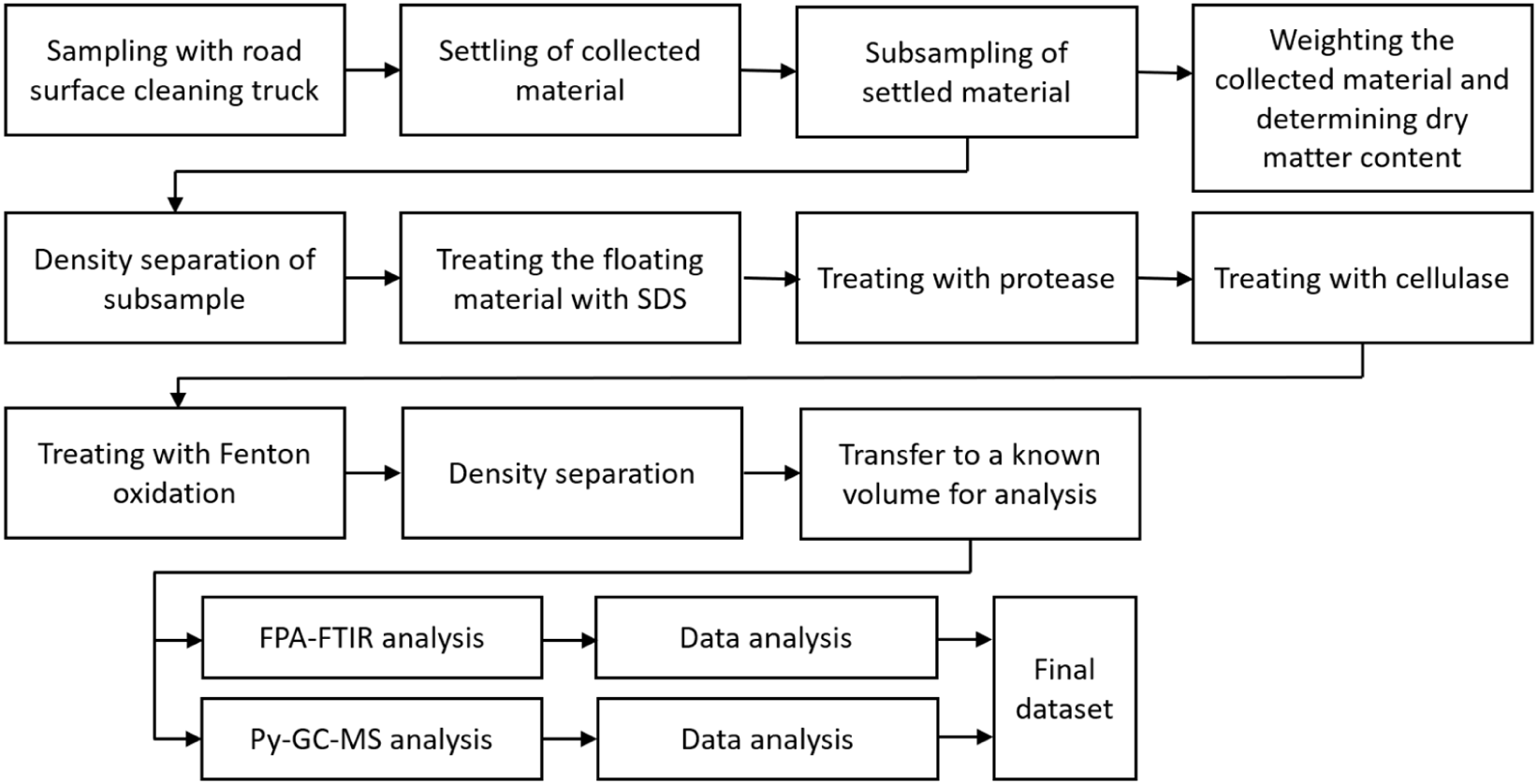
In this study, seven roads and parking lots were sampled by a road surface cleaning truck and approximately 100 kg of particulate material was collected per site. Thereafter, the samples were analysed for microplastics, including tyre wear particles. The analyses revealed that tyre wear constituted 0.09 % of the dry mass of the samples on average. Other plastic types were also identified in the samples, but at on average 49 times lower concentrations compared to tyre wear particles. Although the roads and parking lots were used for residential, industrial, and commercial purposes, no correlation between land use and the total concentrations of microplastics was identified. Of microplastics other than tyre wear particles, polypropylene constituted an important fraction in all samples, whereas other polymers were present at various degrees. The contents of heavy metals, sulphur, and total organic carbon were also measured in the samples, but no correlation between them and microplastics was determined. A back-of-the-envelope estimation indicated that the tyre wear material retained by permeable pavements constituted a non-negligible fraction of the total mass of microplastics released on roads and parking lots. Therefore, permeable pavements can serve as a tool for the management of this pollutant.
Overview
The claims and statistics of this paper haven’t been checked yet.
Run the check — free, no account needed. It reads the open-access text and checks the sources it cites.
Integrity signals
Registry
Cites
Statistics
Figures
Verification
Claims the paper makes
The claims and statistics of this paper haven’t been checked yet.
Run the check — free, no account needed. It reads the open-access text and checks the sources it cites.
Claims other papers make about this one
Each is checked against this paper’s own text: does it say what the citing paper says it does?
The source backs part of the claim, not all of it — or backs it for a different population, condition or comparison.
In the citing paper
“many permeable pavers are installed upon a mix of sand and crushed aggregate with larger pore sizes than soil and vegetation based GSI (Rasmussen et al., 2023).”
From Review of emerging contaminants in green stormwater infrastructure: antibiotic resistance genes, microplastics, tire wear particles, PFAS, and temperature (2024) · cites this paper as Rasmussen et al., 2023
Experimental — accuracy not yet measured
Self-check
Percentages, sums and reported differences re-computed from the paper’s own numbers.
The self-check needs the paper’s full text.
Citations
Cites
No references could be resolved yet.
Research works printed but not linked: 49
- Andersen, 2022, The climate road—a multifunctional full-scale demonstration road that prevents flooding and produces green energy, Water, 14, 666, 10.3390/w14040666 · DOI
- Baensch-Baltruschat, 2020, Tyre and road wear particles (TRWP) - a review of generation, properties, emissions, human health risk, ecotoxicity, and fate in the environment, Sci. Total Environ., 733, 10.1016/j.scitotenv.2020.137823 · DOI · Paper page
- Beaurepaire, 2021, Microplastics in the atmospheric compartment: a comprehensive review on methods, results on their occurrence and determining factors, Curr. Opin. Food Sci., 41, 159, 10.1016/j.cofs.2021.04.010 · DOI
- Boni, 2022, Inter-storm variation in microplastic concentration and polymer type at stormwater outfalls and a bioretention basin, Sci. Total Environ., 809, 10.1016/j.scitotenv.2021.151104 · DOI · Paper page
- Chand, 2021, The occurrence and fate of microplastics in a mesophilic anaerobic digester receiving sewage sludge, grease, and fatty slurries, Sci. Total Environ., 798, 10.1016/j.scitotenv.2021.149287 · DOI
- Dimante-Deimantovica, 2022, Hide-and-seek: threshold values and contribution towards better understanding of recovery rate in microplastic research, MethodsX, 9, 10.1016/j.mex.2021.101603 · DOI
- Djouina, 2022, Oral exposure to polyethylene microplastics alters gut morphology, immune response, and microbiota composition in mice, Environ. Res., 212
- Djukic, 2018, Build-up and characterisation of pollutants on urban impervious surfaces, Water Sci. Technol., 77, 2123, 10.2166/wst.2018.128 · DOI
- Dong, 2020, Inhaled tire-wear microplastic particles induced pulmonary fibrotic injury via epithelial cytoskeleton rearrangement, J. Hazard. Mater., 385
- Dreelin, 2006, A test of porous pavement effectiveness on clay soils during natural storm events, Water Res., 40, 799, 10.1016/j.watres.2005.12.002 · DOI
- Dris, 2017, A first overview of textile fibers, including microplastics, in indoor and outdoor environments, Environ. Pollut., 221, 453, 10.1016/j.envpol.2016.12.013 · DOI
- Eisentraut, 2018, Two birds with one stone-fast and simultaneous analysis of microplastics: microparticles derived from thermoplastics and tire wear, Environ. Sci. Technol. Lett., 5, 608, 10.1021/acs.estlett.8b00446 · DOI
- Goonetilleke, 2009, Mar. Pollut. Bull., 58, 213, 10.1016/j.marpolbul.2008.09.025 · DOI
- Goßmann, 2021, Car and truck tire wear particles in complex environmental samples – a quantitative comparison with “traditional” microplastic polymer mass loads, Sci. Total Environ., 773, 10.1016/j.scitotenv.2021.145667 · DOI
- Goßmann, 2022, Plastic in the air?! - spider webs as spatial and temporal mirror for microplastics including tire wear particles in urban air, Sci. Total Environ., 832, 10.1016/j.scitotenv.2022.155008 · DOI
- Gustavsson, 2006, Comparison of analytical error and sampling error for contaminated soil, J. Hazard. Mater., 138, 252, 10.1016/j.jhazmat.2006.01.082 · DOI
- Haave, 2019, Different stories told by small and large microplastics in sediment – first report of microplastic concentrations in an urban recipient in Norway, Mar. Pollut. Bull., 141, 501, 10.1016/j.marpolbul.2019.02.015 · DOI
- Halle, 2021, Tire wear particle and leachate exposures from a pristine and road-worn tire to Hyalella azteca: comparison of chemical content and biological effects, Aquat. Toxicol., 232, 10.1016/j.aquatox.2021.105769 · DOI
- Herath, 2022, Microplastics in urban stormwater—developing a methodology for its monitoring, Environ. Monit. Assess., 194, 173, 10.1007/s10661-022-09849-1 · DOI
- Hernandez-Crespo, 2019, Influence of rainfall intensity and pollution build-up levels on water quality and quantity response of permeable pavements, Sci. Total Environ., 684, 303, 10.1016/j.scitotenv.2019.05.271 · DOI
- Hernandez-Olivares, 2009, Rubber-modified hot-mix asphalt pavement by dry process, Int.J.Pavement Eng., 10, 277, 10.1080/10298430802169416 · DOI
- Jayakaran, 2019, Remediation of stormwater pollutants by porous asphalt pavement, Water, 11, 520, 10.3390/w11030520 · DOI
- Jung, 2022, Classification and characterization of tire-road wear particles in road dust by density, Polymers, 14, 1005, 10.3390/polym14051005 · DOI
- Khalid, 2021, Linking effects of microplastics to ecological impacts in marine environments, Chemosphere, 264
- Khan, 2019, Acute and long-term toxicity of micronized car tire wear particles to Hyalella azteca, Aquat. Toxicol., 213, 10.1016/j.aquatox.2019.05.018 · DOI
- Kim, 2022, Toxicity assessment of tire particles released from personal mobilities (bicycles, cars, and electric scooters) on soil organisms, J. Hazard. Mater., 437, 10.1016/j.jhazmat.2022.129362 · DOI
- Klöckner, 2019, Tire and road wear particles in road environment - quantification and assessment of particle dynamics by Zn determination after density separation, Chemosphere, 222, 714, 10.1016/j.chemosphere.2019.01.176 · DOI
- Klöckner, 2020, Characterization of tire and road wear particles from road runoff indicates highly dynamic particle properties, Water Res., 185, 10.1016/j.watres.2020.116262 · DOI
- Kole, 2017, Wear and tear of tyres: a stealthy source of microplastics in the environment, Int. J. Environ. Res. Public Health, 14, 1265, 10.3390/ijerph14101265 · DOI
- Lange, 2022, Occurrence and concentration of 20–100 μm sized microplastic in highway runoff and its removal in a gross pollutant trap – bioretention and sand filter stormwater treatment train, Sci. Total Environ., 809, 10.1016/j.scitotenv.2021.151151 · DOI
- Li, 2022, Inhaled tire-wear microplastic particles induced pulmonary fibrotic injury via epithelial cytoskeleton rearrangement, Environ. Int., 164, 10.1016/j.envint.2022.107257 · DOI
- Liu, 2019, Microplastics in urban and highway stormwater retention ponds, Sci. Total Environ., 671, 992, 10.1016/j.scitotenv.2019.03.416 · DOI
- Liu, 2019, Retention of microplastics in sediments of urban and highway stormwater retention ponds, Environ. Pollut., 255, 10.1016/j.envpol.2019.113335 · DOI
- Mennekes, 2022, Tire wear particle emissions: measurement data where are you?, Sci. Total Environ., 830, 10.1016/j.scitotenv.2022.154655 · DOI
- Miller, 2022, Pyrolysis-gas chromatography-mass spectrometry (Py-GC-MS) quantification of tire and road wear particles (TRWP) in environmental matrices: assessing the importance of microstructure in instrument calibration protocols, Anal. Lett., 55, 1004, 10.1080/00032719.2021.1979994 · DOI
- Müller, 2022, Determination of tire wear markers in soil samples and their distribution in a roadside soil, Chemosphere, 294, 10.1016/j.chemosphere.2022.133653 · DOI
- Olesen, 2019, Microplastics in a stormwater pond, Water, 11, 1466, 10.3390/w11071466 · DOI
- Primpke, 2020, Toward the systematic identification of microplastics in the environment: evaluation of a new independent software tool (siMPle) for spectroscopic analysis, Appl. Spectrosc., 74, 1127, 10.1177/0003702820917760 · DOI
- Rasmussen, 2021, A complete mass balance for plastics in a wastewater treatment plant - macroplastics contributes more than microplastics, Water Res., 201, 10.1016/j.watres.2021.117307 · DOI
- Rauert, 2021, Challenges with quantifying tire road wear particles: recognizing the need for further refinement of the ISO technical specification, Environ.Sci.Technol.Lett., 8, 231, 10.1021/acs.estlett.0c00949 · DOI
- Razzaghmanesh, 2018, A review of permeable pavement clogging investigations and recommended maintenance regimes, Water, 10, 337, 10.3390/w10030337 · DOI
- Rhodes, 2012, Zinc leaching from tire crumb rubber, Environ. Sci. Technol., 46, 12856, 10.1021/es3024379 · DOI
- Rist, 2020, Quantification of plankton-sized microplastics in a productive coastal Arctic marine ecosystem, Environ. Pollut., 266
- Rødland, 2022, Characterization of tire and road wear microplastic particle contamination in a road tunnel: from surface to release, J. Hazard. Mater., 435, 10.1016/j.jhazmat.2022.129032 · DOI
- Sieber, 2020, Dynamic probabilistic material flow analysis of rubber release from tires into the environment, Environ. Pollut., 258, 10.1016/j.envpol.2019.113573 · DOI
- Simon, 2021, Accelerated weathering increases the release of toxic leachates from microplastic particles as demonstrated through altered toxicity to the green algae Raphidocelis subcapitata, Toxics, 9, 185, 10.3390/toxics9080185 · DOI
- Simpson, 2019, Assessing maintenance techniques and in-situ pavement conditions to restore hydraulic function of permeable interlocking concrete pavements, J. Environ. Manag., 294
- Sun, 2022, Explorations of tire and road wear microplastics in road dust PM2.5 at eight megacities in China, Sci. Total Environ., 823, 10.1016/j.scitotenv.2022.153717 · DOI
- Zofka, 2021, Fatigue performance of asphalt pavements with highly polymer-modified asphalt binders, Road Mater. Pavement Des., 22, S269
Cited by
Sorted by citations
Bodus, B., O'Malley, K., Dieter, G., Gunawardana, C., & McDonald, W. (2024) · Science of The Total Environment · doi:10.1016/j.scitotenv.2023.167195 · Cited by 76
Metadata
- Authors
- Rasmussen, L. A., Lykkemark, J., Andersen, T. R., & Vollertsen, J.
- Affiliations
- Aalborg University (DK)
- VIA University College (DK)
- Corresponding author
- Rasmussen, Lasse Abraham
- Venue
- Science of The Total Environment
- Publisher
- Elsevier BV
- Published
- 2023-04
- Volume
- 869
- Pages
- 161770
- ISSN
- 0048-9697 (ISSN-L)
- OpenAlex
- W4318065010
- Cited by
- 77
- References
- 0
- Citations by year
- 2026: 8 · 2025: 20 · 2024: 30 · 2023: 19
- FWCI
- 4.95
- Type
- journal article
- Language
- en
- Open access
- hybrid
- doi.org
- Licence
- Locations
- The Science of The Total Environment (publishedVersion, cc-by)
- PubMed (publishedVersion)
- VBN Forskningsportal (Aalborg Universitet) (acceptedVersion, cc-by)
- Topics
- Physical Sciences › Environmental Science › Pollution › Microplastics and Plastic Pollution
- Physical Sciences › Environmental Science › Environmental Engineering › Urban Stormwater Management Solutions
- Physical Sciences › Environmental Science › Pollution › Pharmaceutical and Antibiotic Environmental Impacts
- Keywords
- permeable pavement, tire wear particles, microplastics, parking lots, polypropylene, heavy metals, total organic carbon, microplastic removal, land use, road pollution
About these checks
Registry, retraction, Cites and statistics results are computed, not judged, with one exception: a printed reference that no index lists is read once by a model before it counts as a citation error. Claims are extracted by a model and kept only when their quote appears verbatim in the text; each cited source is then checked, with a model’s help, for whether it says what the claim relies on. Those verdicts can be wrong — read the claim’s quote and the cited source before relying on one.
Statistics and arithmetic are recomputed, not judged.
Confidence bands are shown only for fields calibrated on our annotated test set. None is calibrated yet, so no band is shown.
What counts as a claim ›How we measure confidence ›How we check this ›
Are you an author, or do you see a problem with this page? Request a review
