Cited by 79

The DOI matches its Crossref record.

Single Targeted Exon Mutation Creates a True Congenic Mouse for Competitive Hematopoietic Stem Cell Transplantation: The C57BL/6-CD45.1STEM Mouse

Mercier, Francois E., Sykes, David B., Scadden, David T.·2016·Stem Cell Reports

Overview

The claims and statistics of this paper haven’t been checked yet.

Run the check — free, no account needed. It reads the open-access text and checks the sources it cites.

A few free checks a day · papers already verified open instantly · results are public

Integrity signals

Registry

Crossref · 10.1016/j.stemcr.2016.04.010

Cites

Statistics

Figures

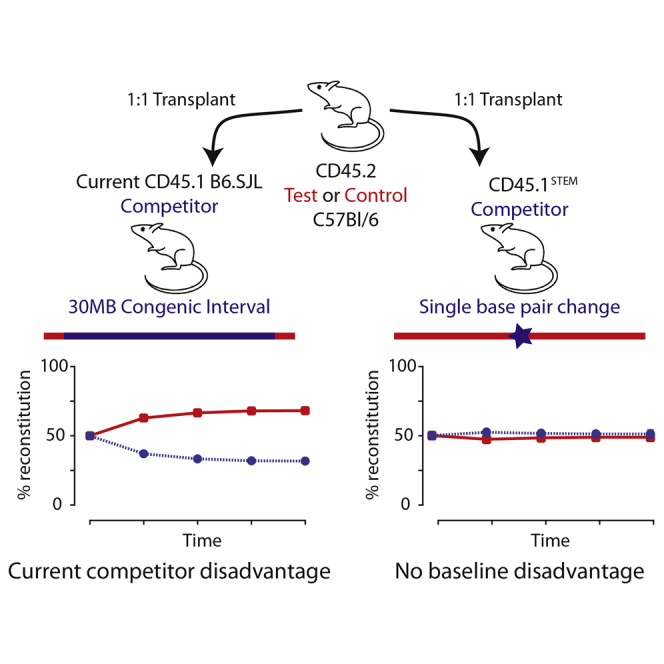
Graphical abstract
Graphical abstract CC BY-NC-ND · PubMed Central
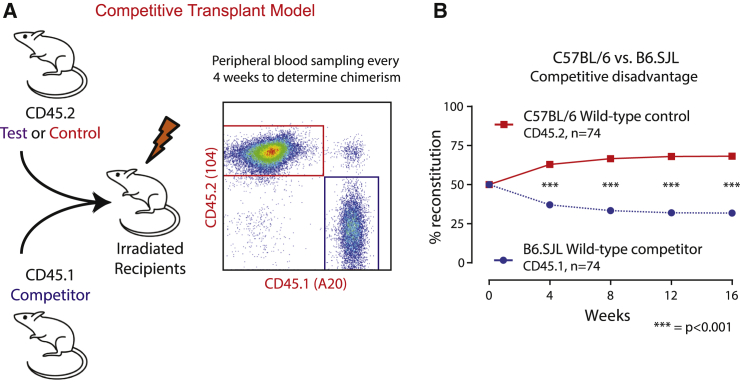
Figure 1 The Current B6.SJL Strain Shows an Inherent Competitive Disadvantage (A) A model of a typical competitive bone marrow transplantation experiment. In the experiment, bone marrow cells from a TEST (CD45.2) mouse are combined with an equal number of bone marrow cells from a COMPETITOR (CD45.1) mouse and transplanted into irradiated recipient mice. The peripheral blood chimerism is followed for 16–20 weeks as a functional assay of hematopoietic stem cell fitness. (B) HSPCs derived from the current B6.SJL (CD45.1) competitor strain show an inherent competitive disadvantage when compared with HSPCs from wild-type C57BL/6 mice. In these experiments, the bone marrow from three littermate C57BL/6 mice or three littermate B6.SJL mice were pooled. 500,000 nucleated bone marrow cells from each donor strain were combined (1 million cells total) and transplanted by intravenous injection in lethally irradiated recipients. Four experiments were performed, two in competition with WT C57BL/6J donors and two in competition with WT C57BL/6NJ donors. Results represent the mean ± SEM. Given the large number of replicates (74 recipient mice in each arm), the error bars are not visible as they are smaller than the squares. ∗∗∗p < 0.001.
Figure 1 The Current B6.SJL Strain Shows an Inherent Competitive Disadvantage (A) A model of a typical competitive bone marrow transplantation experiment. In the experiment, bone marrow cells from a TEST (CD45.2) mouse are combined with an equal number of bone marrow cells from a COMPETITOR (CD45.1) mouse and transplanted into irradiated recipient mice. The peripheral blood chimerism is followed for 16–20 weeks as a functional assay of hematopoietic stem cell fitness. (B) HSPCs derived from the current B6.SJL (CD45.1) competitor strain show an inherent competitive disadvantage when compared with HSPCs from wild-type C57BL/6 mice. In these experiments, the bone marrow from three littermate C57BL/6 mice or three littermate B6.SJL mice were pooled. 500,000 nucleated bone marrow cells from each donor strain were combined (1 million cells total) and transplanted by intravenous injection in lethally irradiated recipients. Four experiments were performed, two in competition with WT C57BL/6J donors and two in competition with WT C57BL/6NJ donors. Results represent the mean ± SEM. Given the large number of replicates (74 recipient mice in each arm), the error bars are not visible as they are smaller than the squares. ∗∗∗p < 0.001.CC BY-NC-ND · PubMed Central
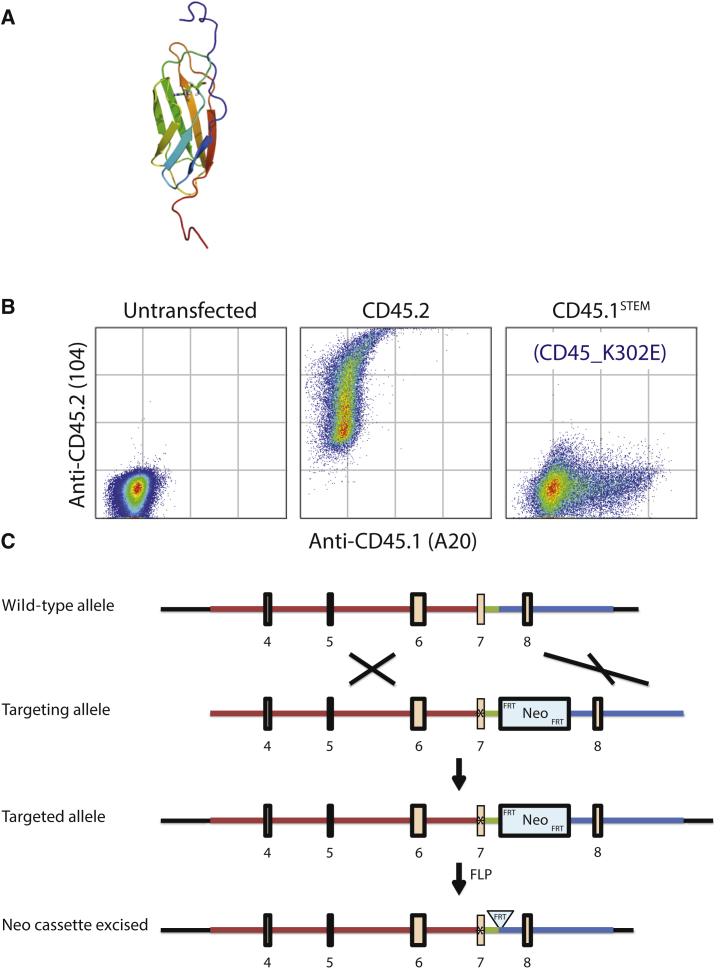
Figure 2 A Single Amino Acid Change Determines the Specificity of CD45.1 and CD45.2 Antibodies (A) A ribbon model of the extracellular fibronectin type III domain. The K302E mutation is highlighted. (B) The single K302E amino acid change determines CD45.1 versus CD45.2 antibody specificity of the Ptprc (CD45) gene. 293T human embryonic kidney cells were transiently transfected with a plasmid containing the original CD45.2 open reading frame, or the open reading frame with the K302E mutation, and then stained with anti-CD45.1 (clone A20) or anti-CD45.2 (clone 104) antibodies. (C) Design of the CD45.1STEM mouse bearing a single point mutation targeting the Ptprc gene in the background of the C57BL/6N strain. The long homology (red), middle homology (green), and short homology (blue) arms are indicated. See also Figure S1.
Figure 2 A Single Amino Acid Change Determines the Specificity of CD45.1 and CD45.2 Antibodies (A) A ribbon model of the extracellular fibronectin type III domain. The K302E mutation is highlighted. (B) The single K302E amino acid change determines CD45.1 versus CD45.2 antibody specificity of the Ptprc (CD45) gene. 293T human embryonic kidney cells were transiently transfected with a plasmid containing the original CD45.2 open reading frame, or the open reading frame with the K302E mutation, and then stained with anti-CD45.1 (clone A20) or anti-CD45.2 (clone 104) antibodies. (C) Design of the CD45.1STEM mouse bearing a single point mutation targeting the Ptprc gene in the background of the C57BL/6N strain. The long homology (red), middle homology (green), and short homology (blue) arms are indicated. See also Figure S1.CC BY-NC-ND · PubMed Central
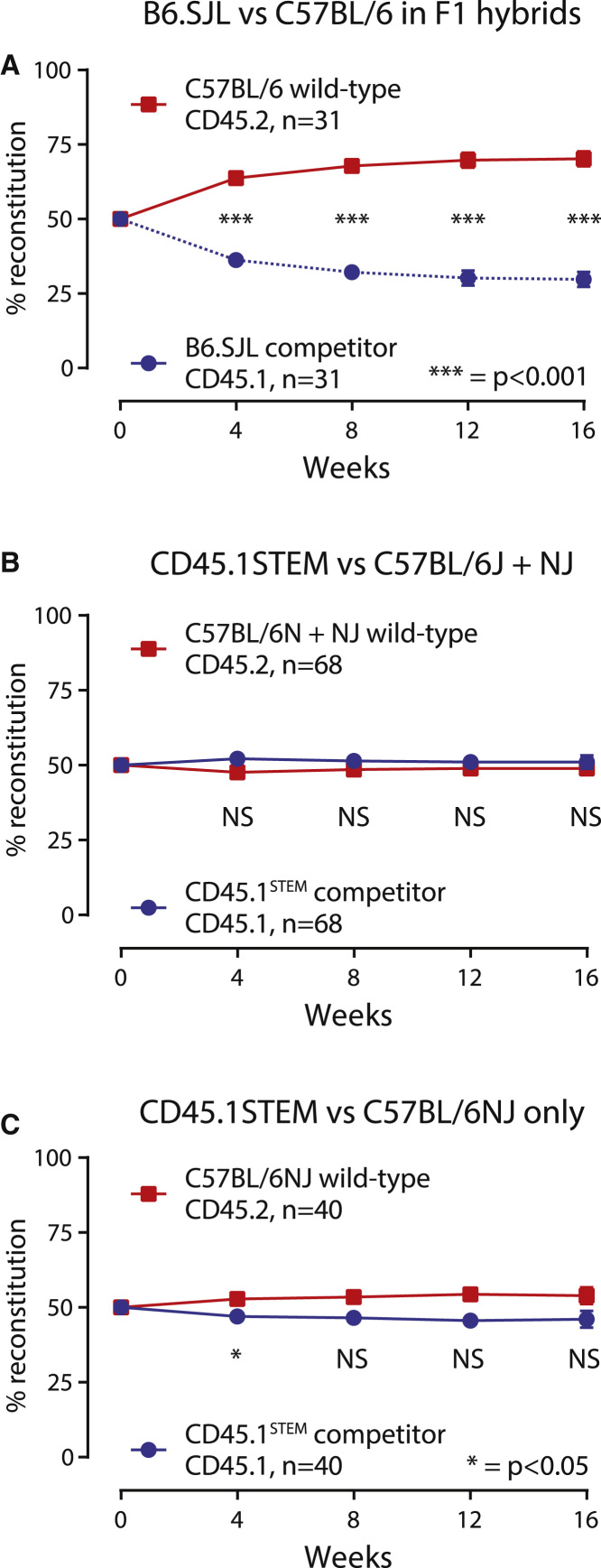
Figure 3 The CD45.1STEM Mouse Is Functionally Equivalent to C57BL/6 in Competitive Transplant Assays For all competitive transplantation experiments, 500,000 nucleated bone marrow cells from each pool of CD45.2 and CD45.1 donors were co-transplanted into lethally irradiated recipients. The percent reconstitution was tracked in the peripheral blood over a period of 16 weeks. (A) HSPCs derived from the current B6.SJL (CD45.1) competitor strain have an inherent competitive disadvantage when compared with HSPCs from wild-type C57BL/6 (CD45.2) mice even when transplanted into the background of F1 B6.SJL∗C57BL/6J hybrid recipients. Three experiments, two in competition with wild-type C57BL/6J donors and one in competition with wild-type C57BL/6NJ donors, were performed (31 recipient mice in total). (B) HSPCs derived from the CD45.1STEM competitor strain show functional equivalence when compared with HSPCs from wild-type C57BL/6 mice. Four experiments, two in competition with wild-type C57BL/6J donors and two in competition with wild-type C57BL/6NJ donors, were performed. The recipients in these four experiments were a mixture of C57BL/6J, C57BL/6NJ, and F1 B6.SJL∗C57BL/6J hybrids (68 recipient mice in total). (C) HSPCs derived from the CD45.1STEM competitor strain show functional equivalence when compared specifically with HSPCs from the wild-type C57BL/6NJ substrain of mice. Two experiments were performed (40 recipient mice in total). The results represent the mean ± SEM Given the large number of replicates, the error bars are not visible as they are smaller than the squares. ∗p < 0.05, ∗∗∗p < 0.001. See also Figure S3.
Figure 3 The CD45.1STEM Mouse Is Functionally Equivalent to C57BL/6 in Competitive Transplant Assays For all competitive transplantation experiments, 500,000 nucleated bone marrow cells from each pool of CD45.2 and CD45.1 donors were co-transplanted into lethally irradiated recipients. The percent reconstitution was tracked in the peripheral blood over a period of 16 weeks. (A) HSPCs derived from the current B6.SJL (CD45.1) competitor strain have an inherent competitive disadvantage when compared with HSPCs from wild-type C57BL/6 (CD45.2) mice even when transplanted into the background of F1 B6.SJL∗C57BL/6J hybrid recipients. Three experiments, two in competition with wild-type C57BL/6J donors and one in competition with wild-type C57BL/6NJ donors, were performed (31 recipient mice in total). (B) HSPCs derived from the CD45.1STEM competitor strain show functional equivalence when compared with HSPCs from wild-type C57BL/6 mice. Four experiments, two in competition with wild-type C57BL/6J donors and two in competition with wild-type C57BL/6NJ donors, were performed. The recipients in these four experiments were a mixture of C57BL/6J, C57BL/6NJ, and F1 B6.SJL∗C57BL/6J hybrids (68 recipient mice in total). (C) HSPCs derived from the CD45.1STEM competitor strain show functional equivalence when compared specifically with HSPCs from the wild-type C57BL/6NJ substrain of mice. Two experiments were performed (40 recipient mice in total). The results represent the mean ± SEM Given the large number of replicates, the error bars are not visible as they are smaller than the squares. ∗p < 0.05, ∗∗∗p < 0.001. See also Figure S3.CC BY-NC-ND · PubMed Central
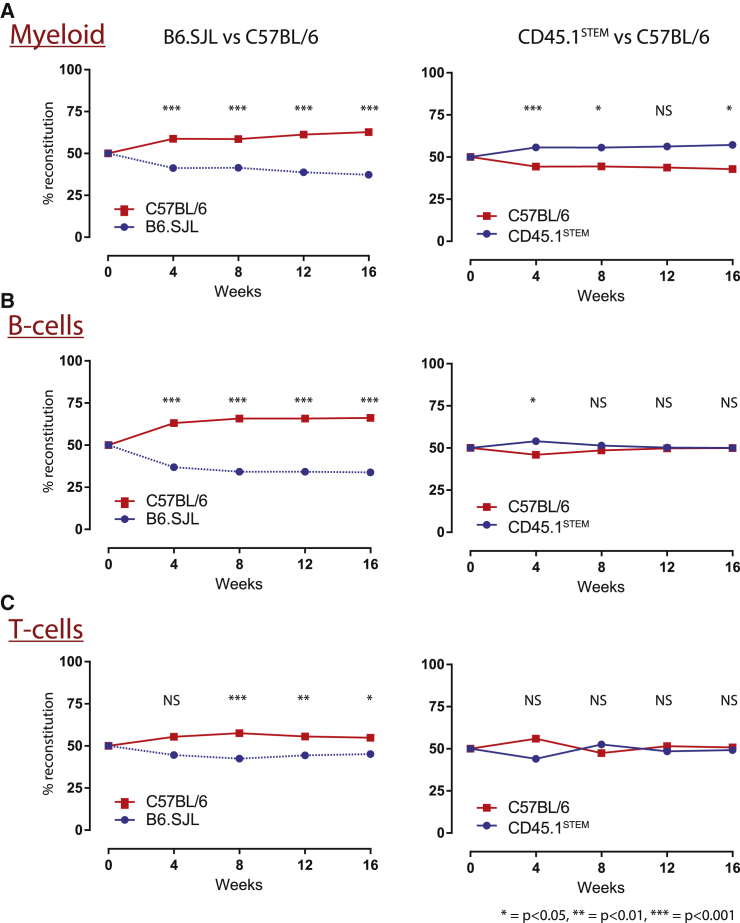
Figure 4 The CD45.1STEM Strain Shows Improved Reconstitution across Hematopoietic Lineages (A–C) Assessment of hematopoietic reconstitution within myeloid (A), B-lymphoid (B), or T-lymphoid (C) lineages for mice transplanted with B6.SJL (left panels) or CD45STEM (right panels) donor cells in competition with wild-type C57BL/6 HSPCs. Four experiments, two in competition with wild-type C57BL/6J donors and two in competition with wild-type C57BL/6NJ donors, were performed. The results represent the mean ± SEM. Given the large number of replicates (left panels, n = 74; right panels, n = 68), the error bars are not visible as they are smaller than the squares. ∗p < 0.05, ∗∗p < 0.01, and ∗∗∗p < 0.001.
Figure 4 The CD45.1STEM Strain Shows Improved Reconstitution across Hematopoietic Lineages (A–C) Assessment of hematopoietic reconstitution within myeloid (A), B-lymphoid (B), or T-lymphoid (C) lineages for mice transplanted with B6.SJL (left panels) or CD45STEM (right panels) donor cells in competition with wild-type C57BL/6 HSPCs. Four experiments, two in competition with wild-type C57BL/6J donors and two in competition with wild-type C57BL/6NJ donors, were performed. The results represent the mean ± SEM. Given the large number of replicates (left panels, n = 74; right panels, n = 68), the error bars are not visible as they are smaller than the squares. ∗p < 0.05, ∗∗p < 0.01, and ∗∗∗p < 0.001.CC BY-NC-ND · PubMed Central

Verification

Claims the paper makes

The claims and statistics of this paper haven’t been checked yet.

Run the check — free, no account needed. It reads the open-access text and checks the sources it cites.

A few free checks a day · papers already verified open instantly · results are public

Claims other papers make about this one

Each is checked against this paper’s own text: does it say what the citing paper says it does?

Self-check

Percentages, sums and reported differences re-computed from the paper’s own numbers.

The self-check needs the paper’s full text.

Citations

Cites

No references could be resolved yet.

Research works printed but not linked: 5

  1. Holmes, 2006, CD45: all is not yet crystal clear, Immunology, 117, 145, 10.1111/j.1365-2567.2005.02265.x · DOI
  2. Lacombe, 2010, Scl regulates the quiescence and the long-term competence of hematopoietic stem cells, Blood, 115, 792, 10.1182/blood-2009-01-201384 · DOI
  3. Nam, 2005, Structural basis for the function and regulation of the receptor protein tyrosine phosphatase CD45, J. Exp. Med., 201, 441, 10.1084/jem.20041890 · DOI
  4. Waterstrat, 2010, Congenic interval of CD45/Ly-5 congenic mice contains multiple genes that may influence hematopoietic stem cell engraftment, Blood, 115, 408, 10.1182/blood-2008-03-143370 · DOI
  5. Zebedee, 1991, Comparison of mouse Ly5a and Ly5b leucocyte common antigen alleles, Dev. Immunol., 1, 243

Cited by

Metadata

Authors
Mercier, F. E., Sykes, D. B., & Scadden, D. T.
Venue
Stem Cell Reports
Publisher
Elsevier BV
Published
2016-06
Volume
6
Issue
6
Pages
985-992
ISSN
2213-6711
Cited by
79
References
0
Language
en
Funders
  • Alex's Lemonade Stand Foundation for Childhood Cancer
  • Harvard University
  • American Society of Hematology
  • Canadian Institutes of Health Research

About these checks

Registry, retraction, Cites and statistics results are computed, not judged, with one exception: a printed reference that no index lists is read once by a model before it counts as a citation error. Claims are extracted by a model and kept only when their quote appears verbatim in the text; each cited source is then checked, with a model’s help, for whether it says what the claim relies on. Those verdicts can be wrong — read the claim’s quote and the cited source before relying on one.

Statistics and arithmetic are recomputed, not judged.

Confidence bands are shown only for fields calibrated on our annotated test set. None is calibrated yet, so no band is shown.

What counts as a claim ›How we measure confidence ›How we check this ›

Are you an author, or do you see a problem with this page? Request a review