

Illicit drugs street samples and their cutting agents. The result of the GC-MS based profiling define the guidelines for sensors development
Open accessThe DOI matches its Crossref record; 46 of the 46 references it cites were found in a registry or an index.
Abstract
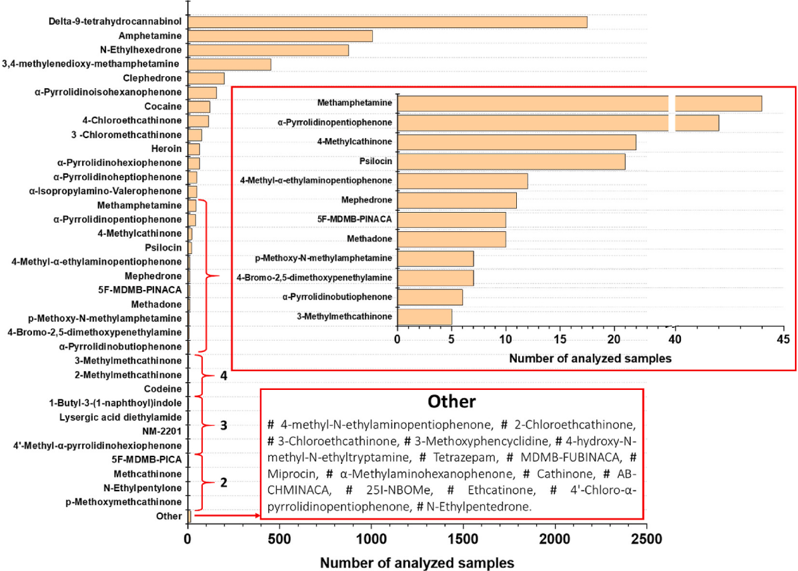
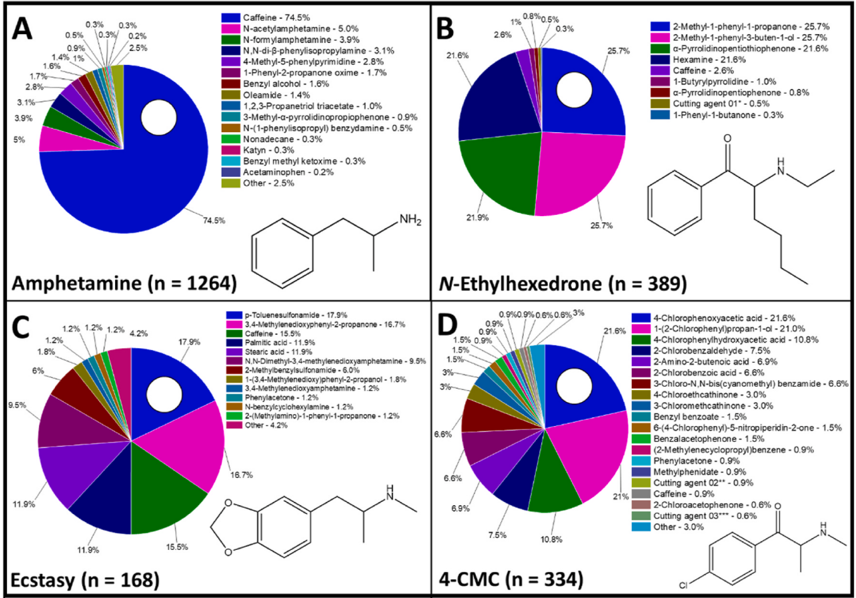
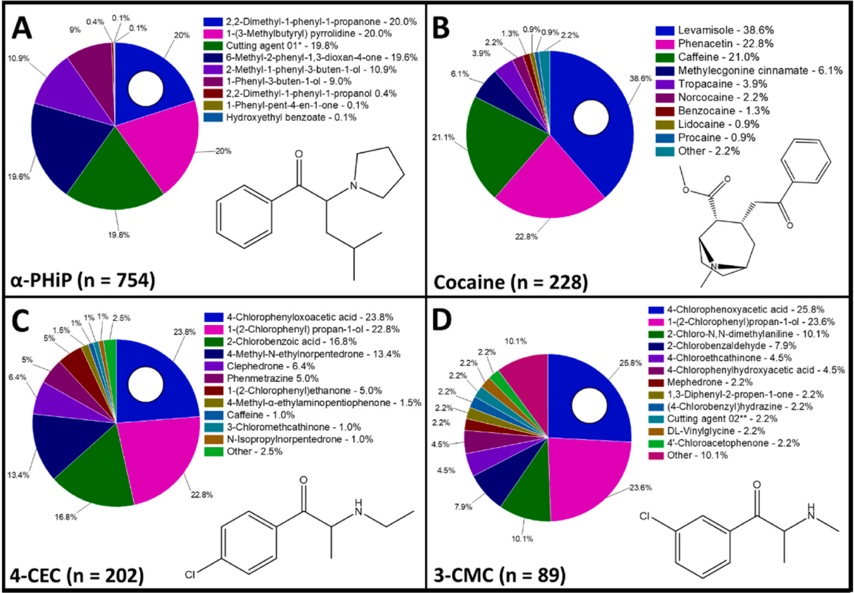
In this work, we have focused on the profiling of 5647 street samples covering marijuana, common and new recreational illicit drugs. All samples were analyzed using gas chromatography-mass spectrometry (GC-MS) technique. In total we have identified 53 illicit drugs with Δ-9-tetrahydrocannabinol (THC), amphetamine, N-ethylhexedrone, 3,4-methylenedioxy methamphetamine (MDMA), 4-chloromethcathinone (4-CMC), α-pyrrolidinoisohexaphenone (α-PHiP), cocaine, and 4-chloroethcathinone (4-CEC) being most commonly found and making 38.5, 17.8, 15.5, 8.0, 3.5, 2.7, 2.1, and 2.0% of the total studied pool, respectively. Except for methadone, all analyzed street samples were spiked with at least one cutting agent. Caffeine was the most frequently found adulterating addition present in around 33% (excluding marijuana) of the analyzed samples. Other identified cutting agents make an impressive group of more than 160 compounds. Finally, we have tabulated, illustrated, and discussed presented data in a view of smart and portable sensors development.
Overview
The claims and statistics of this paper haven’t been checked yet.
Free: it reads the open-access text and checks the first 5 claims that cite a source we can check. Create a free account to check every claim.
Integrity signals
Registry
Cites
Statistics
Figures
Verification
Claims the paper makes
The claims and statistics of this paper haven’t been checked yet.
Free: it reads the open-access text and checks the first 5 claims that cite a source we can check. Create a free account to check every claim.
Claims other papers make about this one
Each is checked against this paper’s own text: does it say what the citing paper says it does?
The check wasn’t confident either way, so it gives no verdict — never disputed.
In the citing paper
“metodesnitazene, detected in one death reported in England by the Office of Health Improvement and Disparities (OHID) in 2024 [20]”
From Evaluation of nitazene immunoassay test strips for rapid in-situ detection of nitazene and nitazene analogs in illicit drug samples (2025) · cites this paper as [20]
Experimental — accuracy not yet measured
Self-check
Percentages, sums and reported differences re-computed from the paper’s own numbers.
The self-check needs the paper’s full text.
Citations
Cites
Substance Use and Associated Health Conditions throughout the Lifespan
Schulte, M. T., & Hser, Y.-I. (2013) · Public Health Reviews · doi:10.1007/bf03391702 · Cited by 480
Cannabinoids, Phenolics, Terpenes and Alkaloids of Cannabis
Radwan, M. M., Chandra, S., Gul, S., & ElSohly, M. A. (2021) · Molecules · doi:10.3390/molecules26092774 · Cited by 397
Portable analytical platforms for forensic chemistry: A review
de Araujo, W. R., Cardoso, T. M. G., da Rocha, R. G., Santana, M. H. P., Muñoz, R. A. A., Richter, E. M., Paixão, T. R. L. C., & Coltro, W. K. T. (2018) · Analytica Chimica Acta · doi:10.1016/j.aca.2018.06.014 · Cited by 280
Raman spectroscopy in forensic analysis: identification of cocaine and other illegal drugs of abuse
de Oliveira Penido, C. A. F., Pacheco, M. T. T., Lednev, I. K., & Silveira, L. (2016) · Journal of Raman Spectroscopy · doi:10.1002/jrs.4864 · Cited by 201
The cutting of cocaine and heroin: A critical review
Broséus, J., Gentile, N., & Esseiva, P. (2016) · Forensic Science International · doi:10.1016/j.forsciint.2016.02.033 · Cited by 173
Detection and Quantitation of Trace Fentanyl in Heroin by Surface-Enhanced Raman Spectroscopy
Haddad, A., Comanescu, M. A., Green, O., Kubic, T. A., & Lombardi, J. R. (2018) · Analytical Chemistry · doi:10.1021/acs.analchem.8b02909 · Cited by 158
A New Aptameric Biosensor for Cocaine Based on Surface‐Enhanced Raman Scattering Spectroscopy
Chen, J., Jiang, J., Gao, X. G., Liu, G., Shen, G., & Yu, R. (2008) · Chemistry - A European Journal · doi:10.1002/chem.200701307 · Cited by 139
Faulds, K., Smith, W. E., Graham, D., & Lacey, R. J. (2002) · The Analyst · doi:10.1039/b107318b · Cited by 136
Falcone, S., Wisby, L., NICOL, T., Blease, A., Starbuck, B., Parker, A., Sanderson, J., Brown, S. D. M., Scudamore, C. L., Pusey, C. D., et al. (2019) · Scientific Reports · doi:10.1038/s41598-019-56837-6 · Cited by 136
Neuropsychological Consequences of Chronic Drug Use: Relevance to Treatment Approaches
Cadet, J. L., & Bisagno, V. (2016) · Frontiers in Psychiatry · doi:10.3389/fpsyt.2015.00189 · Cited by 130
de Jong, M., Sleegers, N., Kim, J., Van Durme, F., Samyn, N., Wang, J., & De Wael, K. (2016) · Chemical Science · doi:10.1039/c5sc04309c · Cited by 127
Tsumura, Y., 三留敏彰, & Kimoto, S. (2005) · Forensic Science International · doi:10.1016/j.forsciint.2004.11.011 · Cited by 104
Sägmüller, B., Schwarze, B., Brehm, G., & Schneider, S. (2001) · The Analyst · doi:10.1039/b105321n · Cited by 97
Kudlacek, O., Hofmaier, T., Luf, A., Mayer, F. P., Stockner, T., Nagy, C., Holy, M., Freissmuth, M., Schmid, R. W., & Sitte, H. H. (2017) · Journal of Chemical Neuroanatomy · doi:10.1016/j.jchemneu.2017.06.001 · Cited by 97
Electrochemical strategies for the detection of forensic drugs
Florea, A., de Jong, M., & Wael, K. D. (2018) · Current Opinion in Electrochemistry · doi:10.1016/j.coelec.2018.06.014 · Cited by 83
Gushgari, A. J., Driver, E. M., Steele, J. C., & Halden, R. U. (2018) · Journal of Hazardous Materials · doi:10.1016/j.jhazmat.2018.07.073 · Cited by 81
Ultra-high frequency piezoelectric aptasensor for the label-free detection of cocaine
Neves, M. A. D., Blaszykowski, C., Bokhari, S. H. A., & Thompson, M. E. (2015) · Biosensors and Bioelectronics · doi:10.1016/j.bios.2015.05.038 · Cited by 80
A Rapid Response Electrochemical Biosensor for Detecting Thc In Saliva
Stevenson, H., Bacon, A., Joseph, K. M., Gwandaru, W. R. W., Bhide, A., Sankhala, D., Dhamu, V. N., & Prasad, S. (2019) · Scientific Reports · doi:10.1038/s41598-019-49185-y · Cited by 79
Alsenedi, K. A., & Morrison, C. (2018) · Analytical Methods · doi:10.1039/c8ay00041g · Cited by 75
Automated Amplified Flow Immunoassay for Cocaine
Bauer, C. G., Eremenko, A. V., Kühn, A. V., Kürzinger, K., Makower, A., & Scheller, F. W. (1998) · Analytical Chemistry · doi:10.1021/ac971388s · Cited by 73
de Oliveira, L. S., Balbino, M. A., de Menezes, M. M. T., Dockal, E. R., & de Oliveira, M. F. (2013) · Microchemical Journal · doi:10.1016/j.microc.2013.04.017 · Cited by 73
Non-invasive detection of cocaine dissolved in beverages using displaced Raman spectroscopy
Eliasson, C., Macleod, N. A., & Matousek, P. (2007) · Analytica Chimica Acta · doi:10.1016/j.aca.2007.11.023 · Cited by 70
Li, X., Qi, H., Shen, L., Gao, Q., & Zhang, C. (2008) · Electroanalysis · doi:10.1002/elan.200704193 · Cited by 69
Gulaboski, R., Cordeiro, M. N. D. S., Milhazes, N., Garrido, J. M. P. J., Borges, F., Jorge, M., Pereira, C. M. D. M., Bogeski, I., Helguera, A. M., Naumoski, B., et al. (2006) · Analytical Biochemistry · doi:10.1016/j.ab.2006.11.006 · Cited by 69
Small Molecule Detection in Saliva Facilitates Portable Tests of Marijuana Abuse
Lee, J., Choi, J., Shultz, T. O., & Wang, S. X. (2016) · Analytical Chemistry · doi:10.1021/acs.analchem.6b01688 · Cited by 63
Rapid GC–MS confirmation of amphetamines in urine by extractive acylation
Marais, A. A. S., & Laurens, J. B. (2008) · Forensic Science International · doi:10.1016/j.forsciint.2008.10.021 · Cited by 59
Yüksel, S., Schwenke, A. M., Soliveri, G., Ardizzone, S. A., Weber, K., Cialla‐May, D., Hoeppener, S., Schubert, U. S., & Popp, J. (2016) · Analytica Chimica Acta · doi:10.1016/j.aca.2016.08.033 · Cited by 58
Moros, J., Galipienso, N., Vilches, R., Garrigues, S., & de la Guárdia, M. (2008) · Analytical Chemistry · doi:10.1021/ac800781c · Cited by 56
Absorptive stripping voltammetry for cannabis detection
Nissim, R., & Compton, R. G. (2015) · Chemistry Central Journal · doi:10.1186/s13065-015-0117-0 · Cited by 55
Tackling Poor Specificity of Cocaine Color Tests by Electrochemical Strategies
de Jong, M., Florea, A., Eliaerts, J., Durme, F. V., Samyn, N., & Wael, K. D. (2018) · Analytical Chemistry · doi:10.1021/acs.analchem.8b00876 · Cited by 49
Electrified Soft Interface as a Selective Sensor for Cocaine Detection in Street Samples
Półtorak, Ł., Eggink, I., Hoitink, M. A., Sudhölter, E. J. R., & de Puit, M. (2018) · Analytical Chemistry · doi:10.1021/acs.analchem.8b00916 · Cited by 43
Półtorak, Ł., Rudnicki, K., Kolivoška, V., Sebechlebská, T., Krzyczmonik, P., & Skrzypek, S. (2020) · Journal of Hazardous Materials · doi:10.1016/j.jhazmat.2020.123411 · Cited by 42
Self-citationElectrochemical cocaine (bio)sensing. From solid electrodes to soft junctions
Półtorak, Ł., Sudhölter, E. J. R., & de Puit, M. (2019) · TrAC Trends in Analytical Chemistry · doi:10.1016/j.trac.2019.02.025 · Cited by 41
Conformation switching of an aptamer based on cocaine enhancement on a surface of modified GCE
Shahdost-fard, F., & Roushani, M. (2016) · Talanta · doi:10.1016/j.talanta.2016.03.055 · Cited by 39
López‐García, E., Mastroianni, N., Nuria, P.-B., Barceló, ., Postigo, C., & de Alda, M. L. (2020) · Journal of Hazardous Materials · doi:10.1016/j.jhazmat.2020.123312 · Cited by 39
Use of NMR in profiling of cocaine seizures
Pagano, B., Lauri, I., Tito, S. D., Persico, G., Chini, M. G., Malmendal, A., Novellino, E., & Randazzo, A. (2013) · Forensic Science International · doi:10.1016/j.forsciint.2013.04.028 · Cited by 38
Electrochemical Analysis of Opiates—An Overview
Garrido, J. M. P. J., Delerue-Matos, C. M., Borges, F., Macedo, T. R. A., & Oliveira‐Brett, A. M. (2004) · Analytical Letters · doi:10.1081/al-120030282 · Cited by 33
“Lab-on-Click” Detection of Illicit Drugs in Oral Fluids by MicroNIR–Chemometrics
Risoluti, R., Gullifa, G., Battistini, A., & Materazzi, S. (2019) · Analytical Chemistry · doi:10.1021/acs.analchem.9b00197 · Cited by 31
Challenges for cocaine detection in smuggling samples
Eliaerts, J., Meert, N., Durme, F. V., Dardenne, P., Charles, S., Wael, K. D., & Samyn, N. (2020) · Forensic Science International · doi:10.1016/j.forsciint.2020.110534 · Cited by 29
Qualitative and quantitative analysis of seized street drug samples and identification of source
Sharma, S. P., Purkait, B. C., & Lahiri, S. (2005) · Forensic Science International · doi:10.1016/j.forsciint.2004.09.114 · Cited by 27
Oroval, M., Coronado‐Puchau, M., Langer, J., Sanz‐Ortiz, M. N., Ribes, À., Aznar, E., Coll, C., Marcos, M. D., Sancenón, F., Liz‐Marzán, L. M., et al. (2016) · Chemistry - A European Journal · doi:10.1002/chem.201602457 · Cited by 27
de la Torre, R., Ortuño, J., González, M. L., Farré, M., Camı́, J., & Segura, J. (1995) · Journal of Pharmaceutical and Biomedical Analysis · doi:10.1016/0731-7085(95)01284-r · Cited by 24
Fast Heroin and Cocaine Analysis by GC–MS with Cold EI: The Important Role of Flow Programming
Amirav, A. (2017) · Chromatographia · doi:10.1007/s10337-017-3249-7 · Cited by 21
Borgul, P., Pawlak, P., Rudnicki, K., Sipa, K., Krzyczmonik, P., Trynda, A., Skrzypek, S., Herzog, G., & Półtorak, Ł. (2021) · Sensors and Actuators B Chemical · doi:10.1016/j.snb.2021.130286 · Cited by 17
Self-citationNo-deuterium proton NMR (No-D NMR): A simple, fast and powerful method for analyses of illegal drugs
Gama, L. A., Merlo, B. B., Lacerda, V., Romão, W., & Neto, Á. C. (2014) · Microchemical Journal · doi:10.1016/j.microc.2014.07.014 · Cited by 16
Profiling of cocaine using ratios of GC-MS peaks
Villesen, P., & Nielsen, L. S. (2017) · Scientific Reports · doi:10.1038/s41598-017-12042-x · Cited by 10
Cited by
State-of-the-Art Analytical Approaches for Illicit Drug Profiling in Forensic Investigations
Ahmed, R., Altamimi, M. J., & Hachem, M. (2022) · Molecules · doi:10.3390/molecules27196602 · Cited by 49
Thompson, E., Tardif, J., Ujeneza, M., Badea, A., Green, T. C., McKee, H., McKenzie, M., & Park, J. N. (2024) · Drug and Alcohol Dependence Reports · doi:10.1016/j.dadr.2024.100241 · Cited by 37
Williams, S. F., Stokes, R., Tang, P. L., & Blanco, A. M. (2023) · Analytical Methods · doi:10.1039/d3ay00766a · Cited by 33
Borgul, P., Sobczak, K., Sipa, K., Rudnicki, K., Skrzypek, S., Trynda, A., & Półtorak, Ł. (2022) · Scientific Reports · doi:10.1038/s41598-022-21689-0 · Cited by 29
Self-citationAwuchi, C. G., Aja, P. M., Mitaki, N. B., Morya, S., Amagwula, I. O., Echeta, C. K., & Igwe, V. S. (2023) · Journal of Chemistry · doi:10.1155/2023/5852315 · Cited by 31
Metadata
- Authors
- Żubrycka, A., Kwaśnica, A., Haczkiewicz, M., Sipa, K., Rudnicki, K., Skrzypek, S., & Poltorak, L.
- Affiliations
- University of Łódź (PL)
- Wrocław University of Environmental and Life Sciences (PL)
- ORCID
- Venue
- Talanta
- Publisher
- Elsevier BV
- Published
- 2022-01
- Volume
- 237
- Pages
- 122904
- ISSN
- 0039-9140 (ISSN-L)
- OpenAlex
- W3204318081
- Cited by
- 39
- References
- 46
- Citations by year
- 2026: 3 · 2025: 15 · 2024: 9 · 2023: 7 · 2022: 5
- FWCI
- 3.42
- Type
- journal article
- Language
- en
- Open access
- hybrid
- doi.org
- Licence
- cc-by-nc-nd
- www.elsevier.com/tdm/userlicense/1.0/ (tdm)
- www.elsevier.com/legal/tdmrep-license (tdm)
- creativecommons.org/licenses/by-nc-nd/4.0/ (vor)
- Locations
- Talanta (publishedVersion, cc-by-nc-nd)
- PubMed (publishedVersion)
- Funders
- Narodowe Centrum Nauki (UMO-2018/31/D/ST4/03259)
- Topics
- Life Sciences › Pharmacology, Toxicology and Pharmaceutics › Toxicology › Forensic Toxicology and Drug Analysis
- Physical Sciences › Chemistry › Analytical Chemistry › Analytical chemistry methods development
- Health Sciences › Medicine › Public Health, Environmental and Occupational Health › Youth, Drugs, and Violence
- Keywords
- illicit drugs, cutting agents, adulterants, drug profiling, cannabis, tetrahydrocannabinol, amphetamine, MDMA, cocaine, caffeine, portable sensors, smart sensors
- MeSH terms
- Amphetamine, Cocaine, Gas Chromatography-Mass Spectrometry, Methamphetamine, Illicit Drugs, Substance Abuse Detection
About these checks
Registry, retraction, Cites and statistics results are computed, not judged, with one exception: a printed reference that no index lists is read once by a model before it counts as a citation error. Claims are extracted by a model and kept only when their quote appears verbatim in the text; each cited source is then checked, with a model’s help, for whether it says what the claim relies on. Those verdicts can be wrong — read the claim’s quote and the cited source before relying on one.
Statistics and arithmetic are recomputed, not judged.
Confidence bands are shown only for fields calibrated on our annotated test set. None is calibrated yet, so no band is shown.
What counts as a claim ›How we measure confidence ›How we check this ›
Are you an author, or do you see a problem with this page? Request a review
Data sources
Bibliographic data: Semantic Scholar, OpenAlex, Crossref.
Contains information from the Semantic Scholar Academic Graph Datasets, made available under the ODC Attribution License (ODC-BY 1.0).
Semantic Scholar’s data is described in: Kinney, R., et al. (2023). The Semantic Scholar Open Data Platform. arXiv:2301.10140.
