

Unlocking green finance through public-private partnerships in agroforestry: scaling nature-based solutions for a circular bioeconomy
Open accessThe DOI matches its Crossref record; 94 of the 94 references it cites were found in a registry or an index; none of the 103 sources its claims cite is checked for support yet.
Abstract
Agroforestry is increasingly recognized as a nature-based solution (NbS) to interconnected global and local challenges, including climate change, land degradation, biodiversity loss, and livelihood insecurity. By integrating trees with crops and livestock, agroforestry enhances ecosystem services such as carbon sequestration, biodiversity conservation, and soil fertility, and diversifies farm income. However, scaling up agroforestry systems remains constrained by institutional, financial, and market barriers. This study examines the role of public-private partnerships (PPPs) in scaling up traditional agroforestry practices and strengthening sustainable land-use systems, thereby facilitating the transition towards a circular bioeconomy. We review diverse PPP models, including community-anchored initiatives, supply chain embedded collaborations, and blended finance mechanisms. PPPs and related multi-stakeholder arrangements can support agroforestry by mobilising investment, providing technical assistance, and improving market access. Green finance can help meet the initial investment and management costs, while diversified products and the productive use of biomass and residues can create income opportunities within a circular bioeconomy. Payments for verified ecosystem services may provide additional income where suitable mechanisms are established. These benefits depend on locally suitable practices, transparent benefit sharing and monitoring, which are important for maintaining agroforestry’s economic viability and environmental value as NbS. However, land tenure insecurity, market uncertainties, institutional coordination gaps, and gender inequities need to be addressed, as they continue to limit scaling efforts. Well-designed PPP frameworks, supported by locally appropriate policies, market-aligned financing mechanisms, and robust monitoring systems, can help accelerate the adoption and scaling up of agroforestry, while contributing to rural development, biodiversity conservation, climate resilience, and sustainable land management.
Overview
CoChat Summary
TL;DR
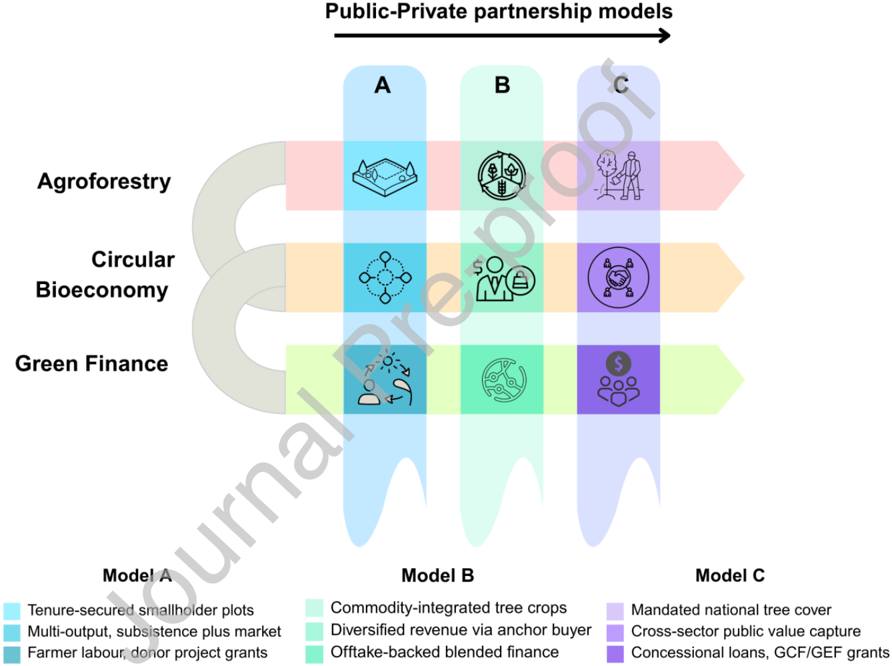
This narrative review examines how public-private partnerships (PPPs) and green finance can scale agroforestry as a nature-based solution within a circular bioeconomy. It proposes three PPP models—community-anchored, supply-chain-embedded, and public-finance scaffold—and argues scaling depends on tenure security, coherent incentives, diversified revenue, inclusive governance, and credible monitoring and verification.
Key findings
- PPPs can support agroforestry by mobilising investment, providing technical assistance, and improving market access; green finance can cover initial investment and management costs, while diversified products and productive use of biomass and residues create circular-bioeconomy income, with payments for verified ecosystem services as possible additional income where suitable mechanisms are established.
- The review groups PPPs into three models based on the anchor actor bearing primary financial risk and the dominant mechanism driving farmer adoption: community-anchored (e.g., Niger FMNR, exceeding 7 million hectares with 60 or more trees per hectare, from around 2–3 trees per hectare in the 1980s; Burkina Faso zaï + FMNR; Peru CUSAF), supply-chain-embedded (e.g., Novella Africa/Allanblackia; Moringa Fund supporting more than 11,500 hectares, more than 2,500 people, and more than 10,500 outgrower farmers across ten companies in eight countries; Belterra Agroflorestas), and public-finance scaffold (e.g., Costa Rica FONAFIFO PES; India’s National Agroforestry Policy/Sub-Mission on Agroforestry; Colombia silvopastoral systems removing up to 26.6 tons CO₂ equivalent per hectare per year; Senegal planting about 15 million trees).
- Carbon finance is highlighted: combined agriculture, forestry, and land-use carbon credits were valued at approximately $6.3 billion in 2023 and projected to reach $97.1 billion in a decade, but with uncertainty from voluntary market demand and credibility challenges facing major carbon registries; permanence and additionality risks require buffer pool mechanisms, long-term land tenure guarantees, and independent verification.
- Across the reviewed cases, no model demonstrated successful adoption at scale without tenure security or coherent incentives; diversification across energy, fodder, and non-timber forest products lowers investment risk, and credible MRV frameworks are needed for climate outcomes and finance.
Methods
- Narrative review using relevance-based literature selection rather than a systematic review; qualitative comparison, thematic synthesis, identification of recurring patterns, and interpretation of evidence across peer-reviewed articles, policy reports, international agency publications, and case studies.
- Searches in Web of Science, ScienceDirect, Google Scholar, and Wiley Online Library, plus policy papers and reports from FAO, CIFOR-ICRAF, World Bank, UNDP, IFAD, and GEF, and targeted government, development-bank, implementing-organisation, and private-sector sources; six thematic search-term categories; literature mainly published between 2005 and 2026, with a small number of earlier foundational works.
- Cases were classified into PPP models using two criteria: the anchor actor bearing primary financial risk and the dominant mechanism driving farmer adoption; the second research question was addressed by comparing the conditions under which each model and its financing instruments have been applied.
Limitations
- Stated: as a narrative review, it did not use a predefined article screening framework, quantitative tracking of retrieved and excluded publications, or formal quality appraisal.
- Stated: Table 2 describes partnership arrangements and stated aims but does not establish their outcomes; many outcomes are reported by implementing organisations rather than independently evaluated.
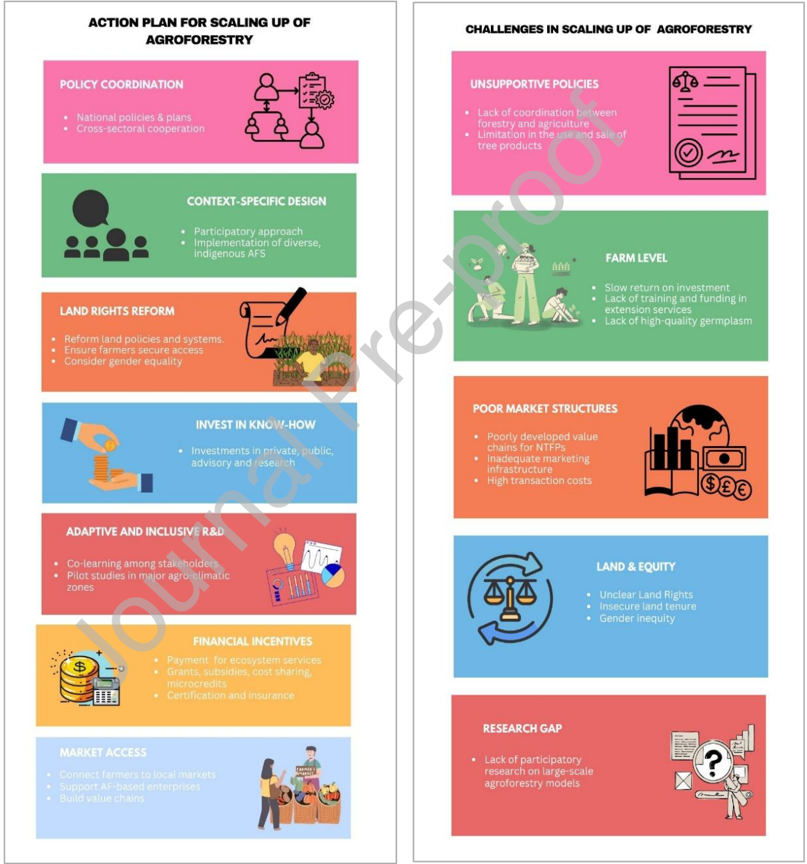
- Stated and evident: carbon-credit projections carry uncertainty from voluntary market demand and registry credibility; AFS carbon permanence and additionality are difficult to establish; MRV cost, frequency, and soil-carbon variability constrain smallholder-dominated programs; land tenure insecurity, market uncertainties, institutional coordination gaps, and gender inequities limit scaling. Evident from the text: case selection is illustrative and geographically uneven, so the findings are not a systematic global assessment.
Model-written summary. Check it against the paper before relying on it.
Integrity signals
Registry
Cites
Statistics
Figures

Verification
Claims the paper makes
0 Valid · 3 Not valid · 82 Not checked · 55 Own results and interpretations
In the paper
“Tree-based oilseed species cultivated in AFS have also performed better than conventional food crop-based biofuels in net energy balances, net energy ratios, and greenhouse-gas emission savings when both biofuel and coproduct energy yields are considered (Pragya et al., 2017).”
§ Unlocking Green Finance through Public-Private Partnerships in Agroforestry: Scaling Nature-based Solutions for a Circular Bioeconomy > 3. Agroforestry as a Nature-based Solution (NbS) for a circular bioeconomy
What the sources say
- Not checked yetcites Pragya et al., 2017 matched to “Biofuel from oil-rich tree seeds: net energy ratio, emissions saving and other environmental impacts associated with agroforestry practices in Hassan district of Karnataka, India” (2017) source
plainstates an association- Asserted: passes — The authors put it forward as true.
- Checkable: passes — It can be checked against evidence.
- Load-bearing: unclear — It is unclear whether the paper’s conclusions depend on it.
- Based: passes — The paper gives a reason why it holds.
In the paper
“When managed effectively, these systems combined fast-growing trees with conventional crop production and had profitability similar to traditional crop rotations (Kralik et al., 2022).”
§ Unlocking Green Finance through Public-Private Partnerships in Agroforestry: Scaling Nature-based Solutions for a Circular Bioeconomy > 3. Agroforestry as a Nature-based Solution (NbS) for a circular bioeconomy
What the sources say
- Not checked yetcites Kralik et al., 2022 matched to “Agroforestry systems as new strategy for bioenergy—case example of Czech Republic” (2022) source
plain- Asserted: passes — The authors put it forward as true.
- Checkable: passes — It can be checked against evidence.
- Load-bearing: unclear — It is unclear whether the paper’s conclusions depend on it.
- Based: passes — The paper gives a reason why it holds.
In the paper
“Therefore, homestead agroforestry was considered more sustainable than standing-crop cultivation in meeting SDG 13 (Climate Action) and 15 (Life on Land) (Mina et al., 2023).”
§ Unlocking Green Finance through Public-Private Partnerships in Agroforestry: Scaling Nature-based Solutions for a Circular Bioeconomy > 3. Agroforestry as a Nature-based Solution (NbS) for a circular bioeconomy
What the sources say
- Not checked yetcites Mina et al., 2023 matched to “Comparative Assessment of Tree Carbon Sequestration Potential and Soil Carbon Dynamics of Major Plantation Crops and Homestead Agroforestry of Kerala, India” (2023) source
plainstates an association- Asserted: passes — The authors put it forward as true.
- Checkable: passes — It can be checked against evidence.
- Load-bearing: passes — The paper’s conclusions depend on it.
- Based: passes — The paper gives a reason why it holds.
A result the paper reports from its own data — it cites no other source for it, so there is none to check. The quote shows it is in the paper.
In the paper
“None of the cases reviewed demonstrated successful adoption at scale in the absence of either tenure or coherent incentives (Table 3).”
§ Unlocking Green Finance through Public-Private Partnerships in Agroforestry: Scaling Nature-based Solutions for a Circular Bioeconomy > 5. PPP-based financial mechanisms for scaling agroforestry outcomes
boosted- Asserted: passes — The authors put it forward as true.
- Checkable: passes — It can be checked against evidence.
- Load-bearing: passes — The paper’s conclusions depend on it.
- Based: passes — The paper gives a reason why it holds.
In the paper
“Agroforestry systems (AFS), which integrate trees and other woody perennials with crops and livestock, represent an important NbS approach to improve land productivity, ecosystem functioning, and livelihood resilience (Nayal et al., 2024).”
§ Unlocking Green Finance through Public-Private Partnerships in Agroforestry: Scaling Nature-based Solutions for a Circular Bioeconomy > 1. Introduction
What the sources say
- Not checked yetcites Nayal et al., 2024 matched to “Participatory analysis of agroforestry systems: bridging ecosystem services and farmer resilience in drylands” (2024) source
plainstates a cause- Asserted: passes — The authors put it forward as true.
- Checkable: passes — It can be checked against evidence.
- Load-bearing: passes — The paper’s conclusions depend on it.
- Based: passes — The paper gives a reason why it holds.
49 more claims
Create a free account to see all 140 claims and to verify the 77 references still open.
- It may state two separate claims as one. 61
- Probably not a substantial claim. 38
Citations
Cites
The State of Food Security and Nutrition in the World 2023
(2023) · FAO; IFAD; UNICEF; WFP; WHO; eBooks · doi:10.4060/cc3017en · Cited by 2,048
The State of Food Security and Nutrition in the World 2022
Beltrán Rodríguez, E. T. (2022) · FAO eBooks · doi:10.4060/cc0639en · Cited by 1,662
Payments for environmental services in Costa Rica
Pagiola, S. (2008) · Ecological Economics · doi:10.1016/j.ecolecon.2007.07.033 · Cited by 651
A new circular business model typology for creating value from agro-waste
Donner, M., Gohier, R., & de Vries, H. (2020) · Science of The Total Environment · doi:10.1016/j.scitotenv.2020.137065 · Cited by 314
Assessment of agroforestry residue potentials for the bioeconomy in the European Union
Thorenz, A., Wietschel, L., Stindt, D., & Tuma, A. (2017) · Journal of Cleaner Production · doi:10.1016/j.jclepro.2017.12.143 · Cited by 177
National Agroforestry Policy in India: a low hanging fruit
Chavan, S. B., Keerthika, A., Dhyani, S. K., Handa, A. K., Newaj, R., & Rajarajan, K. (2015) · doi:10.18520/cs/v108/i10/1826-1834 · Cited by 171
Self-citationDhyani, S., Murthy, I. K., Kadaverugu, R., Dasgupta, R., Kumar, M., & Gadpayle, K. A. (2021) · Forests · doi:10.3390/f12030303 · Cited by 167
Self-citationAgroforestry for sustainable landscape management
Plieninger, T., Muñoz-Rojas, J., Buck, L. E., & Scherr, S. J. (2020) · Sustainability Science · doi:10.1007/s11625-020-00836-4 · Cited by 162
Scaling up farmer-managed natural regeneration in Africa to restore degraded landscapes
Reij, C., & Garrity, D. (2016) · Biotropica · doi:10.1111/btp.12390 · Cited by 128
Reviewing social-ecological resilience for agroforestry systems under climate change conditions
Viñals, E., Maneja, R., Rufí-Salís, M., Martí, M., & Puy, N. (2023) · The Science of The Total Environment · doi:10.1016/j.scitotenv.2023.161763 · Cited by 125
Nath, A. J., Sileshi, G. W., Laskar, S. Y., Pathak, K., Reang, D., Nath, A., & Das, A. K. (2020) · Journal of Cleaner Production · doi:10.1016/j.jclepro.2020.124831 · Cited by 120
Kumar, B. M., & Kunhamu, T. K. (2022) · Nature-Based Solutions · doi:10.1016/j.nbsj.2022.100012 · Cited by 118
Thamo, T., & Pannell, D. J. (2015) · Climate Policy · doi:10.1080/14693062.2015.1075372 · Cited by 117
Agro-forestry waste management- A review
Gupta, J., Kumari, M., Mishra, A., Swati, Akram, M., & Thakur, I. S. (2022) · Chemosphere · doi:10.1016/j.chemosphere.2021.132321 · Cited by 116
Tranchina, M., Reubens, B., Frey, M., Mele, M., & Mantino, A. (2024) · Agroforestry Systems · doi:10.1007/s10457-024-00993-w · Cited by 115
Agroforestry potential for adaptation to climate change: a soil-based perspective
Rolo, V., Rivest, D., Maillard, É., & Moreno, G. (2023) · Soil Use and Management · doi:10.1111/sum.12932 · Cited by 113
Forest ecosystem-service transitions: the ecological dimensions of the forest transition
Wilson, S. J., Schelhas, J., Grau, R., Nanni, A. S., & Sloan, S. (2017) · Ecology and Society · doi:10.5751/es-09615-220438 · Cited by 109
Circular Business Models for the Bio-Economy: A Review and New Directions for Future Research
Reim, W., Parida, V., & Sjödin, D. R. (2019) · Sustainability · doi:10.3390/su11092558 · Cited by 104
A Systematic Map of Agroforestry Research Focusing on Ecosystem Services in the Asia-Pacific Region
Shin, S., Soe, K. T., Lee, H., Kim, T. H., Lee, S., & Park, M. S. (2020) · Forests · doi:10.3390/f11040368 · Cited by 99
Self-citationTelwala, Y. (2022) · Nature-Based Solutions · doi:10.1016/j.nbsj.2022.100045 · Cited by 90
The role of soil ecosystem services in the circular bioeconomy
Anikwe, M., & Ife, K. (2023) · Frontiers in Soil Science · doi:10.3389/fsoil.2023.1209100 · Cited by 82
Kumar, M., & Singh, H. (2020) · Disaster Resilience and Green Growth · doi:10.1007/978-981-15-4712-6_17 · Cited by 78
Paying for green: A scoping review of alternative financing models for nature-based solutions
den Heijer, C., & Coppens, T. (2023) · Journal of Environmental Management · doi:10.1016/j.jenvman.2023.117754 · Cited by 76
A comprehensive analysis of the advances in Indian Digital Agricultural architecture
Balkrishna, A., Pathak, R., Kumar, S., Arya, V., & Singh, S. K. (2023) · Smart Agricultural Technology · doi:10.1016/j.atech.2023.100318 · Cited by 76
Coconut based multiple cropping systems: An analytical review in Sri Lankan coconut cultivations
Nuwarapaksha, T. D., Udumann, S. S., Dissanayaka, D., Dissanayake, D. K. R. P. L., & Atapattu, A. J. (2022) · Circular Agricultural Systems · doi:10.48130/cas-2022-0008 · Cited by 76
Agroforestry in the European common agricultural policy
Mosquera‐Losada, M. R., Santiago-Freijanes, J. J., Pisanelli, A., Rois-Díaz, M., Smith, J., den Herder, M., Moreno, G., Ferreiro‐Domínguez, N., Malignier, N., Lamersdorf, N. P., et al. (2018) · Agroforestry Systems · doi:10.1007/s10457-018-0251-5 · Cited by 66
Incentives and barriers to private finance for forest and landscape restoration
Löfqvist, S., Garrett, R. D., & Ghazoul, J. (2023) · Nature Ecology & Evolution · doi:10.1038/s41559-023-02037-5 · Cited by 62
Gouvello, R. L., Cohen-Shacham, E., Herr, D., Spadone, A., Simard, F., & Brugere, C. (2023) · Frontiers in Marine Science · doi:10.3389/fmars.2023.1146637 · Cited by 58
The circular bioeconomy: pathways to sustainability and resource optimization
Srivastav, A. L., Bagherian, A., & Ghosh, D. (2024) · Clean Technologies and Environmental Policy · doi:10.1007/s10098-024-03060-1 · Cited by 54
The potential of traditional agroforestry practices as nature-based carbon sinks in Ethiopia
Getnet, D., Mekonnen, Z., & Anjulo, A. (2023) · Nature-Based Solutions · doi:10.1016/j.nbsj.2023.100079 · Cited by 52
Spielman, D. J., Hartwich, F., & Grebmer, K. (2010) · Public Administration and Development · doi:10.1002/pad.574 · Cited by 51
Determinants of agroforestry technology adoption in Eastern Cape Province, South Africa
Zerihun, M. F., Muchie, M., & Worku, Z. (2014) · Development Studies Research · doi:10.1080/21665095.2014.977454 · Cited by 46
Watts, M., Hutton, C., Mata Guel, E. O., Suckall, N., & Peh, K. S.-H. (2022) · Frontiers in Forests and Global Change · doi:10.3389/ffgc.2022.880621 · Cited by 41
Dhyani, S., Bartlett, D., Kadaverugu, R., Dasgupta, R., Pujari, P., & Verma, P. (2020) · Restoration Ecology · doi:10.1111/rec.13230 · Cited by 41
Self-citationThe Role of Energy Valuation of Agroforestry Biomass on the Circular Economy
Torreiro, Y., Pérez, L., Piñeiro, G., Saavedra, F. P., & Rodríguez-Abalde, Á. (2020) · Energies · doi:10.3390/en13102516 · Cited by 40
Potential of agroforestry systems in carbon sequestration in India
DHYANI, S. K., RAM, A., & DEV, I. (2016) · The Indian Journal of Agricultural Sciences · doi:10.56093/ijas.v86i9.61348 · Cited by 37
Self-citationLand Use Demands for the CLUE-S Spatiotemporal Model in an Agroforestry Perspective
Mamanis, G., Vrahnakis, M., Chouvardas, D., Nasiakou, S., & Kleftoyanni, V. (2021) · Land · doi:10.3390/land10101097 · Cited by 36
Bridging the adaptation finance gap: the role of nature-based solutions for climate resilience
Meraj, G., & Hashimoto, S. (2025) · Sustainability Science · doi:10.1007/s11625-025-01655-1 · Cited by 33
Das, A. K., Rahman, M. A., Rahman, M. M., Saha, S. R., Keya, S. S., Suvoni, S. S., Miah, M. G., Current, D. A., & Rizvi, J. (2021) · Agroforestry Systems · doi:10.1007/s10457-021-00656-0 · Cited by 32
Pragya, N., Sharma, N., & Gowda, B. (2017) · Journal of Cleaner Production · doi:10.1016/j.jclepro.2017.07.005 · Cited by 30
JAMNADASS, R., DAWSON, I. K., ANEGBEH, P., ASAAH, E., ATANGANA, A., CORDEIRO, N. J., HENDRICKX, H., HENNEH, S., KADU, C. A., KATTAH, C., et al. (2010) · Forests, Trees and Livelihoods · doi:10.1080/14728028.2010.9752670 · Cited by 30
Hazarika, A., Kurmi, B., Francaviglia, R., Weldesemayat Sileshi, G., Paramesh, V., Kumar Das, A., & Jyoti Nath, A. (2024) · Ecological Indicators · doi:10.1016/j.ecolind.2024.112031 · Cited by 29
Agroforestry: a key land use system for sustainable food production and public health
Roy, M. K., Fort, M. P., Kanter, R., & Montagnini, F. (2025) · Trees Forests and People · doi:10.1016/j.tfp.2025.100848 · Cited by 28
Ali, S. A., Tallou, A., Lopriore, G., Vivaldi, G. A., Camposeo, S., Vogiatzakis, I. Ν., & Sanesi, G. (2025) · Italian Journal of Agronomy · doi:10.1016/j.ijagro.2025.100033 · Cited by 25
Public–Private Partnerships in Agroforestry
Jamnadass, R., Langford, K., Anjarwalla, P., & Mithöfer, D. (2014) · Elsevier eBooks · doi:10.1016/b978-0-444-52512-3.00026-7 · Cited by 21
Diversity and composition of agroforestry species in two agro-ecological zones of Rwanda
Ruticumugambi, J. A., Kaplin, B., Blondeel, H., Mukuralinda, A., Ndoli, A., Verdoodt, A., Rutebuka, J., Imanirareba, E., Uwizeyimana, V., Gatesi, J., et al. (2024) · Agroforestry Systems · doi:10.1007/s10457-024-01011-9 · Cited by 21
Min, S., Kim, E., Dayandante, P. B., & Park, M. S. (2024) · Trees Forests and People · doi:10.1016/j.tfp.2024.100646 · Cited by 19
Self-citationAlamsyah, R. T. P., Wulandari, E., Saidah, Z., & Hapsari, H. (2024) · Discover Sustainability · doi:10.1007/s43621-024-00277-4 · Cited by 18
Silva‐Parra, A., Trujillo‐González, J. M., & Brevik, E. C. (2021) · Greenhouse Gases: Science and Technology · doi:10.1002/ghg.2066 · Cited by 16
Unlocking private finance for nature: addressing barriers and reframing risk-return dynamics
Sheikh, H. A., Narain, D., Bartlett, C., & Christiaen, C. (2025) · iScience · doi:10.1016/j.isci.2025.113669 · Cited by 16
Dinesha, S., Hosur, S. R., Toushif, P. K., Bodiga, D., Deepthi Dechamma, N. L., Ashwath, M. N., & Pradhan, D. (2023) · Land and Environmental Management through Forestry · doi:10.1002/9781119910527.ch9 · Cited by 15
Drivers and barriers of residual agroforestry biomass valorization: a systematic literature review
Rijal, P., Carvalho, H., Matias, J. C. O., Azevedo, S. G., & Pimentel, C. (2025) · Agroforestry Systems · doi:10.1007/s10457-024-01131-2 · Cited by 11
Embedding circularity into the transition towards sustainable agroforestry systems in Peru
Parodi, A., Villamonte-Cuneo, G., Loboguerrero, A. M., Martínez-Barón, D., & Vázquez-Rowe, I. (2022) · Science of The Total Environment · doi:10.1016/j.scitotenv.2022.156376 · Cited by 10
Mina, U., Geetha, G., Sharma, R., & Singh, D. (2023) · Anthropocene Science · doi:10.1007/s44177-023-00052-6 · Cited by 10
A sustainable integrated agroforestry system
Comolli, L. R., Schegg, E., Infuleski, C., Fassola, H., von Wallis, A., Bulfe, N. M., Barth, S. R., Gonzalez, P. A., Gauchat, M. E., Munareto, N., et al. (2025) · Frontiers in Plant Science · doi:10.3389/fpls.2025.1635422 · Cited by 9
Jugran, H. P., Upadhyaya, P., & Ghosh, P. (2025) · Agroforestry Systems · doi:10.1007/s10457-025-01346-x · Cited by 9
Meter, A., Penot, É., Vaast, P., Etienne, H., Ponçon, E., & Bertrand, B. (2023) · Open Research Europe · doi:10.12688/openreseurope.14570.2 · Cited by 9
Bastos, T., Nunes, L. J. R., & Teixeira, L. C. (2025) · Land · doi:10.3390/land14020362 · Cited by 9
How England got to mandatory biodiversity net gain: A timeline
Stuart, A., Bond, A., Franco, A. M. A., Gerrard, C., Baker, J., ten Kate, K., Butterworth, T., Bull, J. W., & Treweek, J. (2025) · AMBIO · doi:10.1007/s13280-025-02277-8 · Cited by 8
Son, J., Min, S., & Park, M. S. (2026) · Forest Science and Technology · doi:10.1080/21580103.2025.2609600 · Cited by 7
Self-citationThe national agroforestry policy of India: experiential learning in development and delivery phases
Pal Singh, V., Bhushan Sinha, R., Nayak, D., Neufeldt, H., van Noordwijk, M., & Rizvi, J. (2016) · doi:10.5716/wp16143.pdf · Cited by 7
Future Prospects and Emerging Trends in Agroforestry Research
Nuwarapaksha, T. D., Udumann, S. S., Dissanayaka, N. S., & Atapattu, A. J. (2025) · Advances in environmental engineering and green technologies book series · doi:10.4018/979-8-3693-8282-0.ch017 · Cited by 7
Chapter 1. Farmer-managed restoration of agroforestry parklands in Niger
Smale, M., Tappan, G., & Reij, C. (2018) · Fostering transformation and growth in Niger's agricultural sector · doi:10.3920/978-90-8686-873-5_1 · Cited by 7
Rahmah, D. M., Faojiah, R. S., Dewi, M. S., Amaru, K., Januardi, Setiawan, A., Pramulya, R., Novita, E., Purnomo, B. H., Sutrisno, A., et al. (2025) · Discover Sustainability · doi:10.1007/s43621-025-02039-2 · Cited by 6
Wangmo, K., Kumar, A., Narula, S. A., & Magry, M. A. (2025) · Agroforestry Systems · doi:10.1007/s10457-025-01262-0 · Cited by 6
Agroforestry systems as new strategy for bioenergy—case example of Czech Republic
Kralik, T., Vavrova, K., Knapek, J., & Weger, J. (2022) · Energy Reports · doi:10.1016/j.egyr.2022.02.098 · Cited by 6
Agroforestry Practices Prevailing in SAARC Countries: A Review
Paudel, Y., & Shrestha, S. (2022) · Indonesian Journal of Social and Environmental Issues (IJSEI) · doi:10.47540/ijsei.v3i1.390 · Cited by 5
Sow Badji, A., & Gathu, C. (2026) · Climate Policy · doi:10.1080/14693062.2026.2616965 · Cited by 5
Agroforestry models and business cases : International experiences
Pulleman, M. M., Smit, E., & Wintraecken, E. (2022) · Wageningen University & Research Publications · Cited by 5
Agroforestry for a Climate-Smart Future
(2025) · Advances in environmental engineering and green technologies book series · doi:10.4018/979-8-3693-8282-0 · Cited by 5
Shukla, J., & Dhyani, S. (2023) · Sustainability Sciences in Asia and Africa · doi:10.1007/978-981-19-4602-8_20 · Cited by 4
Self-citationTree species selection for ecosystem services and resilience in agroforestry systems
Staton, T., Beauchamp, K., Broome, A., Smith, L. G., & Breeze, T. D. (2025) · Agricultural Systems · doi:10.1016/j.agsy.2025.104476 · Cited by 4
Agroforestry: a review of its importance, problems and prospects in crop production
Orji, K., Mbah, E., & Akpan, A. (2022) · Ratarstvo i povrtarstvo · doi:10.5937/ratpov59-39353 · Cited by 4
Salma, Singh, L., CHAVAN, S. S., Ali, S., Dagar, J. C., Gupta, S. R., Singh, J. S., Singh, E., Ramanan, S., Chaturvedi, R. K., et al. (2026) · Tropical Ecology · doi:10.1007/s42965-026-00429-9 · Cited by 3
Adding value to the voluntary carbon market through small-scale agroforestry
Shin, S., Nam, Y., Wolf, S., Park, M. S., Okello, O., Mabaya, E., & Liao, C. (2026) · Climate and Development · doi:10.1080/17565529.2025.2574074 · Cited by 3
Self-citationISLAM, M. A., QAISAR, K. N., & BHAT, G. M. (2017) · INTERNATIONAL JOURNAL OF FORESTRY AND CROP IMPROVEMENT · doi:10.15740/has/ijfci/8.1/68-77 · Cited by 3
Ternell, A., Nilsson, A. M., Ohlén, B., Stenholm, D., & Bergsjö, D. H. (2020) · Ecocycles · doi:10.19040/ecocycles.v6i2.180 · Cited by 3
Breaking barriers to agroforestry: FAO’s global capacity needs assessment
Springgay, E., & Pajel, P. (2024) · Tropical Forest Issues · doi:10.55515/tcdu9996 · Cited by 3
Transforming agroforestry through gender practice: Challenges and opportunities
Galudra, G., Rubio Echazarra, N., Juita, R., & Silori, C. S. (2024) · Tropical Forest Issues · doi:10.55515/rmrr6784 · Cited by 2
Soil Conservation Policies and Sustainable Land Management: A Global Overview
Hurni, H. (2024) · Soil and Water Conservation Policies and Programs · doi:10.1201/9781003574040-2 · Cited by 2
Development of Agroforestry Incubation to Nurture Rural Entrepreneurship in India
Ramanan S, S., Arunachalam, A., & Rashmi, R. (2025) · India Studies in Business and Economics · doi:10.1007/978-981-96-4313-4_15 · Cited by 1
Ghosh, S., Patidar, V., Saha, A., Mina, H. K., & Kumar, S. (2026) · Sustainability Sciences in Asia and Africa · doi:10.1007/978-981-95-1483-0_6 · Cited by 1
Nayal, R., Thomas, M., Chalimalla, M., & Dhyani, S. (2024) · Climate Change and Environmental Sustainability · doi:10.5958/2320-642x.2024.00006.7 · Cited by 1
Self-citationPeprah, T., Oduro, K. A., Siaw, D. E. K. A., Cobbinah, J. R., Tchoundjeu, Z., Simons, A. J., Jamnadass, R., & Ofori, D. A. (2015) · Open Journal of Forestry · doi:10.4236/ojf.2015.57060 · Cited by 1
Potential of Agroforestry for Enhancing Africa’s Access to Carbon Markets
Mwadalu, R., Abdi, A. M., Rutto, M., Chappa, L. R., Nungula, E. Z., Rezaei-Chiyaneh, E., Nasar, J., Heydarzadeh, S., Ranjan, S., Sow, S., et al. (2025) · Agroforestry for Monetising Carbon Credits · doi:10.1007/978-3-031-97151-8_13
Innovative agroforestry development in private forest through community partnership
Hak Bisjoe, A. R., Muin, N., Sumirat, B. K., & Isnan, W. (2023) · IOP Conference Series: Earth and Environmental Science · doi:10.1088/1755-1315/1277/1/012014
(2009) · IFPRI E-brary (International Food Policy Research Institute)
(2009) · Indian Journal of Agronomy
Self-citation(2020) · Indian journal of agroforestry
Self-citation(2024) · Indian journal of agroforestry
Self-citationTechnical review of physical risks to carbon sequestration under the Emissions Reduction Fund (ERF)
Roxburgh, S., Paul, K., & Pinkard, L. (2020) · CSIRO · doi:10.25919/5f85eb3423299
(2018) · Indian journal of agroforestry
RECENT TRENDS IN AGROFORESTRY RESEARCH AND DEVELOPMENT
Kaur, A., & Monga, R. (2023) · IIP Series · doi:10.58532/v3bcag14p5ch2
Unlocking Private Finance for Nature: Addressing Barriers and Reframing Risk-Return Dynamics
Sheikh, H. A., Narain, D., Bartlett, C., & Christiaen, C. (2025) · doi:10.2139/ssrn.5414202
Research works printed but not linked: 17
- Adaba, G.B., 2005. The role of agroforestry for sustainable forest use -case study of a community-based initiative in the Kassena-Nankana District of northern Ghana (Master's thesis, Stockholm University). Stockholm Resilience Centre. Retrieved from https://www.stockholmresilience.org/download/18.aeea46911a31274279800084007/ Agroforestry Network., 2022. Scaling up agroforestry: A policy brief. Written by Linnea Pasquier (Vi Agroforestry). Agroforestry Network. https://agroforestrynetwork.org/
- Amatya, S.M., Adhikari, S., 2022. The agroforestry practices in SAARC countries: A critical review. Food and Agriculture Organization of the United Nations. https://openknowledge.fao.org/server/api/core/bitstreams/06fb20d7-5128-46fd-a290- dacf64b1aff6/content (accessed on July 2026)
- AZ Forest documentation., 2023. https://www.astrazeneca.com/media-centre/press- releases/2023/astrazeneca-announces-400-million-investment-in-reforestation-and- biodiversity-in-support-of-climate-action-and-human-health.html# (accessed on 1 September 2026)
- Baral, H., Supriyanto, B., Finlayson, R. F., Leksono, B., Nasi, R., 2025. A pathway to a forest- positive bioeconomy in Indonesia: Harnessing degraded lands for food and energy security. Journal of Korean Society of Forest Science, 114(4), 390-402. https://doi.org/10.14578/jkfs.2025.114.4.390 · doi:10.14578/jkfs.2025.114.4.390
- Campanhola, C., & Pandey, S. (Eds.). (2018). Sustainable food and agriculture: An integrated approach. Academic Press.
- 2025, Brazil’s vision for turning deforestation into restoration, Clim. Invest. Funds
- 2022, Towards forest positive cocoa: annual report 2022, World Cocoa Found.
- Coleman, C., DeKeyser, E., Kobiela, B., Dixon, C., Escudero, E., & Aldrich-Wolfe, L.,2025. Plant community composition following adaptive management. Prairie Nat, 57(2), 40- 57. https://www.researchgate.net/profile/Cami-Dixon- 2/publication/389579436_Plant_Community_Composition_Following_Adaptive_Mana gement/links/67c85f7acc055043ce6de19b/Plant-Community-Composition-Following- Adaptive-Management.pdf
- Dhyani, S.K., 2021. Agroforestry: A nature-based solution for resilient agriculture and climate change mitigation. International Journal of Plant & Soil Science, 33(24), 495-508. https://doi.org/10.9734/ijpss/2021/v33i2430779 · doi:10.9734/ijpss/2021/v33i2430779
- Earth5R, 2025. Agroforestry reimagined: Tribal communities at the forefront of India's sustainable food future. Earth5R, 6 August 2025. https://earth5r.org/agroforestry- reimagined-tribal-communities-at-the-forefront-of-indias-sustainable-food-future/ (accessed 9 September 2026).
- GEF, 2020. A new business model for forests and reforestation. Global Environment Facility, 16 March 2020. https://www.thegef.org/news/new-business-model-forests-and- reforestation
- Godt, S., 2024. Overview of public-private partnerships in sub-Saharan Africa: emerging risks and narratives. Feminist Africa, 4(2), 38-70. Retrieved from https://www.ajol.info/index.php/fa/article/view/275782
- Khoa, D. D., & Anh, D. N., 2024. Integrating green finance for sustainable agricultural practices and economic diversification in rural Vietnam. Організаційний комітет, 109. https://duan.edu.ua/wp-content/uploads/2024/11/37th-conference-issue- 1.pdf#page=110
- Mumina, J. and Bourne, M., 2020. Policy Review and Analysis for the Formulation of the Kenya Agroforestry Strategy (2020-2030). World Agroforestry (ICRAF), 12(4), pp.28-44.
- Musa, S., Jacob, A., & Vandi, S.,2024. BLOCKCHAIN-BASED INTERNET OF THINGS (IOT) SMART FARM SECURITY FRAMEWORK: A COMPREHENSIVE REVIEW. ISSN 0331-0017
- ofi, 2023. Climate-proofing cocoa and coffee: ofi partners with USAID, The Hershey Company and Rikolto on the LASCARCOCO programme in Indonesia. Press release, 7 June 2023. https://www.ofi.com/news-and-events/press-release/climate-proofing-cocoa- and-coffee-usaid.html
- Singh, R., Pandey, C.B., 2011. Integrating trees and livestock for fodder security in agroforestry systems. Range Management and Agroforestry, 32(1), 55-62.
Cited by
Still being checked.
Metadata
- Authors
- Haripriya, P. S., Shukla, J., Saraniya, S., Neha, S., Baral, H., Park, M. S., & Dhyani, S.
- Affiliations
- National Environmental Engineering Research Institute (IN)
- Adelaide University (AU)
- Center for International Forestry Research (ID)
- Seoul National University (KR)
- Corresponding author
- Dhyani, Shalini
- Venue
- Trees, Forests and People
- Publisher
- Elsevier BV
- Published
- 2026-11
- Volume
- 28
- Pages
- 101542
- ISSN
- 2666-7193 (ISSN-L)
- OpenAlex
- W7223882116
- Semantic Scholar
- 33ec6cf0d7aa8fbf6fb6328a0619dd4faf336ae9
- Cited by
- 0
- References
- 86
- FWCI
- 0.00
- Type
- journal article
- Language
- en
- Open access
- gold
- doi.org
- Licence
- cc-by-nc-nd
- www.elsevier.com/tdm/userlicense/1.0/ (tdm)
- www.elsevier.com/legal/tdmrep-license (tdm)
- creativecommons.org/licenses/by-nc-nd/4.0/ (vor)
- Locations
- Trees Forests and People (publishedVersion, cc-by-nc-nd)
- DOAJ (DOAJ: Directory of Open Access Journals) (submittedVersion)
- Funders
- Seoul National University
- Topics
- Life Sciences › Agricultural and Biological Sciences › Forestry › Agroforestry and silvopastoral systems
- Social Sciences › Economics, Econometrics and Finance › Finance › Sustainable Finance and Green Bonds
- Life Sciences › Agricultural and Biological Sciences › Forestry › Forest Management and Policy
- Keywords
- agroforestry, public-private partnerships, green finance, nature-based solutions, circular bioeconomy, payments for ecosystem services, blended finance, land tenure insecurity, market access, sustainable land management, rural development, gender equity
About these checks
Registry, retraction, Cites and statistics results are computed, not judged, with one exception: a printed reference that no index lists is read once by a model before it counts as a citation error. Claims are extracted by a model and kept only when their quote appears verbatim in the text; each cited source is then checked, with a model’s help, for whether it says what the claim relies on. Those verdicts can be wrong — read the claim’s quote and the cited source before relying on one.
A language model drew the claims from the paper on 2026-11-21, under version 3 of the claim definition (model deepseek-v4.1-flash, prompt extract-v3).
A second model labelled each claim on 2026-11-21 (model jev-1.13-20260917, definition revision gold-guideline-v0.2).
Statistics and arithmetic are recomputed, not judged.
Confidence bands are shown only for fields calibrated on our annotated test set. None is calibrated yet, so no band is shown.
What counts as a claim ›How we measure confidence ›How we check this ›
Are you an author, or do you see a problem with this page? Request a review
Data sources
Bibliographic data: Semantic Scholar, OpenAlex, Crossref.
Contains information from the Semantic Scholar Academic Graph Datasets, made available under the ODC Attribution License (ODC-BY 1.0).
Semantic Scholar’s data is described in: Kinney, R., et al. (2023). The Semantic Scholar Open Data Platform. arXiv:2301.10140.
