

The DOI matches its Crossref record; 26 of the 26 references it cites were found in a registry or an index.
The implementation of an advanced practice radiation therapy (APRT) program in Singapore
Open accessAbstract
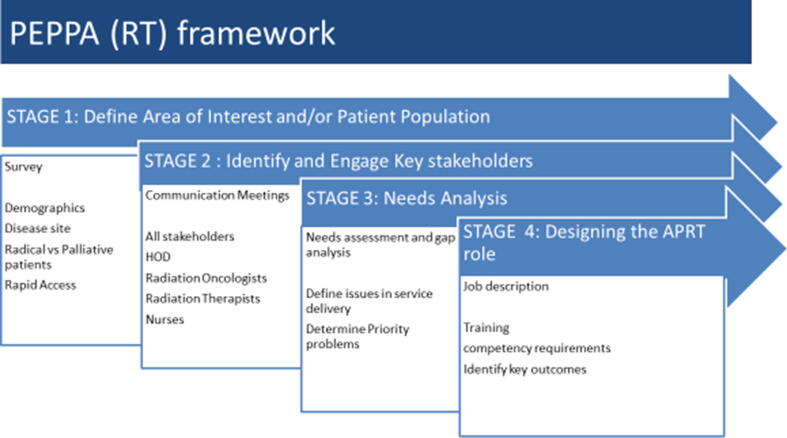
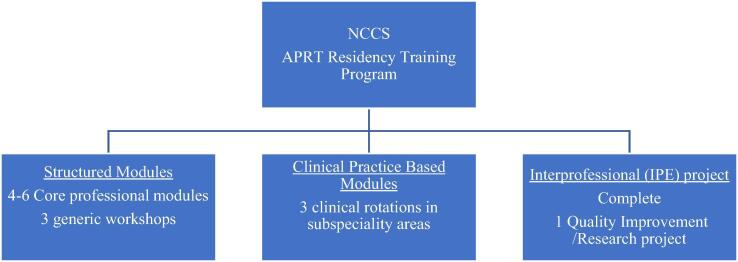
BACKGROUND: The exploration of Advanced Practiced Radiation Therapists (APRTs) development in Singapore started in 2011. This study aims to provide an overview of the development of the APRT roles, and to discuss the approaches used to develop and implement these roles in Singapore. MATERIALS AND METHODS: A mixed methods approach was used in the development of the APRT program. A literature review was carried out to define the APRT scope of practice and core responsibilities. A competency and assessment framework were setup to assess the core competency areas. With this framework, a structured 1-year residency training program was developed. RESULTS: The scope of practice and core responsibilities of APRTs were defined with five proposed advanced practice profiles being successfully validated. A competency framework was set up to assess the core competency domains: clinical, technical and professional competencies, research, education and leadership. A 4-point scoring system was developed for the competency assessment based on two criteria; the frequency with which RTTs would demonstrate competency, and the ability of performing the task competently. A 1-year structured APRT residency program was developed and implemented. The programme consisted of structured lectures, and clinical practice-based modules where APRT residents receive structured mentoring under a mentorship program. CONCLUSION: The APRT program in Singapore employed an evidence-based implementation process that tested the feasibility of a new practice model. Multidisciplinary involvements, mentorship and clinical training were important factors for the success of the APRT program.
Overview
The claims and statistics of this paper haven’t been checked yet.
Run the check — free, no account needed. It reads the open-access text and checks the sources it cites.
Integrity signals
Registry
Cites
Statistics
Figures
Verification
Claims the paper makes
The claims and statistics of this paper haven’t been checked yet.
Run the check — free, no account needed. It reads the open-access text and checks the sources it cites.
Claims other papers make about this one
Each is checked against this paper’s own text: does it say what the citing paper says it does?
The source backs part of the claim, not all of it — or backs it for a different population, condition or comparison.
In the citing paper
“These findings mirror challenges reported internationally in virtual care, AI implementation, and workforce transformation initiatives”
From A Scoping Review of Implemented Innovations in Cancer Care: Implications for Pan-Canadian Scaling (2026) · cites this paper as [67]
Experimental — accuracy not yet measured
Self-check
Percentages, sums and reported differences re-computed from the paper’s own numbers.
The self-check needs the paper’s full text.
Citations
Cites
A framework for the introduction and evaluation of advanced practice nursing roles
Bryant‐Lukosius, D., & DiCenso, A. (2004) · Journal of Advanced Nursing · doi:10.1111/j.1365-2648.2004.03235.x · Cited by 496
Longitudinal changes in extended roles in radiography: A new perspective
Price, R. C., & Masurier, S. B. L. (2006) · Radiography · doi:10.1016/j.radi.2005.11.001 · Cited by 108
Image-guided Radiotherapy to Manage Respiratory Motion: Lung and Liver
Dhont, J., Harden, S., Chee, L. Y. S., Aitken, K. L., Hanna, G. G., & Bertholet, J. (2020) · Clinical Oncology · doi:10.1016/j.clon.2020.09.008 · Cited by 70
Longitudinal changes in extended roles in radiography
Price, R. C., Miller, L. R., & Mellor, F. E. (2002) · Radiography · doi:10.1053/radi.2002.0383 · Cited by 65
Role extension and role advancement – Is there a difference? A discussion paper
Hardy, M., & Snaith, B. A. (2005) · Radiography · doi:10.1016/j.radi.2005.09.004 · Cited by 63
Wang, F., Chen, F., Huo, X., Xu, R., Wu, L., Wang, J., & Lu, C. (2013) · PLoS ONE · doi:10.1371/journal.pone.0074473 · Cited by 59
Advanced practice for therapy radiographers – A discussion paper
Eddy, A. (2006) · Radiography · doi:10.1016/j.radi.2006.07.001 · Cited by 52
Harnett, N., Bak, K., Lockhart, E., Ang, M., Zychla, L., Gutierrez, E., & Warde, P. R. (2018) · Journal of Medical Radiation Sciences · doi:10.1002/jmrs.281 · Cited by 46
Radiologist perceptions of radiographer role development in Scotland
Forsyth, L. J., & Robertson, E. M. (2005) · Radiography · doi:10.1016/j.radi.2005.10.001 · Cited by 46
Impact of breast cancer diagnosis and treatment on women's sexuality: a survey of Japanese patients
Takahashi, M., Ohno, S., Inoue, H., Kataoka, A., Yamaguchi, H., Uchida, Y., Oshima, A., Abiru, K., 小野, 菊., Noguchi, R., et al. (2007) · Psycho-Oncology · doi:10.1002/pon.1297 · Cited by 45
Job, M., Holt, T., & Bernard, A. (2017) · Journal of Medical Radiation Sciences · doi:10.1002/jmrs.243 · Cited by 41
The concept of advanced radiographic practice: An international perspective
Hardy, M., Legg, J. S., Smith, T., Ween, B., Williams, I., & Motto, J. A. (2008) · Radiography · doi:10.1016/j.radi.2008.10.001 · Cited by 40
How to achieve advanced practitioner status: A discussion paper
Snaith, B. A., & Hardy, M. (2006) · Radiography · doi:10.1016/j.radi.2006.01.001 · Cited by 34
Coffey, M. A., & Leech, M. (2018) · Technical Innovations & Patient Support in Radiation Oncology · doi:10.1016/j.tipsro.2018.09.009 · Cited by 32
Shi, J., Cox, J., Atyeo, J., Loh, Y., Wong, L. C., & Back, M. (2008) · Radiotherapy and Oncology · doi:10.1016/j.radonc.2008.05.005 · Cited by 30
Price, R. C., & Edwards, H. (2008) · Radiography · doi:10.1016/j.radi.2008.11.005 · Cited by 29
Harnett, N., Bak, K., Zychla, L., & Lockhart, E. A. (2014) · PubMed · Cited by 29
RTT-led IGRT for cervix cancer; training, implementation and validation
Alexander, S. E., Hopkins, N., Lalondrelle, S., Taylor, A., Titmarsh, K., & McNair, H. A. (2019) · Technical Innovations & Patient Support in Radiation Oncology · doi:10.1016/j.tipsro.2019.10.007 · Cited by 21
D’Alimonte, L., Holden, L., Turner, A. S., Erler, D., Sinclair, E., Harnett, N., & Prospero, L. D. (2017) · Journal of medical imaging and radiation sciences · doi:10.1016/j.jmir.2017.02.073 · Cited by 20
Linden, K. C., Renaud, J., Zohr, R., Gaudet, M., Haddad, A., Pantarotto, J. R., & Dennis, K. E. B. (2019) · Journal of medical imaging and radiation sciences · doi:10.1016/j.jmir.2019.08.009 · Cited by 20
Advanced practice in radiation therapy
Martino, S., & Odle, T. G. (2007) · Cited by 17
An exploration of the feasibility of radiation therapist participation in treatment reviews
Monk, C. M., Wrightson, S. J., & Smith, T. N. (2013) · Journal of Medical Radiation Sciences · doi:10.1002/jmrs.23 · Cited by 14
Lim, L. H., Pang, E. P. P., Jadva-Patel, H., & Wong, S. (2020) · Technical Innovations & Patient Support in Radiation Oncology · doi:10.1016/j.tipsro.2019.11.010 · Cited by 14
Self-citationHolden, L., & Loblaw, D. A. (2005) · Canadian Journal of Medical Radiation Technology · doi:10.1016/s0820-5930(09)60072-4 · Cited by 14
Developing Advanced Practice: Face the Issues, Find the Solutions
Harnett, N. (2007) · Canadian Journal of Medical Radiation Technology · doi:10.1016/s0820-5930(09)60260-7 · Cited by 11
An assessment of OAR delineation by the radiation therapist
Schick, K., Sisson, T., Frantzis, J., Khoo, E., & Middleton, M. (2011) · Radiography · doi:10.1016/j.radi.2011.01.003 · Cited by 10
Cited by
Sorted by citations
Oliveira, C., Barbosa, B., Couto, J. G., Bravo, I., Khine, R., & McNair, H. A. (2022) · Radiography · doi:10.1016/j.radi.2022.04.009 · Cited by 61
Roos, D. E., Job, M., & Holt, T. (2021) · Journal of Medical Imaging and Radiation Oncology · doi:10.1111/1754-9485.13332 · Cited by 15
An Environmental Scan of Advanced Practice Radiation Therapy in the United States: A PESTEL Analysis
McDonagh, D., Tonning, K. L., Freeman, B., Birring, E. J., Dimopoulos, M., Harnett, N., Skubish, S., Starrs, C., Wong, S., Vapiwala, N., et al. (2023) · International Journal of Radiation Oncology*Biology*Physics · doi:10.1016/j.ijrobp.2023.05.007 · Cited by 13
Self-citationEstablished advanced practice roles in radiation therapy: A scoping review
Lawlor, S., & Leech, M. (2024) · Journal of Medical Imaging and Radiation Oncology · doi:10.1111/1754-9485.13634 · Cited by 9
Advanced practice in radiotherapy: How to move to the next level?
Tsang, Y. M., & Harnett, N. (2021) · Technical Innovations & Patient Support in Radiation Oncology · doi:10.1016/j.tipsro.2021.02.004 · Cited by 8
Metadata
- Authors
- Wong, S. M. M., Sin, S. Y., Lim, L. H., Nurul Tassha, B. M. A., Lin, J., Melissa, K., Koh, W. Y., Ho, F., Quah, D. S. C., Sommat, K., Tuan, J. K. L., Wong, F. Y., Ng, W. L., Yeo, R. M. C., Soong, Y. L., & Wang, M. L. C.
- Affiliations
- SingHealth (SG)
- National Cancer Centre Singapore (SG)
- National University Cancer Institute, Singapore (SG)
- National University of Singapore (SG)
- Corresponding author
- Wong, Sharon M.M.
- ORCID
- Venue
- Technical Innovations & Patient Support in Radiation Oncology
- Publisher
- Elsevier BV
- Published
- 2021-03
- Volume
- 17
- Pages
- 63-70
- ISSN
- 2405-6324 (ISSN-L)
- PMC
- PMC8111035
- OpenAlex
- W3136854713
- Cited by
- 20
- References
- 26
- Citations by year
- 2026: 3 · 2025: 4 · 2024: 5 · 2023: 3 · 2022: 2 · 2021: 3
- FWCI
- 3.65
- Type
- journal article
- Language
- en
- Open access
- gold
- doi.org
- Licence
- Locations
- Technical Innovations & Patient Support in Radiation Oncology (publishedVersion, cc-by-nc-nd)
- PubMed Central (publishedVersion, cc-by-nc-nd)
- PubMed (publishedVersion)
- National University of Singapore (submittedVersion)
- Figshare (submittedVersion, cc-by-nc-nd)
- Topics
- Health Sciences › Health Professions › General Health Professions › Nursing Roles and Practices
- Health Sciences › Medicine › Radiology, Nuclear Medicine and Imaging › Advances in Oncology and Radiotherapy
- Social Sciences › Education › Innovations in Medical Education
- Keywords
- scope of practice, competency framework, competency assessment, mentoring, clinical teaching, Singapore
About these checks
Registry, retraction, Cites and statistics results are computed, not judged, with one exception: a printed reference that no index lists is read once by a model before it counts as a citation error. Claims are extracted by a model and kept only when their quote appears verbatim in the text; each cited source is then checked, with a model’s help, for whether it says what the claim relies on. Those verdicts can be wrong — read the claim’s quote and the cited source before relying on one.
Statistics and arithmetic are recomputed, not judged.
Confidence bands are shown only for fields calibrated on our annotated test set. None is calibrated yet, so no band is shown.
What counts as a claim ›How we measure confidence ›How we check this ›
Are you an author, or do you see a problem with this page? Request a review
