

Phase 3 randomized clinical trials of simufilam in mild-to-moderate Alzheimer’s disease
Open accessThe DOI matches its Crossref record; 45 of the 45 references it cites were found in a registry or an index; none of the 39 sources its claims cite is checked for support yet.
Abstract
BACKGROUND: Soluble amyloid β1-42 (Aβ42) signals via the α7 nicotinic acetylcholine receptor to hyperphosphorylate tau in Alzheimer's disease (AD). Simufilam disrupts this pathogenic signaling by binding filamin A and disrupts its linkages with inflammatory receptors to reduce neuroinflammation. We assessed simufilam in two Phase 3 clinical trials in mild-to-moderate AD. METHODS: Participants were age 50-87 with Stage 4 or 5 CE, a mini-mental state exam (MMSE) ≥16 and ≤27 and a Clinical Dementia Rating Global Score (CDR-GS) of 0.5, 1 or 2. The criterion supporting AD pathology was plasma phosphorylated (p)-tau181 or prior amyloid PET. RETHINK randomized participants to simufilam 100 mg or placebo for 52 weeks. REFOCUS evaluated simufilam 50 and 100 mg versus placebo for 76 weeks. Co-primary endpoints were change from baseline on ADAS-Cog12 and ADCS-ADL. Sub-studies assessed exploratory plasma biomarkers and, in REFOCUS only, CSF and imaging biomarkers. RESULTS: Both trials failed to meet co-primary, secondary or exploratory biomarker endpoints. REFOCUS was terminated early, with 22% of participants still active in the trial. In the predefined mild subgroup in REFOCUS, simufilam was associated with slower cognitive decline than placebo through Week 64 (p = 0.019). This finding disappeared at Week 76 with 45% missing data and did not replicate in RETHINK. Favorable nominal exploratory post-hoc findings amongst participants with the highest half of screening plasma p-tau181 levels occurred in RETHINK but not REFOCUS. The plasma p-tau181 entry criterion did not reliably exclude amyloid PET negativity in the sub-study. CONCLUSIONS: Simufilam did not meet co-primary or secondary endpoints in these Phase 3 trials. Simufilam was safe and well tolerated. Trials registered at clinicaltrials.gov: NCT04994483 and NCT05026177.
Overview
CoChat Summary
TL;DR
Two Phase 3 randomized trials of simufilam in mild-to-moderate Alzheimer’s disease failed to meet co-primary, secondary, or exploratory biomarker endpoints, and simufilam was reported as safe and well tolerated. A nominal mild-subgroup cognitive finding in REFOCUS did not replicate in RETHINK and disappeared at Week 76 with 45% missing data.
Key findings
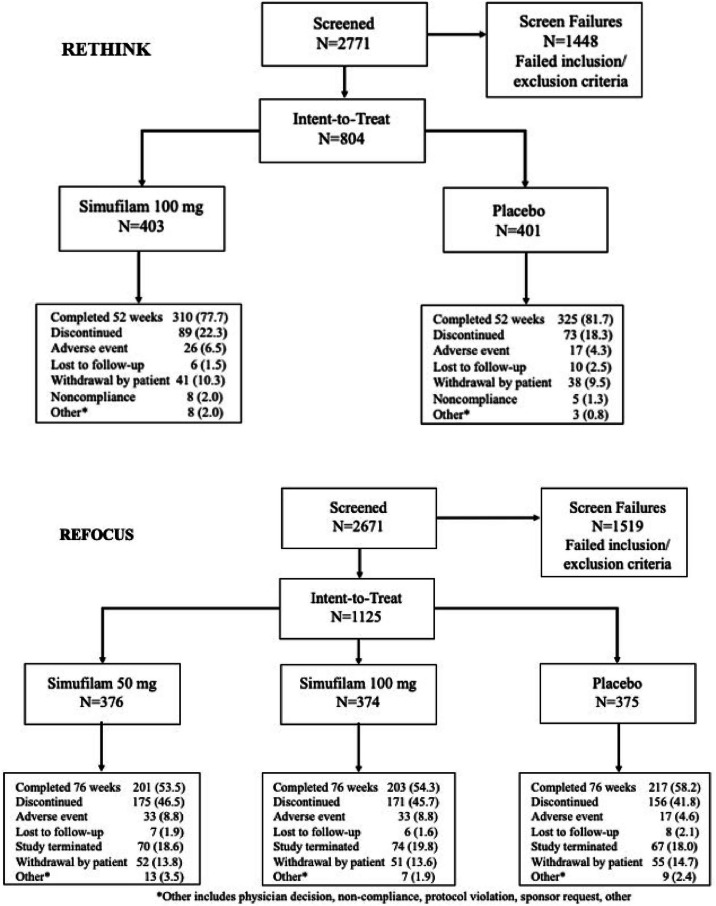
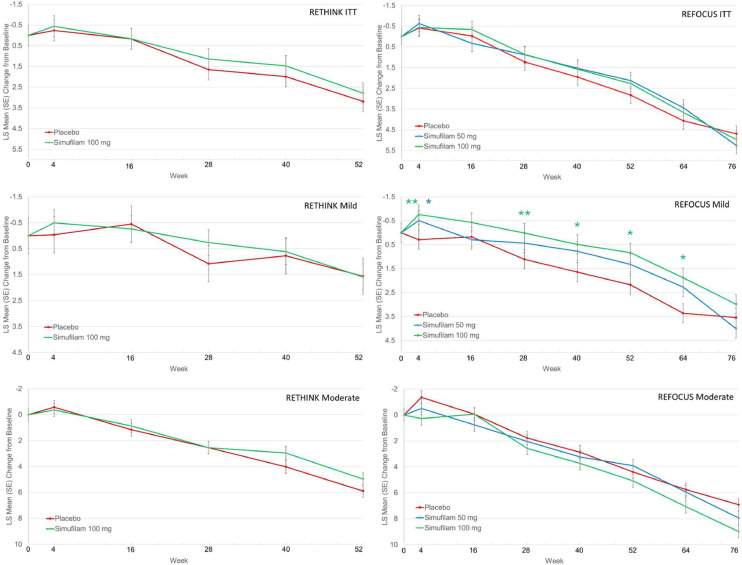
- Both trials failed co-primary endpoints. RETHINK: ADAS-Cog12 LS mean difference −0.39 (95% CI −1.37, 0.59; p=0.431) and ADCS-ADL 0.51 (95% CI −0.68, 1.7; p=0.403). REFOCUS 100 mg: ADAS-Cog12 0.27 (95% CI −0.97, 1.51; p=0.666) and ADCS-ADL −0.95 (95% CI −2.50, 0.60; p=0.232); no secondary endpoints were significant.
- REFOCUS was terminated early with 22% of participants still active and 53% having completed Week 76. In the predefined mild subgroup, simufilam 100 mg was associated with slower ADAS-Cog12 decline through Week 64 (abstract p=0.019), but this disappeared at Week 76 with 45% missing data and did not replicate in RETHINK.
- Biomarker sub-studies showed no significant treatment differences; the REFOCUS amyloid PET sub-study found 33/160 (20.6%) baseline scans were amyloid negative, indicating the plasma p-tau181 entry criterion did not reliably exclude amyloid PET negativity. Nominal trends included plasma GFAP in REFOCUS 100 mg (p=0.07) and tau PET in REFOCUS 50 mg (p=0.08).
- Safety: TEAEs were mostly mild/moderate and similar between groups; in RETHINK, any TEAE occurred in 71.2% simufilam vs 67.6% placebo, and a nonsignificant hip fracture imbalance (1.8% vs 0.3%, p=0.08) was not observed in REFOCUS.
Methods
- Two Phase 3 randomized, double-blind, placebo-controlled, parallel-group trials: RETHINK (NCT04994483) randomized 804 participants 1:1 to simufilam 100 mg BID or placebo for 52 weeks; REFOCUS (NCT05026177) randomized 1125 participants 1:1:1 to simufilam 50 mg, 100 mg BID, or placebo for 76 weeks.
- Participants were age 50–87 with Stage 4 or 5 CE, MMSE ≥16 and ≤27, CDR-GS 0.5/1/2, and AD supported by plasma p-tau181 or prior amyloid PET/CSF. Co-primary endpoints were change from baseline on ADAS-Cog12 and ADCS-ADL, analyzed by MMRM; primary populations were ITT for RETHINK and mITT for REFOCUS (plasma p-tau181 ≥44 pg/mL or prior positive amyloid PET/CSF).
- Sub-studies assessed exploratory plasma biomarkers in both trials and CSF, amyloid PET, tau PET, and volumetric MRI in REFOCUS only.
Limitations
- Paper-stated limitations: potential inclusion of MCI participants with or without amyloid pathology; small biomarker sub-study group sizes; early termination of REFOCUS mostly impacting Week 76 data; the plasma p-tau181 assay did not reliably exclude negative amyloid PET; and the mild-subgroup finding did not replicate in RETHINK.
- Evident from the text: Week 76 had 45% missing data (19% due to trial termination), and the paper notes that >40% missing data should be considered exploratory; the MMRM used a missing-at-random assumption, while missing-not-at-random due to termination was possible, and a completer analysis was not significant.
- Evident from the text: baseline imbalances and site differences may complicate interpretation, including APOE4 homozygotes in RETHINK (13.9% simufilam vs 8.2% placebo), no site overlap between trials, and REFOCUS participants having a 7% higher level of university or higher education than RETHINK participants.
Model-written summary. Check it against the paper before relying on it.
Integrity signals
Registry
Cites
Statistics
Figures
Verification
Claims the paper makes
0 Valid · 1 Not valid · 19 Not checked · 144 Own results and interpretations
A result the paper reports from its own data — it cites no other source for it, so there is none to check. The quote shows it is in the paper.
In the paper
“A prespecified pooled analysis of mild (MMSE 21–27) and moderate (MMSE 16–20) subgroups of RETHINK and REFOCUS for ADAS-Cog12 through Week 52 showed nominal treatment group differences in mild disease (n = 1208) at Weeks 4 and 28 (p < 0.01; Supplemental Figure 14).”
§ Phase 3 randomized clinical trials of simufilam in mild-to-moderate Alzheimer’s disease > Results > Efficacy
plainstates an associationn = 1,208 ·- Asserted: passes — The authors put it forward as true.
- Checkable: passes — It can be checked against evidence.
- Load-bearing: unclear — It is unclear whether the paper’s conclusions depend on it.
- Based: passes — The paper gives a reason why it holds.
A result the paper reports from its own data — it cites no other source for it, so there is none to check. The quote shows it is in the paper.
In the paper
“However, in a responder analysis by mild versus moderate AD, a greater percentage of moderate participants in the simufilam group improved on the ADAS-Cog12 at Week 52 compared to placebo (31 % versus 21 %) (p = 0.039).”
§ Phase 3 randomized clinical trials of simufilam in mild-to-moderate Alzheimer’s disease > Results > Efficacy
plainstates an association- Asserted: passes — The authors put it forward as true.
- Checkable: passes — It can be checked against evidence.
- Load-bearing: unclear — It is unclear whether the paper’s conclusions depend on it.
- Based: passes — The paper gives a reason why it holds.
A result the paper reports from its own data — it cites no other source for it, so there is none to check. The quote shows it is in the paper.
In the paper
“nor were there any significant differences in responders in mild or moderate subgroups at Week 76.”
§ Phase 3 randomized clinical trials of simufilam in mild-to-moderate Alzheimer’s disease > Results > Efficacy
plain- Asserted: passes — The authors put it forward as true.
- Checkable: passes — It can be checked against evidence.
- Load-bearing: unclear — It is unclear whether the paper’s conclusions depend on it.
- Based: passes — The paper gives a reason why it holds.
A result the paper reports from its own data — it cites no other source for it, so there is none to check. The quote shows it is in the paper.
In the paper
“There was also no significant difference in change from baseline to Week 52 for the other co-primary endpoint, ADCS-ADL (Supplemental Figure 2).”
§ Phase 3 randomized clinical trials of simufilam in mild-to-moderate Alzheimer’s disease > Results > Efficacy
plain- Asserted: passes — The authors put it forward as true.
- Checkable: passes — It can be checked against evidence.
- Load-bearing: passes — The paper’s conclusions depend on it.
- Based: passes — The paper gives a reason why it holds.
A result the paper reports from its own data — it cites no other source for it, so there is none to check. The quote shows it is in the paper.
In the paper
“and did not replicate in RETHINK”
§ Phase 3 randomized clinical trials of simufilam in mild-to-moderate Alzheimer’s disease > Abstract > Results
plain- Asserted: passes — The authors put it forward as true.
- Checkable: passes — It can be checked against evidence.
- Load-bearing: passes — The paper’s conclusions depend on it.
- Based: passes — The paper gives a reason why it holds.
87 more claims
Create a free account to see all 164 claims and to verify the 39 references still open.
- Probably not a substantial claim. 22
- It may state two separate claims as one. 57
Self-check
Percentages, sums and reported differences re-computed from the paper’s own numbers.
Each contradiction between two passages listed here was confirmed by an independent check.
Rated minor: it would not touch a result — a value no result rests on, a p-value that stays on the same side of the significance level, or a conflict that is clerical, resolved elsewhere in the paper, or outside its own findings.
In the paper
“| Drug-related TEAEs | 68 (17.0) | 49 (12.3) | 50 (13.3) | 70 (16.7) | 53 (14.2) |”
§ Phase 3 randomized clinical trials of simufilam in mild-to-moderate Alzheimer’s disease > Results > Safety and tolerability
Reported 16.7 · recomputed 18.716578
Rated minor: it would not touch a result — a value no result rests on, a p-value that stays on the same side of the significance level, or a conflict that is clerical, resolved elsewhere in the paper, or outside its own findings.
In the paper
§ Phase 3 randomized clinical trials of simufilam in mild-to-moderate Alzheimer’s disease > Results > Safety and tolerability
“The majority of TEAEs were mild or moderate (85 participants, 7.6 %).”
§ Phase 3 randomized clinical trials of simufilam in mild-to-moderate Alzheimer’s disease > Results > Safety and tolerability
“| Severe | 34 (8.5) | 24 (6.0) | 33 (8.8) | 25 (6.7) | 27 (7.2) |”
Rated minor: it would not touch a result — a value no result rests on, a p-value that stays on the same side of the significance level, or a conflict that is clerical, resolved elsewhere in the paper, or outside its own findings.
In the paper
§ Phase 3 randomized clinical trials of simufilam in mild-to-moderate Alzheimer’s disease > Discussion
“the 18-month placebo decline rate of 5.26 on ADAS-Cog12 in REFOCUS”
§ Phase 3 randomized clinical trials of simufilam in mild-to-moderate Alzheimer’s disease > Results > Efficacy
“| Endpoint | RETHINK Simufilam 100 mg BID N = 403 | RETHINK Placebo N = 401 | REFOCUS Simufilam 50 mg BID N = 376 | REFOCUS Simufilam 100 mg BID N = 374 | REFOCUS Placebo N = 375 | | --- | --- | --- | --- | --- | --- | | ADAS-Cog12 | | | | | | | LS mean (SE) | 2.79 (0.36) | 3.19 (0.36) | 5.26 (0.46) | 4.97 (0.46) | 4.70 (0.46) |”
Cited works that were retracted
Works this paper cites that were later retracted, from the retraction notices publishers deposit. Major when the notice came out before this paper was published.
Rated major: it would touch a result — a value a result rests on, reported and recomputed p-values on opposite sides of the significance level, two passages that conflict with no sign which is right, or a cited work retracted before this paper was published.
In the paper
“Wang, 2017, PTI-125 binds and reverses an altered conformation of filamin A to reduce Alzheimer's disease pathogenesis, Neurobiol Aging, 55, 99, 10.1016/j.neurobiolaging.2017.03.016”
Cited work 10.1016/j.neurobiolaging.2017.03.016 · retracted 2017-07-01 · notice 10.1016/j.neurobiolaging.2017.03.016 · this paper published 2026-03
Citations
Cites
1 retracted
Wang, H.-Y., Lee, K.-C., Pei, Z., Khan, A., Bakshi, K., & Burns, L. H. (2017) · Neurobiology of Aging · doi:10.1016/j.neurobiolaging.2017.03.016 · Cited by 46
Self-citationRetractedFolstein, M. F., Folstein, S. E., & McHugh, P. R. (1975) · Journal of Psychiatric Research · doi:10.1016/0022-3956(75)90026-6 · Cited by 88,282
NIA‐AA Research Framework: Toward a biological definition of Alzheimer's disease
Jack, C. R., Bennett, D. A., Blennow, K., Carrillo, M. C., Dunn, B., Haeberlein, S. B., Holtzman, D. M., Jagust, W., Jessen, F., Karlawish, J., et al. (2018) · Alzheimer's & Dementia · doi:10.1016/j.jalz.2018.02.018 · Cited by 10,537
The Clinical Dementia Rating (CDR): Current version and scoring rules
Morris, J. C. (1993) · Neurology · doi:10.1212/wnl.43.11.2412-a · Cited by 9,882 · cited 1×
“…on Aging – Alzheimer ’ s Association) [27], a gradual and progressive change in memory for > 6 months, a Mini Mental State Examination (MMSE) [26,28] ≥ 16 and ≤ 27 (stratified by low [16 – 20] or high [21-27] MMSE), and a Clinical Dementia Rating Global Score (CDR-GS)[29,30] of 0.5, 1 or 2.”
InfluentialThe Neuropsychiatric Inventory: Comprehensive assessment of psychopathology in dementia
Cummings, J. L., Mega, M., Gray, K., Rosenberg-Thompson, S., Carusi, D. A., & Gornbein, J. (1994) · Neurology · doi:10.1212/wnl.44.12.2308 · Cited by 7,568
Lecanemab in early Alzheimer's disease
van Dyck, C. H., Swanson, C. J., Aisen, P., Bateman, R. J., Chen, C., Gee, M., Kanekiyo, M., Li, D., Reyderman, L., Cohen, S., et al. (2023) · New England Journal of Medicine · doi:10.1056/nejmoa2212948 · Cited by 5,678
Posner, K., Brown, G. K., Stanley, B., Brent, D. A., Yershova, K. V., Oquendo, M. A., Currier, G. W., Melvin, G. A., Greenhill, L., Shen, S., et al. (2011) · American Journal of Psychiatry · doi:10.1176/appi.ajp.2011.10111704 · Cited by 5,157
Soluble protein oligomers in neurodegeneration: lessons from the Alzheimer's amyloid β-peptide
Haass, C., & Selkoe, D. J. (2007) · Nature Reviews Molecular Cell Biology · doi:10.1038/nrm2101 · Cited by 4,744
Clinical and biomarker changes in dominantly inherited Alzheimer's disease
Bateman, R. J., Xiong, C., Benzinger, T. L. S., Fagan, A. M., Goate, A., Fox, N. C., Marcus, D. S., Cairns, N. J., Xie, X., Blazey, T. M., et al. (2012) · New England Journal of Medicine · doi:10.1056/nejmoa1202753 · Cited by 3,814 · cited 1×
“Because amyloid deposition occurs up to two decades before cognitive symptoms appear [39,40], the negative amyloid PET scans observed in the sub-study likely reflect non-AD pathology.”
Donanemab in Early Symptomatic Alzheimer Disease: The TRAILBLAZER-ALZ 2 Randomized Clinical Trial
Sims, J. R., Zimmer, J. A., Evans, C. D., Lu, M., Ardayfio, P., Sparks, J., Wessels, A. M., Shcherbinin, S., Wang, H., Monkul Nery, E. S., et al. (2023) · JAMA · doi:10.1001/jama.2023.13239 · Cited by 2,932 · cited 1×
“…low, at 3.19 points, compared to 4.5 or 5.5 historically reported for mild-to-moderate AD [37,43], and the 18-month placebo decline rate of 5.26 on ADAS-Cog12 in REFOCUS was lower than the 7-point placebo decline on ADAS-Cog13 in a recent Phase 3 clinical trial in early AD (MCI to mild AD) [9].”
InfluentialSelf-citation
Research works printed but not linked: 1
- Wang H.Y. Burns Barbier L. Inventors; Pain Therapeutics, Inc., assignee Method Inhib Growth Cancer Cells 2016
Cited by
Toll-like receptors in innate immunity and inflammation: from fundamental biology to clinic insights
Qian, C., Cao, X., & Hoffmann, J. A. (2026) · Immunity & Inflammation · doi:10.1007/s44466-026-00040-6 · Cited by 50
Bialer, M., Landmark, C. J., Koepp, M. J., Perucca, E., Perucca, P., Tomson, T., White, H. S., & Wirrell, E. C. (2026) · Epilepsia · doi:10.1002/epi.70354 · Cited by 3
Evaluating emerging amyloid-β centric drugs for the treatment of Alzheimer's disease
Lozupone, M., Dibello, V., Sardone, R., Zupo, R., Castellana, F., Bortone, I., Lampignano, L., Matteo, M. D., Moramarco, G., Dellegrazie, F., et al. (2026) · Expert Opinion on Emerging Drugs · doi:10.1080/14728214.2026.2693701 · Cited by 2
“Overall, simufilam was safe and well tolerated but did not demonstrate clinical efficacy in Phase III RCTs [53].”
Srivastava, A., Renna, H. A., Hossain, T., Palaia, T. A., Pinkhasov, A., Gomolin, I. H., Leon, J. D., Wısnıewskı, T., & Reiss, A. B. (2026) · Pharmaceuticals · doi:10.3390/ph19020281 · Cited by 2
Filamin A phosphorylation at S2152: a molecular switch fueling cancer and neurodegeneration
Burns, L. H., & Romero, A. (2026) · Cell Communication and Signaling · doi:10.1186/s12964-026-02806-2
“…α7nAChR responds to acetylcholine, insulin receptors respond to insulin and signal to mTOR, and integrins are generally maintained in an inactive state by FLNA binding to β tails Simufilam advanced to two Phase 3 clinical trials in mild-to-moderate AD, which did not meet co-primary endpoints [102].”
Self-citation
Metadata
- Authors
- Kupiec, J. W., Porsteinsson, A. P., Turner, R. S., Hendrix, S., Mallinckrodt, C., Khan, A., Cohen, I., Liss, J., Clarnette, R., Park, K. H., Hernandez, A. M., & Burns, L. H.
- Affiliations
- Cassava Sciences (United States) (US)
- University of Rochester Medicine (US)
- Gachon University Gil Medical Center (KR)
- Corresponding author
- Kupiec, James W.
- ORCID
- Venue
- The Journal of Prevention of Alzheimer's Disease
- Publisher
- Elsevier BV
- Published
- 2026-03
- Volume
- 13
- Issue
- 3
- Pages
- 100469
- ISSN
- 2274-5807 (ISSN-L)
- PMC
- PMC12988371
- OpenAlex
- W7119091317
- Cited by
- 6
- References
- 45
- Citations by year
- 2026: 6
- FWCI
- 7.03
- Type
- journal article
- Language
- en
- Open access
- gold
- doi.org
- Licence
- cc-by-nc-nd
- www.elsevier.com/tdm/userlicense/1.0/ (tdm)
- www.elsevier.com/legal/tdmrep-license (tdm)
- creativecommons.org/licenses/by-nc-nd/4.0/ (vor)
- Locations
- The Journal of Prevention of Alzheimer s Disease (publishedVersion, cc-by-nc-nd)
- PubMed Central (publishedVersion, cc-by-nc-nd)
- PubMed (publishedVersion)
- DOAJ (DOAJ: Directory of Open Access Journals) (submittedVersion)
- Topics
- Life Sciences › Neuroscience › Cellular and Molecular Neuroscience › Alzheimer's disease research and treatments
- Health Sciences › Medicine › Psychiatry and Mental health › Dementia and Cognitive Impairment Research
- Life Sciences › Neuroscience › Neurology › Neuroinflammation and Neurodegeneration Mechanisms
- Keywords
- Alzheimer's disease, filamin A, tau hyperphosphorylation, amyloid-beta, alpha7 nicotinic acetylcholine receptor, neuroinflammation, cognitive decline, amyloid PET, clinical trial failure, biomarkers
- MeSH terms
- Mental Status and Dementia Tests, Aged, Aged, 80 and over, Alzheimer Disease, Double-Blind Method, Female, Humans, Male, Peptide Fragments, Biomarkers, Amyloid beta-Peptides, tau Proteins
About these checks
Registry, retraction, Cites and statistics results are computed, not judged, with one exception: a printed reference that no index lists is read once by a model before it counts as a citation error. Claims are extracted by a model and kept only when their quote appears verbatim in the text; each cited source is then checked, with a model’s help, for whether it says what the claim relies on. Those verdicts can be wrong — read the claim’s quote and the cited source before relying on one.
A language model drew the claims from the paper on 2026-11-27, under version 3 of the claim definition (model deepseek-v4.1-flash, prompt extract-v3).
A second model labelled each claim on 2026-11-27 (model jev-1.13-20260917, definition revision gold-guideline-v0.2).
Statistics and arithmetic are recomputed, not judged.
Confidence bands are shown only for fields calibrated on our annotated test set. None is calibrated yet, so no band is shown.
What counts as a claim ›How we measure confidence ›How we check this ›
Are you an author, or do you see a problem with this page? Request a review
How to cite
Cite CoChat for the checks on this page, and the paper for its own findings.
- This page
- CoChat. (2026). Citation check: Phase 3 randomized clinical trials of simufilam in mild-to-moderate Alzheimer’s disease. https://app.cochat.ai/papers/10.1016/j.tjpad.2025.100469
- The paper
- Kupiec, J. W., Porsteinsson, A. P., Turner, R. S., Hendrix, S., Mallinckrodt, C., Khan, A., Cohen, I., Liss, J., Clarnette, R., Park, K. H., Hernandez, A. M., & Burns, L. H. (2026). Phase 3 randomized clinical trials of simufilam in mild-to-moderate Alzheimer’s disease. The Journal of Prevention of Alzheimer's Disease. https://doi.org/10.1016/j.tjpad.2025.100469
Data sources
Bibliographic data: Semantic Scholar, OpenAlex, Crossref.
Contains information from the Semantic Scholar Academic Graph Datasets, made available under the ODC Attribution License (ODC-BY 1.0).
Semantic Scholar’s data is described in: Kinney, R., et al. (2023). The Semantic Scholar Open Data Platform. arXiv:2301.10140.
