

The DOI matches its Crossref record; 83 of the 86 references it cites were found in a registry or an index.
A review of long-term pesticide monitoring studies to assess surface water quality trends
Open accessAbstract
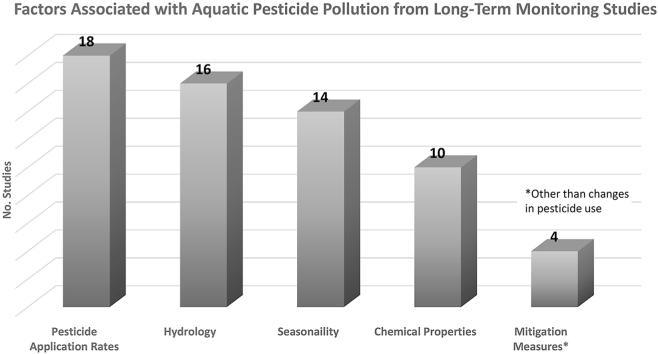
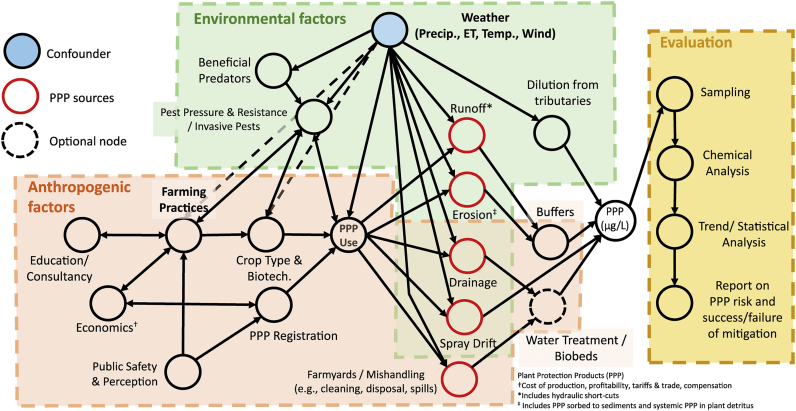
Aquatic pesticide pollution from both agricultural and urban pest control is a concern in many parts of the world. Making an accurate assessment of pesticide exposure is the starting point to protecting aquatic ecosystems. This in turn requires the design of an effective monitoring program. Monitoring is also essential to evaluate the efficacy of mitigation measures aimed to curb pesticide pollution. However, empirical evidence for their efficacy can be confounded by additional influencing factors, most prominently variable weather conditions. This review summarizes the experiences gained from long-term (>5 years) pesticide monitoring studies for detecting trends and provides recommendations for their improvement. We reviewed articles published in the scientific literature, with a few complements from selected grey literature, for a total of 20 studies which fulfill our search criteria. Overall, temporal trends of pesticide use and hydrological conditions were the two most common factors influencing aquatic pesticide pollution. Eighteen studies demonstrated observable effects to surface water concentrations from changes in pesticide application rates (e.g., use restriction) and sixteen studies from interannual variability in hydrological conditions during the application period. Accounting for seasonal- and streamflow-related variability in trend analysis is important because the two factors can obscure trends caused by changes in pesticide use or management practices. Other mitigation measures (e.g., buffer strips) were only detectable in four studies where concentrations or loads were reduced by > 45%. Collecting additional agricultural (e.g., pesticide use, mitigation measures) and environmental (e.g., precipitation, stream flow) data, as well as establishing a baseline before the implementation of mitigation measures have been consistently reported as prerequisites to interpret water quality trends from long-term monitoring studies, but have rarely been implemented in the past.
Overview
The claims and statistics of this paper haven’t been checked yet.
Run the check — free, no account needed. It reads the open-access text and checks the sources it cites.
Integrity signals
Registry
Cites
Statistics
Figures
Verification
Claims the paper makes
The claims and statistics of this paper haven’t been checked yet.
Run the check — free, no account needed. It reads the open-access text and checks the sources it cites.
Claims other papers make about this one
Each is checked against this paper’s own text: does it say what the citing paper says it does?
The source backs part of the claim, not all of it — or backs it for a different population, condition or comparison.
In the citing paper
“Pollution of water resources by various organic chemicals has been identified as a growing crisis all over the world.”
From Advanced Oxidation Processes for Degradation of Water Pollutants—Ambivalent Impact of Carbonate Species: A Review (2023) · cites this paper as [6]
Experimental — accuracy not yet measuredThe source backs part of the claim, not all of it — or backs it for a different population, condition or comparison.
In the citing paper
“Prosulfocarb was previously detected in surface waters several kil ometres away from the application area during treatment weeks (Chow et al., 2020; Devault et al., 2022; Slaby et al., 2023).”
From Occurrence of emerging and persistent organic pollutants in the rivers Cam, Ouse and Thames, UK (2025) · cites this paper as Chow et al., 2020
Experimental — accuracy not yet measured
Self-check
Percentages, sums and reported differences re-computed from the paper’s own numbers.
The self-check needs the paper’s full text.
Citations
Cites
Rudin, C. (2019) · Nature Machine Intelligence · doi:10.1038/s42256-019-0048-x · Cited by 10,561
The environment and disease: association or causation?
Hill, A. B. (2015) · Journal of the Royal Society of Medicine · doi:10.1177/0141076814562718 · Cited by 7,804
The Environment and Disease: Association or Causation?
Hill, A. B. (1965) · Proceedings of the Royal Society of Medicine · doi:10.1177/003591576505800503 · Cited by 6,974
Techniques of trend analysis for monthly water quality data
Hirsch, R. M., Slack, J. R., & Smith, R. A. (1982) · Water Resources Research · doi:10.1029/wr018i001p00107 · Cited by 2,982
Statistical Methods in Water Resources
Helsel, D. R., & Hirsch, R. M. (1992) · Studies in environmental science · doi:10.1016/s0166-1116(08)x7035-9 · Cited by 2,892
Sampling Design and Statistical Methods for Environmental Biologists
Green, R. H. (1979) · Andalas University Repository (Andalas University) · Cited by 1,557
Inferring causation from time series in Earth system sciences
Runge, J., Bathiany, S., Bollt, E. M., Camps‐Valls, G., Coumou, D., Deyle, E. R., Glymour, C., Kretschmer, M., Mahecha, M. D., Muñoz-Marı́, J., et al. (2019) · Nature Communications · doi:10.1038/s41467-019-10105-3 · Cited by 1,093
Sampling Design and Statistical Methods for Environmental Biologists.
Brown, K. G., & Green, R. H. (1980) · Journal of the American Statistical Association · doi:10.2307/2287493 · Cited by 1,039
Pesticides reduce regional biodiversity of stream invertebrates
Beketov, M. A., Kefford, B. J., Schäfer, R. B., & Liess, M. (2013) · Proceedings of the National Academy of Sciences · doi:10.1073/pnas.1305618110 · Cited by 924
The evolutionary origins of pesticide resistance
Hawkins, N. J., Bass, C., Dixon, A. L., & Neve, P. (2018) · Biological reviews/Biological reviews of the Cambridge Philosophical Society · doi:10.1111/brv.12440 · Cited by 908
Research works printed but not linked: 8
- Cheremisinoff, 2010, vol. 3
- Daouk, 2019, Pesticides dans les eaux de surface : mesures de réduction et monitoring – synthese des apprentissages lies aux projects, Aqua & Gas N°, 1
- Hermosin, 2013, 164, 229
- Kreuger, 2019, Long-term monitoring of pesticides in air and atmospheric deposition in Sweden, Oral Presentation at IUPAC, Ghent, Belgium, 1
- Larsson, 2014, Kemiska bekämpningsmedel i grundvatten 1986-2014. Sammanställning av resultat och trender i Sverige under tre decennier, samt internationella utblickar. CKB rapport 2014:1. Sveriges lantbruksuniversitet, Havs- och vattenmyndighetens rapport, 15
- Singer, 2005, Pestizidbelastung von Oberflächengewässer: auswirkungen der ökologischen Massnahmen in der Landwirtschaft, GWA. Gas, Wasser, Abwasser, 85, 879
- Wang, 2016, 571, 332
- 1998, vol. 814, 201
Cited by
Sorted by citations
Rayaroth, M. P., Aravindakumar, C. T., Shah, N. S., & Boczkaj, G. (2022) · Chemical Engineering Journal · doi:10.1016/j.cej.2021.133002 · Cited by 532
Parra-Arroyo, L., González-González, R. B., Castillo-Zacarías, C., Melchor-Martínez, E. M., Sosa‐Hernández, J. E., Bilal, M., Iqbal, H. M. N., Barceló, ., & Parra‐Saldívar, R. (2021) · The Science of The Total Environment · doi:10.1016/j.scitotenv.2021.151879 · Cited by 192
Halbach, K., Möder, M., Schrader, S., Liebmann, L., Schäfer, R. B., Schneeweiss, A., Schreiner, V. C., Vormeier, P., Weisner, O., Liess, M., et al. (2021) · Water Research · doi:10.1016/j.watres.2021.117535 · Cited by 165
Rayaroth, M. P., Boczkaj, G., Aubry, O., Aravind, U. K., & Aravindakumar, C. T. (2023) · Water · doi:10.3390/w15081615 · Cited by 171
Rayaroth, M. P., Aravind, U. K., Boczkaj, G., & Aravindakumar, C. T. (2023) · Chemosphere · doi:10.1016/j.chemosphere.2023.140203 · Cited by 122
Metadata
- Authors
- Chow, R., Scheidegger, R., Doppler, T., Dietzel, A., Fenicia, F., & Stamm, C.
- Affiliations
- Swiss Federal Institute of Aquatic Science and Technology (CH)
- Corresponding author
- Chow, R.
- Venue
- Water Research X
- Publisher
- Elsevier BV
- Published
- 2020-12
- Volume
- 9
- Pages
- 100064
- ISSN
- 2589-9147 (ISSN-L)
- PMC
- PMC7501075
- OpenAlex
- W3084398703
- Cited by
- 156
- References
- 86
- Citations by year
- 2026: 13 · 2025: 31 · 2024: 35 · 2023: 32 · 2022: 27 · 2021: 17
- FWCI
- 0.85
- Type
- journal article
- Language
- en
- Open access
- gold
- doi.org
- Licence
- Locations
- Water Research X (publishedVersion, cc-by-nc-nd)
- PubMed Central (publishedVersion, cc-by-nc-nd)
- PubMed (publishedVersion)
- Socio-Environmental Systems Modeling (acceptedVersion, cc-by-nc-nd)
- DORA Eawag (Swiss Federal Institute of Aquatic Science and Technology (Eawag)) (submittedVersion, cc-by-nc-nd)
- DOAJ (DOAJ: Directory of Open Access Journals) (submittedVersion, cc-by-sa)
- Funders
- Eidgenössische Anstalt für Wasserversorgung Abwasserreinigung und Gewässerschutz
- Topics
- Physical Sciences › Environmental Science › Pollution › Pesticide and Herbicide Environmental Studies
- Life Sciences › Agricultural and Biological Sciences › Food Science › Pesticide Residue Analysis and Safety
- Physical Sciences › Environmental Science › Environmental Chemistry › Soil and Water Nutrient Dynamics
- Keywords
- pesticide contamination, surface water quality, long-term monitoring, temporal trends, agricultural pesticides, urban pest control, hydrological conditions, streamflow variability, mitigation measures, buffer strips, pesticide load, baseline data
About these checks
Registry, retraction, Cites and statistics results are computed, not judged, with one exception: a printed reference that no index lists is read once by a model before it counts as a citation error. Claims are extracted by a model and kept only when their quote appears verbatim in the text; each cited source is then checked, with a model’s help, for whether it says what the claim relies on. Those verdicts can be wrong — read the claim’s quote and the cited source before relying on one.
Statistics and arithmetic are recomputed, not judged.
Confidence bands are shown only for fields calibrated on our annotated test set. None is calibrated yet, so no band is shown.
What counts as a claim ›How we measure confidence ›How we check this ›
Are you an author, or do you see a problem with this page? Request a review
