

The DOI matches its Crossref record.
The trading profits of SOES bandits
Open accessAbstract
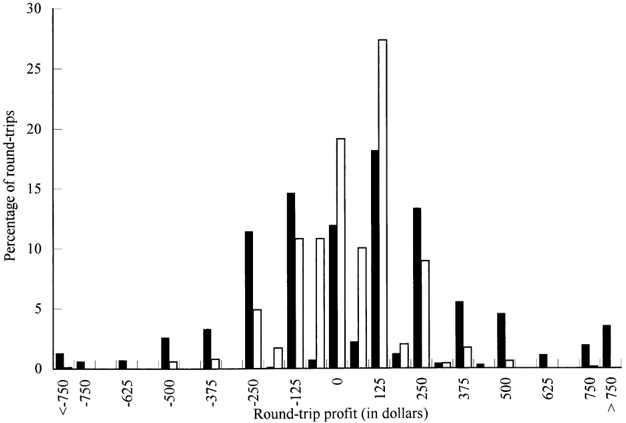
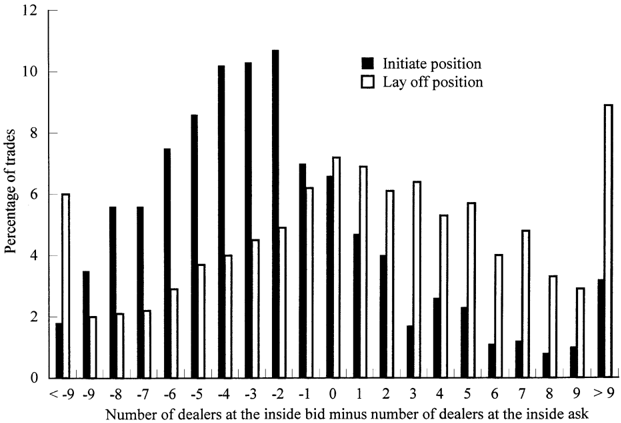
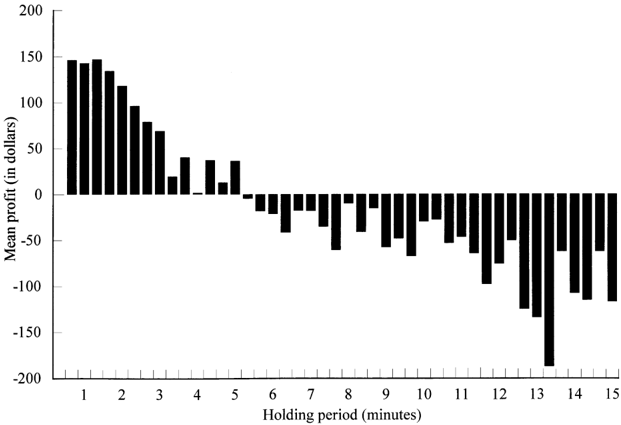
SOES bandits are individual investors who use Nasdaq's Small Order Execution System (SOES) for day trading. Their average profit per trade is small, but they trade dozens or hundreds of times per week. Bandits usually establish a position before most market-makers have updated their quotes, and lay off the position at favorable prices through Instinet or SelectNet. It is noteworthy that they trade profitably with market-makers despite having less information. Bandits keep the profits and bear the losses from their trades. Thus they have greater incentives to trade well than the employees of market-making firms.
Overview
The claims and statistics of this paper haven’t been checked yet.
Run the check — free, no account needed. It reads the open-access text and checks the sources it cites.
Integrity signals
Registry
Cites
Statistics
Figures
Verification
Claims the paper makes
The claims and statistics of this paper haven’t been checked yet.
Run the check — free, no account needed. It reads the open-access text and checks the sources it cites.
Claims other papers make about this one
Each is checked against this paper’s own text: does it say what the citing paper says it does?
The source backs part of the claim, not all of it — or backs it for a different population, condition or comparison.
In the citing paper
“Harris and Schultz (1998) document that SOES bandits are able to profit from trading with market makers who ostensibly are better informed and better financed.”
From The cross-section of speculator skill: Evidence from day trading (2014) · cites this paper as Harris and Schultz (1998)
Experimental — accuracy not yet measuredThe cited source says what the claim attributes to it.
In the citing paper
“Four small-scale academic studies of day trading provide evidence that day trading can be profitable.”
From The cross-section of speculator skill: Evidence from day trading (2014) · cites this paper as Harris and Schultz (1998)
The cited source says what the claim attributes to it.
In the citing paper
“Though the SOES traders lose money almost as frequently as they make money, they earn a small average profit per trade.”
From The cross-section of speculator skill: Evidence from day trading (2014) · cites this paper as Harris and Schultz (1998)
The cited source says what the claim attributes to it.
In the citing paper
“Harris and Schultz write that SOES bandits appear to profit by paying close attention to the market and reacting more quickly than most market makers to changing market conditions.”
From The cross-section of speculator skill: Evidence from day trading (2014) · cites this paper as Harris and Schultz (1998)
Self-check
Percentages, sums and reported differences re-computed from the paper’s own numbers.
The self-check needs the paper’s full text.
Citations
Cites
No references could be resolved yet.
Research works printed but not linked: 3
- Battalio, 1997, SOES trading and market volatility, Journal of Financial and Quantitative Analysis, 32, 225, 10.2307/2331174 · DOI
- Harris, 1997, The Importance of firm quotes and rapid executions: Evidence from the January 1994 change in SOES, Journal of Financial Economics, 45, 135, 10.1016/S0304-405X(97)00013-5 · DOI
- Hinden, 1994, Nasdaq's big guns send trading bandits packing, Washington Post, February, 7, 1994
Cited by
Sorted by citations
Why do (some) households trade so much?
Linnainmaa, J. T. (2011) · Review of Financial Studies · doi:10.1093/rfs/hhr009 · Cited by 141
The cross-section of speculator skill: Evidence from day trading
Barber, B. M., Lee, Y.-T., Liu, Y.-J., & Odean, T. (2014) · Journal of Financial Markets · doi:10.1016/j.finmar.2013.05.006 · Cited by 112
Metadata
- Authors
- Harris, J. H., & Schultz, P. H.
- Affiliations
- University of Notre Dame (US)
- Corresponding author
- Schultz, Paul H.
- Venue
- Journal of Financial Economics
- Publisher
- Elsevier BV
- Published
- 1998-10
- Volume
- 50
- Issue
- 1
- Pages
- 39-62
- ISSN
- 0304-405X (ISSN-L)
- OpenAlex
- W1552154167
- Cited by
- 113
- References
- 0
- Citations by year
- 2026: 2 · 2024: 3 · 2023: 3 · 2022: 3 · 2021: 1 · 2020: 3 · 2019: 4 · 2018: 2 · 2017: 1 · 2016: 4 · 2015: 4 · 2014: 8 · 2013: 3 · 2012: 3
- FWCI
- 10.38
- Type
- journal article
- Language
- en
- Open access
- hybrid
- doi.org
- Licence
- Locations
- Journal of Financial Economics (publishedVersion, cc-by-nc-nd)
- SSRN Electronic Journal (submittedVersion)
- RePEc: Research Papers in Economics (submittedVersion)
- Topics
- Social Sciences › Economics, Econometrics and Finance › Finance › Financial Markets and Investment Strategies
- Social Sciences › Economics, Econometrics and Finance › Finance › Stochastic processes and financial applications
- Social Sciences › Business, Management and Accounting › Accounting › Financial Analysis and Corporate Governance
- Keywords
- state-owned enterprises, day trading, retail investors, market makers, NASDAQ, trading profits, market microstructure, information asymmetry
About these checks
Registry, retraction, Cites and statistics results are computed, not judged, with one exception: a printed reference that no index lists is read once by a model before it counts as a citation error. Claims are extracted by a model and kept only when their quote appears verbatim in the text; each cited source is then checked, with a model’s help, for whether it says what the claim relies on. Those verdicts can be wrong — read the claim’s quote and the cited source before relying on one.
Statistics and arithmetic are recomputed, not judged.
Confidence bands are shown only for fields calibrated on our annotated test set. None is calibrated yet, so no band is shown.
What counts as a claim ›How we measure confidence ›How we check this ›
Are you an author, or do you see a problem with this page? Request a review
