

Ebola virus disease mathematical models and epidemiological parameters: a systematic review
Open accessThe DOI matches its Crossref record; 42 of the 44 references it cites were found in a registry or an index.
Abstract
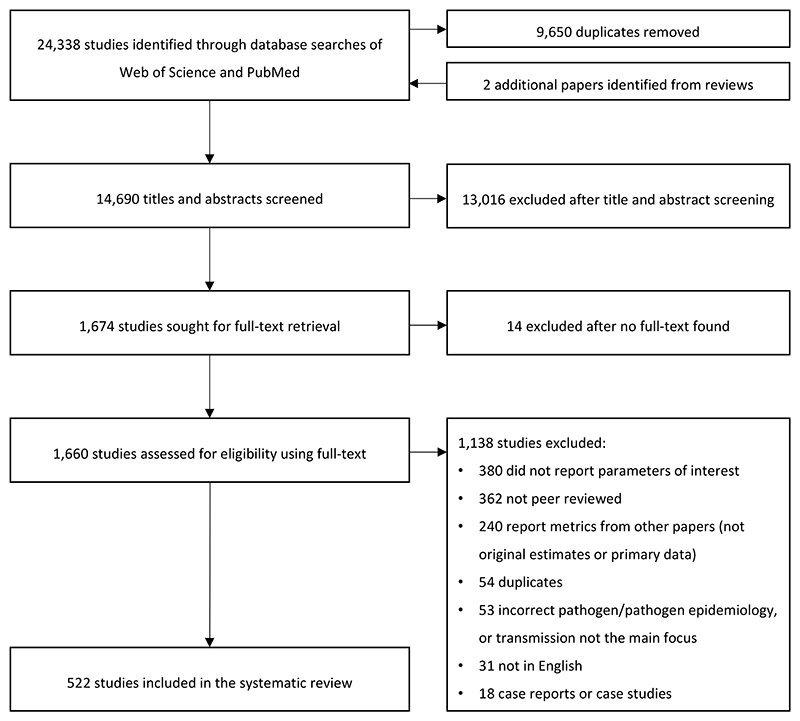
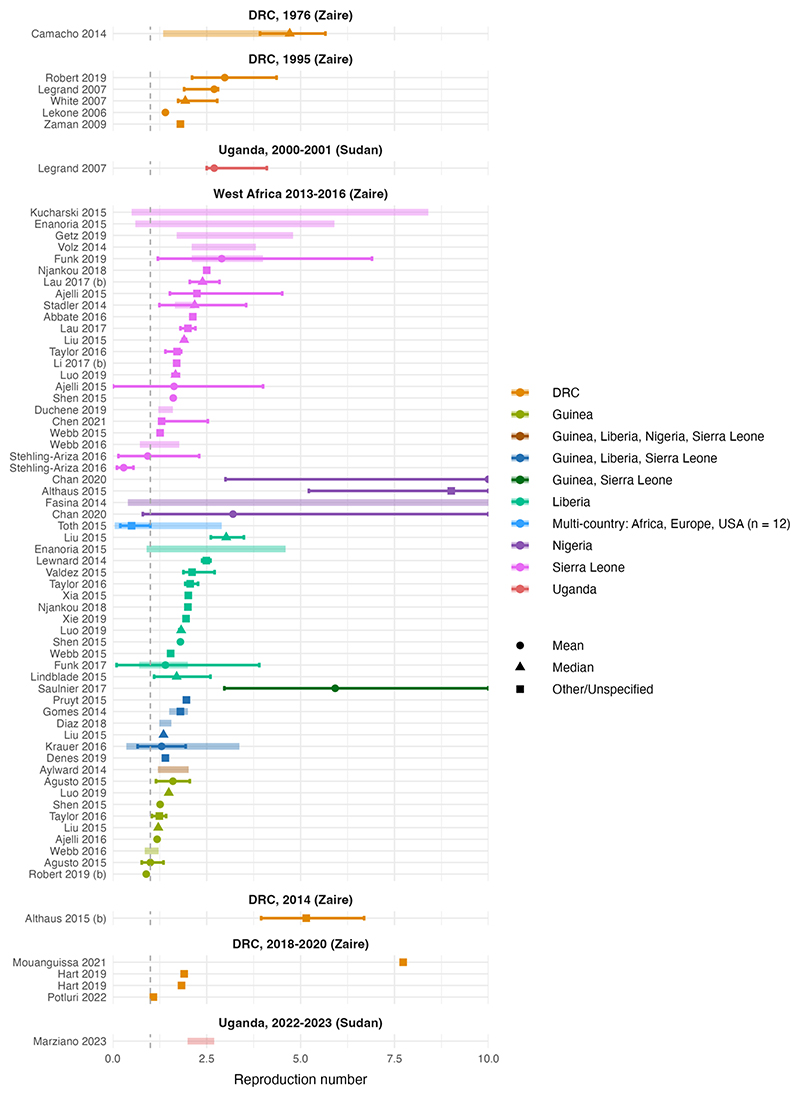
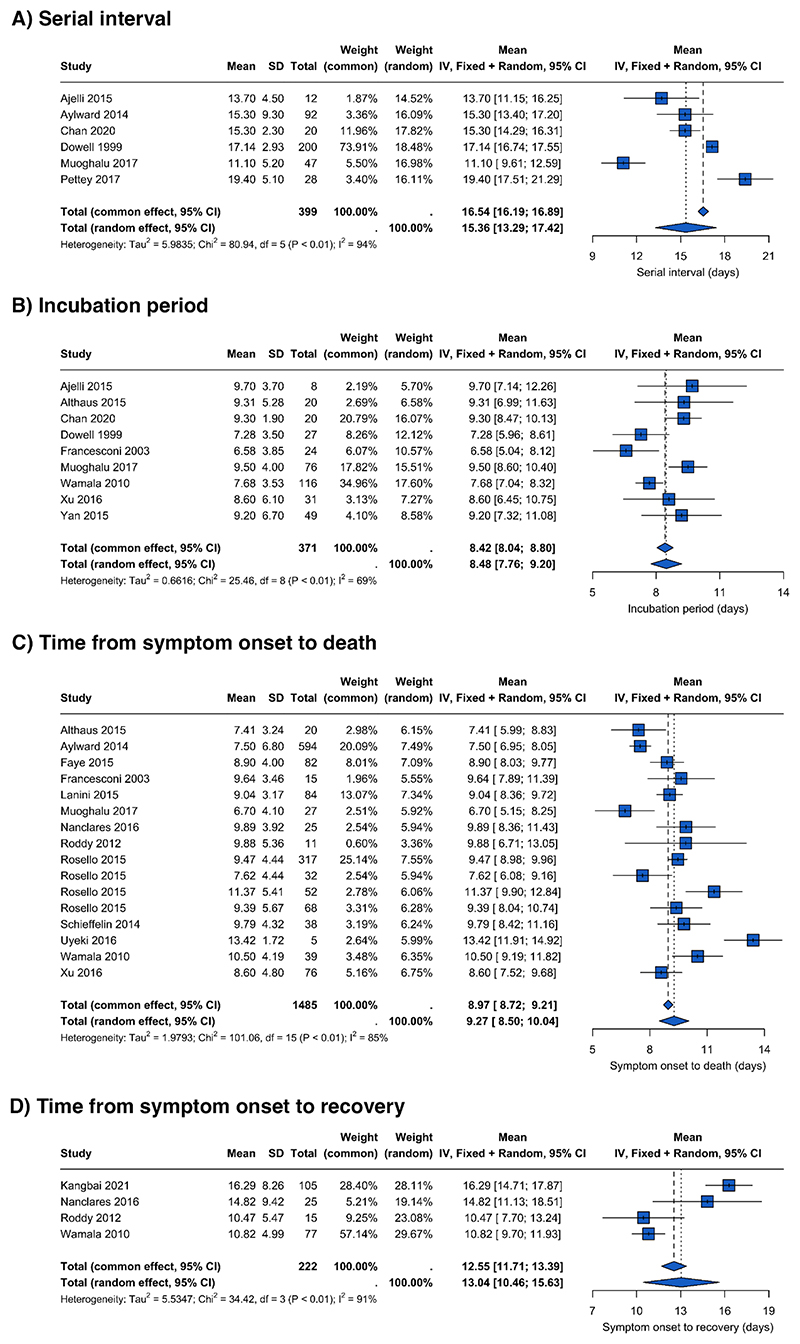
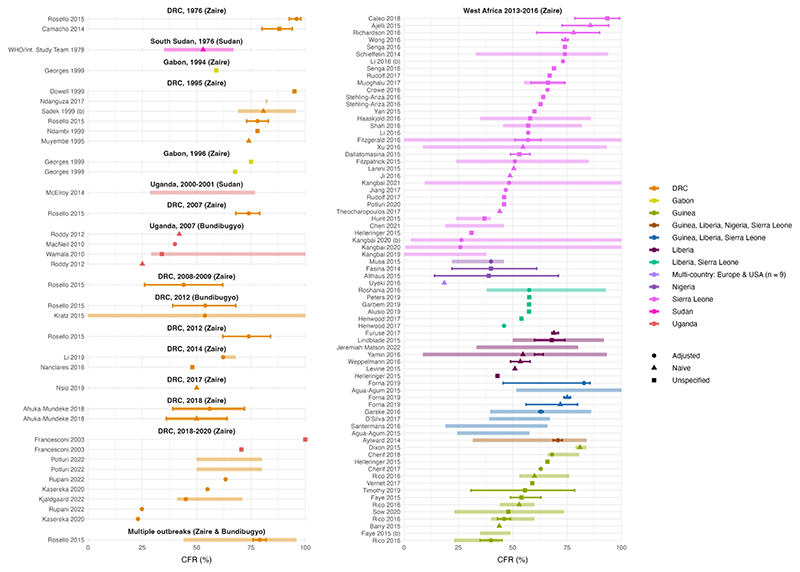
Ebola virus disease poses a recurring risk to human health. We conducted a systematic review (PROSPERO CRD42023393345) of Ebola virus disease transmission models and parameters published from database inception to July 7, 2023, from PubMed and Web of Science. Two people screened each abstract and full text. Papers were extracted with a bespoke Access database, 10% were double extracted. We extracted 1280 parameters and 295 models from 522 papers. Basic reproduction number estimates were highly variable, as were effective reproduction numbers, likely reflecting spatiotemporal variability in interventions. Random-effect estimates were 15·4 days (95% CI 13·2-17·5) for the serial interval, 8·5 days (7·7-9·2) for the incubation period, 9·3 days (8·5-10·1) for the symptom-onset-to-death delay, and 13·0 days (10·4-15·7) for symptom-onset-to-recovery. Common effect estimates were similar, albeit with narrower CIs. Case-fatality ratio estimates were generally high but highly variable, which could reflect heterogeneity in underlying risk factors. Although a substantial body of literature exists on Ebola virus disease models and epidemiological parameter estimates, many of these studies focus on the west African Ebola epidemic and are primarily associated with Zaire Ebola virus, which leaves a key gap in our knowledge regarding other Ebola virus species and outbreak contexts.
Overview
The claims and statistics of this paper haven’t been checked yet.
Free: it reads the open-access text and checks the first 5 claims that cite a source we can check. Create a free account to check every claim.
Integrity signals
Registry
Cites
Statistics
Figures
Verification
Claims the paper makes
The claims and statistics of this paper haven’t been checked yet.
Free: it reads the open-access text and checks the first 5 claims that cite a source we can check. Create a free account to check every claim.
Claims other papers make about this one
Each is checked against this paper’s own text: does it say what the citing paper says it does?
The source backs part of the claim, not all of it — or backs it for a different population, condition or comparison.
In the citing paper
“Only the extracted parameters from high-QA-score studies (with QA scores >50%, as in a previous study 28 ) were included in the main analysis.”
From Severe acute respiratory syndrome (SARS) mathematical models and disease parameters: a systematic review (2025) · cites this paper as [28]
Experimental — accuracy not yet measured
Self-check
Percentages, sums and reported differences re-computed from the paper’s own numbers.
The self-check needs the paper’s full text.
Citations
Cites
Quantifying heterogeneity in a meta‐analysis
Higgins, J. P. T., & Thompson, S. G. (2002) · Statistics in Medicine · doi:10.1002/sim.1186 · Cited by 36,763 · cited 1×
“Our full analysis can be reproduced using https://github.com/mrc-ide/priority-pathogens.”
MethodHow to perform a meta-analysis with R: a practical tutorial
Balduzzi, S., Rücker, G., & Schwarzer, G. (2019) · Evidence Based Mental Health · doi:10.1136/ebmental-2019-300117 · Cited by 5,827
Superspreading and the effect of individual variation on disease emergence
Lloyd-Smith, J. O., Schreiber, S. J., Kopp, P. E., & Getz, W. M. (2005) · Nature · doi:10.1038/nature04153 · Cited by 2,514 · cited 1×
“Evidence from Lloyd-Smith et al. (50) would suggest that this corresponds to between ~30-90% of transmission being attributed to the most infectious 20% of individuals, which is less over dispersive than Severe Acute Respiratory Syndrome (SARS) but highly uncertain.”
Ebola virus disease in West Africa—the first 9 months of the epidemic and forward projections
WHO Ebola Response Team (2014) · New England Journal of Medicine · doi:10.1056/nejmoa1411100 · Cited by 1,674 · cited 5×
“Mathematical epidemic models typically use various parameters characterising the pathogen as inputs, for example the incubation and infectious periods, with the robustness of modelling outputs directly depending on the reliability of parameter values.”
BackgroundMethodInfluentialHenao-Restrepo, A. M., Camacho, A., Longini, I. M., Watson, C. H., Edmunds, W. J., Egger, M., Carroll, M. W., Dean, N. E., Diatta, I., Doumbia, M., et al. (2017) · The Lancet · doi:10.1016/s0140-6736(16)32621-6 · Cited by 1,110 · cited 1×
“A vaccine (Ervebo), trialled against the Zaire species during the WA epidemic (10), is now used as part of outbreak response activities to prevent disease using a “ring vaccination” strategy.”
The discovery of Bombali virus adds further support for bats as hosts of ebolaviruses
Goldstein, T., Anthony, S. J., Gbakima, A., Bird, B. H., Bangura, J., Tremeau-Bravard, A., Belaganahalli, M. N., Wells, H. L., Dhanota, J. K., Liang, E., et al. (2018) · Nature Microbiology · doi:10.1038/s41564-018-0227-2 · Cited by 385 · cited 3×
“One species, Reston, is only known to cause disease in non-human primates (4) and a sixth species, Bombali, was identified in samples taken from bats in Sierra Leone (8).”
Feldmann, H., Sprecher, A., & Geisbert, T. W. (2020) · New England Journal of Medicine · doi:10.1056/nejmra1901594 · Cited by 217
West African Ebola Epidemic after One Year — Slowing but Not Yet under Control
WHO Ebola Response Team (2015) · New England Journal of Medicine · doi:10.1056/nejmc1414992 · Cited by 187 · cited 2×
“This heterogeneity is likely driven by differences in epidemic context, with time to hospitalisation often being used as a marker of response performance (13,14).”
Van Kerkhove, M. D., Bento, A. I., Mills, H. L., Ferguson, N. M., & Donnelly, C. A. (2015) · Scientific Data · doi:10.1038/sdata.2015.19 · Cited by 170 · cited 2×
“Most estimates of epidemiological delays were highly variable across studies, which agrees with previous reviews (21,22).”
Potential for large outbreaks of Ebola virus disease
Camacho, A., Kucharski, A. J., Funk, S., Breman, J. G., Piot, P., & Edmunds, W. J. (2014) · Epidemics · doi:10.1016/j.epidem.2014.09.003 · Cited by 149 · cited 2×
“…in R 0 values may be driven by more than just the epidemic context e.g. some of the early epidemics with high R 0 estimates were driven mostly by nosocomial transmission (43,44) or the methodological approach taken differed (e.g. branching processes e.g. (13) or using phylogenies e.g (45)).”
Research works printed but not linked: 1
- Covidence Covidence - Better systematic review management cited 2024 Mar 11 [Internet]. Available from: https://www.covidence.org/
Cited by
Mannan, A., Shoket, N., Rahman, J. U., & Uwitije, R. (2025) · Modeling Earth Systems and Environment · doi:10.1007/s40808-024-02256-0 · Cited by 26
“…and analysis of ebola virus disease dynamics by dividing the infected population into groups that are conscious and those that are not, as well as including a section for hospitalized patients, their study takes a targeted approach to investigating EVD (Ullah et al. 2024; Nash et al. 2024).”
Mathematical modeling of Ebola using delay differential equations
Raza, A., Ahmed, N., Rafiq, M., Akgül, A., Cordero, A., & Torregrosa, J. R. (2024) · Modeling Earth Systems and Environment · doi:10.1007/s40808-024-02124-x · Cited by 18
CRISPR-Cas: a game-changer in vaccine development and the fight against viral infections
Yang, F., Aliyari, S. R., Zhu, Z., Zheng, H., Cheng, G., & Zhang, S. (2025) · Trends in Microbiology · doi:10.1016/j.tim.2025.02.006 · Cited by 11
A systematic review and meta-analysis of Zika virus epidemiology
McCain, K., Vicco, A., Morgenstern, C., Rawson, T., Naidoo, T. M., Bhatia, S., Dee, D. P., Doohan, P., Fraser, K., Hartner, A.-M., et al. (2026) · Nature Health · doi:10.1038/s44360-025-00051-4 · Cited by 9
Self-citationPost-acute sequelae after Nipah virus infection: a systematic review and meta-analysis
Zhang, T., Wei, Q., & Schmit, N. (2026) · EClinicalMedicine · doi:10.1016/j.eclinm.2026.103878 · Cited by 8
Metadata
- Authors
- Nash, R. K., Bhatia, S., Morgenstern, C., Doohan, P., Jorgensen, D., McCain, K., McCabe, R., Nikitin, D., Forna, A., Cuomo-Dannenburg, G., Hicks, J. T., Sheppard, R. J., Naidoo, T., van Elsland, S., Geismar, C., Rawson, T., Leuba, S. I., Wardle, J., Routledge, I., Fraser, K., Imai-Eaton, N., Cori, A., & Unwin, H. J. T.
- Affiliations
- Imperial College London (GB)
- UK Health Security Agency (GB)
- University of Liverpool (GB)
- University of Georgia (US)
- University of California, San Francisco (US)
- University of Bristol (GB)
- Corresponding author
- Unwin, H Juliette T
- ORCID
- Nash, Rebecca K
- Bhatia, Sangeeta
- Morgenstern, Christian
- Doohan, Patrick
- Jorgensen, David
- McCain, Kelly
- McCabe, Ruth
- Nikitin, Dariya
- Forna, Alpha
- Cuomo-Dannenburg, Gina
- Hicks, Joseph T
- Sheppard, Richard J
- Geismar, Cyril
- Rawson, Thomas
- Leuba, Sequoia Iris
- Wardle, Jack
- Routledge, Isobel
- Fraser, Keith
- Cori, Anne
- Unwin, H Juliette T
- Venue
- The Lancet Infectious Diseases
- Publisher
- Elsevier BV
- Published
- 2024-12
- Volume
- 24
- Issue
- 12
- Pages
- e762-e773
- ISSN
- 1473-3099 (ISSN-L)
- PMC
- PMC7616620
- OpenAlex
- W4401381325
- Semantic Scholar
- e71ced191f7980e106ae2555ea85bef50c132d94
- Cited by
- 35
- References
- 44
- Citations by year
- 2026: 21 · 2025: 11 · 2024: 3
- FWCI
- 2.91
- Type
- journal article
- Language
- en
- Open access
- Licence
- cc-by-nc-nd
- www.elsevier.com/tdm/userlicense/1.0/ (tdm)
- www.elsevier.com/legal/tdmrep-license (tdm)
- doi.org/10.15223/policy-017 (stm-asf)
- doi.org/10.15223/policy-037 (stm-asf)
- doi.org/10.15223/policy-012 (stm-asf)
- doi.org/10.15223/policy-029 (stm-asf)
- doi.org/10.15223/policy-004 (stm-asf)
- Locations
- The Lancet Infectious Diseases (publishedVersion)
- PubMed (publishedVersion)
- Bristol Research (University of Bristol) (publishedVersion, cc-by-nc-nd)
- PubMed Central (acceptedVersion, cc-by)
- Explore Bristol Research (acceptedVersion, cc-by-nc-nd)
- Research at the University of Copenhagen (University of Copenhagen) (submittedVersion)
- Funders
- Wellcome Trust
- The Schmidt Family Foundation
- National Institute for Health Research Health Protection Research Unit
- Academy of Medical Sciences
- UKRI Medical Research Council
- Topics
- Health Sciences › Medicine › Infectious Diseases › Viral Infections and Outbreaks Research
- Physical Sciences › Mathematics › Applied Mathematics › Mathematical and Theoretical Epidemiology and Ecology Models
- Physical Sciences › Mathematics › Modeling and Simulation › COVID-19 epidemiological studies
- Keywords
- Ebola virus disease, transmission model, epidemiological parameters, basic reproduction number, effective reproduction number, serial interval, incubation period, case fatality rate, Zaire ebolavirus, outbreak dynamics
- MeSH terms
- Disease Outbreaks, Humans, Models, Theoretical, Hemorrhagic Fever, Ebola, Ebolavirus, Basic Reproduction Number
About these checks
Registry, retraction, Cites and statistics results are computed, not judged, with one exception: a printed reference that no index lists is read once by a model before it counts as a citation error. Claims are extracted by a model and kept only when their quote appears verbatim in the text; each cited source is then checked, with a model’s help, for whether it says what the claim relies on. Those verdicts can be wrong — read the claim’s quote and the cited source before relying on one.
Statistics and arithmetic are recomputed, not judged.
Confidence bands are shown only for fields calibrated on our annotated test set. None is calibrated yet, so no band is shown.
What counts as a claim ›How we measure confidence ›How we check this ›
Are you an author, or do you see a problem with this page? Request a review
Data sources
Bibliographic data: Semantic Scholar, OpenAlex, Crossref.
Contains information from the Semantic Scholar Academic Graph Datasets, made available under the ODC Attribution License (ODC-BY 1.0).
Semantic Scholar’s data is described in: Kinney, R., et al. (2023). The Semantic Scholar Open Data Platform. arXiv:2301.10140.
