

Patients receiving inpatient rehabilitation for lower limb orthopaedic conditions do much less physical activity than recommended in guidelines for healthy older adults: an observational study
Open accessThe DOI matches its Crossref record; 40 of the 42 references it cites were found in a registry or an index.
Abstract
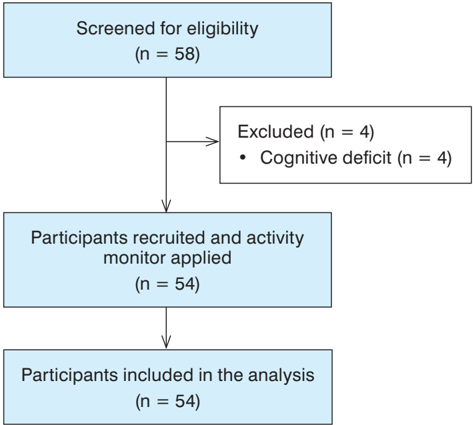
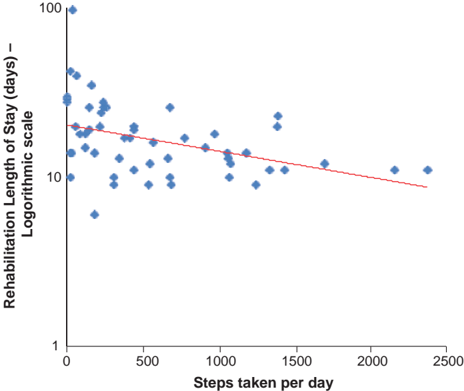
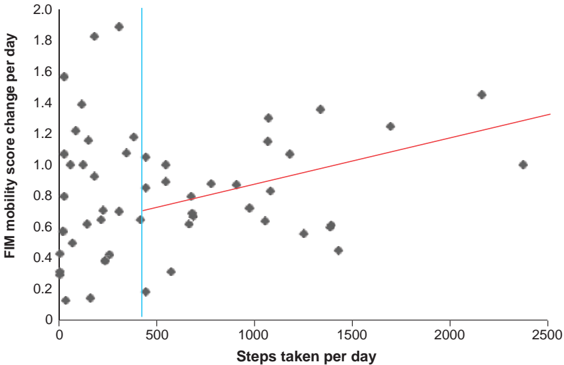
QUESTION: Are ambulant patients who are admitted for inpatient rehabilitation for a lower limb orthopaedic condition active enough to meet current physical activity guidelines? DESIGN: Prospective observational study. PARTICIPANTS: Adults admitted for inpatient rehabilitation for a lower limb orthopaedic condition who were cognitively alert and able to walk independently or with assistance. OUTCOME MEASURES: Participants wore an activity monitor for three full days. Daily time spent in moderate intensity physical activity was used to determine whether the levels of physical activity recommended in clinical guidelines were achieved. RESULTS: Fifty-four participants with a mean age of 74 years (SD 11) took a median of 398 (IQR 140 to 993) steps per day and spent a median of 8 (IQR 3 to 16) minutes walking per day. No participant completed a 10-minute bout of moderate intensity physical activity during the monitoring period. One participant accumulated 30 minutes of moderate intensity physical activity and nine participants accumulated 15 minutes of moderate intensity physical activity in a day. Physical activity was associated with shorter length of stay (r=-0.43) and higher functional status on discharge (r=0.39). CONCLUSIONS: Adults with lower limb orthopaedic conditions in inpatient rehabilitation are relatively inactive and do not meet current physical activity guidelines for older adults. Results of this study indicate that strategies to increase physical activity are required.
Overview
The claims and statistics of this paper haven’t been checked yet.
Free: it reads the open-access text and checks the first 5 claims that cite a source we can check. Create a free account to check every claim.
Integrity signals
Registry
Cites
Statistics
Figures
Verification
Claims the paper makes
The claims and statistics of this paper haven’t been checked yet.
Free: it reads the open-access text and checks the first 5 claims that cite a source we can check. Create a free account to check every claim.
Claims other papers make about this one
Each is checked against this paper’s own text: does it say what the citing paper says it does?
The source backs part of the claim, not all of it — or backs it for a different population, condition or comparison.
In the citing paper
“Evidence suggests that patients in rehabilitation at SNF settings are ≈80% less active compared with community-dwelling older adults, and they do not engage in an adequate intensity of rehabilitation to facilitate meaningful improvements in physical function.236–238”
From Prioritizing Functional Capacity as a Principal End Point for Therapies Oriented to Older Adults With Cardiovascular Disease: A Scientific Statement for Healthcare Professionals From the American Heart Association (2017) · cites this paper as [237]
Experimental — accuracy not yet measured
Self-check
Percentages, sums and reported differences re-computed from the paper’s own numbers.
The self-check needs the paper’s full text.
Citations
Cites
Physical Activity in the United States Measured by Accelerometer
TROIANO, R. P., BERRIGAN, D., DODD, K. W., MÂSSE, L. C., TILERT, T., & MCDOWELL, M. (2008) · Medicine & Science in Sports & Exercise · doi:10.1249/mss.0b013e31815a51b3 · Cited by 7,638
Validation of a combined comorbidity index
Charlson, M., Szatrowski, T. P., Peterson, J., & Gold, J. (1994) · Journal of Clinical Epidemiology · doi:10.1016/0895-4356(94)90129-5 · Cited by 6,587
Compendium of Physical Activities: Classification of energy costs of human physical activities
AINSWORTH, B. E., HASKELL, W. L., LEON, A. S., JACOBS, D. R., MONTOYE, H. J., SALLIS, J. F., & PAFFENBARGER, R. S. (1993) · Medicine & Science in Sports & Exercise · doi:10.1249/00005768-199301000-00011 · Cited by 4,102
Conducting accelerometer-based activity assessments in field-based research
TROST, S. G., MCIVER, K. L., & PATE, R. R. (2005) · Medicine & Science in Sports & Exercise · doi:10.1249/01.mss.0000185657.86065.98 · Cited by 2,033
Wen, C. P., Wai, J. P. M., Tsai, M. K., Yang, Y. C., Cheng, T. Y. D., Lee, M.-C., Chan, H. T., Tsao, C. K., Tsai, S. P., & Wu, X. (2011) · The Lancet · doi:10.1016/s0140-6736(11)60749-6 · Cited by 1,908
Medicine & science in sports & exercise
(1994) · Journal of the American Dietetic Association · doi:10.1016/0002-8223(94)92575-5 · Cited by 1,303
The validity and reliability of a novel activity monitor as a measure of walking
Ryan, C. G., Grant, P. M., Tigbe, W. W., & Granat, M. H. (2006) · British Journal of Sports Medicine · doi:10.1136/bjsm.2006.027276 · Cited by 490
Research works printed but not linked: 1
- Kanoun N (2009) Validation of the ActivPAL activity monitor as a measure of walking at pre-determined slow walking speeds in a healthy population in a controlled setting. Reinvention: a Journal of Undergraduate Research 2: 5-9.
Cited by
Forman, D. E., Arena, R., Boxer, R., Dolansky, M. A., Eng, J. J., Fleg, J. L., Haykowsky, M., Jahangir, A., Kaminsky, L. A., Kitzman, D. W., et al. (2017) · Circulation · doi:10.1161/cir.0000000000000483 · Cited by 319
Clark, I. N., Baker, F. A., & Taylor, N. F. (2015) · Nordic Journal of Music Therapy · doi:10.1080/08098131.2015.1008558 · Cited by 166
Self-citationPeiris, C. L., Shields, N., Brusco, N. K., Watts, J. J., & Taylor, N. F. (2013) · BMC Medicine · doi:10.1186/1741-7015-11-198 · Cited by 93
“In addition, higher levels of physical activity during rehabilitation were associated with higher levels of functional independence on discharge and shorter length of stay [30].”
BackgroundSelf-citationChallenging rehabilitation environment for older patients
Tijsen, L. M., Derksen, E. W., Achterberg, W. P., & Buijck, B. I. (2019) · Clinical Interventions in Aging · doi:10.2147/cia.s207863 · Cited by 78
“A decrease of therapy time was associated with return to hospital or death.(18,19,22,23,33)”
BackgroundPhysical Activity Levels During Acute Inpatient Admission After Hip Fracture are Very Low
Davenport, S. J., Arnold, M., Hua, C., Schenck, A., Batten, S., & Taylor, N. F. (2014) · Physiotherapy Research International · doi:10.1002/pri.1616 · Cited by 73
Self-citationRissman, C. M., Keeney, B. J., Ercolano, E. M., & Koenig, K. M. (2015) · The Journal of Arthroplasty · doi:10.1016/j.arth.2015.09.002 · Cited by 58
“Restoring adequate ROM is an important goal of arthroplasty and is one of the few clinical measures that a surgeon can use to compare outcomes [28,29].”
Verlaan, L., Bolink, S. A. A. N., van Laarhoven, S. N., Lipperts, M., Heyligers, I. C., Grimm, B. P., & Senden, R. H. J. (2015) · The Open Biomedical Engineering Journal · doi:10.2174/1874120701509010157 · Cited by 63
“Although rehabilitation after TKR aims to improve physical activity [30], still an important minority of patients do not improve postoperatively [31].”
Zusman, E. Z., Dawes, M. G., Edwards, N. Y., & Ashe, M. C. (2017) · Clinical Rehabilitation · doi:10.1177/0269215517741665 · Cited by 54
Taylor, N. F., Harding, K. E., Dennett, A. M., Febrey, S., Warmoth, K., Hall, A., Prendergast, L. A., & Goodwin, V. A. (2021) · Age and Ageing · doi:10.1093/ageing/afab154 · Cited by 54
“Physical activity levels in older people undergoing inpatient rehabilitation are also low, with less than 10% of the 8-hour day spent walking [7], and steps averaging 400 daily [8].”
Self-citationTurunen, K. M., Salpakoski, A., Edgren, J., Törmäkangas, T., Arkela-Kautiainen, M., Kallinen, M., Pesola, M., Hartikainen, S. A., Nikander, R., & Sipilä, S. (2017) · Archives of Physical Medicine and Rehabilitation · doi:10.1016/j.apmr.2017.01.004 · Cited by 54
Master, H., Pennings, J. S., Coronado, R. A., Bley, J. A., Robinette, P. E., Haug, C. M., Skolasky, R. L., Riley, L. H., Neuman, B. J., Cheng, J. S., et al. (2021) · Archives of Physical Medicine and Rehabilitation · doi:10.1016/j.apmr.2021.06.002 · Cited by 33
Dennett, A. M., Shields, N., Peiris, C. L., Prendergast, L. A., O’Halloran, P., Parente, P., & Taylor, N. F. (2018) · Journal of physiotherapy · doi:10.1016/j.jphys.2018.08.003 · Cited by 35
Self-citationPedometers alone do not increase mobility in inpatient rehabilitation: a randomized controlled trial
Atkins, A., Cannell, J., & Barr, C. (2019) · Clinical Rehabilitation · doi:10.1177/0269215519838312 · Cited by 29
Alsop, T., Woodforde, J., Rosbergen, I. C. M., Mahendran, N., Brauer, S., & Gomersall, S. R. (2023) · Clinical Rehabilitation · doi:10.1177/02692155231170451 · Cited by 34
Schmid‐Zalaudek, K., Fischer, T., Száva, Z., Lackner, H. K., Kropiunig, U., Bittner, C., Höcker, K., Winkler, G., & Peternell, G. (2022) · Journal of Clinical Medicine · doi:10.3390/jcm11102683 · Cited by 26
Use of Wearable Technology to Measure Activity in Orthopaedic Trauma Patients: A Systematic Review
Marmor, M. T., Grimm, B. P., Hanflik, A. M., Richter, P. H., Sivananthan, S., Yarboro, S. R., & Braun, B. J. (2022) · Indian Journal of Orthopaedics · doi:10.1007/s43465-022-00629-0 · Cited by 27
“For example, one study used cadence, Metabolic Equivalents (METs), and an activity score monitoring for three days in patients on an orthopaedic rehabilitation ward after a lower extremity injury [26].”
MethodWalking tolerance of patients recovering from hip fracture: a phase I trial
Taylor, N. F., Peiris, C. L., Kennedy, G., & Shields, N. (2016) · Disability and Rehabilitation · doi:10.3109/09638288.2015.1107776 · Cited by 24
“Higher levels of walking by patients with lower limb orthopaedic conditions including those after hip fracture are associated with shorter length of stay and higher level of functional independence on discharge from rehabilitation.[17] There is also preliminary evidence that prescribed physical activity in the form of…”
BackgroundSelf-citationMeester, S. B., Wagenmakers, R., van den Akker‐Scheek, I., & Stevens, M. J. (2018) · PLoS ONE · doi:10.1371/journal.pone.0202494 · Cited by 24
Measuring Activity Performance of Older Adults Using the activPAL: A Rapid Review
Chan, C., Slaughter, S. E., Jones, C. A., Ickert, C., & Wagg, A. (2017) · Healthcare · doi:10.3390/healthcare5040094 · Cited by 30
“The lowest mean daily hours spent upright was found in adult inpatients with a lower limb orthopaedic condition [24] while the highest mean time was found in individuals with thoracic cancer [37].”
BackgroundInfluentialBate, G., Kirk, C., Rehman, R. Z. U., Guan, Y., Yarnall, A. J., Din, S. D., & Lawson, R. A. (2023) · Sensors · doi:10.3390/s23104881 · Cited by 34
Being active after hip fracture; older people’s lived experiences of facilitators and barriers
Rasmussen, B., Nielsen, C. V., & Uhrenfeldt, L. (2018) · International Journal of Qualitative Studies on Health and Well-Being · doi:10.1080/17482631.2018.1554024 · Cited by 24
Engdal, M., Foss, O. A., Taraldsen, K., Husby, V. S., & Winther, S. B. (2016) · American Journal of Physical Medicine & Rehabilitation · doi:10.1097/phm.0000000000000657 · Cited by 24
Dorsch, S., Weeks, K., King, L., & Polman, E. (2018) · Journal of physiotherapy · doi:10.1016/j.jphys.2018.11.004 · Cited by 20
Observations of Activity Levels in a Purpose-Built, Inpatient, Rehabilitation Facility
Scrivener, K., Pocovi, N. C., Jones, T., Dean, B., Gallagher, S., Henrisson, W., Thorburn, M., & Dean, C. M. (2019) · HERD Health Environments Research & Design Journal · doi:10.1177/1937586718823519 · Cited by 18
Sedentary Behaviour in Hospitalised Older People: A Scoping Review
Jasper, U. S., Yadav, L., Dollard, J., Jadczak, A. D., Yu, S., & Visvanathan, R. (2020) · International Journal of Environmental Research and Public Health · doi:10.3390/ijerph17249359 · Cited by 27
“0%) [16], most likely due to capturing all forms of sitting as SB, compared to other behavioural mapping based studies that interpreted sitting unsupported out of bed and rolling to sit up on the bed as PA.”
BackgroundInfluentialBrusco, N. K., Tilley, L., Walpole, B., Kugler, H. L., Li, R., Kennedy, E., & Morris, M. E. (2019) · Australian Occupational Therapy Journal · doi:10.1111/1440-1630.12614 · Cited by 20
A pragmatic implementation of a 6-day physiotherapy service in a mixed inpatient rehabilitation unit
Caruana, E. L., Kuys, S. S., Clarke, J., & Bauer, S. G. (2016) · Disability and Rehabilitation · doi:10.1080/09638288.2016.1211181 · Cited by 14
“Increased activity levels in rehabilitation have also been associated with improved functional independence and reduced LOS.[34] The 6-day physiotherapy service described in this study was pragmatically delivered.”
BackgroundInfluentialAcceptability of physical activity monitoring in older adults undergoing inpatient rehabilitation
Raymond, M., Winter, A., Jeffs, K. J., Soh, S., & Holland, A. E. (2017) · Aging Clinical and Experimental Research · doi:10.1007/s40520-017-0857-x · Cited by 12
“Results from this pilot study concur with other studies demonstrating that hospitalized older adults spend a significant amount of their day in bed and inactive [1, 2, 8, 9]; hospitalization is not conducive to older adults being physically active.”
ResultTaylor, N. F., O’Halloran, P., Watts, J. J., Morris, R., Peiris, C. L., Porter, J. A., Prendergast, L. A., Harding, K. E., Snowdon, D. A., Ekegren, C. L., et al. (2021) · BMJ Open · doi:10.1136/bmjopen-2020-047970 · Cited by 14
Self-citationPeiris, C. L., Shields, N., Kingsley, M., Yeung, J., Hau, R., & Taylor, N. F. (2017) · Archives of Physical Medicine and Rehabilitation · doi:10.1016/j.apmr.2017.03.027 · Cited by 14
Self-citationTurunen, K. M., Aaltonen, L. A., Kumpumäki, J., Portegijs, E., Keikkala, S., Kinnunen, M.-L., Finni, T. J., Sipilä, S., & Nikander, R. (2017) · BMC Musculoskeletal Disorders · doi:10.1186/s12891-017-1825-5 · Cited by 18
“Obviously, patients who have had an orthopedic surgery are even less active during hospitalization than those who have not been treated surgically [13, 14].”
BackgroundBui, T., King, C., Llado, A., Lee, D., Leong, G., Paraparum, A., Lin, I., & Scrivener, K. (2019) · Pilot and Feasibility Studies · doi:10.1186/s40814-019-0430-9 · Cited by 11
“Published research demonstrates that individuals participating in inpatient rehabilitation have low levels of activity and complete less activity than recommended for healthy older adults, with a total of 8 min of walking and 398 steps per day [10, 11].”
BackgroundKozica, S. L., McRae, P., Bew, P. G., & Mudge, A. (2020) · Australian Journal on Ageing · doi:10.1111/ajag.12777 · Cited by 15
Corna, S., Arcolin, I., Giardini, M., Bellotti, L., & Godi, M. (2020) · Clinical Rehabilitation · doi:10.1177/0269215520968694 · Cited by 11
Mudge, A., Bew, P. G., Smith, S. S., & McRae, P. (2020) · Australian Journal on Ageing · doi:10.1111/ajag.12793 · Cited by 11
The influence of communal spaces on patient activity in rehabilitation: a mixed methods study
Kelso, L. R., Stockton, K. A., Mahendran, N., Brauer, S., & Rosbergen, I. C. M. (2023) · Disability and Rehabilitation · doi:10.1080/09638288.2022.2160834 · Cited by 12
“However, scheduled therapy only forms a small portion of a patient’s day in rehabilitation [10–12], and almost half (47”
BackgroundDennett, A. M., Peiris, C. L., Shields, N., Prendergast, L. A., & Taylor, N. F. (2018) · Rehabilitation Oncology · doi:10.1097/01.reo.0000000000000132 · Cited by 9
“transitions 46 (13) [47, 12-83] 23 (7) [51, 48-63] 46 (13) [47, 12-83]”
Self-citationTaylor, N. F., Peiris, C. L., Thompson, L. A., Prendergast, L. A., Harding, K. E., Hau, R., & Shields, N. (2020) · Physiotherapy Research International · doi:10.1002/pri.1876 · Cited by 9
Self-citationSenserrick, C., Lawler, K., Scroggie, G., Williams, K. A., & Taylor, N. F. (2020) · Physiotherapy · doi:10.1016/j.physio.2020.12.002 · Cited by 10
Self-citationvan Dartel, D., Wang, Y., Hegeman, J. H., Vermeer, M., Vollenbroek-Hutten, M. M. R., on behalf of the Up&Go after a hip fracture group, Broersma, B., Brouwer, K., Folbert, E. C., Gerrits, T. A. J., et al. (2023) · BMC Geriatrics · doi:10.1186/s12877-023-04054-2 · Cited by 9
An observational study of physical, cognitive and social activities in rehabilitation inpatients
McRae, P., Bew, P. G., Smith, S. S., & Mudge, A. (2020) · Australian Journal on Ageing · doi:10.1111/ajag.12785 · Cited by 8
“Read/TV/game/radio 11(0-29) 14 (0-36) 19(7-46) 20 (8-42)”
InfluentialSnowdon, D. A., Sounthakith, V., Kolic, J., Brooks, S., Scanlon, S., & Taylor, N. F. (2020) · Disability and Rehabilitation · doi:10.1080/09638288.2020.1745906 · Cited by 8
“During inpatient rehabilitation, physical activity levels are significantly lower than guideline recommended levels of physical activity for community-dwelling adults [42,43].”
BackgroundSelf-citationvan der Slikke, R. M. A., de Leeuw, A., de Rooij, A., & Berger, M. (2024) · Sensors · doi:10.3390/s24020657 · Cited by 5
“Lower-limb orthopedic patients in inpatient rehabilitation do much less physical activity than recommended in guidelines, especially in the elderly population [3].”
BackgroundQuick, S. M., Cleary, S. L., & Shields, N. (2019) · Physiotherapy Canada · doi:10.3138/ptc-2018-0067 · Cited by 8
Self-citationType A behavior pattern shortens length of stay in comprehensive rehabilitation units
Usui, H., & Nishida, Y. (2015) · Journal of Physical Therapy Science · doi:10.1589/jpts.27.183 · Cited by 4
Beisheim, E. H., Hinrichs‐Kinney, L., Butera, K. A., Derlein, D. L., Pontiff, M. E., Pisegna, J., Altic, R., Malone, D. J., & Stevens‐Lapsley, J. E. (2025) · Journal of Geriatric Physical Therapy · doi:10.1519/jpt.0000000000000443 · Cited by 4
FSBI RISC �RTO� of the RF Ministry of Health, K., Губин, А. В., Борисович, О. А., Зуфарович, Н. М., FSBI RISC �RTO� of the RF Ministry of Health, K., Анатольевич, К. А., FSBI RISC �RTO� of the RF Ministry of Health, K., Reznik, A. V., FSBI RISC �RTO� of the RF Ministry of Health, K., Goncharuk, E., et al. (2016) · Genij Ortopedii · doi:10.18019/1028-4427-2016-1-18-27 · Cited by 3
“При этом отделения традиционно работают как с госпитализированными больными, так и уже с выписанными [42, 53, 56].”
Skouras, A. Z., Antonakis-Karamintzas, D., Tsolakis, C. K., Tsantes, A. Ε., Kourlaba, G., Zafeiris, I., Soucacos, F., Papagiannis, G. I., Triantafyllou, A. I., Houhoula, D. P., et al. (2023) · Biomedicines · doi:10.3390/biomedicines11051263 · Cited by 3
“Although postoperative (post-hospitalization) moderate-intensity aerobic exercise programs have been used in hip fracture patients and tested for safety and efficacy [17,64], these patients typically fail to incorporate the minimum weekly physical activity guidelines into their rehabilitation program, as recommended b…”
BackgroundPlater, J. C., Baxter, D. G., Wood, L. C., Mueller, J., & Fisher, T. (2024) · BMJ Open · doi:10.1136/bmjopen-2024-088692 · Cited by 2
Nuevas perspectivas sobre educación, salud y movimiento
Mendoza Ayala, M. A., & Méndez Avila, J. C. (2023) · Editorial Transdigital eBooks · doi:10.56162/transdigitalb11 · Cited by 2
Characteristics of Early Postoperative Sedentary Time in Patients with Hip Fractures
Toriyama, T., Fukutani, T., Sakurai, T., Takeda, M., Tomii, K., Kodaira, H., Sekizaki, K., Kobayashi, Y., & Nishimura, N. (2025) · Progress in Rehabilitation Medicine · doi:10.2490/prm.20250014 · Cited by 1
Hinrichs‐Kinney, L., Pontiff, M. E., Butera, K. A., Beisheim, E. H., Magnusson, D., & Stevens‐Lapsley, J. E. (2026) · Physical Therapy · doi:10.1093/ptj/pzag008 · Cited by 1
Wattel, E., Groen, W. G., Visser, D., van der Wouden, J. C., Meiland, F. J. M., Hertogh, C. M. P. M., & Gerrits, K. H. L. (2025) · Disability and Rehabilitation · doi:10.1080/09638288.2025.2506823 · Cited by 1
“Moreover, patients in orthopedic GR are much less physically active than recommended in the guidelines [19].”
Shelyakina, O., Mamonova, N. V., Aronov, A. M., Карева, Н. П., & Kopanev, A. A. (2018) · Biomedical Engineering · doi:10.1007/s10527-018-9763-6 · Cited by 1
Letter to the Editor: Do Activity Levels Increase After Total Hip and Knee Arthroplasty?
Brandes, M., & Rosenbaum, D. (2014) · Clinical Orthopaedics and Related Research · doi:10.1007/s11999-014-3742-3 · Cited by 1
“There is growing evidence [3, 5, 6] that further efforts are needed as different research groups did not find a satisfactory increase of physical activity after arthroplasty.”
Губин, А. В., Борисович, О. А., Зуфарович, Н. М., Анатольевич, К. А., Reznik, A., Goncharuk, E., Евгеньевич, К. А., Smelysheva, L. N., Chakushina, I. V., & Олеговна, М. Л. (2016) · CyberLeninK (CyberLeninka)
Discharge planning in Saudi Arabia following limb injury
Alshammari, M. H. (2017) · Figshare · doi:10.4225/03/58b662a5c514d
An investigation of the pragmatic implementation of weekend rehabilitation services in Australia
Caruana, E. L. (2018) · The University of Queensland · doi:10.14264/uql.2019.23
Evaluation of the early mobilization effectiveness after total knee and hip artroplasty
Юрьевич, Е. И., Abramenkov, A., & Sotvoldiev, N. (2020) · Glavvrač (Chief Medical Officer) · doi:10.33920/med-03-2001-05
Moving out of the lab: movement analyses in patients with osteoarthritis of the knee
Verlaan, L. (2020) · Research Publications (Maastricht University) · doi:10.26481/dis.20210122lv
Functional status of community-dwelling older adults after inpatient rehabilitation
Peiris, C. L., Shields, N., Lowe, A. C., Tan, G. A., & Taylor, N. F. (2022) · International Journal of Therapy and Rehabilitation · doi:10.12968/ijtr.2020.0084
“Physical activity levels are also positively associated with functional independence in healthy older adults (Paterson and Warburton 2010) and during inpatient rehabilitation (Peiris et al. 2013b).”
BackgroundSelf-citationKugler, H. L., Brusco, N. K., & Taylor, N. F. (2024) · Physiotherapy Theory and Practice · doi:10.1080/09593985.2024.2406286 · Cited by 1
“Adult hospital inpatients spend between 87 to 100% of the day lying in bed or sitting (Fazio et al., 2020) and rarely meet physical activity guidelines (Peiris, Taylor, and Shields, 2013).”
Self-citationThe use of rehabilitation beds following hip fracture leads to an increased length of stay
FOXWORTHY, C., ROSS, A., & HOLT, G. (2024) · Acta Orthopaedica Belgica · doi:10.52628/90.3.12540
van Dartel, D., Wang, Y., Hegeman, J. H., Vermeer, M., & Vollenbroek-Hutten, M. M. R. (2023) · Figshare · doi:10.6084/m9.figshare.23536134
van Dartel, D., Wang, Y., Hegeman, J. H., Vermeer, M., & Vollenbroek-Hutten, M. M. R. (2023) · Figshare · doi:10.6084/m9.figshare.23536137
van Dartel, D., Wang, Y., Hegeman, J. H., Vermeer, M., & Vollenbroek-Hutten, M. M. R. (2023) · Figshare · doi:10.6084/m9.figshare.23536131
Bate, G., Gerakios, F., Yarnall, A. J., Richardson, S. J., Wright, L., Taylor, J., Burn, D. J., Stebbins, G. T., Allan, L. M., Din, S. D., et al. (2026) · Journal of Medical Internet Research · doi:10.2196/91009
“Removal due to skin irritation has been reported in previous studies across a range of clinical populations including stroke [36], respiratory conditions [37,38], orthopedic surgery [39], oncology [40], and cardiology [41].”
Peiris, C. L., Trussell, C., Lu, A., Loughnan, E., Devlin, A., Dorward, E., Brusco, N. K., & Langford, J. (2026) · Disability and Rehabilitation · doi:10.1080/09638288.2026.2751577
Self-citation
Metadata
- Authors
- Peiris, C. L., Taylor, N. F., & Shields, N.
- Affiliations
- La Trobe University (AU)
- Corresponding author
- Peiris, Casey L.
- Venue
- Journal of Physiotherapy
- Publisher
- Elsevier BV
- Published
- 2013-03
- Volume
- 59
- Issue
- 1
- Pages
- 39-44
- ISSN
- 1836-9553 (ISSN-L)
- OpenAlex
- W2107301773
- Cited by
- 69
- References
- 42
- Citations by year
- 2026: 3 · 2025: 3 · 2024: 4 · 2023: 9 · 2022: 3 · 2021: 3 · 2020: 10 · 2019: 6 · 2018: 7 · 2017: 8 · 2016: 6 · 2015: 4 · 2014: 2 · 2013: 1
- FWCI
- 3.01
- Type
- journal article
- Language
- en
- Open access
- gold
- doi.org
- Licence
- cc-by-nc-nd
- www.elsevier.com/tdm/userlicense/1.0/ (tdm)
- creativecommons.org/licenses/by-nc-nd/3.0/ (vor, 355 d)
- Locations
- Journal of physiotherapy (publishedVersion, cc-by-nc-nd)
- PubMed (publishedVersion)
- Topics
- Health Sciences › Medicine › Public Health, Environmental and Occupational Health › Physical Activity and Health
- Health Sciences › Health Professions › Physical Therapy, Sports Therapy and Rehabilitation › Medical Practices and Rehabilitation
- Health Sciences › Health Professions › Physical Therapy, Sports Therapy and Rehabilitation › Balance, Gait, and Falls Prevention
- Keywords
- physical activity, inpatient rehabilitation, older adults, physical activity guidelines, moderate physical activity, step count, length of hospital stay, functional status, outpatients
- MeSH terms
- Aged, Aged, 80 and over, Female, Hip Fractures, Humans, Inpatients, Leg, Male, Middle Aged, Motor Activity, Prospective Studies, Practice Guidelines as Topic, Arthroplasty, Replacement, Hip, Arthroplasty, Replacement, Knee, Physical Therapy Modalities
About these checks
Registry, retraction, Cites and statistics results are computed, not judged, with one exception: a printed reference that no index lists is read once by a model before it counts as a citation error. Claims are extracted by a model and kept only when their quote appears verbatim in the text; each cited source is then checked, with a model’s help, for whether it says what the claim relies on. Those verdicts can be wrong — read the claim’s quote and the cited source before relying on one.
Statistics and arithmetic are recomputed, not judged.
Confidence bands are shown only for fields calibrated on our annotated test set. None is calibrated yet, so no band is shown.
What counts as a claim ›How we measure confidence ›How we check this ›
Are you an author, or do you see a problem with this page? Request a review
Data sources
Bibliographic data: Semantic Scholar, OpenAlex, Crossref.
Contains information from the Semantic Scholar Academic Graph Datasets, made available under the ODC Attribution License (ODC-BY 1.0).
Semantic Scholar’s data is described in: Kinney, R., et al. (2023). The Semantic Scholar Open Data Platform. arXiv:2301.10140.
