

Financing transformative health systems towards achievement of the health Sustainable Development Goals: a model for projected resource needs in 67 low-income and middle-income countries
Open accessThe DOI matches its Crossref record; 23 of the 24 references it cites were found in a registry or an index.
Abstract
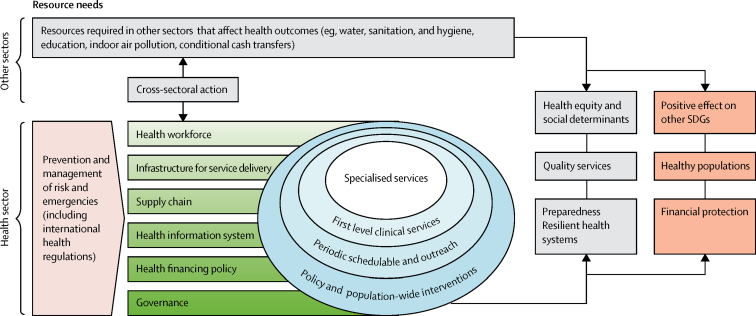
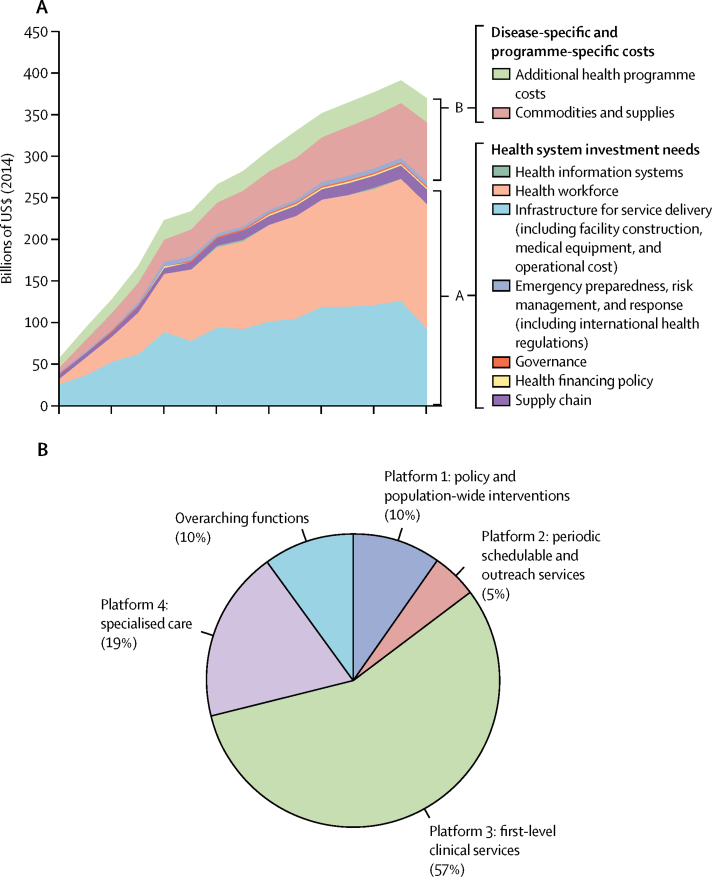
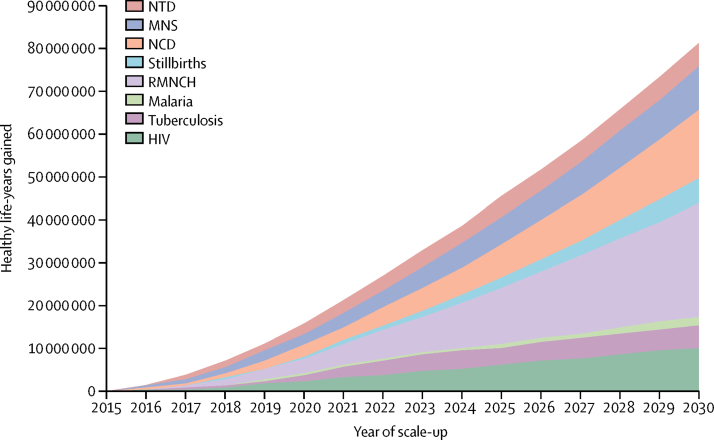
BACKGROUND: The ambitious development agenda of the Sustainable Development Goals (SDGs) requires substantial investments across several sectors, including for SDG 3 (healthy lives and wellbeing). No estimates of the additional resources needed to strengthen comprehensive health service delivery towards the attainment of SDG 3 and universal health coverage in low-income and middle-income countries have been published. METHODS: We developed a framework for health systems strengthening, within which population-level and individual-level health service coverage is gradually scaled up over time. We developed projections for 67 low-income and middle-income countries from 2016 to 2030, representing 95% of the total population in low-income and middle-income countries. We considered four service delivery platforms, and modelled two scenarios with differing levels of ambition: a progress scenario, in which countries' advancement towards global targets is constrained by their health system's assumed absorptive capacity, and an ambitious scenario, in which most countries attain the global targets. We estimated the associated costs and health effects, including reduced prevalence of illness, lives saved, and increases in life expectancy. We projected available funding by country and year, taking into account economic growth and anticipated allocation towards the health sector, to allow for an analysis of affordability and financial sustainability. FINDINGS: We estimate that an additional $274 billion spending on health is needed per year by 2030 to make progress towards the SDG 3 targets (progress scenario), whereas US$371 billion would be needed to reach health system targets in the ambitious scenario-the equivalent of an additional $41 (range 15-102) or $58 (22-167) per person, respectively, by the final years of scale-up. In the ambitious scenario, total health-care spending would increase to a population-weighted mean of $271 per person (range 74-984) across country contexts, and the share of gross domestic product spent on health would increase to a mean of 7·5% (2·1-20·5). Around 75% of costs are for health systems, with health workforce and infrastructure (including medical equipment) as the main cost drivers. Despite projected increases in health spending, a financing gap of $20-54 billion per year is projected. Should funds be made available and used as planned, the ambitious scenario would save 97 million lives and significantly increase life expectancy by 3·1-8·4 years, depending on the country profile. INTERPRETATION: All countries will need to strengthen investments in health systems to expand service provision in order to reach SDG 3 health targets, but even the poorest can reach some level of universality. In view of anticipated resource constraints, each country will need to prioritise equitably, plan strategically, and cost realistically its own path towards SDG 3 and universal health coverage. FUNDING: WHO.
Overview
The claims and statistics of this paper haven’t been checked yet.
Free: it reads the open-access text and checks the first 5 claims that cite a source we can check. Create a free account to check every claim.
Integrity signals
Registry
Cites
Statistics
Figures
Verification
Claims the paper makes
The claims and statistics of this paper haven’t been checked yet.
Free: it reads the open-access text and checks the first 5 claims that cite a source we can check. Create a free account to check every claim.
Claims other papers make about this one
Each is checked against this paper’s own text: does it say what the citing paper says it does?
The source backs part of the claim, not all of it — or backs it for a different population, condition or comparison.
In the citing paper
“Nationally and globally, there exist profound differences in health outcomes, the socioeconomic determinants of health, and the availability and affordability of quality health services.”
From The legal determinants of health: harnessing the power of law for global health and sustainable development (2019) · cites this paper as [119]
Experimental — accuracy not yet measuredThe source backs part of the claim, not all of it — or backs it for a different population, condition or comparison.
In the citing paper
“These inequities occur both between countries (healthy life expectancy is 44·4 years in Sierra Leone, compared with 74·9 in Japan)119 and within countries (ethnicity, geography, and socio-economic status can greatly reduce the accessibility and quality of health care).120”
From The legal determinants of health: harnessing the power of law for global health and sustainable development (2019) · cites this paper as [119]
Experimental — accuracy not yet measuredThe cited source says what the claim attributes to it.
In the citing paper
“Previous studies have assessed the mortality impact of interventions like these in diverse country settings.125,127”
From Global health 2050: the path to halving premature death by mid-century (2024) · cites this paper as [127]
In the citing paper
“Low-income and middle-income countries do need to devote a higher percentage of their gross domestic product (GDP) into health systems, but still might be unable to afford the estimated US$86 per capita (2012) required for UHC, and $112 per capita (2014) to achieve the health SDG.146, 147”
From The legal determinants of health: harnessing the power of law for global health and sustainable development (2019) · cites this paper as [147]
Self-check
Percentages, sums and reported differences re-computed from the paper’s own numbers.
The self-check needs the paper’s full text.
Citations
Cites
Transforming Our World: The 2030 Agenda for Sustainable Development
(2018) · A New Era in Global Health · doi:10.1891/9780826190123.ap02 · Cited by 19,351
Stowman, K. (1949) · The Milbank Memorial Fund Quarterly · doi:10.2307/3348165 · Cited by 2,096
Health systems financing and the path to universal coverage
Evans, D. B., & Etienne, C. (2010) · Bulletin of the World Health Organization · doi:10.2471/blt.10.078741 · Cited by 1,279
Global health 2035: a world converging within a generation
Jamison, D. T., Summers, L. H., Alleyne, G., Arrow, K. J., Berkley, S., Binagwaho, A., Bustreo, F., Evans, D., Feachem, R. G. A., Frenk, J., et al. (2013) · The Lancet · doi:10.1016/s0140-6736(13)62105-4 · Cited by 1,220
Self-citationProtecting Households From Catastrophic Health Spending
Xu, K., Evans, D. B., Carrin, G., Aguilar-Rivera, A. M., Musgrove, P., & Evans, T. (2007) · Health Affairs · doi:10.1377/hlthaff.26.4.972 · Cited by 1,071
[Global health 2035: a world converging within a generation].
Jamison, D. T. T., Summers, L. H., Alleyne, G. A. O., Arrow, K. J., Berkley, S., Binagwaho, A., Bustreo, F., Evans, D., Feachem, R. G., Frenk, J. M., et al. (2015) · PubMed · Cited by 944
Self-citationGlobal technical strategy for malaria 2016–2030
Alonso, P. L., Noor, A., Santelli, A. C. F. E. S., Ghani, A. C., de Quadrós, C. A., Karema, C., Gao, Q., Baird, J. K., Conteh, L., Gyapong, M., et al. (2015) · ResearchOnline at James Cook University (James Cook University) · Cited by 853
Hutton, G., & Varughese, M. (2016) · World Bank, Washington, DC eBooks · doi:10.1596/k8543 · Cited by 370
Stenberg, K., Axelson, H., Sheehan, P., Anderson, I., Gülmezoglu, A. M., Temmerman, M., Mason, E., Friedman, H. S., Bhutta, Z. A., Lawn, J. E., et al. (2014) · The Lancet · doi:10.1016/s0140-6736(13)62231-x · Cited by 355
Self-citationStover, J., Bollinger, L., Izazola, J. A., Loures, L., DeLay, P., Ghys, P. D., & Fast Track modeling working group (2016) · PLOS ONE · doi:10.1371/journal.pone.0154893 · Cited by 229 · cited 1×
“26 Stover et al, 2016.”
Self-citation
Research works printed but not linked: 1
- UN Department of Economic and Social Affairs Addis Ababa Action Agenda of the Third International Conference on Financing for Development http://www.un.org/esa/ffd/wp-content/uploads/2015/08/AAAA_Outcome.pdf (accessed Nov 1, 2016).
Cited by
Items 201–300 of 601
Piatti-Fünfkirchen, M., & Smets, L. (2019) · doi:10.18235/0001561 · Cited by 18
“Progress toward achieving universal health coverage and the Sustainable Development Goal (SDG) of ‘ensuring healthy lives and promoting well-being for all at all ages’ will require significant additional resources to the sector, estimated at approximately US$371 billion globally by 2030 (Stenberg et al., 2017).”
BackgroundMenezes, C. M., Tucci, C., Tamai, K., Chhabra, H. S., AlHelal, F. H., Bussières, A., Muehlbauer, E. J., Roberts, L. C., Alsobayel, H., Barneschi, G., et al. (2024) · Global Spine Journal · doi:10.1177/21925682241290226 · Cited by 18
Universal health coverage and key populations
Macdonald, V., Verster, A., Seale, A., Baggaley, R. C., & Ball, A. (2019) · Current Opinion in HIV and AIDS · doi:10.1097/coh.0000000000000570 · Cited by 17
“In general, external funding for vertical programmes is decreasing and current projections indicate funding may be inadequate to reach future targets [15].”
BackgroundChou, V. B., Bubb-Humfryes, O., Sanders, R., Walker, N., Stover, J., Cochrane, T., Stegmuller, A. R., Magalona, S., von Drehle, C., Walker, D. G., et al. (2018) · BMJ Global Health · doi:10.1136/bmjgh-2018-001126 · Cited by 18
Self-citationDınçer, H., Uzunkaya, S. Ş., & Yüksel, S. (2019) · International Journal of Computational Intelligence Systems · doi:10.2991/ijcis.d.190312.001 · Cited by 16
King, J., Powell‐Jackson, T., Makungu, C., Hargreaves, J., & Goodman, C. A. (2021) · Health Policy and Planning · doi:10.1093/heapol/czab039 · Cited by 16
Health and Healthcare Delivery in Zimbabwe: Past and Present
Chipunza, T., & Nhamo, S. (2023) · Advances in African economic, social and political development · doi:10.1007/978-3-031-30541-2_10 · Cited by 16
Yigezu, A., Misganaw, A., Getnet, F., Berheto, T. M., Walker, A., Zergaw, A., Gobena, F. A., Argaw, M., Hailu, A., Memirie, S. T., et al. (2023) · BMJ Open · doi:10.1136/bmjopen-2022-068498 · Cited by 16
The economic value of reducing avoidable mortality
Chang, A. Y., Stevens, G. A., Cardoso, D. S., Cao, B., & Jamison, D. T. T. (2024) · Nature Medicine · doi:10.1038/s41591-024-03253-7 · Cited by 16
“21).”
Kirigia, J. M., Muthuri, R. N. D. K., & Muthuri, N. G. (2019) · BMC Public Health · doi:10.1186/s12889-019-7542-2 · Cited by 16
Laar, A. S., Asare, M., & Dalinjong, P. A. (2021) · Cost Effectiveness and Resource Allocation · doi:10.1186/s12962-021-00323-2 · Cited by 16
Michalopoulos, C. (2022) · Springer eBooks · doi:10.1007/978-3-030-96036-0_10 · Cited by 16
Bozzani, F. M., Vassall, A., & Gomez, G. B. (2021) · Epidemics · doi:10.1016/j.epidem.2021.100450 · Cited by 16
Gaudin, S., Raza, W., Skordis, J., Soucat, A. L. B., Stenberg, K., & Alwan, A. (2023) · BMJ Global Health · doi:10.1136/bmjgh-2022-010735 · Cited by 16
“21 The potential for miscalculating the real cost of implementation is thus very significant.”
Self-citationCytopathology in Low Medical Infrastructure Countries
Field, A. S. (2018) · Clinics in Laboratory Medicine · doi:10.1016/j.cll.2017.10.014 · Cited by 15
The Problem of Private Health Insurance: Insights from Middle-Income Countries
Murray, S. F. (2024) · Cambridge University Press eBooks · doi:10.1017/9781009208178 · Cited by 15
Chukwuma, J. N., Romero, M. J., & Waeyenberge, E. V. (2025) · Review of Evolutionary Political Economy · doi:10.1007/s43253-024-00140-2 · Cited by 15
The Monetary Value of Disability-Adjusted-Life-Years Lost in the East African Community in 2015
Kirigia, J. M., & Mwabu, G. M. (2018) · Modern Economy · doi:10.4236/me.2018.97087 · Cited by 15
“The per capita total expenditure on health for EAC countries is between US$22 and US$78 [5]; which is far much lower than US$ 112 to US$ 146 per person per year recommended for achieving United Nations Sustainable Development Goal 3 (SDG3) on health [6].”
BackgroundHalasa‐Rappel, Y. A., Fardous, T., Jrasat, M., Al-Halaseh, I., Abu-Shaer, M., Hijazeen, R., & Shepard, D. S. (2020) · Eastern Mediterranean Health Journal · doi:10.26719/2020.26.2.206 · Cited by 15
Lapinskaitė, I., Skvarciany, V., & Janulevičius, P. (2020) · Sustainability · doi:10.3390/su12062421 · Cited by 15
“In order to reach SDG health targets, scientists analyzed the way to strengthen the investment for a country’s health systems [9,10].”
BackgroundGong, H., Wu, W., Li, J., Wu, B., Gao, M., & Yang, Y. (2025) · Frontiers in Public Health · doi:10.3389/fpubh.2025.1591358 · Cited by 14
Binyaruka, P., Kuwawenaruwa, A., Ally, M., Piatti, M., & Mtei, G. (2021) · BMJ Open · doi:10.1136/bmjopen-2020-045807 · Cited by 15
Kelly, S. L., Walsh, T., Delport, D., Brink, D. T., Martin‐Hughes, R., Homer, C., Butler, J. A., Adedeji, O., Beni, D. D., Maurizio, F., et al. (2021) · BMJ Global Health · doi:10.1136/bmjgh-2022-010018 · Cited by 15
Rosemberg, N., & Cotlear, D. (2018) · World Bank, Washington, DC eBooks · doi:10.1596/29177 · Cited by 14
Kirigia, J. M., Muthuri, R. N. D. K., & Muthuri, N. G. (2020) · Healthcare · doi:10.3390/healthcare8020084 · Cited by 17
Perspectives and Theories of Social Innovation for Ageing Population
Klimczuk, A., & Tomczyk, Ł. (2020) · Frontiers research topics · doi:10.3389/978-2-88963-620-4 · Cited by 15
Economic evaluation and health systems strengthening: a review of the literature
Cleary, S. (2020) · Health Policy and Planning · doi:10.1093/heapol/czaa116 · Cited by 14
Cohn, J., Kostova, D., Moran, A. E., Cobb, L. K., Pathni, A. K., & Bisrat, D. (2021) · Journal of Human Hypertension · doi:10.1038/s41371-021-00583-8 · Cited by 14
SDG 3 and financing instruments in Austria and Ukraine: Challenges and perspectives
Situm, M., Plastun, A., Макаренко, І., Serpeninova, Y., & Sorrentino, G. (2021) · Problems and Perspectives in Management · doi:10.21511/ppm.19(3).2021.11 · Cited by 15
“Stenberg et al. (2017) stated that all countries need to strengthen investments in healthcare through prioritizing equitably, strategic planning to implement a national path towards SDG 3 goals achievement.”
BackgroundMohamed, I. S., Hepburn, J. S., Ekman, B., & Sundewall, J. (2022) · Health Systems & Reform · doi:10.1080/23288604.2021.2006587 · Cited by 14
“” This study focuses on the primary health care (PHC) level because achieving UHC is contingent on prioritizing investments in PHC(1) and most resources will be needed to support services at this level.(17) As such, EPHSs concerning only PHC or all levels of care were collected.”
BackgroundSaha, A., Mishra, A. R., Rani, P., Deveci, M., Debnath, B. K., Jamil, N., & Mahmoud, M. A. (2024) · Environmental Science & Policy · doi:10.1016/j.envsci.2024.103913 · Cited by 13
Adegoke, Y. O., Mbonigaba, J., & George, G. (2025) · International Journal of Environmental Research and Public Health · doi:10.3390/ijerph22040482 · Cited by 13
“Although the United Nations (UN) target for maternal mortality is 70 deaths per 100,000 births and 25 deaths per 1000 live births for child mortality by 2030 [2], countries in SSA have much higher rates because of limited public health expenditure (PHE) [3–5].”
Global health trajectories: analysis of health production functions and inequality decomposition
Sethy, M., Mahapatro, S. R., Mishra, U. S., & Mundu, G. B. (2026) · Frontiers in Public Health · doi:10.3389/fpubh.2026.1811111 · Cited by 13
“The binding constraint is not fiscal but political: the willingness to increase domestic revenue mobilization, reallocate budget shares toward health, expand mandatory pre-payment systems, and implement pro-poor targeting mechanisms (20).”
Banke-Thomas, A. O., Abejirinde, I. O., Banke-Thomas, O., Maikano, A., & Ameh, C. (2019) · BMJ Open · doi:10.1136/bmjopen-2018-027822 · Cited by 13
“In searching the various databases, and where relevant, we will combine medical subject headings and/or keywords, using Boolean linkages ‘OR’ within categories and ‘AND’ between three groups of words and phrases that capture the interventions, costs and the setting of interest—LMICs.”
InfluentialEpilogue: Randomization and Social Policy Evaluation Revisited
Heckman, J. J. (2020) · Oxford University Press eBooks · doi:10.1093/oso/9780198865360.003.0014 · Cited by 13
Waran, V., Thillainathan, R., Karuppiah, R., & Pickard, J. D. (2021) · World Neurosurgery · doi:10.1016/j.wneu.2021.10.112 · Cited by 13
Inglesi‐Lotz, R., Kuziboev, B., Ibragimov, J., Xushnudbekovich, R. A., Liu, J., & Abdullaev, F. O. (2024) · International Journal of Energy Economics and Policy · doi:10.32479/ijeep.15934 · Cited by 13
Lince-Deroche, N., Sully, E., Firestein, L., & Riley, T. (2020) · Sexual and Reproductive Health Matters · doi:10.1080/26410397.2020.1779631 · Cited by 13
Global Health in the Age of COVID-19: Responsive Health Systems Through a Right to Health Fund.
Friedman, E., Gostin, L. O., Maleche, A. A., Nilo, A., Foguito, F., Rugege, U., Stevenson, S., Gitahi, G., Ruano, A. L., Barry, M., et al. (2020) · PubMed · Cited by 13
Afriyie, D. O., Muhongerwa, D. K., Nabyonga‐Orem, J., & Chukwujekwu, O. (2025) · Journal of Global Health · doi:10.7189/jogh.15.04233 · Cited by 12
Weapons, wealth, and health: the arms industry as a commercial determinant of health
Bellis, M. A., Jones, L., Tucker, J., Muggah, R., Hughes, K. E., Ford, K., Smith, E., & Feder, G. S. (2025) · BMJ · doi:10.1136/bmj-2025-086166 · Cited by 12
“38 Many countries are facing difficult funding choices in the context of greater healthcare demand and increasing pressure to build military capabilities, all against a challenging economic backdrop in which the arms industry has a significant role in shaping national defence agendas.”
Gearing health systems for universal health coverage
Cerf, M. E. (2023) · Frontiers in Health Services · doi:10.3389/frhs.2023.1200238 · Cited by 12
Building a Workforce for Future Health Systems: Reflections from Health Policy and Systems Research
Javadi, D., Tran, N. T., & Ghaffar, A. (2018) · Health Services Research · doi:10.1111/1475-6773.12978 · Cited by 12
Gowran, R. J., Goldberg, M. R., Comanescu, G. M., Ungureanu, C., Garcia, F. D. S., Xavier, C. A., & Pearlman, J. L. (2019) · Disability and Rehabilitation Assistive Technology · doi:10.1080/17483107.2018.1539131 · Cited by 12
“In addition, Stenberg et al’s [11] paper highlight the importance of investing in transformative health system infrastructure, towards the achievement of the health SDGs, presenting a model for projected resource needs in 67 lowincome and middle-income countries.”
BackgroundReid, M. J. A., Roberts, G., Goosby, E., & Wesson, P. (2019) · PLoS ONE · doi:10.1371/journal.pone.0223559 · Cited by 12
“[4, 15] To achieve this, the pathway to UHC needs to be a publicly financed approach that covers those core health services that directly benefit people living in poverty [3,16] and TB care and prevention functions must be prioritized within essential service packages.”
BackgroundGibson, A., Noguchi, L., Kinney, M. V., Blencowe, H. K., Freedman, L. P., Mofokeng, T., Chopra, M., Dube, Q., Ntirushwa, D., Nguku, A., et al. (2021) · Global Health Science and Practice · doi:10.9745/ghsp-d-20-00575 · Cited by 13
“Considering the multiple categories of SDG financing, both public and private domestic and international funds, multiple paths must be explored to address the finance gaps.(32) Uncoordinated approaches to funding and limited ability to track resources are potential barriers to more rapid acceleration of achievements i…”
Background50 years of Broken Promises: The $5.7 trillion debt owed to the poorest people
Seery, E. (2020) · doi:10.21201/2020.6737 · Cited by 12
IMF Social Spending Floors: A fig leaf for austerity?
Kentikelenis, A., & Stubbs, T. (2023) · doi:10.21201/2023.621495 · Cited by 12
Abdullah, N., Ayob, M. B., Lam, M. C., Sabar, N. R., Kendall, G., & Razali, M. K. M. (2024) · IEEE Access · doi:10.1109/access.2024.3524599 · Cited by 11
“The achievement of Sustainable Development Goal 3 (SDG 3) requires substantial additional healthcare investment by 2030, estimated between $274 billion and $371 billion annually [1].”
Lee, C. T., Katz, R., Eaneff, S., Mahar, M., & Ojo, O. E. (2020) · Health Security · doi:10.1089/hs.2019.0063 · Cited by 11
Big Data and Artificial Intelligence for Global Health: Ethical Challenges and Opportunities
Vayena, E., & Ferretti, A. (2021) · Cambridge University Press eBooks · doi:10.1017/9781108692137.036 · Cited by 12
Mahdavi, M., & Sajadi, H. S. (2021) · BMC Health Services Research · doi:10.1186/s12913-021-06985-1 · Cited by 11
“Countries need to know where they stand in their paths toward UHC, prioritize equitability, plan strategically, and spend realistically [3, 4].”
BackgroundCancedda, C., Binagwaho, A., & Kerry, V. B. (2018) · BMJ Global Health · doi:10.1136/bmjgh-2018-001067 · Cited by 11
“for global health has plateaued over the past 3 years despite the fact that there is currently an estimated gap of US$20–50 billion per year needed to achieve SDG3 in 67 low-income and middle-income countries.(6) A series of additional trends are contributing to an evolving funding environment, which academic institut…”
BackgroundHeikel, J. (2020) · theses.fr (ABES) · doi:10.70675/58a55b64z80d3z4f52zb898z01353d8f7423 · Cited by 11
Mapping inequities in global vaccine sentiment research
Balsamo, D., Offeddu, V., Aghamohammadi, Z., Chiavenna, C., Leone, L. P., D’Agnese, E., Sharma, D., Torbica, A., Shayegh, S., Andreu-Pérez, J., et al. (2025) · BMJ Global Health · doi:10.1136/bmjgh-2024-018587 · Cited by 10
Nwankwor, O., Okoronkwo, I., Enebeli, U. U., Ogbonna, U. G., & Okechukwu Kalu, I. R. O. (2020) · European Scientific Journal ESJ · doi:10.19044/esj.2020.v16n15p148 · Cited by 10
Hepburn, J. S., Mohamed, I. S., Ekman, B., & Sundewall, J. (2021) · Sexual and Reproductive Health Matters · doi:10.1080/26410397.2021.1985826 · Cited by 10
“Similar to a study by Stenberg et al.15 we included all 31 countries classified as LICs and the 20 most populous LMICs in the study population.”
BackgroundMethodResultInfluentialHIV: from exceptionalism to endgame
Sands, P. (2018) · The Lancet · doi:10.1016/s0140-6736(18)31434-x · Cited by 10
“6 We must rediscover the energy and global solidarity that inspired the exceptionalism of the HIV response, expanding its reach to encompass SDG3.”
BackgroundRoad to family planning and RMNCHN related SDGs: Tracing the role of public health spending in India
Goli, S., Moradhvaj, James, K. S., Singh, D., & Srinivasan, V. (2020) · Global Public Health · doi:10.1080/17441692.2020.1809692 · Cited by 10
Health sector funding in Ghana: The effect of IMF conditionalities
Boachie, M. K., Agyemang, J. K., & Immurana, M. (2022) · Dialogues in Health · doi:10.1016/j.dialog.2022.100045 · Cited by 9
“To achieve the health-related Sustainable Development Goals(SDGs),there is growing interest in organising resources from all possible sources hence the interest in stimulating domestic revenue mobilisation for health in low-and middle-income countries in the presence of declining aid fl ows [8,9].”
BackgroundYang, J., Feng, X., Zhou, S., Zhang, L., Hu, Y., Chen, Y., Zhang, Z., & Xu, M. (2023) · Global Health Research and Policy · doi:10.1186/s41256-023-00310-5 · Cited by 9
“Despite tremendous progress in global health financing, an additional $274 billion spending on health is needed per year by 2030 to make progress towards the Sustainable Development Goal 3 (progress scenario), whereas US$371 billion would be needed to reach health system targets in the ambitious scenario [4].”
BackgroundDesafios da cobertura vacinal no Brasil: fake news e desigualdades
da Silva, T. M. R., & de Sá, A. C. M. G. N. (2024) · doi:10.29327/5389264.1-7 · Cited by 9
Pienkowska, A., Ravaut, M., Mammadova, M., Ang, C., Wang, H., Ong, Q. C., Bojić, I., Qin, V. M., Sumsuzzman, D. M., Ajuebor, O., et al. (2024) · JMIR Formative Research · doi:10.2196/53574 · Cited by 9
(2024) · International Journal of Advanced Computer Research · doi:10.19101/ijacr.2023.1362017 · Cited by 9
“These contexts and their various administrative structures deal with several topics that scholars have long examined [37].”
Objective-Oriented Health Systems Reform
Kutzin, J., Sparkes, S. P., Earle, A. J., Gatome-Munyua, A., & Ravishankar, N. (2024) · Health Systems & Reform · doi:10.1080/23288604.2024.2428415 · Cited by 9
Ethnomedicianal Profile of Flora of District Sialkot, Punjab, Pakistan.
Noreen, F., Choudri, M., Noureen, S., Adil, M., Yaqoob, M., Mustafa, A. G., Cheema, F., Sajjad, F., & Mushtaq, U. (2020) · New Trends in Medicine Sciences · Cited by 9
İLASLAN, N., & ÇAKAR, M. (2021) · Turkiye Klinikleri Journal of Nursing Sciences · doi:10.5336/nurses.2020-79658 · Cited by 10
Watkins, D., Ahmed, S., & Pickersgill, S. J. (2023) · Journal of Benefit-Cost Analysis · doi:10.1017/bca.2023.25 · Cited by 9
“It is possible that other interventions outside the DCP3 or WHO lists might represent “ best investments ” in some countries with unique disease burdens or health system features; however, we believe our list is comprehensive from a global standpoint.”
InfluentialIslam, M. N., Rabbani, A., & Sarker, M. (2019) · Health Economics Review · doi:10.1186/s13561-019-0249-3 · Cited by 9
Delays in Achieving Maternal, Newborn, and Child Health Targets for 2021 and 2030 in Liberia
Laaser, U., Broniatowski, R., Byepu, S., & Bjegovic-Mikanovic, V. M. (2019) · Frontiers in Public Health · doi:10.3389/fpubh.2019.00386 · Cited by 9
Breaking Specialty Silos: Improving Global Child Health Through Essential Surgical Care
Wasserman, I., Peters, A. W., Roa, L., Amanullah, F., & Samad, L. (2020) · Global Health Science and Practice · doi:10.9745/ghsp-d-20-00009 · Cited by 9
The Monetary Value of Disability-Adjusted Life Years in Kenya in 2017
Muthuri, R. N. D. K., & Kirigia, J. M. (2020) · SAGE Open · doi:10.1177/2158244020970556 · Cited by 9
Hatchard, J. L., Buykx, P., Wilson, L. B., Brennan, A., & Gillespie, D. (2023) · International Journal of Drug Policy · doi:10.1016/j.drugpo.2023.104247 · Cited by 8
Benefits and Costs of Debt: The Dose Makes the Poison
Köse, M. A., Nagle, P., Ohnsorge, F. L., & Sugawara, N. (2021) · World Bank, Washington, DC eBooks · doi:10.1596/978-1-4648-1544-7_ch2 · Cited by 8
Qi, F., & Wang, Q. (2020) · Risk Management and Healthcare Policy · doi:10.2147/rmhp.s273685 · Cited by 8
Spatial Assessment of COVID-19 First-Wave Mortality Risk in the Global South
Mansour, S., Abulibdeh, A. O., Alahmadi, M., & Ramadan, E. (2022) · The Professional Geographer · doi:10.1080/00330124.2021.2009888 · Cited by 8
“The United Nations (UN) identified “Ensure healthy lives and promote well-being for all at all ages” as the third of its Sustainable Development Goals (SDGs) to be reached by 2030, with the aim of improving the health of millions of people across the globe (WHO 2015; Stenberg et al. 2017).”
BackgroundInfluentialPublic mental health: An opportunity to address implementation failure
Campion, J., Javed, A., Saxena, S., & Sharan, P. (2022) · Indian Journal of Psychiatry · doi:10.4103/indianjpsychiatry.indianjpsychiatry_87_22 · Cited by 8
“[24,34] Governments have the lead responsibility for their population’s health although can work with other organizations including the United Nations (WHO, 2021b) [35] • Coordination between providers of different PMH interventions.”
A pandemic triad: HIV, COVID-19 and debt in low- and middle-income countries
Birungi, C., Azcona, J. A., & Munevar, D. (2022) · African Journal of AIDS Research · doi:10.2989/16085906.2022.2104168 · Cited by 8
“3% of GDP required to achieve the third sustainable development goal by 2030 in low-income countries (Stenberg et al., 2017).”
BackgroundInfluentialReliability and validity of an innovative high performing healthcare system assessment tool
Aqil, A., Saldaña, K., Mian, N. U., & Ndu, M. N. (2023) · BMC Health Services Research · doi:10.1186/s12913-022-08852-z · Cited by 8
Divergence of healthcare expenditure in sub-Saharan Africa
Jeetoo, J., & Jaunky, V. C. (2023) · Studies in Economics and Econometrics · doi:10.1080/03796205.2023.2185664 · Cited by 8
“Stenberg et al. (2017) estimate that among 67 low-income countries and middle-income countries - representing 95% of the population of all low-income countries and middle-income countries—the annual financing gap to reach the SDG health targets is more than $370 billion.”
BackgroundProbst, L. F., Cavalcante, D. D. F. B., Vanni, T., da Silva, É. T., & Pereira, A. C. (2020) · Jornal Brasileiro de Economia da Saúde · doi:10.21115/jbes.v12.n1.p88-91 · Cited by 8
“Added to this, priority setting in the allocation of public resources is always a political issue, and in this sense, it is necessary to strengthen rationality relative to investments in health systems and stimulate adequate expansion in the provision of services (Stenberg et al., 2017).”
BackgroundKirigia, J. M., Muthuri, R. N. D. K., & Muthuri, N. G. (2020) · doi:10.21203/rs.3.rs-24711/v1 · Cited by 8
Kadiyala, S., Richter, L., Kulkarni, B., Chitaya, A., & Fry, H. A. H. (2024) · BMJ · doi:10.1136/bmj.q1874 · Cited by 8
Nie, J., & Fitzgerald, R. P. (2021) · Cambridge University Press eBooks · doi:10.1017/9781108692137.027 · Cited by 7
Sustainable ophthalmology: an overview of concepts and practices
Maheshwari, A., Dave, V. P., de Ribot, F. M., Romano, M. R., Arévalo, J. F., Özdek, Ş., Chang, A., Ruamviboonsuk, P., Pappuru, R. R., Fernandes, M., et al. (2025) · Eye · doi:10.1038/s41433-025-03999-5 · Cited by 7
“It has been estimated that an additional 372 billion US dollars would need to be invested every year in 67 low-resource regions to meet SDG targets of universal health coverage [69].”
van de Klundert, J. J., de Vries, H., Pérez-Galarce, F., Valdés, N., & Simon, F. (2025) · Frontiers in Health Services · doi:10.3389/frhs.2025.1545864 · Cited by 7
Pecuniary Value of Disability-Adjusted-Life-Years in the Arab Maghreb Union in 2015
Muthuri, R. N. D. K., Muthuri, N. G., & Kirigia, J. M. (2018) · Journal of Human Resource and Sustainability Studies · doi:10.4236/jhrss.2018.64041 · Cited by 7
“The per capita total expenditure on health for AMU countries is between US$49 and US$372 [4], which falls short of the US$ 146 (lower-middle income) to US$ 536 (upper-middle income) per person per year health systems investment recommended for achieving health sustainable development goal (SDG) 3 [5].”
BackgroundEbuenyi, I. D., Regeer, B. J., Aguocha, C., Bunders, J., & Guxens, M. (2020) · International Journal of Mental Health Systems · doi:10.1186/s13033-020-00354-x · Cited by 7
Feinstein, A., & Choonara, I. (2020) · BMJ Paediatrics Open · doi:10.1136/bmjpo-2020-000809 · Cited by 7
Estimating the SDGs' Demand for InnovationPreprint
Kenny, C. J., & Patel, D. (2017) · SSRN Electronic Journal · doi:10.2139/ssrn.3062920 · Cited by 7
“Such exercises include Stenberg et al. (2016), Hutton and Varughese (2016), Chongcharoentanawat et al. (2016), Greenhill et al. (2015), and United Nations General Assembly (2014).”
BackgroundHatefi, A., & Allen, L. N. (2018) · Journal of Epidemiology & Community Health · doi:10.1136/jech-2018-210605 · Cited by 7
McGuire, F., Mohan, S., Rao, M., Nabyonga‐Orem, J., Nundoochan, A., Sombié, I., Kataika, E., Bland, S., & Revill, P. A. (2025) · SSM - Health Systems · doi:10.1016/j.ssmhs.2025.100104 · Cited by 7
IMF Engagement on Health Spending Issues in Surveillance and Program Work
Soto, M., Palomba, G., Bloch, C., Carroll, N., Atashbar, T., Kale, D., Shang, B., Tokuoka, K., de Mooij, R., & Chabert, G. (2023) · Technical Notes and Manuals · doi:10.5089/9798400258732.005 · Cited by 6
Saxenian, H., Bharali, I., Ogbuoji, O., & Yamey, G. (2019) · Gates Open Research · doi:10.12688/gatesopenres.12900.2 · Cited by 6
Noncommunicable disease outcomes and the effects of vertical and horizontal health aid
Kostova, D., Nugent, R. A., & Richter, P. (2020) · Economics & Human Biology · doi:10.1016/j.ehb.2020.100935 · Cited by 6
Tsagkaris, C., Nikolakea, M., Laskaratou, E. D., Samaras, C., Huang, H. Y. R., Laubscher, L., & Bobirca, A. V. (2023) · The International Journal of Health Planning and Management · doi:10.1002/hpm.3617 · Cited by 6
Needed: a financing breakthrough at the UN High-level Meeting on Universal Health Coverage
Sachs, J. D., & Perry, H. B. (2023) · The Lancet · doi:10.1016/s0140-6736(23)01924-4 · Cited by 6
Lateef, A., & Mhlongo, E. M. (2021) · Open Journal of Nursing · doi:10.4236/ojn.2021.119065 · Cited by 6
Integrating family planning into universal health coverage efforts.
Jeanna, H., & Sarker, I. (2018) · Cited by 6
Nkwanyana, N. M., & Voce, A. S. (2019) · BMC Health Services Research · doi:10.1186/s12913-019-4583-2 · Cited by 6
Metadata
- Authors
- Stenberg, K., Hanssen, O., Edejer, T. T.-T., Bertram, M., Brindley, C., Meshreky, A., Rosen, J. E., Stover, J., Verboom, P., Sanders, R., & Soucat, A.
- Affiliations
- World Health Organization (CH)
- Avenir Health (US)
- Corresponding author
- Stenberg, Karin
- ORCID
- Venue
- The Lancet Global Health
- Publisher
- Elsevier BV
- Published
- 2017-09
- Volume
- 5
- Issue
- 9
- Pages
- e875-e887
- ISSN
- 2214-109X (ISSN-L)
- PMC
- PMC5554796
- OpenAlex
- W2734373255
- Semantic Scholar
- 2ff55615c03b67f85cf3a01aaff1dfce3a937745
- Cited by
- 506
- References
- 24
- Citations by year
- 2026: 30 · 2025: 25 · 2024: 52 · 2023: 36 · 2022: 58 · 2021: 90 · 2020: 84 · 2019: 68 · 2018: 45 · 2017: 14
- FWCI
- 84.07
- Type
- journal article
- Language
- en
- Open access
- gold
- doi.org
- Licence
- cc-by
- www.elsevier.com/tdm/userlicense/1.0/ (tdm)
- creativecommons.org/licenses/by/3.0/igo/ (vor)
- Locations
- The Lancet Global Health (publishedVersion, cc-by)
- Europe PMC (PubMed Central) (publishedVersion, cc-by)
- PubMed Central (publishedVersion, cc-by)
- PubMed (publishedVersion)
- Bushehr University of Medical Sciences Repository (Bushehr University of Medical Sciences) (acceptedVersion)
- DOAJ (DOAJ: Directory of Open Access Journals) (submittedVersion, cc-by-sa)
- Funders
- United States Agency for International Development
- GAVI Alliance
- World Bank Group
- World Health Organization
- Inter-American Development Bank
- UNICEF
- Johns Hopkins University
- Georgetown University
- Queen Margaret University
- Topics
- Health Sciences › Medicine › Public Health, Environmental and Occupational Health › Healthcare Systems and Reforms
- Social Sciences › Economics, Econometrics and Finance › Economics and Econometrics › Global Health Care Issues
- Health Sciences › Medicine › Public Health, Environmental and Occupational Health › Healthcare Systems and Practices
- Keywords
- health care financing, Sustainable Development Goal 3, health system strengthening, financing gap, universal health coverage, low- and middle-income countries, healthcare workers, health infrastructure, lives saved, life expectancy, financial sustainability, health budget allocation
- MeSH terms
- Conservation of Natural Resources, Costs and Cost Analysis, Delivery of Health Care, Developing Countries, Goals, Health Resources, Health Services Needs and Demand, Humans, Models, Theoretical, Universal Health Insurance
About these checks
Registry, retraction, Cites and statistics results are computed, not judged, with one exception: a printed reference that no index lists is read once by a model before it counts as a citation error. Claims are extracted by a model and kept only when their quote appears verbatim in the text; each cited source is then checked, with a model’s help, for whether it says what the claim relies on. Those verdicts can be wrong — read the claim’s quote and the cited source before relying on one.
Statistics and arithmetic are recomputed, not judged.
Confidence bands are shown only for fields calibrated on our annotated test set. None is calibrated yet, so no band is shown.
What counts as a claim ›How we measure confidence ›How we check this ›
Are you an author, or do you see a problem with this page? Request a review
Data sources
Bibliographic data: Semantic Scholar, OpenAlex, Crossref.
Contains information from the Semantic Scholar Academic Graph Datasets, made available under the ODC Attribution License (ODC-BY 1.0).
Semantic Scholar’s data is described in: Kinney, R., et al. (2023). The Semantic Scholar Open Data Platform. arXiv:2301.10140.
