

Potential effect of household contact management on childhood tuberculosis: a mathematical modelling study
Open accessThe DOI matches its Crossref record; 24 of the 24 references it cites were found in a registry or an index.
Abstract
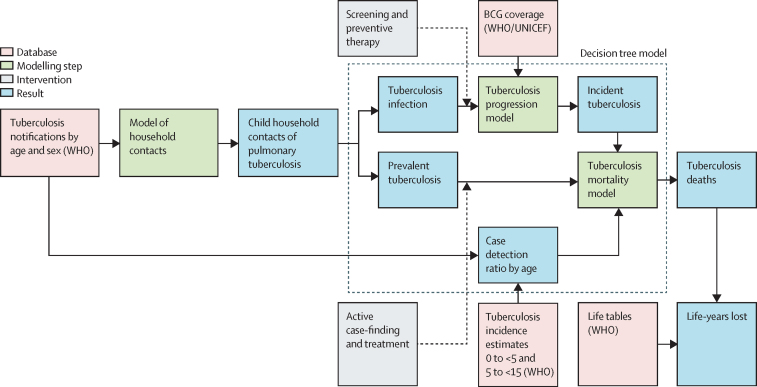
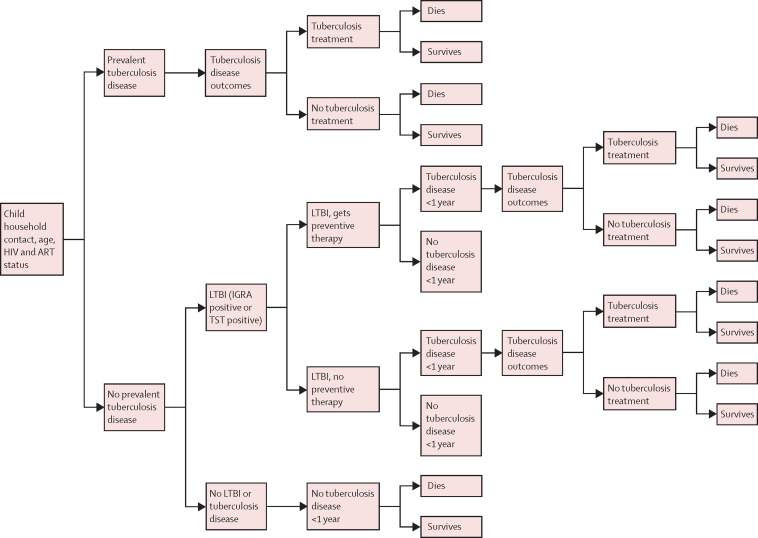
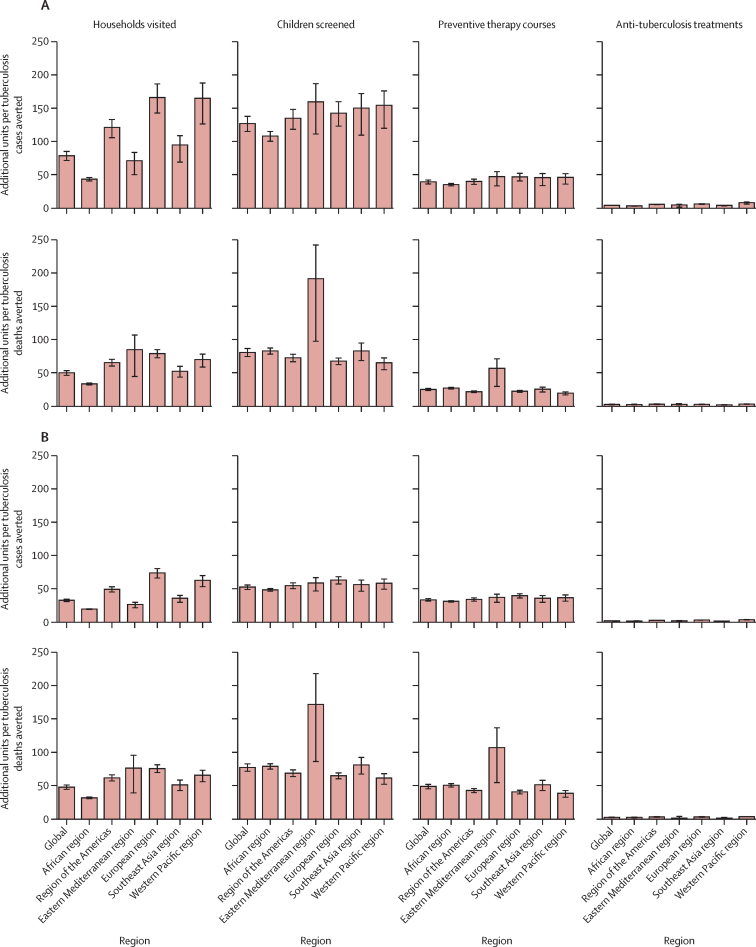
BACKGROUND: Tuberculosis is recognised as a major cause of morbidity and mortality in children, with most cases in children going undiagnosed and resulting in poor outcomes. Household contact management, which aims to identify children with active tuberculosis and to provide preventive therapy for those with HIV or those younger than 5 years, has long been recommended but has very poor coverage globally. New guidelines include widespread provision of preventive therapy to children with a positive tuberculin skin test (TST) who are older than 5 years. METHODS: In this mathematical modelling study, we provide the first global and national estimates of the impact of moving from zero to full coverage of household contact management (with and without preventive therapy for TST-positive children older than 5 years). We assembled data on tuberculosis notifications, household structure, household contact co-prevalence of tuberculosis disease and infection, the efficacy of preventive therapy, and the natural history of childhood tuberculosis. We used a model to estimate households visited, children screened, and treatment courses given for active and latent tuberculosis. We calculated the numbers of tuberculosis cases, deaths, and life-years lost because of tuberculosis for each intervention scenario and country. FINDINGS: We estimated that full implementation of household contact management would prevent 159 500 (75% uncertainty interval [UI] 147 000-170 900) cases of tuberculosis and 108 400 (75% UI 98 800-116 700) deaths in children younger than 15 years (representing the loss of 7 305 000 [75% UI 6 663 000-7 874 000] life-years). We estimated that preventing one child death from tuberculosis would require visiting 48 households, screening 77 children, giving 48 preventive therapy courses, and giving two tuberculosis treatments versus no household contact management. INTERPRETATION: Household contact management could substantially reduce childhood disease and death caused by tuberculosis globally. Funding and research to optimise its implementation should be prioritised. FUNDING: UK Medical Research Council, US National Institutes of Health, Fulbright Commission, Janssen Global Public Health.
Overview
The claims and statistics of this paper haven’t been checked yet.
Free: it reads the open-access text and checks the first 5 claims that cite a source we can check. Create a free account to check every claim.
Integrity signals
Registry
Cites
Statistics
Figures
Verification
Claims the paper makes
The claims and statistics of this paper haven’t been checked yet.
Free: it reads the open-access text and checks the first 5 claims that cite a source we can check. Create a free account to check every claim.
Claims other papers make about this one
Each is checked against this paper’s own text: does it say what the citing paper says it does?
In the citing paper
“integrating effective household contact-tracing programmes63, 64 with community-based strategies (eg, routine or mass screening, targeted preventive therapy, and environmental interventions) will be particularly important for continued progress.”
Self-check
Percentages, sums and reported differences re-computed from the paper’s own numbers.
The self-check needs the paper’s full text.
Citations
Cites
Country-Level Cost-Effectiveness Thresholds: Initial Estimates and the Need for Further Research
Woods, B., Revill, P., Sculpher, M., & Claxton, K. (2016) · Value in Health · doi:10.1016/j.jval.2016.02.017 · Cited by 884
Self-citationMarais, B. J., Gie, R. P., Schaaf, H. S., Hesseling, A. C., Obihara, C. C., Starke, J., Enarson, D. A., Donald, P. R., & Beyers, N. (2004) · PubMed · Cited by 806
A blood RNA signature for tuberculosis disease risk: a prospective cohort study
Zak, D. E., Penn-Nicholson, A., Scriba, T. J., Thompson, E., Suliman, S., Amon, L. M., Mahomed, H., Erasmus, M., Whatney, W., Hussey, G. D., et al. (2016) · The Lancet · doi:10.1016/s0140-6736(15)01316-1 · Cited by 780
Contact investigation for tuberculosis: a systematic review and meta-analysis
Fox, G. J., Barry, S. E., Britton, W. J., & Marks, G. B. (2013) · European Respiratory Journal · doi:10.1183/09031936.00070812 · Cited by 709
The global burden of tuberculosis mortality in children: a mathematical modelling study
Dodd, P. J., Yuen, C. M., Sismanidis, C., Seddon, J. A., & Jenkins, H. E. (2017) · The Lancet Global Health · doi:10.1016/s2214-109x(17)30289-9 · Cited by 445
Self-citationBurden of childhood tuberculosis in 22 high-burden countries: a mathematical modelling study
Dodd, P. J., Gardiner, E., Coghlan, R., & Seddon, J. A. (2014) · The Lancet Global Health · doi:10.1016/s2214-109x(14)70245-1 · Cited by 370
Self-citationTreatment outcomes of childhood tuberculous meningitis: a systematic review and meta-analysis
Chiang, S. S., Khan, F. A., Milstein, M. B., Tolman, A. W., Benedetti, A., Starke, J. R., & Becerra, M. C. (2014) · The Lancet Infectious Diseases · doi:10.1016/s1473-3099(14)70852-7 · Cited by 316
Self-citationMortality in children diagnosed with tuberculosis: a systematic review and meta-analysis
Jenkins, H. E., Yuen, C. M., Rodriguez, C. A., Nathavitharana, R. R., McLaughlin, M. M., Donald, P., Marais, B. J., & Becerra, M. C. (2017) · The Lancet Infectious Diseases · doi:10.1016/s1473-3099(16)30474-1 · Cited by 246
Self-citationGlobal burden of drug-resistant tuberculosis in children: a mathematical modelling study
Dodd, P. J., Sismanidis, C., & Seddon, J. A. (2016) · The Lancet Infectious Diseases · doi:10.1016/s1473-3099(16)30132-3 · Cited by 227
Self-citationVillarino, M. E., Scott, N. A., Weis, S. E., Weiner, M., Conde, M. B., Jones, B., Nachman, S., Oliveira, R., Moro, R. N., Shang, N., et al. (2015) · JAMA Pediatrics · doi:10.1001/jamapediatrics.2014.3158 · Cited by 226
Research works printed but not linked: 2
- WHO Recommendations for investigating contacts of persons with infectious tuberculosis in low- and middle-income countries 2012 World Health Organization Geneva http://www.who.int/tb/publications/2012/contact_investigation2012/en/ 24404639
- WHO Latent TB infection: updated and consolidated guidelines for programmatic management 2018 World Health Organization Geneva http://www.who.int/tb/publications/2018/latent-tuberculosis-infection/en/ 30277688
Cited by
Building a tuberculosis-free world: The Lancet Commission on tuberculosis
Reid, M. J. A., Arinaminpathy, N., Bloom, A., Bloom, B. R., Boehme, C., Chaisson, R., Chin, D. P., Churchyard, G., Cox, H., Ditiu, L., et al. (2019) · The Lancet · doi:10.1016/s0140-6736(19)30024-8 · Cited by 361
Self-citationLedesma, J. R., Ma, J., Zhang, M., Basting, A. V. L., Chu, H. T., Vongpradith, A., Novotney, A., LeGrand, K. E., Xu, Y. Y., Dai, X., et al. (2024) · The Lancet Infectious Diseases · doi:10.1016/s1473-3099(24)00007-0 · Cited by 146
“…that most tuberculosis transmission among children occurs outside the household, 62 integrating effective household contact-tracing programmes 63,64 with community-based strategies (eg, routine or mass screen ing, targeted preventive therapy, and environmental interventions) will be…”
Challenges and controversies in childhood tuberculosis
Reuter, A., Hughes, J. A., & Furin, J. J. (2019) · The Lancet · doi:10.1016/s0140-6736(19)32045-8 · Cited by 113
Martinez, L., Lo, N. C., Cords, O., Hill, P. C., Khan, P., Hatherill, M., Mandalakas, A., Kay, A., Croda, J., Horsburgh, C. R., et al. (2019) · The Lancet Respiratory Medicine · doi:10.1016/s2213-2600(19)30137-7 · Cited by 85
Laycock, K. M., Enane, L. A., & Steenhoff, A. P. (2021) · Tropical Medicine and Infectious Disease · doi:10.3390/tropicalmed6030148 · Cited by 75
“contact management implementation demonstrated that providing TPT to all children under age 5 years and all older household contacts with TB infection would prevent nearly 160,000 cases of TB disease and 110,000 deaths in children under age 15 years, with the largest effects seen in children under age 5 years [110].”
Method
Metadata
- Authors
- Dodd, P. J., Yuen, C. M., Becerra, M. C., Revill, P., Jenkins, H. E., & Seddon, J. A.
- Affiliations
- University of Sheffield (GB)
- Brigham and Women's Hospital (US)
- University of York (GB)
- Boston University (US)
- Stellenbosch University (ZA)
- Corresponding author
- Dodd, Peter J
- Venue
- The Lancet Global Health
- Publisher
- Elsevier BV
- Published
- 2018-12
- Volume
- 6
- Issue
- 12
- Pages
- e1329-e1338
- ISSN
- 2214-109X (ISSN-L)
- PMC
- PMC6227381
- OpenAlex
- W2889578996
- Cited by
- 74
- References
- 24
- Citations by year
- 2026: 4 · 2025: 5 · 2024: 2 · 2023: 11 · 2022: 8 · 2021: 14 · 2020: 13 · 2019: 16 · 2018: 1
- FWCI
- 8.32
- Type
- journal article
- Language
- en
- Open access
- gold
- doi.org
- Licence
- cc-by
- www.elsevier.com/tdm/userlicense/1.0/ (tdm)
- creativecommons.org/licenses/by/4.0/ (vor)
- Locations
- The Lancet Global Health (publishedVersion, cc-by)
- Europe PMC (PubMed Central) (publishedVersion, other-oa)
- PubMed Central (publishedVersion, cc-by)
- PubMed (publishedVersion)
- White Rose Research Online (University of Leeds, The University of Sheffield, University of York) (acceptedVersion)
- White Rose Research Online (University of Leeds, The University of Sheffield, University of York) (submittedVersion)
- DOAJ (DOAJ: Directory of Open Access Journals) (submittedVersion, cc-by-sa)
- SUNScholar (Stellenbosch University) (submittedVersion)
- Spiral (Imperial College London) (submittedVersion, other-oa)
- Funders
- US National Institutes of Health (US NIH K01AI102944)
- Topics
- Health Sciences › Medicine › Infectious Diseases › Tuberculosis Research and Epidemiology
- Health Sciences › Medicine › Public Health, Environmental and Occupational Health › HIV, TB, and STIs Epidemiology
- Health Sciences › Medicine › Infectious Diseases › Diagnosis and treatment of tuberculosis
- Keywords
- pediatric tuberculosis, prophylaxis, tuberculin skin test, latent tuberculosis infection, tuberculosis screening, tuberculosis prevention, tuberculosis mortality, years of life lost, intervention impact estimation, household composition, HIV coinfection
- MeSH terms
- Child, Preschool, Family Characteristics, Humans, Infant, Infant, Newborn, Models, Theoretical, Tuberculosis
About these checks
Registry, retraction, Cites and statistics results are computed, not judged, with one exception: a printed reference that no index lists is read once by a model before it counts as a citation error. Claims are extracted by a model and kept only when their quote appears verbatim in the text; each cited source is then checked, with a model’s help, for whether it says what the claim relies on. Those verdicts can be wrong — read the claim’s quote and the cited source before relying on one.
Statistics and arithmetic are recomputed, not judged.
Confidence bands are shown only for fields calibrated on our annotated test set. None is calibrated yet, so no band is shown.
What counts as a claim ›How we measure confidence ›How we check this ›
Are you an author, or do you see a problem with this page? Request a review
How to cite
Cite CoChat for the checks on this page, and the paper for its own findings.
- This page
- CoChat. (2026). Citation check: Potential effect of household contact management on childhood tuberculosis: a mathematical modelling study. https://app.cochat.ai/papers/10.1016/s2214-109x(18)30401-7
- The paper
- Dodd, P. J., Yuen, C. M., Becerra, M. C., Revill, P., Jenkins, H. E., & Seddon, J. A. (2018). Potential effect of household contact management on childhood tuberculosis: a mathematical modelling study. The Lancet Global Health. https://doi.org/10.1016/s2214-109x(18)30401-7
Data sources
Bibliographic data: Semantic Scholar, OpenAlex, Crossref.
Contains information from the Semantic Scholar Academic Graph Datasets, made available under the ODC Attribution License (ODC-BY 1.0).
Semantic Scholar’s data is described in: Kinney, R., et al. (2023). The Semantic Scholar Open Data Platform. arXiv:2301.10140.
