

Effect of a novel vital sign device on maternal mortality and morbidity in low-resource settings: a pragmatic, stepped-wedge, cluster-randomised controlled trial
Open accessThe DOI matches its Crossref record; 39 of the 39 references it cites were found in a registry or an index.
Abstract
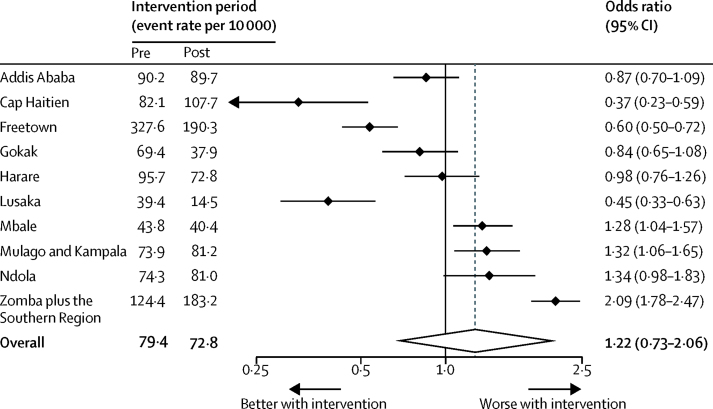
BACKGROUND: In 2015, an estimated 303 000 women died in pregnancy and childbirth. Obstetric haemorrhage, sepsis, and hypertensive disorders of pregnancy account for more than 50% of maternal deaths worldwide. There are effective treatments for these pregnancy complications, but they require early detection by measurement of vital signs and timely administration to save lives. The primary aim of this trial was to determine whether implementation of the CRADLE Vital Sign Alert and an education package into community and facility maternity care in low-resource settings could reduce a composite of all-cause maternal mortality or major morbidity (eclampsia and hysterectomy). METHODS: We did a pragmatic, stepped-wedge, cluster-randomised controlled trial in ten clusters across Africa, India, and Haiti, introducing the device into routine maternity care. Each cluster contained at least one secondary or tertiary hospital and their main referral facilities. Clusters crossed over from existing routine care to the CRADLE intervention in one of nine steps at 2-monthly intervals, with CRADLE devices replacing existing equipment at the randomly allocated timepoint. A computer-generated randomly allocated sequence determined the order in which the clusters received the intervention. Because of the nature of the intervention, this trial was not masked. Data were gathered monthly, with 20 time periods of 1 month. The primary composite outcome was at least one of eclampsia, emergency hysterectomy, and maternal death. This study is registered with the ISRCTN registry, number ISRCTN41244132. FINDINGS: Between April 1, 2016, and Nov 30, 2017, among 536 223 deliveries, the primary outcome occurred in 4067 women, with 998 maternal deaths, 2692 eclampsia cases, and 681 hysterectomies. There was an 8% decrease in the primary outcome from 79·4 per 10 000 deliveries pre-intervention to 72·8 per 10 000 deliveries post-intervention (odds ratio [OR] 0·92, 95% CI 0·86-0·97; p=0·0056). After planned adjustments for variation in event rates between and within clusters over time, the unexpected degree of variability meant we were unable to judge the benefit or harms of the intervention (OR 1·22, 95% CI 0·73-2·06; p=0·45). INTERPRETATION: There was an absolute 8% reduction in primary outcome during the trial, with no change in resources or staffing, but this reduction could not be directly attributed to the intervention due to variability. We encountered unanticipated methodological challenges with this trial design, which can provide valuable learning for future research and inform the trial design of future international stepped-wedge trials. FUNDING: Newton Fund Global Research Programme: UK Medical Research Council; Department of Biotechnology, Ministry of Science & Technology, Government of India; and UK Department of International Development.
Overview
The claims and statistics of this paper haven’t been checked yet.
Free: it reads the open-access text and checks the first 5 claims that cite a source we can check. Create a free account to check every claim.
Integrity signals
Registry
Cites
Statistics
Figures
Verification
Claims the paper makes
The claims and statistics of this paper haven’t been checked yet.
Free: it reads the open-access text and checks the first 5 claims that cite a source we can check. Create a free account to check every claim.
Claims other papers make about this one
Each is checked against this paper’s own text: does it say what the citing paper says it does?
The source backs part of the claim, not all of it — or backs it for a different population, condition or comparison.
In the citing paper
“However, due to substantial variability within and between clusters, no significant benefit could be attributed directly to the intervention.”
From Scale-up of a novel vital signs alert device to improve maternity care in Sierra Leone: a mixed methods evaluation of adoption (2023) · cites this paper as [11]
Experimental — accuracy not yet measuredThe source backs part of the claim, not all of it — or backs it for a different population, condition or comparison.
In the citing paper
“Post intervention, there was an 8% reduction in primary composite outcome (at least one of eclampsia, emergency hysterectomy and maternal death).”
From Scale-up of a novel vital signs alert device to improve maternity care in Sierra Leone: a mixed methods evaluation of adoption (2023) · cites this paper as [11]
Experimental — accuracy not yet measuredThe source backs part of the claim, not all of it — or backs it for a different population, condition or comparison.
In the citing paper
“Champions also reported faults with the battery itself (e.g., not retaining charge), which were similarly reported in the CRCT [11].”
From Scale-up of a novel vital signs alert device to improve maternity care in Sierra Leone: a mixed methods evaluation of adoption (2023) · cites this paper as [11]
Experimental — accuracy not yet measuredIn the citing paper
“If deteriorating vital signs are detected early, maternal morbidity and mortality are preventable with simple, cost-effective interventions that are widely available in SL [6, 8].”
In the citing paper
“Freetown, SL’s urban capital city, reported a 40% reduction in the primary outcome (at least one of eclampsia, emergency hysterectomy, and maternal death) [odds ratio (OR) 0.60 (95% CI 0.50–0.72), p < 0.001] and a 60% reduction in maternal death (risk ratio (RR) 0.37 [95% CI 0.25 to 0.55], p < 0.0001) [6].”
4 more claims about this paper
Create a free account to see every claim other papers make about this one.
Self-check
Percentages, sums and reported differences re-computed from the paper’s own numbers.
The self-check needs the paper’s full text.
Citations
Cites
Global causes of maternal death: a WHO systematic analysis
Say, L., Chou, D., Gemmill, A., Tunçalp, Ö., Moller, A.-B., Daniels, J., Gülmezoglu, A. M., Temmerman, M., & Alkema, L. (2014) · The Lancet Global Health · doi:10.1016/s2214-109x(14)70227-x · Cited by 6,582
Process evaluation of complex interventions: Medical Research Council guidance
Moore, G. F., Audrey, S., Barker, M., Bond, L., Bonell, C., Hardeman, W., Moore, L., O'Cathain, A., Tinati, T., Wight, D., et al. (2015) · BMJ · doi:10.1136/bmj.h1258 · Cited by 6,204
Too far to walk: Maternal mortality in context
Thaddeus, S., & Maine, D. (1994) · Social Science & Medicine · doi:10.1016/0277-9536(94)90226-7 · Cited by 3,240
The World Health report 2006 1 : Working together for health 2
Guilbert, J.-J. (2006) · Education for Health: Change in Learning & Practice · doi:10.1080/13576280600937911 · Cited by 2,654
Strategies for reducing maternal mortality: getting on with what works
Campbell, O. M., & Graham, W. J. (2006) · The Lancet · doi:10.1016/s0140-6736(06)69381-1 · Cited by 1,785
The Hawthorne Effect: a randomised, controlled trial
McCarney, R., Warner, J., Iliffe, S., van Haselen, R., Griffin, M., & Fisher, P. (2007) · BMC Medical Research Methodology · doi:10.1186/1471-2288-7-30 · Cited by 1,715
The stepped wedge cluster randomised trial: rationale, design, analysis, and reporting
Hemming, K., Haines, T. P., Chilton, P. J., Girling, A. J., & Lilford, R. J. (2015) · BMJ · doi:10.1136/bmj.h391 · Cited by 1,410
Design and analysis of stepped wedge cluster randomized trials
Hussey, M. A., & Hughes, J. P. (2007) · Contemporary Clinical Trials · doi:10.1016/j.cct.2006.05.007 · Cited by 1,393
The World Health Report 2005 - make every mother and child count
Lerberghe, W. V., Manuel, A., Matthews, Z., & Wolfheim, C. (2005) · ePrints Soton (University of Southampton) · Cited by 1,015
The role of theory in HIV prevention
Fishbein, M. (2000) · AIDS Care · doi:10.1080/09540120050042918 · Cited by 965
Cited by
Ma, L., Hu, X., Song, L., Chen, X., Ouyang, M., Billot, L., Li, Q., Malavera, A., Li, X., Muñoz-Venturelli, P., et al. (2023) · The Lancet · doi:10.1016/s0140-6736(23)00806-1 · Cited by 407
Poon, L. C., Magee, L. A., Verlohren, S., Shennan, A. H., von Dadelszen, P., Sheiner, E., Hadar, E., Visser, G. H. A., Costa, F. D. S., Kapur, A., et al. (2021) · International Journal of Gynecology & Obstetrics · doi:10.1002/ijgo.13763 · Cited by 159
Self-citationVousden, N., Lawley, E., Seed, P. T., Gidiri, M. F., Goudar, S. S., Sandall, J., Chappell, L. C., Shennan, A. H., & on behalf of the CRADLE Trial Collaborative Group (2019) · PLoS Medicine · doi:10.1371/journal.pmed.1002775 · Cited by 132
Self-citationAshish, K. C., Ewald, U., Basnet, O., Gurung, A., Pyakuryal, S. N., Jha, B. K., Bergström, A., Eriksson, L., Paudel, P., Karki, S., et al. (2019) · PLoS Medicine · doi:10.1371/journal.pmed.1002900 · Cited by 95
The role of medical smartphone apps in clinical decision-support: A literature review
Watson, H. A., Tribe, R. M., & Shennan, A. H. (2019) · Artificial Intelligence in Medicine · doi:10.1016/j.artmed.2019.101707 · Cited by 85
Self-citationThe assessment of blood pressure in pregnant women: pitfalls and novel approaches
Hurrell, A., Webster, L., Chappell, L. C., & Shennan, A. H. (2021) · American Journal of Obstetrics and Gynecology · doi:10.1016/j.ajog.2020.10.026 · Cited by 81
“This included 3 studies; one was a feasibility study of self-measurement vs clinic measurement,(36) one compared K4 with K5 to represent diastolicBP,(23) and thefinal trial compared the CRADLE intervention with usual care.(52) Other studies have identified intraindividual variation among types of monitors,(53) and BP…”
ResultSelf-citationA guide to systems-level, participatory, theory-informed implementation research in global health
Seward, N., Hanlon, C., Hinrichs, S., Lund, C., Murdoch, J., Salisbury, T. T., Verhey, R., Shidhaye, R. R., Thornicroft, G., Araya, R., et al. (2021) · BMJ Global Health · doi:10.1136/bmjgh-2021-005365 · Cited by 68
Akuze, J., Annerstedt, K. S., Beňová, L., Chipeta, E. K., Dossou, J., Groß, M. M., Kidanto, H. L., Marchal, B., Alvesson, H. M., Pembe, A. B., et al. (2021) · BMC Health Services Research · doi:10.1186/s12913-021-07155-z · Cited by 50
“We used intra-cluster correlation coefficients for stillbirth and neonatal mortality from a study in Malawi [50] and maternal morbidity from a recent trial [51].”
Methodon behalf of the CRADLE Trial Collaborative Group, Vousden, N., Lawley, E., Seed, P. T., Gidiri, M. F., Charantimath, U., Makonyola, G., Brown, A., Yadeta, L., Best, R., et al. (2019) · Implementation Science · doi:10.1186/s13012-019-0885-3 · Cited by 31
Self-citationWinters, M., Oppenheim, B., Sengeh, P., Jalloh, M. B., Webber, N., Pratt, S., Leigh, B., Mölsted-Alvesson, H., Zeebari, Z., Sundberg, C. J., et al. (2021) · BMJ Global Health · doi:10.1136/bmjgh-2021-006954 · Cited by 39
Malde, A. K., Prabhu, V. G., Banga, D., Hsieh, M. T., Renduchintala, C., & Pirrallo, R. G. (2025) · Future Internet · doi:10.3390/fi17050190 · Cited by 36
“…solutions such as remote health monitoring and AI-driven tools, the potential of minimal data, such as vital signs, for predicting maternal health risks is increasingly recognized as a cost-effective and scalable approach for improving outcomes in resource-constrained and rural settings [12].”
Madar, H., Deneux‐Tharaux, C., Sentilhes, L., & the TRAAP Study Group (2023) · BJOG An International Journal of Obstetrics & Gynaecology · doi:10.1111/1471-0528.17634 · Cited by 30
“…negative predictive values of SI at 15 and 30 minutes after delivery for predicting QBL ≥1000 ml make it a possibly useful tool for caregivers 41,42 in some contexts, in particular low-and middle-income countries with limited resources and equipment, as it may help clinicians to decide on the…”
BackgroundMethodSetting and techniques for monitoring blood pressure during pregnancy
Ashworth, D., Maule, S. P., Stewart, F. A., Nathan, H. L., Shennan, A. H., & Chappell, L. C. (2020) · Cochrane Database of Systematic Reviews · doi:10.1002/14651858.cd012739.pub2 · Cited by 30
Self-citationNagraj, S., Kennedy, S. H., Norton, R., Jha, V., Praveen, D., Hinton, L., & Hirst, J. E. (2020) · Frontiers in Cardiovascular Medicine · doi:10.3389/fcvm.2020.00040 · Cited by 21
von Dadelszen, P., Vidler, M., Tsigas, E. Z., & Magee, L. A. (2021) · Maternal-Fetal Medicine · doi:10.1097/fm9.0000000000000096 · Cited by 35
Clinical decision support systems for maternity care: a systematic review and meta-analysis
Cockburn, N., Osborne, C., Withana, S., Elsmore, A., Nanjappa, R., South, M., Parry‐Smith, W., Taylor, B., Chandan, J. S., & Nirantharakumar, K. (2024) · EClinicalMedicine · doi:10.1016/j.eclinm.2024.102822 · Cited by 38
Vousden, N., Holmes, E., Seed, P. T., Gidiri, M., Goudar, S. S., Sandall, J., Chinkoyo, S., Kumsa, L., Brown, A., Charantimath, U., et al. (2020) · BJOG An International Journal of Obstetrics & Gynaecology · doi:10.1111/1471-0528.16309 · Cited by 21
Self-citationNew Concept and Management for Sepsis in Pregnancy and the Puerperium
Fan, S., Liu, P., Yan, S.-M., Huang, L. F., & Liu, X. (2020) · Maternal-Fetal Medicine · doi:10.1097/fm9.0000000000000058 · Cited by 27
Giblin, L., Vousden, N., Nathan, H. L., Gidiri, F., Goudar, S. S., Charantimath, U., Sandall, J., Seed, P. T., Chappell, L. C., & Shennan, A. H. (2021) · BMC Pregnancy and Childbirth · doi:10.1186/s12884-021-03796-4 · Cited by 17
Self-citationNakitende, I., Nabiryo, J., Namujwiga, T., Wasingya, L., & Kellett, J. G. (2020) · Clinical Medicine · doi:10.7861/clinmed.2019-0196 · Cited by 14
Estimating and testing an index of bias attributable to composite outcomes in comparative studies
Díaz-Quijano, F. A. (2020) · Journal of Clinical Epidemiology · doi:10.1016/j.jclinepi.2020.12.003 · Cited by 15
Seward, N., Hanlon, C., Murdoch, J., Colbourn, T., Prince, M. J., Venkatapuram, S., & Sevdalis, N. (2020) · BMJ Global Health · doi:10.1136/bmjgh-2020-003456 · Cited by 15
“42 The sensitivity and positive predictive value of the device had been previously established in low-resource settings 43 but it was unknown whether the device would be effective when implemented using lay healthcare workers with minimal training.”
Physiological track-and-trigger/early warning systems for use in maternity care
Smith, V. A., Kenny, L. C., Sandall, J., Devane, D., & Noonan, M. (2021) · Cochrane Database of Systematic Reviews · doi:10.1002/14651858.cd013276.pub2 · Cited by 21
Self-citationBright, S., Moses, F., Ridout, A., Sam, B., Momoh, M., Goodhart, V., Smart, F., Mannah, M., Issa, S., Herm-Singh, S., et al. (2023) · Reproductive Health · doi:10.1186/s12978-022-01551-2 · Cited by 12
“Due to the variation in impact and process seen in the CRCT, further in-depth evaluation at individual sites was recommended [12].”
BackgroundSelf-citationShobo, O. G., Okoro, A., Okolo, M., Longtoe, P., Omale, I., Ofiemu, E., & Anyanti, J. (2020) · Implementation Science Communications · doi:10.1186/s43058-020-00076-8 · Cited by 14
“The true effect of the intervention on the prevalence of hypertensive disorders in pregnancy is better examined with a randomized control trial which may change if we control extraneous variables across the study settings [29].”
BackgroundRidout, A. E., Moses, F. L., Herm-Singh, S., Turienzo, C. F., Seed, P. T., Goodhart, V., Vousden, N., Sam, B., Momoh, M., Kamara, D., et al. (2023) · Trials · doi:10.1186/s13063-023-07587-4 · Cited by 8
“However, this trial design has a strong, context specific evidence base [6, 9], with substantial pilot and feasibility work, and is underpinned by several sustained collaborative partnerships in Sierra Leone, including with the MoHS.”
BackgroundInfluentialSelf-citationMatovu, B., Takuwa, M., Mpaata, C. N., Denison, F. C., Kiwanuka, N., Lewis, S. C., Norrie, J. D., Ononge, S., Muhimbise, O., Tuck, S., et al. (2022) · Frontiers in Medical Technology · doi:10.3389/fmedt.2022.952767 · Cited by 15
“Furthermore, Vouseden and Giblin et al. in 2019 and 2021 reported results from the CRADLE Vital Signs Alert device (CRADLE VSA) as a semi-automated device designed for use in resource limited environments to detect underlying preeclampsia and hysterectomy in Harare Zimbabwe (18, 28).”
BackgroundGlobal Blood Pressure Screening During and After Pregnancy: May Measurement Month 2019
Bowen, L., Stevens, R., Schutte, A. E., Beaney, T. E., Poulter, N. R., McManus, R. J., & Chappell, L. C. (2024) · Hypertension · doi:10.1161/hypertensionaha.124.23458 · Cited by 8
Self-citationThe Escalating Inequalities in Global Maternal Mortality—Time to Act: A Commentary
Martin, A., Ridout, A. E., Afolabi, B. B., & Shennan, A. H. (2025) · BJOG An International Journal of Obstetrics & Gynaecology · doi:10.1111/1471-0528.18246 · Cited by 5
“Yet, access to these basic diagnostics and interventions remains uneven in LMICs [8].”
Self-citationRidout, A. E., Moses, F., Herm-Singh, S., Beoku-Betts, C., Businge, E., Turienzo, C. F., Goodhart, V., Hurrell, A., Kamara, D., Kamara, J., et al. (2025) · The Lancet Obstetrics Gynaecology & Women s Health · doi:10.1016/j.lanogw.2025.09.003 · Cited by 6
Self-citationTurienzo, C. F., November, L., Kamara, M., Conteh, O., Kamara, P., Kingsford, A. M., Koroma, P. J. S., Munu, M., Ridout, A. E., Sam, B., et al. (2025) · The Lancet · doi:10.1016/s0140-6736(25)00454-4 · Cited by 9
Self-citationBoatin, A. A., Ngonzi, J. N. J., Wylie, B. J., Lugobe, H. M., Bebell, L. M., Mugyenyi, G. R., Mohamed, S., Martinez, K., Musinguzi, N., Psaros, C., et al. (2021) · BMC Pregnancy and Childbirth · doi:10.1186/s12884-021-03550-w · Cited by 8
Eclampsia among adolescent mothers in low- and middle-Income countries
van der Krogt, L., Ridout, A. E., Vousden, N., Nathan, H. L., Seed, P. T., Sam, B., Momoh, M., Sesay, T., Smart, F., Bellad, M., et al. (2025) · PLOS Global Public Health · doi:10.1371/journal.pgph.0003890 · Cited by 3
“CRADLE-3 was a stepped-wedge, cluster-randomised controlled trial introducing the CRADLE intervention across ten sites in eight countries – Ethiopia, Sierra Leone, Zimbabwe, Uganda, Zambia, Malawi, India, and Haiti - between April 2016 and November 2017 [23].”
Self-citationKuhrt, K., Mabula‐Bwalya, C. M., Boulding, H., Beardmore‐Gray, A., Ridout, A. E., Koroma, O. B., Sam, B., Williams, P. T., Smart, F., Meleki, I., et al. (2025) · BMC Global and Public Health · doi:10.1186/s44263-024-00116-8 · Cited by 5
“The CRADLE VSA intervention was associated with a 60% reduction in maternal mortality in Sierra Leone (RR 0.37 [95% CI 0.25 to 0.55], p 0.0001) [14] (CRADLE-3).”
InfluentialSelf-citationWu, E., Lee, Y. G., Vinogradov, V., Zhakupova, G., Mergenova, G., Davis, A., Paine, E. A., Hunt, T., Reeder, K. G., Primbetova, S., et al. (2026) · AIDS and Behavior · doi:10.1007/s10461-026-05079-5 · Cited by 2
“Yet the use of three socioeconomically varied cities geographically dispersed across the country is a strength.”
Turienzo, C. F., Kamara, M., November, L., Kamara, P., Kingsford, A. M., Ridout, A. E., Thomas, S., Seed, P. T., Shennan, A. H., Sandall, J., et al. (2024) · PLoS ONE · doi:10.1371/journal.pone.0294538 · Cited by 3
Self-citationHypertensive disorders of pregnancy: risk stratification and management
Cerdeira, A. S., Sarma, A., Hirst, J. E., Henry, A., Muñoz-Ortiz, E., Saad, A., Scott, N. S., Sharma, G. V., Brazile, T. L., Conrad, N., et al. (2026) · The Lancet Obstetrics Gynaecology & Women s Health · doi:10.1016/s3050-5038(26)00190-1 · Cited by 4
Household air pollution and incidence of eclampsia in eight low‐ and middle‐income countries
Robbins, T., Kuhrt, K., Vousden, N., Seed, P. T., & Shennan, A. H. (2022) · International Journal of Gynecology & Obstetrics · doi:10.1002/ijgo.14484 · Cited by 2
Self-citationCarle’s obstetric early warning score as a screening tool for critical care admission
Gupta, C., Suri, J., Bachani, S., Bharti, R., Pandey, D., & Mittal, P. (2023) · International Journal of Microbiology Research · doi:10.4103/ijmr.ijmr_2478_21 · Cited by 1
“There continues to be the use of different regional versions of OEWS that vary in parameters and cut-offs 13-17 .”
BackgroundProceedings of the 6th UK and Ireland implementation science research conference
Brooks, C., Bridges, J., Frankland, J., & Myall, M. (2024) · Implementation Science · doi:10.1186/s13012-024-01341-3 · Cited by 4
The challenge of measuring blood pressure in low-resource settings
Roberts, J. M., & Assibey‐Mensah, V. (2019) · The Lancet Global Health · doi:10.1016/s2214-109x(19)30019-1 · Cited by 1
Robbins, T., Vousden, N., Shennan, A. H., Chappell, L. C., Makanga, P. T., & Downward, G. S. (2019) · Pregnancy Hypertension · doi:10.1016/j.preghy.2019.08.146
Self-citationOliveira, L. G., Roberts, J. M., Jeyabalan, A., Poston, L., Seed, P. T., Blount, K., Chappell, L. C., & Dias, M. A. B. (2022) · SSRN Electronic Journal · doi:10.2139/ssrn.4000472
Self-citationRidout, A. E., Moses, F., Singh, S. H., Turienzo, C. F., Seed, P. T., Goodhart, V., Vousden, N., Sam, B., Momoh, M., Kamara, D., et al. (2023) · Research Square · doi:10.21203/rs.3.rs-3019173/v1
Self-citationBoatin, A. A., Ngonzi, J. N. J., Wylie, B. J., Lugobe, H. M., Bebell, L. M., Mugyenyi, G. R., Mohamed, S., Martinez, K., Musinguzi, N., Psaros, C., et al. (2021) · Figshare · doi:10.6084/m9.figshare.13979440
von Dadelszen, P., Sandhu, A., Bone, J. N., Qureshi, R. N., Dada, O. A., Mallapur, A. A., Temmerman, M., Volvert, M., Waiswa, J. A., Mukhanya, M. W., et al. (2026) · JMIR mhealth and uhealth · doi:10.2196/73307 · Cited by 1
“In summary, the BP 3AS1-2 and CRADLE VSA have been used reliably in a number of other clinical trials and studies with largely positive results [24-27].”
Self-citationBlood Pressure Measurement During Pregnancy
Péchère-Bertschi, A. (2026) · Updates in hypertension and cardiovascular protection · doi:10.1007/978-3-032-32879-3_5
Metadata
- Authors
- Vousden, N., Lawley, E., Nathan, H. L., Seed, P. T., Gidiri, M. F., Goudar, S., Sandall, J., Chappell, L. C., Shennan, A. H., Kachinjika, M., Bukani, D., Makwakwa, J., Makonyola, G., Brown, A., Toussaint, P., Vixama, A., Greene, G., Hill, C., Nakiriija, E., Birungi, D., Kalyowa, N., Namakula, D., Byamugisha, J., Nakimuli, A., Mackayi Odeke, N., Ditai, J., Wandabwa, J., Momodou, F., Sesay, M., Sandi, P., Conteh, J., Kamara, J., Clarke, M., Best, R., Miti, J., Kopeka, M., Vwalika, B., Chima, M., Musonda, T., Jere, C., Chinkoyo, S., Mambo, V., Guchale, Y., Yadeta, L., Surur, F., Mungarwadi, G. M., Mastiholi, S. S., Karadiguddi, C. C., Charantimath, U., Bellad, M., Hezelgrave, N., & Duhig, K. E.
- Affiliations
- King's College London (GB)
- University of Zimbabwe (ZW)
- Jawaharlal Nehru Medical College (IN)
- Corresponding author
- Vousden, Nicola
- ORCID
- Vousden, Nicola
- Lawley, Elodie
- Nathan, Hannah L
- Seed, Paul T
- Goudar, Shivaprasad
- Sandall, Jane
- Chappell, Lucy C
- Shennan, Andrew H
- Birungi, Doreen
- Byamugisha, Josaphat
- Nakimuli, Annettee
- Ditai, James
- Wandabwa, Julius
- Vwalika, Bellington
- Chinkoyo, Sebastian
- Charantimath, Umesh
- Bellad, Mrutyunjaya
- Hezelgrave, Natasha
- Duhig, Kate E
- Venue
- The Lancet Global Health
- Publisher
- Elsevier BV
- Published
- 2019-03
- Volume
- 7
- Issue
- 3
- Pages
- e347-e356
- ISSN
- 2214-109X (ISSN-L)
- PMC
- PMC6379820
- OpenAlex
- W2902167734
- Cited by
- 48
- References
- 39
- Citations by year
- 2026: 4 · 2025: 6 · 2024: 5 · 2023: 6 · 2022: 3 · 2021: 10 · 2020: 8 · 2019: 6
- FWCI
- 6.97
- Type
- journal article
- Language
- en
- Open access
- gold
- doi.org
- Licence
- cc-by
- www.elsevier.com/tdm/userlicense/1.0/ (tdm)
- creativecommons.org/licenses/by/4.0/ (vor)
- Locations
- The Lancet Global Health (publishedVersion, cc-by)
- Europe PMC (PubMed Central) (publishedVersion, other-oa)
- PubMed Central (publishedVersion, cc-by)
- PubMed (publishedVersion)
- DOAJ (DOAJ: Directory of Open Access Journals) (submittedVersion, cc-by-sa)
- Research Portal (King's College London) (submittedVersion, cc-by-nc-nd)
- OPUS - Open Publications of UTS Scholars (University of Technology Sydney) (submittedVersion, cc-by)
- Research Explorer (The University of Manchester) (submittedVersion)
- Greater South Information System
- Funders
- UK Department of International Development Global Research Programme (MR/N006240/1)
- NIHR Research Professorship (RP-2014-05-019)
- Topics
- Health Sciences › Medicine › Pediatrics, Perinatology and Child Health › Global Maternal and Child Health
- Health Sciences › Medicine › Pediatrics, Perinatology and Child Health › Maternal and fetal healthcare
- Health Sciences › Medicine › Obstetrics and Gynecology › Maternal and Perinatal Health Interventions
- Keywords
- maternal mortality, vital signs monitoring, eclampsia, emergency hysterectomy, obstetric hemorrhage, sepsis, hypertensive disorders of pregnancy, resource-limited settings, health worker education, early detection of pregnancy complications, maternal morbidity, India, Haiti
- MeSH terms
- Heart Rate Determination, Africa, Blood Pressure Determination, Eclampsia, Female, Haiti, Health Personnel, Health Resources, Postpartum Hemorrhage, Humans, Hysterectomy, India, Maternal Health Services, Maternal Mortality, Pregnancy, Pregnancy Complications, Pregnancy Complications, Infectious, Sepsis, Early Diagnosis, Hypertension, Pregnancy-Induced, Vital Signs, Early Medical Intervention
About these checks
Registry, retraction, Cites and statistics results are computed, not judged, with one exception: a printed reference that no index lists is read once by a model before it counts as a citation error. Claims are extracted by a model and kept only when their quote appears verbatim in the text; each cited source is then checked, with a model’s help, for whether it says what the claim relies on. Those verdicts can be wrong — read the claim’s quote and the cited source before relying on one.
Statistics and arithmetic are recomputed, not judged.
Confidence bands are shown only for fields calibrated on our annotated test set. None is calibrated yet, so no band is shown.
What counts as a claim ›How we measure confidence ›How we check this ›
Are you an author, or do you see a problem with this page? Request a review
Data sources
Bibliographic data: Semantic Scholar, OpenAlex, Crossref.
Contains information from the Semantic Scholar Academic Graph Datasets, made available under the ODC Attribution License (ODC-BY 1.0).
Semantic Scholar’s data is described in: Kinney, R., et al. (2023). The Semantic Scholar Open Data Platform. arXiv:2301.10140.
