

The DOI matches its Crossref record; 21 of the 24 references it cites were found in a registry or an index.
Impact of the SARS-CoV-2 pandemic on routine immunisation services: evidence of disruption and recovery from 170 countries and territories
Open accessAbstract
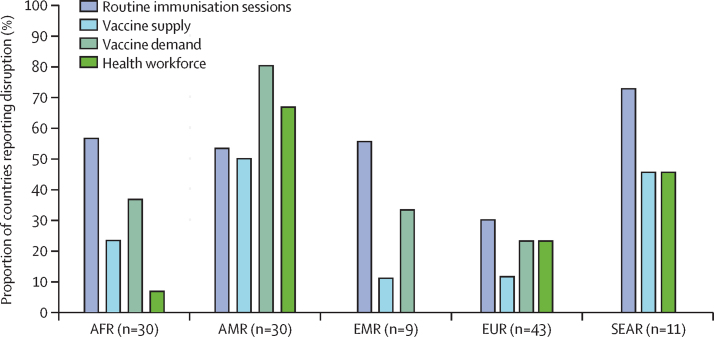
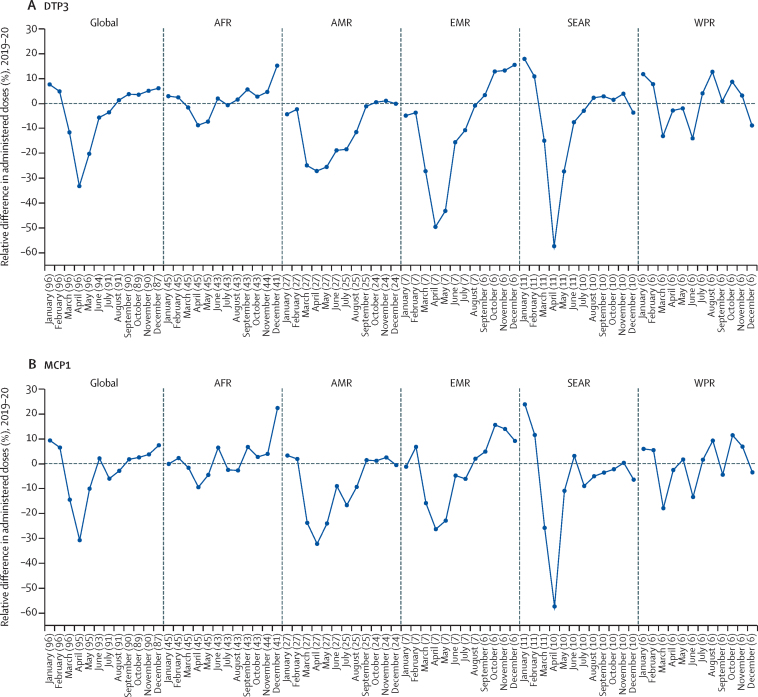
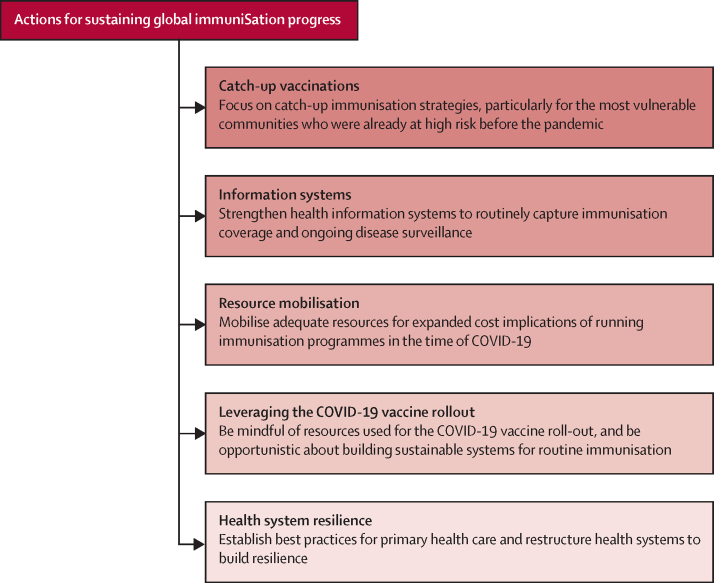
BACKGROUND: The SARS-CoV-2 pandemic has revealed the vulnerability of immunisation systems worldwide, although the scale of these disruptions has not been described at a global level. This study aims to assess the impact of COVID-19 on routine immunisation using triangulated data from global, country-based, and individual-reported sources obtained during the pandemic period. METHODS: This report synthesised data from 170 countries and territories. Data sources included administered vaccine-dose data from January to December, 2019, and January to December, 2020, WHO regional office reports, and a WHO-led pulse survey administered in April, 2020, and June, 2020. Results were expressed as frequencies and proportions of respondents or reporting countries. Data on vaccine doses administered were weighted by the population of surviving infants per country. FINDINGS: A decline in the number of administered doses of diphtheria-pertussis-tetanus-containing vaccine (DTP3) and first dose of measles-containing vaccine (MCV1) in the first half of 2020 was noted. The lowest number of vaccine doses administered was observed in April, 2020, when 33% fewer DTP3 doses were administered globally, ranging from 9% in the WHO African region to 57% in the South-East Asia region. Recovery of vaccinations began by June, 2020, and continued into late 2020. WHO regional offices reported substantial disruption to routine vaccination sessions in April, 2020, related to interrupted vaccination demand and supply, including reduced availability of the health workforce. Pulse survey analysis revealed that 45 (69%) of 65 countries showed disruption in outreach services compared with 27 (44%) of 62 countries with disrupted fixed-post immunisation services. INTERPRETATION: The marked magnitude and global scale of immunisation disruption evokes the dangers of vaccine-preventable disease outbreaks in the future. Trends indicating partial resumption of services highlight the urgent need for ongoing assessment of recovery, catch-up vaccination strategy implementation for vulnerable populations, and ensuring vaccine coverage equity and health system resilience. FUNDING: US Agency for International Development.
Overview
The claims and statistics of this paper haven’t been checked yet.
Run the check — free, no account needed. It reads the open-access text and checks the sources it cites.
Integrity signals
Registry
Cites
Statistics
Figures
Verification
Claims the paper makes
The claims and statistics of this paper haven’t been checked yet.
Run the check — free, no account needed. It reads the open-access text and checks the sources it cites.
Claims other papers make about this one
Each is checked against this paper’s own text: does it say what the citing paper says it does?
In the citing paper
“The crisis and its cascading effects placed extraordinary pressure on health systems and providers, immunisation supply chains, and health spending, which—combined with social distancing and stay-at-home measures—severely limited the ability of health workers and those in need of care to provide and access services.62”
Self-check
Percentages, sums and reported differences re-computed from the paper’s own numbers.
The self-check needs the paper’s full text.
Citations
Cites
Vaccine hesitancy: the next challenge in the fight against COVID-19
Dror, A. A., Eisenbach, N., Taiber, S., Morozov, N. G., Mizrachi, M., Zigron, A., Srouji, S., & Sela, E. (2020) · European Journal of Epidemiology · doi:10.1007/s10654-020-00671-y · Cited by 1,717
Roberton, T., Carter, E. D., Chou, V. B., Stegmuller, A. R., Jackson, B. D., Tam, Y., Sawadogo‐Lewis, T., & Walker, N. (2020) · The Lancet Global Health · doi:10.1016/s2214-109x(20)30229-1 · Cited by 1,444
Causey, K., Fullman, N., Sorensen, R. J. D., Galles, N. C., Zheng, P., Aravkin, A., Danovaro-Holliday, M. C., Martinez-Piedra, R., Sodha, S. V., Velandia-González, M. P., et al. (2021) · The Lancet · doi:10.1016/s0140-6736(21)01337-4 · Cited by 450
Self-citationAbbas, K., Procter, S. R., van Zandvoort, K., Clark, A. D., Funk, S., Mengistu, T., Hogan, D. R., Dansereau, E. A., Jit, M., Flasche, S., et al. (2020) · The Lancet Global Health · doi:10.1016/s2214-109x(20)30308-9 · Cited by 362
Building resilient health systems: a proposal for a resilience index
Kruk, M. E., Ling, E. J., Bitton, A., Cammett, M. C., Cavanaugh, K., Chopra, M., El‐Jardali, F., Macauley, R., Muraguri, M. K., Konuma, S., et al. (2017) · BMJ · doi:10.1136/bmj.j2323 · Cited by 357
Turner, N. (2009) · PubMed · Cited by 298
Effects of the West Africa Ebola Virus Disease on Health-Care Utilization – A Systematic Review
Brolin, K., Saulnier, D. D., Eriksson, A., & von Schreeb, J. (2016) · Frontiers in Public Health · doi:10.3389/fpubh.2016.00222 · Cited by 272
The impact of the COVID-19 pandemic on immunization campaigns and programs: a systematic review
Lassi, Z. S., Naseem, R., Salam, R. A., Siddiqui, F., & Das, J. K. (2021) · International Journal of Environmental Research and Public Health · doi:10.3390/ijerph18030988 · Cited by 251
Reduced vaccination and the risk of measles and other childhood infections post-Ebola
Takahashi, S., Metcalf, C. J. E., Ferrari, M. J., Moss, W. J., Truelove, S., Tatem, A. J., Grenfell, B. T., & Lessler, J. (2015) · Science · doi:10.1126/science.aaa3438 · Cited by 207
Mapping routine measles vaccination in low- and middle-income countries
Collaborators, L. B. O. D. V. C., Sbarra, A. N., Rolfe, S., Nguyen, J. Q., Earl, L., Galles, N. C., Marks, A., Abbas, K. M., Abbasi-Kangevari, M., Abbastabar, H., et al. (2021) · Nature · doi:10.1038/s41586-020-03043-4 · Cited by 125
Research works printed but not linked: 3
- Din, 2020, Impact of COVID-19 on polio vaccination in Pakistan: a concise overview, Rev Med Virol, 31
- Masresha, 2020, The performance of routine immunization in selected African countries during the first six months of the COVID-19 pandemic, Pan Afr Med J, 37, 12
- Dixit, 2021, Addressing disruptions in childhood routine immunisation services during the COVID-19 pandemic: perspectives and lessons learned from Liberia, Nepal, and Senegal, medRxiv
Cited by
Sorted by citations
Items 301–364 of 364
Ahmad, T., & Feeney, K. M. (2024) · The Egyptian Journal of Internal Medicine · doi:10.1186/s43162-024-00355-z
Sulcebe, G., Ylli, A., Cenko, F., Kurti-Prifti, M., Shyti, E., Dashi-Pasholli, J., Lazri, E., Seferi-Qendro, I., & Perry, M. J. (2024) · IJID Regions · doi:10.1016/j.ijregi.2024.100440
Rubella epidemiology in Lesotho after vaccine introduction: a five-year review, 2018–2022
Makhupane, T., & Habedi, D. S. K. (2024) · BMC Public Health · doi:10.1186/s12889-024-20081-z
Persson, L. Å., & Arifeen, S. E. (2024) · Springer eBooks · doi:10.1007/978-1-4614-6625-3_84-1
COVID Shock and Maternal and Child Health Services: Evidence from IndiaPreprint
Dongre, A. A., & Surana, M. (2024) · SSRN Electronic Journal · doi:10.2139/ssrn.5008299
The effect of the pandemic on the care of other health conditions
MacLean, D., & Ganesh, A. (2025) · Elsevier eBooks · doi:10.1016/b978-0-443-19170-1.00007-3
Imamura, T., Mochida, K., Balogun, O. O., Tchicondingosse, L., Sapalalo, P., Francisco, K. R., Aoki, A., Ishiguro, A., & Takehara, K. (2025) · Tropical Medicine and Health · doi:10.1186/s41182-024-00668-3
Costantini, C., Guanà, R., Zambaiti, E., Stanton, E. J., Lonati, L., Shilly, S., Gennari, F., & Scottoni, F. (2025) · Minerva Pediatrics · doi:10.23736/s2724-5276.25.07722-5
The impact of COVID-19 on the implementation of routine immunisation for children in RwandaPreprint
Mbonigaba, E., Yu, F., Reñosa, M. D. C., Cho, F. N., Chen, Q., Chen, W., Denkinger, C. M., McMahon, S. A., & Chen, S. (2025) · medRxiv · doi:10.1101/2025.04.09.25325536
Das, P., Shukla, S. K., Bhatia, M., Kothari, N., Jandu, H. S., Monga, D., & Aggarwal, M. K. (2025) · doi:10.12688/verixiv.1055.1
COVID-19 Disruption and Maternal and Child Health Services: Evidence from India
Dongre, A. A., & Surana, M. (2025) · Maternal and Child Health Journal · doi:10.1007/s10995-025-04134-2
COVID pandemic created immunisation gaps in Africa. Over half a million children are at risk
Amponsah‐Dacosta, E. (2022) · doi:10.64628/aaj.fuw3ammyy
Nugraheni, W. P., Ernawaty, E., Hartono, R. K., & Kusuma, D. P. (2025) · International Journal of Healthcare Management · doi:10.1080/20479700.2025.2545222
A ascensão letal da anticiência
Hotez, P. J. (2025) · Editora FIOCRUZ eBooks · doi:10.7476/9786557083017
Hotez, P. J. (2025) · Editora FIOCRUZ eBooks · doi:10.7476/9786557083017.0001
Tempos Difíceis para Ser Cientista
Hotez, P. J. (2025) · Editora FIOCRUZ eBooks · doi:10.7476/9786557083017.0006
A Mais Árdua Comunicação Pública da Ciência de Todos os Tempos
Hotez, P. J. (2025) · Editora FIOCRUZ eBooks · doi:10.7476/9786557083017.0008
Um Ecossistema Político Anticiência
Hotez, P. J. (2025) · Editora FIOCRUZ eBooks · doi:10.7476/9786557083017.0005
A Propaganda sobre Liberdade de Escolha em Saúde nos Estados Unidos
Hotez, P. J. (2025) · Editora FIOCRUZ eBooks · doi:10.7476/9786557083017.0003
Um Exército de Patriotas se Volta contra os Cientistas
Hotez, P. J. (2025) · Editora FIOCRUZ eBooks · doi:10.7476/9786557083017.0002
O Manual de Estratégias Autoritárias
Hotez, P. J. (2025) · Editora FIOCRUZ eBooks · doi:10.7476/9786557083017.0007
Centro Meridional da Lei da Pobreza para Cientistas
Hotez, P. J. (2025) · Editora FIOCRUZ eBooks · doi:10.7476/9786557083017.0009
Hotez, P. J. (2025) · Editora FIOCRUZ eBooks · doi:10.7476/9786557083017.0004
Das, P., Shukla, S. K., Bhatia, M., Kothari, N., Jandu, H. S., Monga, D., & Aggarwal, M. K. (2025) · BMC Public Health · doi:10.1186/s12889-025-25318-z
Zang, Z., Yu, L., Li, S., Xu, X., Zhou, H. P., Yue, Q., & Li, Y. (2025) · BMJ Open · doi:10.1136/bmjopen-2025-102980
Wassenaar, M., Fombah, A. E., Chen, H., Owusu-Kyei, K., Williams, J. S., Sunders, J.-H. C., Llach, M., Quintó, L., Sesay, T., Samai, M. H., et al. (2024) · Figshare · doi:10.6084/m9.figshare.26666101
Guarnizo-Herreño, C. C., Buitrago, G., & Wehby, G. L. (2024) · Figshare · doi:10.6084/m9.figshare.26589033
Wassenaar, M., Fombah, A. E., Chen, H., Owusu-Kyei, K., Williams, J., Sunders, J.-H. C., Llach, M., Quintó, L., Sesay, T., Samai, M. H., et al. (2024) · Figshare · doi:10.6084/m9.figshare.26666098
Wassenaar, M., Fombah, A. E., Chen, H., Owusu-Kyei, K., Williams, J., Sunders, J.-H. C., Llach, M., Quintó, L., Sesay, T., Samai, M. H., et al. (2024) · Figshare · doi:10.6084/m9.figshare.26666104
Karami, H., Rajaram, V., Lee, S., Mamelund, S., & Chowell, G. (2026) · Research Square · doi:10.21203/rs.3.rs-8427494/v1 · Cited by 1
Zhang, S., Chen, C., Qi, J., Xu, Y., & Xiao, Y. (2026) · Human Vaccines & Immunotherapeutics · doi:10.1080/21645515.2026.2621476
Evaluation of measles immunity in the central black sea region of Türkiye
Kalaycı, H. Ö., İbik, Y. E., & Çalgın, M. K. (2026) · BMC Infectious Diseases · doi:10.1186/s12879-026-12779-9
Xu, Q., Zhang, X., Xie, T., Hua, W., Cheng, Y., Tai, H. S., Wei, Y., Lu, Q.-B., & Cui, F. (2026) · npj Vaccines · doi:10.1038/s41541-026-01392-1
Sever, S. Ö., Aksu, S. B., & Öztürk, G. Z. (2026) · The Italian Journal of Pediatrics/Italian journal of pediatrics · doi:10.1186/s13052-026-02226-5
James, E. K., Christie, S., Boye, B., Githieya, D., Jamil, Z., Obisa, J., Palamar, L., Tariq, T., Khan, K., Malik, A. A., et al. (2026) · Vaccine · doi:10.1016/j.vaccine.2026.128475
Prevention and management of vaccine hesitancy
Reis, C., & Jacobson, R. M. (2026) · Srpski medicinski casopis Lekarske komore · doi:10.5937/smclk7-62537
Spatio-temporal patterns and determinants of measles incidence in Ethiopia between 2018 and 2024
Wolde, H. M., Raza, A., Kebede, W., Jeong, B., Kim, Y., Kim, S., Dong, J. J., Bae, Y., & Lee, S. W. (2026) · Frontiers in Public Health · doi:10.3389/fpubh.2026.1760450
Metiboba, L., Femi-Ojo, O., Hassan, S. H., Tambuwal, S. A., Adeniran, M. O. A., Bello, A., & Nwakaogor, G. U. (2026) · Open Journal of Social Sciences · doi:10.4236/jss.2026.144034
Global burden and time trends of vaccine-preventable diseases in children and adolescents
Jin, X., Wang, R., Tu, S., Yuan, C., Ge, F., Liu, Y., Wang, S., Ma, Y., & Sun, G. (2026) · The Italian Journal of Pediatrics/Italian journal of pediatrics · doi:10.1186/s13052-026-02256-z
Omondi, J., Ambogo, R., Ochieng, C., Farag, M. M. A., & Mutwiri, G. (2026) · Vaccines · doi:10.3390/vaccines14050432
Ogwel, B., Mzazi, V. H., Awuor, A. O., Onyando, B. O., Okello, C., Juma, J., Okello, G. O., Ochieng, J. B., Parashar, U. D., Omore, R., et al. (2026) · Vaccine X · doi:10.1016/j.jvacx.2026.100831
Synthesising Vaccine Hesitancy Research: A Bibliometric Analysis and Structured Review
Acharya, S., Dhir, S., Aechtner, T., & Venaik, S. (2026) · Springer eBooks · doi:10.1007/978-981-95-8349-2_10
Makhijani, A. V., Rak, A., Jenkins, N., Vidmar, S., Addlem, L., Elía, S., Cheng, D. R., Perrett, K. P., Kaufman, J., & Danchin, M. H. (2026) · Vaccine · doi:10.1016/j.vaccine.2026.128726
Qin, M., Hong, N. Y., Kim, S. W., Park, J.-H., Yoo, S. J., Park, S. J., Kim, Y., Cho, S. Y., Park, S. H., Kang, H. J., et al. (2026) · Tropical Medicine and Infectious Disease · doi:10.3390/tropicalmed11060150
Wongnaah, F. G., Osborne, A., Adeleye, K. K., & Ahinkorah, B. O. (2026) · PLoS ONE · doi:10.1371/journal.pone.0349584
Namasambi, S., Migisha, R., Ankunda, C., Matovu, N., Lanyero, C., Sagyiri, P., Okello, E. O., Katongole, D., Eyu, P., Kwesiga, B., et al. (2026) · medRxiv · doi:10.64898/2026.06.17.26355922
Asraoui, A., & Soulaymani, A. (2026) · BMC Public Health · doi:10.1186/s12889-026-28209-z
Kigongo, E., Heaney, C., McBride, L., Gliga, G., & Burns, R. (2026) · BMC Public Health · doi:10.1186/s12889-026-27893-1 · Cited by 1
Measles Surveillance in Tuscany (Italy), 2019–2024: A Six-Year Epidemiological Analysis
Chiavarini, M., Romano, R., Guida, A., Morelli, E., Nizio, C. D., Picchi, T. V., Napoli, G., Murolo, R., Filieri, V., Porchia, B. R., et al. (2026) · Vaccines · doi:10.3390/vaccines14070558
Strengthening Data Systems and Use for Infectious Outbreak Preparedness in Uganda
Nizeyimana, I., Ario, A. R., Mwangi, T., Muthiru, A., Ofori, M. A., Adedokun, O., & Mwangi, A. (2026) · Journal of Epidemiology and Global Health · doi:10.1007/s44197-026-00602-2
Clemens‐Kangbai, N., Kangbai, D. M., Sesay, E. N., James, P. B., Kemoh, A. K., Kargbo, N. M., Wamalwa, D. C., Akech, S., & Laving, A. (2026) · Discover Public Health · doi:10.1186/s12982-026-02441-9
Progress towards measles and rubella elimination in Eswatini by 2024
Dlamini, X., Simelane, T., Kamalizeni, S., Khumalo, L., Dlamini, A., Mitiku, K., & Masresha, B. (2026) · PLOS Global Public Health · doi:10.1371/journal.pgph.0006860
Ernst, K. C., Luzingu, J. K., Virani, M., & Miiro, F. N. (2026) · Springer eBooks · doi:10.1007/978-1-0716-5436-1_8
Li, J., Wang, Z., & Gong, Y. (2026) · Vaccine · doi:10.1016/j.vaccine.2026.128973
Azumah, G. E., & Saani, A. T. (2026) · The Lancet Regional Health - Africa · doi:10.1016/j.lanafr.2026.100124
Community-Level Social Norms and Childhood Immunization: A Multilevel Contextual AnalysisPreprint
Brhanie, T. W. (2026) · Research Square · doi:10.21203/rs.3.rs-10652976/v1
Celi, D. Y. T., Ramírez, J. D. C. C., & Celi, L. A. D. (2026) · Salud Medicina e Innovación Journal · doi:10.70577/v85nj785
Gedefaw, A., Berhe, N. M., Yimer, N. B., Argaw, T., Worku, M. D., Hussen, S., Ayalew, M., Amare, A., Hailu, D., Debalke, D., et al. (2026) · BMC Health Services Research · doi:10.1186/s12913-026-15386-1
Erence, B. Y., Erdem, F., Tepe, E., & Arica, S. G. (2026) · Vaccines · doi:10.3390/vaccines14090785
Zhou, D., Zhang, J., Ma, K., Sun, T., Deng, F., Wu, S., Hu, H., Duan, H., Zhang, T., Yu, A., et al. (2026) · One Health · doi:10.1016/j.onehlt.2026.101590
Qyli, Z. (2026) · Romanian Journal of Pediatrics · doi:10.37897/rjp.2026.3.8
Yolusever, A. (2026) · Frontiers in Public Health · doi:10.3389/fpubh.2026.1965676
Mwale, M., Chipimo, P. J., Phiri, A. M., Sakubita, P., Penelope, K.-M., Musonda, B., Mwela, C., Mwangilwa, K., Chipoya, M., Gardner, P. N., et al. (2026) · PLOS Global Public Health · doi:10.1371/journal.pgph.0006618
Metadata
- Authors
- Shet, A., Carr, K., Danovaro-Holliday, M. C., Sodha, S. V., Prosperi, C., Wunderlich, J., Wonodi, C., Reynolds, H. W., Mirza, I., Gacic-Dobo, M., O'Brien, K. L., & Lindstrand, A.
- Affiliations
- Johns Hopkins University (US)
- World Health Organization (CH)
- Gavi (CH)
- United Nations Children's Fund (US)
- Corresponding author
- Shet, Anita
- Lindstrand, Ann
- Venue
- The Lancet Global Health
- Publisher
- Elsevier BV
- Published
- 2022-02
- Volume
- 10
- Issue
- 2
- Pages
- e186-e194
- ISSN
- 2214-109X (ISSN-L)
- PMC
- PMC8691849
- OpenAlex
- W4200055909
- Cited by
- 363
- References
- 24
- Citations by year
- 2026: 48 · 2025: 64 · 2024: 93 · 2023: 93 · 2022: 63
- FWCI
- 34.67
- Type
- journal article
- Language
- en
- Open access
- gold
- doi.org
- Licence
- Locations
- The Lancet Global Health (publishedVersion, cc-by-nc-nd)
- PubMed Central (publishedVersion, cc-by-nc-nd)
- PubMed (publishedVersion)
- Funders
- USAID
- Topics
- Social Sciences › Health › Vaccine Coverage and Hesitancy
- Health Sciences › Medicine › Oncology › COVID-19 and healthcare impacts
- Physical Sciences › Mathematics › Modeling and Simulation › COVID-19 epidemiological studies
- Keywords
- COVID-19 pandemic, SARS-CoV-2, routine immunization, vaccine doses administered, measles-containing vaccine, catch-up vaccination, health workforce shortage, health system resilience, vaccine-preventable disease outbreaks
- MeSH terms
- Vaccination Coverage, Vaccine-Preventable Diseases, COVID-19, SARS-CoV-2, Humans, Global Health, World Health Organization, Immunization Programs, Pandemics
About these checks
Registry, retraction, Cites and statistics results are computed, not judged, with one exception: a printed reference that no index lists is read once by a model before it counts as a citation error. Claims are extracted by a model and kept only when their quote appears verbatim in the text; each cited source is then checked, with a model’s help, for whether it says what the claim relies on. Those verdicts can be wrong — read the claim’s quote and the cited source before relying on one.
Statistics and arithmetic are recomputed, not judged.
Confidence bands are shown only for fields calibrated on our annotated test set. None is calibrated yet, so no band is shown.
What counts as a claim ›How we measure confidence ›How we check this ›
Are you an author, or do you see a problem with this page? Request a review
