

Self-harm and violent criminality among young people who experienced trauma-related hospital admission during childhood: a Danish national cohort study
Open accessThe DOI matches its Crossref record; 26 of the 26 references it cites were found in a registry or an index.
Abstract
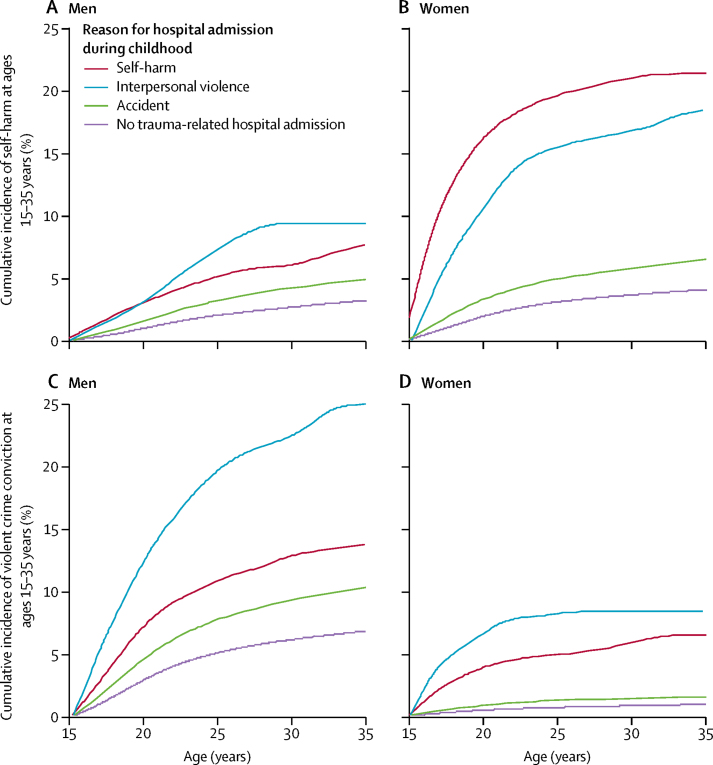
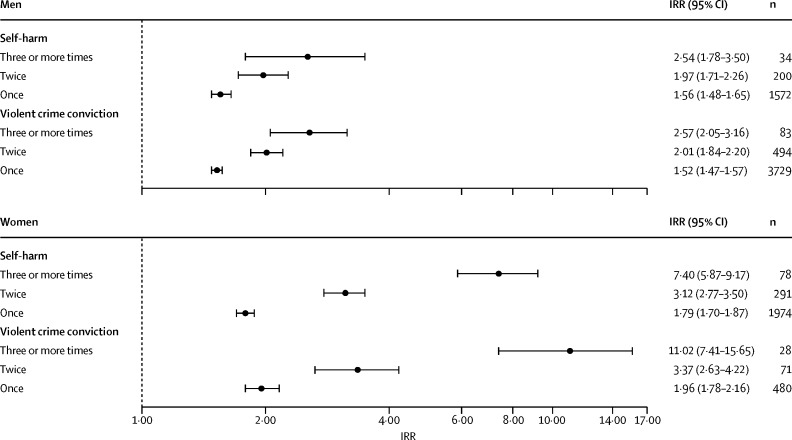
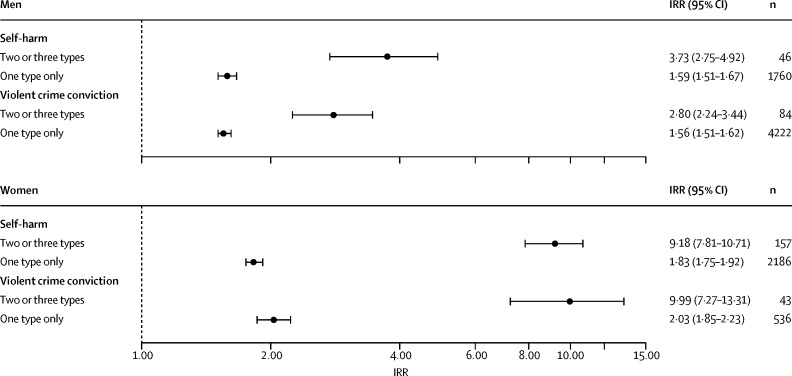
BACKGROUND: Development of a better understanding of subsequent pathways for individuals who experienced trauma during childhood might usefully inform clinicians and public health professionals regarding the causes of self-harm and interpersonal violence. We aimed to examine these risks during late adolescence and early adulthood among people admitted to hospital following injuries or poisonings during their childhood. METHODS: This national cohort study included Danish people born between Jan 1, 1977, and Dec 31, 1997, and was linked to the National Patient Register and Psychiatric Central Research Register to identify all people exposed to hospital admissions for injuries or poisonings due to self-harm, interpersonal violence, or accidents before their 15th birthday. Linkage to these two registers and to the National Crime Register enabled ascertainment of self-harm and violent offending, respectively, as adverse outcomes at ages 15-35 years. Sex-specific incidence rate ratios (IRRs; relative risks) and cumulative incidence percentage values (absolute risks) were estimated. The confounding influence of parental socioeconomic status was also explored. FINDINGS: 1 087 672 Danish people were included in this study. The prevalence of any trauma-related hospital admission was 10% (105 753 per 1 087 672; males: 64 454 [11%]; females: 44 299 [8%]) and for both sexes, accident was by far the most prevalent of the categories assessed (males: 59 011 [11%]; females: 40 756 [8%]). Similar patterns of increased risk for self-harm and violent criminality were observed in both sexes, although the IRRs were consistently and significantly larger in women (self-harm: IRR 1·94 [95% CI 1·85-2·02]; violent criminality: 2·16 [1·97-2·36]) than in men (self-harm: 1·61 [1·53-1·69]; violent criminality: 1·58 [1·53-1·63]). Confounding by parental socioeconomic status explained little of the increased risks observed. For young adult men, the highest absolute risk observed was for violent offending among individuals admitted to hospital for interpersonal violence injury during childhood (cumulative incidence 25·0% [95% CI 21·2-28·9]). For young adult women, absolute risk was highest for repeat self-harm among those admitted to hospital following self-harm during childhood (cumulative incidence 21·4% [95% CI 19·8-23·1]). More frequent trauma-related hospital admissions in childhood, and being admitted multiple times for more than one reason, conferred substantial risk increases among young people, with especially steep gradients of this nature observed among women. INTERPRETATION: Trauma-related hospital admission early in life could be a useful marker for childhood distress that subsequently predicts internalised and externalised destructive behaviours among youths and young adults and might provide a timely opportunity for initiating family-oriented interventions. FUNDING: European Research Council.
Overview
The claims and statistics of this paper haven’t been checked yet.
Free: it reads the open-access text and checks the first 5 claims that cite a source we can check. Create a free account to check every claim.
Integrity signals
Registry
Cites
Statistics
Figures
Verification
Claims the paper makes
The claims and statistics of this paper haven’t been checked yet.
Free: it reads the open-access text and checks the first 5 claims that cite a source we can check. Create a free account to check every claim.
Claims other papers make about this one
Each is checked against this paper’s own text: does it say what the citing paper says it does?
The source backs part of the claim, not all of it — or backs it for a different population, condition or comparison.
In the citing paper
“Furthermore, childhood experiences of adversity are associated with lifelong negative impacts on health and well-being.”
From What factors are associated with resilient outcomes in children exposed to social adversity? A systematic review (2019) · cites this paper as [18]
Experimental — accuracy not yet measured
Self-check
Percentages, sums and reported differences re-computed from the paper’s own numbers.
The self-check needs the paper’s full text.
Citations
Cites
The Danish National Patient Register
Lynge, E., Sandegaard, J. L., & Rebolj, M. (2011) · Scandinavian Journal of Public Health · doi:10.1177/1403494811401482 · Cited by 3,968
Statistical Methods in Cancer Research. Volume II – The Design and Analysis of Cohort Studies
Juul, S. (1989) · Scandinavian Journal of Social Medicine · doi:10.1177/140349488901700214 · Cited by 3,592
Statistical Models Based on Counting Processes
Bry, X., Andersen, P. K., Borgan, Ø., Gill, R. D., Keiding, N., & Borgan, O. (1997) · Population (French Edition) · doi:10.2307/1534625 · Cited by 2,884
Dube, S. R., Anda, R. F., Felitti, V. J., Chapman, D. P., Williamson, D. F., & Giles, W. H. (2001) · JAMA · doi:10.1001/jama.286.24.3089 · Cited by 2,296
Statistical methods in cancer research. Volume II--The design and analysis of cohort studies.
Breslow, N. E., & Day, N. E. (1987) · PubMed · Cited by 1,684
The Danish Civil Registration System. A cohort of eight million persons.
Pedersen, C. B., Gøtzsche, H., Møller, J. O., & Mortensen, P. B. (2006) · PubMed · Cited by 1,617
Self-citationThe Danish Psychiatric Central Research Register
Mors, O., Perto, G. P., & Mortensen, P. B. (2011) · Scandinavian Journal of Public Health · doi:10.1177/1403494810395825 · Cited by 1,589
Absolute Risk of Suicide After First Hospital Contact in Mental Disorder
Nordentoft, M. (2011) · Archives of General Psychiatry · doi:10.1001/archgenpsychiatry.2011.113 · Cited by 689
CORSO, P., MERCY, J., SIMON, T., FINKELSTEIN, E., & MILLER, T. (2007) · American Journal of Preventive Medicine · doi:10.1016/j.amepre.2007.02.010 · Cited by 359
Adolescent victimization and associated suicidal and violent behaviors.
Cleary, S. D. (2000) · PubMed · Cited by 156
Cited by
Gartland, D., Riggs, E., Muyeen, S., Giallo, R., Afifi, T. O., MacMillan, H., Herrman, H., Bulford, E., & Brown, S. J. (2019) · BMJ Open · doi:10.1136/bmjopen-2018-024870 · Cited by 248
Richmond-Rakerd, L. S., Caspi, A., Arseneault, L., Baldwin, J. R., Danese, A., Houts, R. M., Matthews, T., Wertz, J., & Moffitt, T. E. (2019) · American Journal of Psychiatry · doi:10.1176/appi.ajp.2018.18060740 · Cited by 95
Childhood trauma: psychiatry's greatest public health challenge?
Sara, G., & Lappin, J. (2017) · The Lancet Public Health · doi:10.1016/s2468-2667(17)30104-4 · Cited by 67
Sariaslan, A., Mikkonen, J., Aaltonen, M., Hiilamo, H., Martikainen, P., & Fazel, S. (2021) · International Journal of Epidemiology · doi:10.1093/ije/dyab099 · Cited by 53
Borschmann, R., Young, J. T., Moran, P., Spittal, M. J., Snow, K., Mok, K., & Kinner, S. A. (2017) · CMAJ Open · doi:10.9778/cmajo.20170058 · Cited by 34
Mitchell, R. J., Seah, R., Ting, H. P., Curtis, K., & Foster, K. (2018) · Australian and New Zealand Journal of Public Health · doi:10.1111/1753-6405.12782 · Cited by 31
Trauma and violent offending among adolescents: a birth cohort study
Peltonen, K., Ellonen, N., Pitkänen, J., Aaltonen, M., & Martikainen, P. (2020) · Journal of Epidemiology & Community Health · doi:10.1136/jech-2020-214188 · Cited by 43
Carr, M., Steeg, S., Mok, P. L. H., Pedersen, C. B., Antonsen, S., Kapur, N., & Webb, R. T. (2020) · International Journal of Environmental Research and Public Health · doi:10.3390/ijerph17249409 · Cited by 37
“[38] found that rates of self-harm and violent criminality were considerably raised among adults aged 35 years and under who had been hospitalized for self-harm or assault before the age of 15.”
BackgroundSelf-citationKar, H. L. (2018) · Aggression and Violent Behavior · doi:10.1016/j.avb.2018.10.004 · Cited by 26
Bertele, S., Heitland, I., Fraccarollo, D., Stapel, B., Bauersachs, J. K., Westhoff‐Bleck, M., & Kahl, K. G. (2022) · Frontiers in Psychiatry · doi:10.3389/fpsyt.2022.1002143 · Cited by 26
Holper, S., Foster, E., Lloyd, M., Rayner, G., Rychkova, M., Ali, R., Winton‐Brown, T., Velakoulis, D., O'Brien, T. J., Kwan, P., et al. (2021) · Epilepsia · doi:10.1111/epi.16871 · Cited by 19
Remes, H. M., Moustgaard, H., Kestilä, L., & Martikainen, P. (2019) · Journal of Epidemiology & Community Health · doi:10.1136/jech-2018-211316 · Cited by 22
Violence Against Children: A Critical Issue for Development
Hoeffler, A. (2017) · European Journal of Development Research · doi:10.1057/s41287-017-0107-2 · Cited by 19
“…public health challenge (Sara and Lappin, 2017) as well as a development challenge, because parental violence reduces human capital, increases violence and delinquency (e.g. Webb et al, 2017), substance abuse (e.g. Scheidell et al, 2017) and risky sexual behaviour (e.g. Wamoyi et al, 2015).”
BackgroundMethodNon-suicidal self-harm in prison: A national population-based study
Vinokur, D., & Levine, S. Z. (2018) · Psychiatry Research · doi:10.1016/j.psychres.2018.12.103 · Cited by 21
Koebach, A., & Robjant, K. (2021) · European Journal of Psychotraumatology · doi:10.1080/20008198.2021.1992962 · Cited by 17
“…and leads to an increased collective aggression (see Figure 1, Figure 2), and therefore higher levels of family (Catani, 2010; Webermann et al., 2020) and community violence (Nandi et al., 2017; Robjant, Schmitt, Chibashimba, et al., 2020), or crime (Aebi et al., 2017; Webb et al., 2017).”
BackgroundSchmitt, S., Robjant, K., & Koebach, A. (2021) · Brain and Behavior · doi:10.1002/brb3.2156 · Cited by 14
“Interpersonal victimization predicts violent behavior later in life (Johnson et al., 2016; Peltonen et al., 2020; Webb et al., 2017).”
BackgroundRe-examining the dual harm profile: an assessment using US prison population-level data
Slade, K., Smith, H. P., Potter, A., & Baguley, T. S. (2022) · Psychology Crime and Law · doi:10.1080/1068316x.2022.2127716 · Cited by 18
“There is also evidence that over 6% of suicides in the community have received a violent conviction (Webb et al., 2017) whereby violent conviction rates stand around 3.9% (Falk et al., 2014) with between a third and a half of those who self-harm engaging in aggression or violence in their lifetime…”
InfluentialRobjant, K., Schmitt, S., Carleial, S., Elbert, T. R., Abreu, L., Chibashimba, A., Hinkel, H., Hoeffler, A., Rukundo-Zeller, A. C., Rockstroh, B. S., et al. (2022) · Proceedings of the National Academy of Sciences · doi:10.1073/pnas.2204698119 · Cited by 16
The relationship between childhood traumas and crime in male prisoners
Cantürk, M., FARAJİ, H., & Tezcan, A. E. (2020) · Anatolian Journal of Psychiatry · doi:10.5455/apd.111825 · Cited by 29
Trauma-informed practice: a paradigm shift in the education of mental health nurses
Young, J., Taylor, J., Paterson, B., Smith, I., & McComish, S. (2019) · Mental Health Practice · doi:10.7748/mhp.2019.e1359 · Cited by 16
The Suitability of the Childhood Trauma Questionnaire in Criminal Offender Samples
Wente, V., Retz‐Junginger, P., Crombach, A., Retz, W., & Barra, S. (2023) · International Journal of Environmental Research and Public Health · doi:10.3390/ijerph20065195 · Cited by 16
Security and development: Shifting the focus to interpersonal violence
Hoeffler, A. (2018) · The Economics of Peace and Security Journal · doi:10.15355/epsj.13.1.12 · Cited by 11
Refugees’ integration and emotional distress over the course of 9 months
Potter, F., Dohrmann, K., Rockstroh, B. S., & Crombach, A. (2024) · Frontiers in Psychology · doi:10.3389/fpsyg.2024.1459934 · Cited by 9
Allardyce, J., Hollander, A., Rahman, S. G., Dalman, C., & Zammit, S. (2021) · Psychological Medicine · doi:10.1017/s0033291721003287 · Cited by 7
Barra, S., Groß, S., Crombach, A., Turner, D., Retz‐Junginger, P., Merscher, J., & Retz, W. (2026) · Frontiers in Child and Adolescent Psychiatry · doi:10.3389/frcha.2026.1765690 · Cited by 2
Autolesiones no suicidas, factores de riesgo, salud mental y adolescencia
Gamboa, D. C. R., & Soto, J. A. R. (2022) · TEMPUS PSICOLÓGICO · doi:10.30554/tempuspsi.5.2.4506.2022 · Cited by 2
Potter, F., Dohrmann, K., Rockstroh, B. S., Schauer, M., & Crombach, A. (2022) · Frontiers in Psychology · doi:10.3389/fpsyg.2022.1023252 · Cited by 3
Exploring factors associated with dual harm among young adult men in prison
Thurston, L., Slade, K., Baguley, T. S., & Blagden, N. (2025) · Psychology Crime and Law · doi:10.1080/1068316x.2025.2555590 · Cited by 2
Rieder, T., Robjant, K., Chibashimba, A., Schmitt, S., Goerigk, S. A., Elbert, T. R., Koebach, A., & Jobst, A. (2025) · Conflict and Health · doi:10.1186/s13031-025-00710-z · Cited by 3
“Furthermore, childhood maltreatment has been associated with later violent, aggressive [59] and antisocial behavior (Braga et al.)”
Addressing and preventing adverse childhood experiences
Hughes-Morris, D. (2018) · British Journal of School Nursing · doi:10.12968/bjsn.2018.13.10.511 · Cited by 1
Reseach progress in dual harm.
Huang, Y., & Wang, X. (2022) · PubMed Central · doi:10.11817/j.issn.1672-7347.2022.210653 · Cited by 1
Atariata, O. A., Sekoni, O. O., Adetoro, A. A., & Etim, M. B. (2022) · PubMed Central · doi:10.14293/s2199-1006.1.sor-.ppbqu4o.v1 · Cited by 3
Hoeffler, A. (2023) · Working Paper Series · doi:10.35188/unu-wider/2023/426-7 · Cited by 1
Gadelkareem, R. A., Shahat, A. A., Abdelhafez, M. F., Reda, A., & Khalil, M. (2019) · Current Urology · doi:10.1159/000489423
Storr, C. L., Lakin, D. P., & Tol, W. A. (2019) · Oxford University Press eBooks · doi:10.1093/oso/9780190916602.003.0013
Ethical Issues in the Psychotherapy of High Risk Offenders
Adshead, G. M. J. (2019) · Oxford University Press eBooks · doi:10.1093/oxfordhb/9780198817338.013.68
Roncero, C. Í., Lázaro, P. M. R., & Hornero, J. P. (2022) · Nutrición Hospitalaria · doi:10.20960/nh.04185 · Cited by 4
The Gender Perspective in Trauma Spectrum Disorders
López-Atanes, M., Schäfer, I., Rodrigo, M. J., & Erkoreka, L. (2026) · Springer eBooks · doi:10.1007/978-3-032-17883-1_20
The Association Between Relative Deprivation and Aggression: A Three-Level Meta-Analysis
Xu, J., Zhang, Q., & Hu, X. (2026) · Trauma Violence & Abuse · doi:10.1177/15248380261467484
Metadata
- Authors
- Webb, R. T., Antonsen, S., Carr, M. J., Appleby, L., Pedersen, C. B., & Mok, P. L. H.
- Affiliations
- Manchester Academic Health Science Centre (GB)
- Aarhus University (DK)
- Corresponding author
- Webb, Roger T
- Venue
- The Lancet Public Health
- Publisher
- Elsevier BV
- Published
- 2017-07
- Volume
- 2
- Issue
- 7
- Pages
- e314-e322
- ISSN
- 2468-2667 (ISSN-L)
- PMC
- PMC5500314
- OpenAlex
- W2620737378
- Semantic Scholar
- 099289d3ef182f609ce0d712fd52c3de6edc70f0
- Cited by
- 39
- References
- 26
- Citations by year
- 2026: 3 · 2025: 2 · 2024: 1 · 2023: 2 · 2022: 8 · 2021: 5 · 2020: 3 · 2019: 7 · 2018: 5 · 2017: 3
- FWCI
- 6.11
- Type
- journal article
- Language
- en
- Open access
- gold
- doi.org
- Licence
- cc-by
- www.elsevier.com/tdm/userlicense/1.0/ (tdm)
- creativecommons.org/licenses/by/4.0/ (vor)
- Locations
- The Lancet Public Health (publishedVersion, cc-by)
- PubMed Central (publishedVersion, cc-by)
- PubMed (publishedVersion)
- Research Explorer (The University of Manchester) (publishedVersion, other-oa)
- DOAJ (DOAJ: Directory of Open Access Journals) (submittedVersion, cc-by-sa)
- Funders
- European Research Council starting grant awarded to RTW (ref no 335905)
- Topics
- Social Sciences › Psychology › Clinical Psychology › Suicide and Self-Harm Studies
- Social Sciences › Psychology › Clinical Psychology › Child Abuse and Trauma
- Health Sciences › Medicine › Public Health, Environmental and Occupational Health › Injury Epidemiology and Prevention
- Keywords
- childhood trauma, self-harm, violent offending, childhood injuries, pediatric poisoning, childhood accidents, late adolescence, early adulthood, sex differences, parental socioeconomic status, adverse childhood experiences, Denmark, National Patient Register, incidence rate ratio, confounding
About these checks
Registry, retraction, Cites and statistics results are computed, not judged, with one exception: a printed reference that no index lists is read once by a model before it counts as a citation error. Claims are extracted by a model and kept only when their quote appears verbatim in the text; each cited source is then checked, with a model’s help, for whether it says what the claim relies on. Those verdicts can be wrong — read the claim’s quote and the cited source before relying on one.
Statistics and arithmetic are recomputed, not judged.
Confidence bands are shown only for fields calibrated on our annotated test set. None is calibrated yet, so no band is shown.
What counts as a claim ›How we measure confidence ›How we check this ›
Are you an author, or do you see a problem with this page? Request a review
Data sources
Bibliographic data: Semantic Scholar, OpenAlex, Crossref.
Contains information from the Semantic Scholar Academic Graph Datasets, made available under the ODC Attribution License (ODC-BY 1.0).
Semantic Scholar’s data is described in: Kinney, R., et al. (2023). The Semantic Scholar Open Data Platform. arXiv:2301.10140.
