

The DOI matches its Crossref record; 48 of the 51 references it cites were found in a registry or an index.
Life course health consequences and associated annual costs of adverse childhood experiences across Europe and North America: a systematic review and meta-analysis
Open accessAbstract
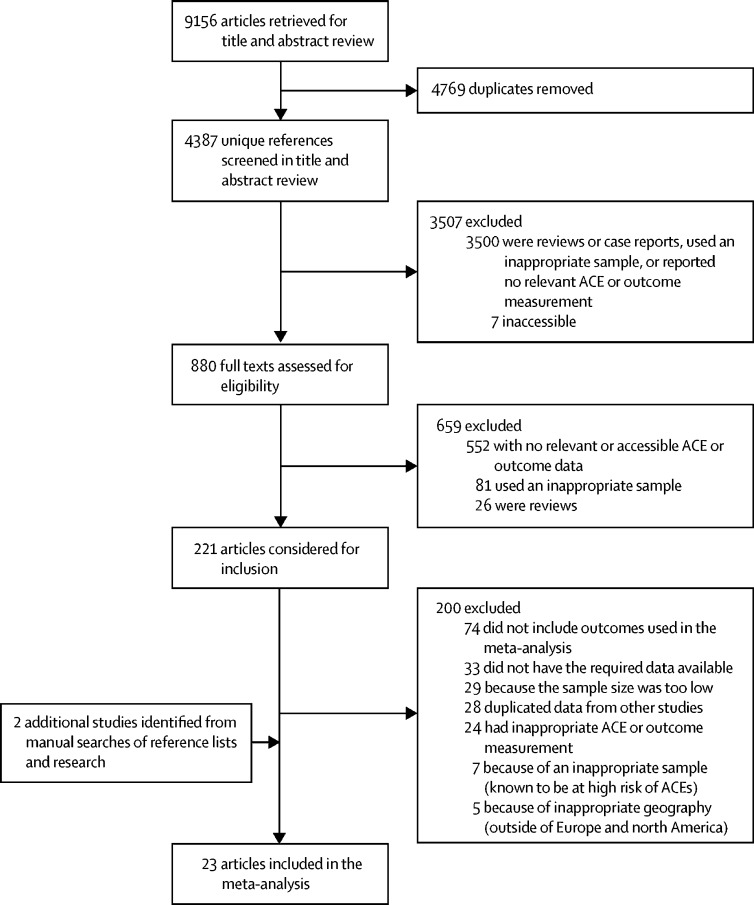
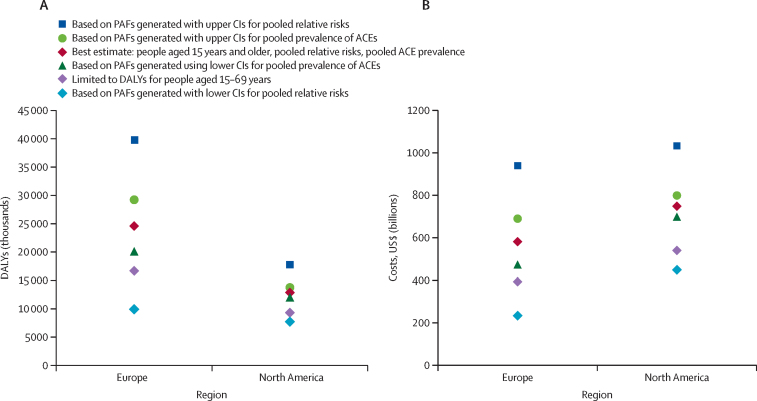
BACKGROUND: An increasing number of studies are identifying associations between adverse childhood experiences (ACEs) and ill health throughout the life course. We aimed to calculate the proportions of major risk factors for and causes of ill health that are attributable to one or multiple types of ACE and the associated financial costs. METHODS: In this systematic review and meta-analysis, we searched for studies in which risk data in individuals with ACEs were compared with these data in those without ACEs. We searched six electronic databases (MEDLINE, CINAHL, PsycINFO, Applied Social Sciences Index and Abstracts, Criminal Justice Databases, and the Education Resources Information Center) for quantitative studies published between Jan 1, 1990, and July 11, 2018, that reported risks of health-related behaviours and causes of ill health in adults that were associated with cumulative measures of ACEs (ie, number of ACEs). We included studies in adults in populations that did not have a high risk of ACEs, that had sample sizes of at least 1000 people, and that provided ACE prevalence data. We calculated the pooled RR for risk factors (harmful alcohol use, illicit drug use, smoking, and obesity) and causes of ill health (cancer, diabetes, cardiovascular disease, respiratory disease, anxiety, and depression) associated with ACEs. RRs were used to estimate the population-attributable fractions (PAFs) of risk attributable to ACEs and the disability-adjusted life-years (DALYs) and financial costs associated with ACEs. This study was prospectively registered in PROSPERO (CRD42018090356). FINDINGS: Of 4387 unique articles found following our initial search, after review of the titles (and abstracts, when the title was relevant), we assessed 880 (20%) full-text articles. We considered 221 (25%) full-text articles for inclusion, of which 23 (10%) articles met all selection criteria for our meta-analysis. We found a pooled prevalence of 23·5% of individuals (95% CI 18·7-28·5) with one ACE and 18·7% (14·7-23·2) with two or more ACEs in Europe (from ten studies) and of 23·4% of individuals (22·0-24·8) with one ACE and 35·0% (31·6-38·4) with two or more ACEs in north America (from nine studies). Illicit drug use had the highest PAFs associated with ACEs of all the risk factors assessed in both regions (34·1% in Europe; 41·1% in north America). In both regions, PAFs of causes of ill health were highest for mental illness outcomes: ACEs were attributed to about 30% of cases of anxiety and 40% of cases of depression in north America and more than a quarter of both conditions in Europe. Costs of cardiovascular disease attributable to ACEs were substantially higher than for most other causes of ill health because of higher DALYs for this condition. Total annual costs attributable to ACEs were estimated to be US$581 billion in Europe and $748 billion in north America. More than 75% of these costs arose in individuals with two or more ACEs. INTERPRETATION: Millions of adults across Europe and north America live with a legacy of ACEs. Our findings suggest that a 10% reduction in ACE prevalence could equate to annual savings of 3 million DALYs or $105 billion. Programmes to prevent ACEs and moderate their effects are available. Rebalancing expenditure towards ensuring safe and nurturing childhoods would be economically beneficial and relieve pressures on health-care systems. FUNDING: World Health Organization Regional Office for Europe.
Overview
The claims and statistics of this paper haven’t been checked yet.
Run the check — free, no account needed. It reads the open-access text and checks the sources it cites.
Integrity signals
Registry
Cites
Statistics
Figures
Verification
Claims the paper makes
The claims and statistics of this paper haven’t been checked yet.
Run the check — free, no account needed. It reads the open-access text and checks the sources it cites.
Self-check
Percentages, sums and reported differences re-computed from the paper’s own numbers.
The self-check needs the paper’s full text.
Citations
Cites
Felitti, V. J., Anda, R. F., Nordenberg, D., Williamson, D. F., Spitz, A. M., Edwards, V., Koss, M. P., & Marks, J. S. (1998) · American Journal of Preventive Medicine · doi:10.1016/s0749-3797(98)00017-8 · Cited by 18,943
Child abuse: Adolescent records vs. adult recall
Femina, D. D., Yeager, C. A., & Lewis, D. O. (1990) · Child Abuse & Neglect · doi:10.1016/0145-2134(90)90033-p · Cited by 8,820
Hughes, K., Bellis, M. A., Hardcastle, K. A., Sethi, D., Butchart, A., Mikton, C., Jones, L., & Dunne, M. P. (2017) · The Lancet Public Health · doi:10.1016/s2468-2667(17)30118-4 · Cited by 5,255
Self-citationAnda, R. F., Felitti, V. J., Bremner, J. D., Walker, J. D., Whitfield, C., Perry, B. D., Dube, S. R., & Giles, W. H. (2006) · European archives of psychiatry and clinical neuroscience · doi:10.1007/s00406-005-0624-4 · Cited by 4,292
The Lancet Commission on global mental health and sustainable development
Patel, V., Saxena, S., Lund, C., Thornicroft, G., Baingana, F., Bolton, P., Chisholm, D., Collins, P. Y., Cooper, J. L., Eaton, J., et al. (2018) · The Lancet · doi:10.1016/s0140-6736(18)31612-x · Cited by 3,692
García‐Moreno, C., Pallitto, C., Devries, K. M., Stöckl, H., Watts, C. G., & Abrahams, N. (2013) · Cited by 3,342
The global prevalence of common mental disorders: a systematic review and meta-analysis 1980–2013
Steel, Z., Marnane, C., Iranpour, C., Chey, T., Jackson, J. W., Patel, V., & Silove, D. (2014) · International Journal of Epidemiology · doi:10.1093/ije/dyu038 · Cited by 2,846
Validity of adult retrospective reports of adverse childhood experiences: review of the evidence
Hardt, J., & Rutter, M. (2004) · Journal of Child Psychology and Psychiatry · doi:10.1111/j.1469-7610.2004.00218.x · Cited by 2,827
Adverse childhood experiences, allostasis, allostatic load and age-related disease
Danese, A., & McEwen, B. S. (2012) · Physiology & Behavior · doi:10.1016/j.physbeh.2011.08.019 · Cited by 2,140
Use and misuse of population attributable fractions
Rockhill, B., Newman, B., & Weinberg, C. (1998) · American Journal of Public Health · doi:10.2105/ajph.88.1.15 · Cited by 1,683
Cited by
Sorted by citations
Merrick, M. T., Ford, D. C., Ports, K. A., Guinn, A. S., Chen, J., Klevens, J., Metzler, M. M., Jones, C. M., Simon, T. R., Daniel, V. M., et al. (2019) · MMWR Morbidity and Mortality Weekly Report · doi:10.15585/mmwr.mm6844e1 · Cited by 698
“These findings are consistent with those from similar analyses conducted in England, Europe, and North America (1,2) and suggest that preventing adverse childhood experiences might reduce occurrences of the outcomes examined, with potential reductions ranging from 1.”
ResultAdversity in childhood is linked to mental and physical health throughout life
Nelson, C. A., Bhutta, Z. A., Burke Harris, N., Danese, A., & Samara, M. (2020) · BMJ · doi:10.1136/bmj.m3048 · Cited by 741
McKay, M. T., Cannon, M., Chambers, D., Conroy, R. M., Coughlan, H., Dodd, P., Healy, C., O’Donnell, L., & Clarke, M. C. (2021) · Acta Psychiatrica Scandinavica · doi:10.1111/acps.13268 · Cited by 548
The potential impact of the COVID-19 pandemic on child growth and development: a systematic review
Araújo, L. A. D., Veloso, C. F., Souza, M. D. C., Azevedo, J. M. C. D., & Tarro, G. (2021) · Jornal de Pediatria · doi:10.1016/j.jped.2020.08.008 · Cited by 410
Lin, L., Wang, H., Lu, C., Chen, W., & Guo, V. Y. (2021) · JAMA Network Open · doi:10.1001/jamanetworkopen.2021.30143 · Cited by 320
Metadata
- Authors
- Bellis, M. A., Hughes, K., Ford, K., Ramos Rodriguez, G., Sethi, D., & Passmore, J.
- Affiliations
- Bangor University (GB)
- World Health Organization Regional Office for Europe (DK)
- Corresponding author
- Bellis, Mark A
- Venue
- The Lancet Public Health
- Publisher
- Elsevier BV
- Published
- 2019-10
- Volume
- 4
- Issue
- 10
- Pages
- e517-e528
- ISSN
- 2468-2667 (ISSN-L)
- PMC
- PMC7098477
- OpenAlex
- W2971937136
- Cited by
- 1,032
- References
- 51
- Citations by year
- 2026: 132 · 2025: 178 · 2024: 216 · 2023: 161 · 2022: 167 · 2021: 118 · 2020: 57 · 2019: 2
- FWCI
- 13.65
- Type
- journal article
- Language
- en
- Open access
- gold
- doi.org
- Licence
- Locations
- The Lancet Public Health (publishedVersion, cc-by)
- PubMed Central (publishedVersion, cc-by)
- PubMed (publishedVersion)
- Bangor University Research Portal (Bangor University) (publishedVersion, other-oa)
- Liverpool John Moores University (acceptedVersion)
- DOAJ (DOAJ: Directory of Open Access Journals) (submittedVersion)
- Topics
- Social Sciences › Psychology › Clinical Psychology › Child Abuse and Trauma
- Social Sciences › Sociology and Political Science › Child Welfare and Adoption
- Social Sciences › Health › Intimate Partner and Family Violence
- Keywords
- adverse childhood experiences, life course health, population attributable fraction, disability-adjusted life years, health care costs, alcohol consumption, illicit drug use, smoking, obesity, cancer, diabetes mellitus, cardiovascular disease, respiratory diseases, anxiety, depression, health disparities
- MeSH terms
- Adult Survivors of Child Adverse Events, Adverse Childhood Experiences, Costs and Cost Analysis, Europe, Health Status, Humans, North America
About these checks
Registry, retraction, Cites and statistics results are computed, not judged, with one exception: a printed reference that no index lists is read once by a model before it counts as a citation error. Claims are extracted by a model and kept only when their quote appears verbatim in the text; each cited source is then checked, with a model’s help, for whether it says what the claim relies on. Those verdicts can be wrong — read the claim’s quote and the cited source before relying on one.
Statistics and arithmetic are recomputed, not judged.
Confidence bands are shown only for fields calibrated on our annotated test set. None is calibrated yet, so no band is shown.
What counts as a claim ›How we measure confidence ›How we check this ›
Are you an author, or do you see a problem with this page? Request a review
