

The impact of air pollution on deaths, disease burden, and life expectancy across the states of India: the Global Burden of Disease Study 2017
Open accessThe DOI matches its Crossref record; 39 of the 42 references it cites were found in a registry or an index.
Abstract
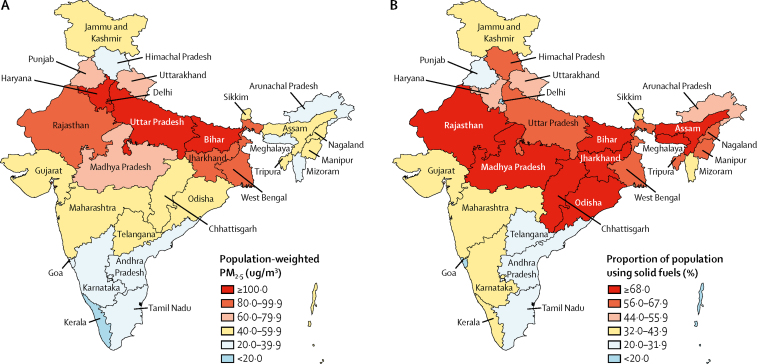
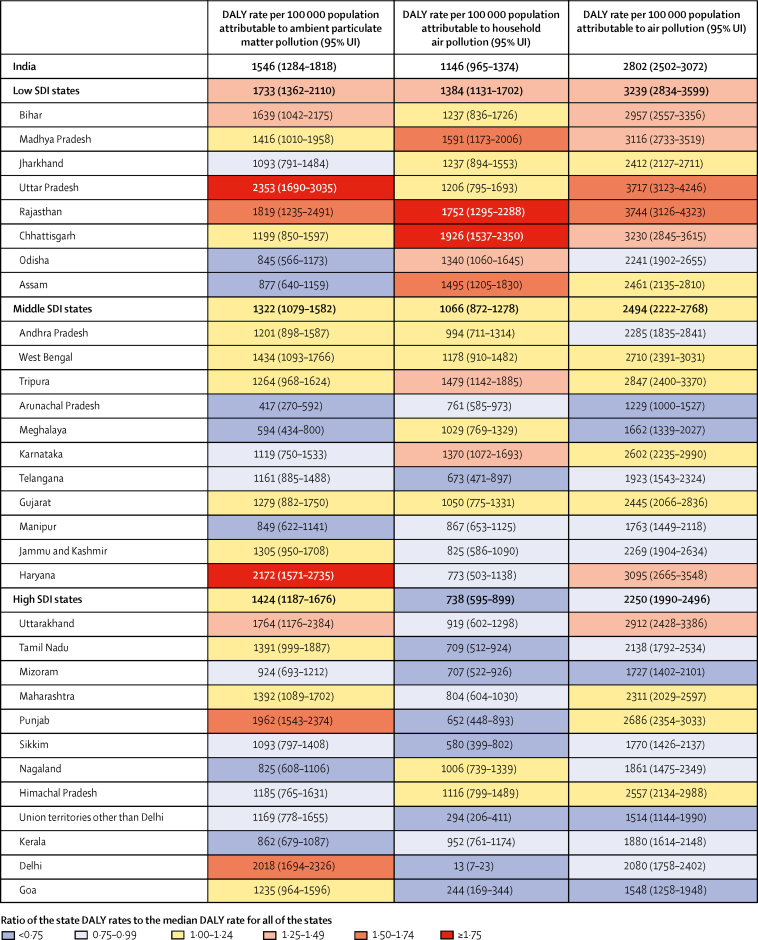
Background Air pollution is a major planetary health risk, with India estimated to have some of the worst levels globally. To inform action at subnational levels in India, we estimated the exposure to air pollution and its impact on deaths, disease burden, and life expectancy in every state of India in 2017. Methods We estimated exposure to air pollution, including ambient particulate matter pollution, defined as the annual average gridded concentration of PM 2.5 , and household air pollution, defined as percentage of households using solid cooking fuels and the corresponding exposure to PM 2.5 , across the states of India using accessible data from multiple sources as part of the Global Burden of Diseases, Injuries, and Risk Factors Study (GBD) 2017. The states were categorised into three Socio-demographic Index (SDI) levels as calculated by GBD 2017 on the basis of lag-distributed per-capita income, mean education in people aged 15 years or older, and total fertility rate in people younger than 25 years. We estimated deaths and disability-adjusted life-years (DALYs) attributable to air pollution exposure, on the basis of exposure–response relationships from the published literature, as assessed in GBD 2017; the proportion of total global air pollution DALYs in India; and what the life expectancy would have been in each state of India if air pollution levels had been less than the minimum level causing health loss. Findings The annual population-weighted mean exposure to ambient particulate matter PM 2·5 in India was 89·9 μg/m 3 (95% uncertainty interval [UI] 67·0–112·0) in 2017. Most states, and 76·8% of the population of India, were exposed to annual population-weighted mean PM 2·5 greater than 40 μg/m 3 , which is the limit recommended by the National Ambient Air Quality Standards in India. Delhi had the highest annual population-weighted mean PM 2·5 in 2017, followed by Uttar Pradesh, Bihar, and Haryana in north India, all with mean values greater than 125 μg/m 3 . The proportion of population using solid fuels in India was 55·5% (54·8–56·2) in 2017, which exceeded 75% in the low SDI states of Bihar, Jharkhand, and Odisha. 1·24 million (1·09–1·39) deaths in India in 2017, which were 12·5% of the total deaths, were attributable to air pollution, including 0·67 million (0·55–0·79) from ambient particulate matter pollution and 0·48 million (0·39–0·58) from household air pollution. Of these deaths attributable to air pollution, 51·4% were in people younger than 70 years. India contributed 18·1% of the global population but had 26·2% of the global air pollution DALYs in 2017. The ambient particulate matter pollution DALY rate was highest in the north Indian states of Uttar Pradesh, Haryana, Delhi, Punjab, and Rajasthan, spread across the three SDI state groups, and the household air pollution DALY rate was highest in the low SDI states of Chhattisgarh, Rajasthan, Madhya Pradesh, and Assam in north and northeast India. We estimated that if the air pollution level in India were less than the minimum causing health loss, the average life expectancy in 2017 would have been higher by 1·7 years (1·6–1·9), with this increase exceeding 2 years in the north Indian states of Rajasthan, Uttar Pradesh, and Haryana. Interpretation India has disproportionately high mortality and disease burden due to air pollution. This burden is generally highest in the low SDI states of north India. Reducing the substantial avoidable deaths and disease burden from this major environmental risk is dependent on rapid deployment of effective multisectoral policies throughout India that are commensurate with the magnitude of air pollution in each state. Funding Bill & Melinda Gates Foundation; and Indian Council of Medical Research, Department of Health Research, Ministry of Health and Family Welfare, Government of India.
Overview
The claims and statistics of this paper haven’t been checked yet.
Free: it reads the open-access text and checks the first 5 claims that cite a source we can check. Create a free account to check every claim.
Integrity signals
Registry
Cites
Statistics
Figures
Verification
Claims the paper makes
The claims and statistics of this paper haven’t been checked yet.
Free: it reads the open-access text and checks the first 5 claims that cite a source we can check. Create a free account to check every claim.
Self-check
Percentages, sums and reported differences re-computed from the paper’s own numbers.
The self-check needs the paper’s full text.
Citations
Cites
Cohen, A. J., Brauer, M., Burnett, R., Anderson, H. R., Frostad, J., Estep, K., Balakrishnan, K., Brunekreef, B., Dandona, L., Dandona, R., et al. (2017) · The Lancet · doi:10.1016/s0140-6736(17)30505-6 · Cited by 6,583
Self-citationStanaway, J. D., Afshin, A., Gakidou, E., Lim, S. S., Abate, D., Abate, K. H., Abbafati, C., Abbasi, N., Abbastabar, H., Abd-Allah, F., et al. (2018) · The Lancet · doi:10.1016/s0140-6736(18)32225-6 · Cited by 4,943
Self-citationThe Lancet Commission on pollution and health
Landrigan, P. J., Fuller, R., Acosta, N. J. R., Adeyi, O., Arnold, R., Basu, N. (., Baldé, A. B., Bertollini, R., Bose-O'Reilly, S., Boufford, J. I., et al. (2018) · The Lancet · doi:10.1016/s0140-6736(17)32345-0 · Cited by 4,929
Self-citationKyu, H. H., Abate, D., Abate, K. H., Abay, S. M., Abbafati, C., Abbasi, N., Abbastabar, H., Abd-Allah, F., Abdela, J., Abdelalim, A., et al. (2018) · The Lancet · doi:10.1016/s0140-6736(18)32335-3 · Cited by 4,081
Self-citationGlobal estimates of mortality associated with long-term exposure to outdoor fine particulate matter
Burnett, R., Chen, H., Szyszkowicz, M., Fann, N., Hubbell, B., Pope, C. A., Apte, J. S., Brauer, M., Cohen, A., Weichenthal, S., et al. (2018) · Proceedings of the National Academy of Sciences · doi:10.1073/pnas.1803222115 · Cited by 2,504
Self-citationBurnett, R. T., Pope, C. A., Ezzati, M., Olives, C., Lim, S. S., Mehta, S., Shin, H. H., Singh, G., Hubbell, B., Brauer, M., et al. (2014) · Environmental Health Perspectives · doi:10.1289/ehp.1307049 · Cited by 1,901
Self-citationAmbient Air Pollution Exposure Estimation for the Global Burden of Disease 2013
Brauer, M., Freedman, G., Frostad, J., van Donkelaar, A., Martin, R. V., Dentener, F., Dingenen, R. V., Estep, K., Amini, H., Apte, J. S., et al. (2016) · Environmental Science & Technology · doi:10.1021/acs.est.5b03709 · Cited by 1,215
Self-citationDicker, D., Nguyen, G., Abate, D., Abate, K. H., Abay, S. M., Abbafati, C., Abbasi, N., Abbastabar, H., Abd-Allah, F., Abdela, J., et al. (2018) · The Lancet · doi:10.1016/s0140-6736(18)31891-9 · Cited by 1,209
Self-citationvan Donkelaar, A., Martin, R. V., Brauer, M., Hsu, N. C., Kahn, R. A., Levy, R. C., Lyapustin, A., Sayer, A. M., & Winker, D. M. (2016) · Environmental Science & Technology · doi:10.1021/acs.est.5b05833 · Cited by 1,206
Self-citationDandona, L., Dandona, R., Kumar, G. A., Shukla, D. K., Paul, V. K., Balakrishnan, K., Prabhakaran, D., Tandon, N., Salvi, S., Dash, A. P., et al. (2017) · The Lancet · doi:10.1016/s0140-6736(17)32804-0 · Cited by 1,059
Self-citation
Research works printed but not linked: 9
- Press Information Bureau Ministry of Environment Forest and Climate Change Government of India India's intended nationally determined contribution is balanced and comprehensive: Environment Minister. New Delhi http://pib.nic.in/newsite/PrintRelease.aspx?relid=128403 2015
- Press Information Bureau, Ministry of Environment, Forest and Climate Change, Government of India. Government has made serious efforts to deal with air pollution: Environment Ministry. pib.nic.in/Pressreleaseshare.aspx?PRID=1531036 (accessed Sept 14, 2018).
- Press Information Bureau Ministry of Environment Forest and Climate Change Government of India National Clean Air Programme http://pib.nic.in/newsite/mbErel.aspx?relid=175437 2018
- Press Information Bureau Ministry of Road Transport and Highways Government of India Government decides to directly shift from BS-IV to BS-VI emission norms http://pib.nic.in/newsite/PrintRelease.aspx?relid=134232 2016
- Press Information Bureau Ministry of Environment Forest and Climate Change Government of India Environment Ministry launches a regional project to tackle stubble burning http://pib.nic.in/newsite/PrintRelease.aspx?relid=174977 Dec 28, 2017
- Press Information Bureau, Ministry of Petroleum and Natural Gas, Government of India. Pradhan Mantri Ujjwala Yojana achieves 5 core mark. Aug 3, 2018. pib.nic.in/Pressreleaseshare.aspx?PRID=1541545 (accessed Sept 14, 2018).
- WHO WHO guidelines for indoor air quality: household fuel combustion 2014 World Health Organization Geneva http://apps.who.int/iris/bitstream/handle/10665/141496/9789241548885_eng.pdf?sequence=1 25577935
- Tripathi A Promoting clean and affordable cooking smarter subsidies for LPG Econ Polit Wkly 50 2015 7 8
- India Today 3-day heads up for poisonous air: govt's plan to tackle winter pollution woes India Today Oct 15, 2018 https://www.indiatoday.in/india/story/delhi-pollution-air-quality-prediction-system-launched-1368450-2018-10-15
Cited by
Items 601–700 of 1,000
Health system resilience and the health impacts of environmental degradation: A global analysis
Elkomy, S., & Jackson, T. P. (2025) · Public Health · doi:10.1016/j.puhe.2025.106048 · Cited by 5
“4,12,13,40 48 Life expectancy at age 60, reflecting health system quality, is a critical indicator of resilience against pollution-induced mortality.”
InfluentialLow-smoke fuels for residential heating linked to an increase in ultrafine particle emissions
Lin, C., Čeburnis, D., Trubetskaya, A., Lü, L., Wang, S., Liu, Y., Yuan, W., Cui, H., Smith, W., Johnson, R. L., et al. (2026) · Nature Geoscience · doi:10.1038/s41561-026-01942-1 · Cited by 5
Air quality and health benefits achievable by mitigating Indian coal-fired power plant SO2 emissions
Ghosh, S., Philip, S., Sarkar, D., Kharol, S. K., Fioletov, V., McLinden, C. A., & Dey, S. (2026) · npj Clean Air · doi:10.1038/s44407-026-00075-4 · Cited by 4
Self-citationKuldeep, K., Sisodiya, S., & Mathur, A. K. (2022) · ECS Transactions · doi:10.1149/10701.0561ecst · Cited by 4
Effect of COVID-19 on air pollution related illnesses in India
Uday, U., Bethineedi, L. D., Hasanain, M., Ghazi, B. K., Nadeem, A., Patel, P., & Khalid, Z. (2022) · Annals of Medicine and Surgery · doi:10.1016/j.amsu.2022.103871 · Cited by 4
“A study conducted by India ’ s State Level Disease Burden Initiative (SLDBI) estimates that if the air pollution levels were lower than the minimum levels associated with health loss,the average life expectancy in India would have increased by 1.7 years [5].”
InfluentialRojas‐Rueda, D., Lamsal, S., Kak, M., El-Saharty, S., & Herbst, C. H. (2024) · International Journal of Environmental Research and Public Health · doi:10.3390/ijerph21060667 · Cited by 4
Kuikel, S., Paudel, H. K., Kuinkel, D., Joshi, K., Sapkota, S., Malakar, N. K., Wang, S. Y. S., & Pokharel, B. (2025) · Atmospheric Environment X · doi:10.1016/j.aeaoa.2025.100334 · Cited by 5
Garg, A., Gupta, N. C., & Kumar, A. (2021) · Exposure and Health · doi:10.1007/s12403-021-00422-8 · Cited by 4
Disaster Preparedness and Emergency Response for Air Pollution and Related Health Extremes
Barwal, A., Bindal, S., & Gupta, A. K. (2022) · Disaster Resilience and Green Growth · doi:10.1007/978-981-16-7727-4_14 · Cited by 6
Odediran, E. T., Yusuf, O. O., & Adeniran, A. S. (2022) · Nigerian Journal of Technological Development · doi:10.4314/njtd.v19i3.3 · Cited by 4
Rao, R. S., Sasiharan, G. M., & Ganapathy, S. (2023) · Indian Journal of Occupational and Environmental Medicine · doi:10.4103/ijoem.ijoem_200_22 · Cited by 4
Field calibration protocol for optical-based air quality sensors in Indian conditions
Dhawan, S., Kumar, A., Kumar, M., Khare, M., Nagendra, S. M. S., & Mehta, D. S. (2024) · Materials Today Proceedings · doi:10.1016/j.matpr.2024.03.020 · Cited by 4
Chhabra, D., Jahangiri, K., Sohrabizadeh, S., Ghomian, Z., & Shahsavani, A. (2024) · Cureus · doi:10.7759/cureus.64630 · Cited by 4
“India contributed 18.1% of the global population but had 26.2% of the global air pollution disability-associated life years (DALYs) in 2017 [5].”
BackgroundInfluentialZahrani, A., Roosmawarni, A., & Senoaji, F. (2024) · Improvement Jurnal Manajemen dan Bisnis · doi:10.30651/imp.v4i2.23907 · Cited by 4
Jangid, M., Chaubey, S., & Mishra, A. K. (2019) · Energy, environment, and sustainability · doi:10.1007/978-981-15-0540-9_9 · Cited by 4
Patra, S. S., Das, T., & Boopathy, R. (2021) · Aerosol Science and Engineering · doi:10.1007/s41810-021-00097-3 · Cited by 4
Antimicrobials in Livestock Production and Its Cross-Domain Dynamics
Pokharel, B. B., & Karna, S. R. (2022) · Springer eBooks · doi:10.1007/978-3-030-84126-3_1 · Cited by 5
Fuzzy-based missing value imputation technique for air pollution data
Mustafi, A., Middya, A. I., & Roy, S. (2022) · Artificial Intelligence Review · doi:10.1007/s10462-022-10168-7 · Cited by 4
“In recent years, pollution has been a very pressing issue all over India, and around the world (Balakrishnan et al. 2019; Rajak and Chattopadhyay 2020).”
BackgroundSpatial and Temporal Variations on Air Quality Prediction Using Deep Learning Techniques
Vandhana, S., & Anuradha, J. (2023) · Cybernetics and Information Technologies · doi:10.2478/cait-2023-0045 · Cited by 4
Williams, I., Daniel, J., Mansur, A. H., Christopher, D. J., & Krishna, M. T. (2024) · Clinical & Experimental Allergy · doi:10.1111/cea.14477 · Cited by 4
Self-citationAn Introduction to the Geography of Health
Anthamatten, P., & Hazen, H. (2026) · Routledge eBooks · doi:10.4324/9781003614128 · Cited by 4
Trends in advanced materials for sustainable environmental remediation
Kumar, V., Younis, S. A., Vikrant, K., & Kim, K. (2022) · Elsevier eBooks · doi:10.1016/b978-0-323-90485-8.00013-8 · Cited by 4
Household air pollution and COVID-19 risk in India: A potential concernPreprint
Sharma, R., & Hossain, M. M. (2020) · SocArXiv (OSF Preprints) · doi:10.31235/osf.io/4ghde · Cited by 5
Devi, N. L., Yadav, I. C., & Kumar, A. (2024) · Atmosphere · doi:10.3390/atmos15080878 · Cited by 3
The influence of local and regional sources on concentrations of fine particulate matter in Delhi
Srivastava, D., Alam, M. S., Rooney, D. J., Crilley, L. R., Kramer, L. J., Saksakulkrai, S., Dhawan, S., Khare, M., Shivani, Gadi, R., et al. (2025) · Atmospheric Pollution Research · doi:10.1016/j.apr.2025.102476 · Cited by 3
COVID-19 lockdown was insufficient to bring India’s PM 2.5 levels below national standards
Nandi, I., Kumar, A., Imam, F., Ganguly, D., & Dey, S. (2025) · Environmental Research Communications · doi:10.1088/2515-7620/add3d4 · Cited by 3
Self-citationIndoor Air Pollution in Urban Environments: A Case Study of Air Quality in Pune, Maharashtra
Nachankar, R. R., Somalkar, A. V., Sharma, A., & Mane, A. V. (2025) · World Journal of Environmental Biosciences · doi:10.51847/wqw5nbkwtx · Cited by 3
Power quality control in electric vehicle connected PV-Grid using soft computing techniques
Kishore, M. P., Shrivastava, A., & Soni, A. (2025) · Soft Computing · doi:10.1007/s00500-025-10666-0 · Cited by 3
Self-citationWang, E., Li, S., Wu, Y., Liu, H., Yang, L., & Zhou, T. (2025) · Ecotoxicology and Environmental Safety · doi:10.1016/j.ecoenv.2025.118913 · Cited by 3
Air Pollution in India: Ecological, Health, and Socio-Economic Implications - A Review
Tomar, D. K. (2025) · Journal for Research in Applied Sciences and Biotechnology · doi:10.55544/jrasb.4.2.29 · Cited by 3
Pramanik, P., Mondal, T., Arosh, S., & Saha, M. (2025) · Sustainability · doi:10.3390/su17198924 · Cited by 3
Adeagbo, A., Muhammad, T., & Pai, M. (2025) · Clinical Gerontologist · doi:10.1080/07317115.2025.2572798 · Cited by 3
“5 concentrations compared to states like Kerala or Assam, which have relatively better air quality (Balakrishnan et al., 2019; Bhuyan et al., 2025).”
Chen, Y., & Chen, M. (2025) · BMC Public Health · doi:10.1186/s12889-025-24456-8 · Cited by 3
“Low-and middle-income countries (LMICs) often face challenges such as a reliance on single-source energy structures (e.g., biomass fuels), high population density, rapid urbanization, and insufficient public healthcare services, which increase the exposure risk for children[^23].”
Improving Air Quality Forecasts with LSTM and SHAP Explainability: A Case Study in Jakarta
Radjabaycolle, J. E. T., Wattimena, E. M. C., & Pattiradjawane, V. E. (2025) · Journal of Embedded Systems Security and Intelligent Systems · doi:10.59562/jessi.v6i3.9512 · Cited by 3
“Both acute and chronic contact with air pollutants has been consistently linked to adverse health outcomes [4].”
Karigowda, Jain, K., Imran, M., Un-Nabi, M., Baig, A., Patra, S., Raman, R. S., & Habib, G. (2026) · Atmospheric Environment · doi:10.1016/j.atmosenv.2026.121825 · Cited by 3
City dwellers' perception of environmental hazards and risks in Dhaka city
Baser, S., & Rahman, M. M. (2021) · Journal of the Asiatic Society of Bangladesh Science · doi:10.3329/jasbs.v47i1.54186 · Cited by 3
A systems lens to evaluate the compound human health impacts of anthropogenic activities
Singh, D., Karambelas, A., Chhatre, A., DeFries, R., Kinney, P. L., & Davis, K. F. (2021) · One Earth · doi:10.1016/j.oneear.2021.08.006 · Cited by 4
“The disease burden and premature mortality attributable to air pollution in India is among the highest globally, contributing to millions of premature deaths annually.(14,15,41,106,107) In addition, air pollution and climate change have simultaneously reduced the yields of major cereal crops and agricultural productio…”
BackgroundGaussian process-based analysis of the nitrogen dioxide at Madrid Central Low Emission Zone
Gómez-González, J. L., & Cárdenas‐Montes, M. (2024) · Logic Journal of IGPL · doi:10.1093/jigpal/jzae041 · Cited by 3
Strategic Urban Air Quality Improvement: Perspectives on Public Health
Patra, B., Pradhan, S. N., & Paulraj, R. (2024) · Springer eBooks · doi:10.1007/978-981-97-1363-9_15 · Cited by 3
Buwaniwal, A., Joshi, M., Sharma, V., Gupta, G., Khan, A., Kansal, S., & Sapra, B. K. (2024) · Chemosphere · doi:10.1016/j.chemosphere.2024.142949 · Cited by 3
Islamova, A. G., Tkachenko, P. P., & Strizhak, P. A. (2025) · Journal of Aerosol Science · doi:10.1016/j.jaerosci.2025.106537 · Cited by 3
Jain, Y., Kumar, V., Garaga, R., & Kota, S. H. (2025) · Environmental Pollution · doi:10.1016/j.envpol.2025.126223 · Cited by 3
Impact of residential cooking and heating on temporal changes of black carbon in rural India
Chakraborty, M., Jain, S., Thornton, S., Aklin, M., Giang, A., & Zimmerman, N. (2025) · Scientific Reports · doi:10.1038/s41598-025-18384-1 · Cited by 4
Air pollution and cardiovascular disease: Time for a wake-up call
Manoria, P. C. (2025) · Heart India · doi:10.4103/heartindia.heartindia_50_25 · Cited by 3
Artificial neural network modeling and exposure assessments: a new scaling approach
Gupta, S. (2019) · Human and Ecological Risk Assessment An International Journal · doi:10.1080/10807039.2019.1689354 · Cited by 4
Active Learning for Air Quality Station Location Recommendation
Narayanan, S. D., Agnihotri, A., & Batra, N. (2020) · Joint International Conference on Data Science & Management of Data (CODS-COMAD) · doi:10.1145/3371158.3371208 · Cited by 3
“Motivation: Recent years have seen a decline in air quality across the planet, with studies suggesting that a significant proportion of global population has reduced life expectancy by up to 4 years [1, 2, 5].”
BackgroundTrace gases and PM2.5-bound metal abundance over a tropical urban environment, South India
Abdul Shukkur, M., Gopikrishna, V. G., Vishnu, N. G., & Mohan, M. (2021) · Journal of Atmospheric Chemistry · doi:10.1007/s10874-021-09420-1 · Cited by 3
“It is, therefore, highly significant to understand the atmospheric pollutant concentration in smaller cities and rural areas (Pant et al. 2015; Balakrishnan et al. 2019).”
BackgroundIşınkaralar, Ö., & Bayraktar, E. P. (2022) · Kastamonu University Journal of Engineering and Sciences · doi:10.55385/kastamonujes.1177807 · Cited by 3
Consumer Motivation behind the Use of Ecological Charcoal in Cameroon
Mfokeu, A. M., Chrysostome, E., Gueyié, J., & Ngapna, O. E. M. (2023) · Sustainability · doi:10.3390/su15031749 · Cited by 5
Community kitchen tandoors (CKT)-a potential candidate for air pollution mitigation strategies?
Naved, M. M., Wathore, R., Kumbhare, H., Gupta, A., & Labhsetwar, N. K. (2023) · Environmental Science and Pollution Research · doi:10.1007/s11356-023-26176-1 · Cited by 3
“Ambient air pollution is categorised as a major health risk, with India exhibiting the highest levels globally (Balakrishnan et al. 2019).”
BackgroundGolzarpour, M., Santana, P., Sajjadi, H., Harouni, G. G., da Costa, C. H., Ziapour, A., Azizi, S. A., Akbari, M., & Afrashteh, S. (2023) · Frontiers in Public Health · doi:10.3389/fpubh.2023.1134411 · Cited by 3
Bio Energy Sources for Sustainable Development: Affordable and Clean Energy Goal in India
Vivek, C. M., Srividhya, P. K., Ramkumar, P., & Sivasubramanian, M. (2023) · Springer eBooks · doi:10.1007/978-3-031-24942-6_26 · Cited by 3
Kumar, A., & Attri, A. K. (2023) · Atmospheric Pollution Research · doi:10.1016/j.apr.2023.101945 · Cited by 3
Pal, R., Kumar, L., Anand, S., & Bharadvaja, N. (2024) · Environmental science and engineering · doi:10.1007/978-3-031-45956-6_5 · Cited by 3
The Health Menace of Myriad Air Pollutants: An Indian Perspective
Satpathy, P., Mishra, M., Nath, J., Boopathy, R., & Das, T. (2024) · Springer eBooks · doi:10.1007/978-981-97-1363-9_14 · Cited by 3
Yapay Zekâ Tabanlı Hava Kalitesi İyileştirme Stratejilerinin Değerlendirilmesi
Pekdoğan, T. (2024) · Eebbm bilimsel dergisi. · doi:10.61512/emobd.1498119 · Cited by 6
Vishisth, K., Krishnan, R., Ayantika, D. C., Swapna, P., Singh, M., Sandeep, N., Vellore, R. K., & Rao, V. B. (2024) · Environmental Research Climate · doi:10.1088/2752-5295/ad6f3c · Cited by 6
Jain, R. R., Sahni, B. K., Mishra, I., & Izhar, S. (2024) · Atmospheric Environment X · doi:10.1016/j.aeaoa.2024.100290 · Cited by 3
EXAMINING THE LOCATIONAL APPROACH TOWARDS OPTIMAL SITING OF AIR QUALITY MONITORING STATIONS IN INDIA
Choudhary, S., Kaur, H., Saharan, V. K., & Saharan, V. K. (2024) · Environmental Engineering and Management Journal · doi:10.30638/eemj.2024.093 · Cited by 3
Thakkar, N., George, P. E., Alam, P., Yasobant, S., Saxena, D. B., & Shah, J. (2024) · Indian Journal of Community Medicine · doi:10.4103/ijcm.ijcm_73_24 · Cited by 3
“[40,41] Further research is needed to address these limitations and to evaluate the effectiveness of state-specific initiatives in India.”
Dolui, M., & Sarkar, S. (2025) · Air Quality Atmosphere & Health · doi:10.1007/s11869-025-01770-z · Cited by 3
“Higher levels of AAP, especially near the Indo-Gangetic Plain, are found to be a leading factor in the burden of multiple chronic non-communicable diseases (NCDs) related to air pollution in India (Balakrishnan et al. 2019).”
The energy-health-environment nexus: assessing the transboundary impacts of coal-fired power plants
Dhar, R., Sarkar, S., Luo, C., Anand, M., Dasgupta, S., Neogi, U., Bossios, A., Zamir, R., Shoeb, M., & Routh, J. (2025) · Frontiers in Public Health · doi:10.3389/fpubh.2025.1581460 · Cited by 3
Empirical analysis of life quality based on air pollution in states of India
Sharma, N., Taneja, S., & Bhatt, A. (2020) · Journal of Statistics and Management Systems · doi:10.1080/09720510.2020.1799579 · Cited by 3
Climate Change, Air Pollution, and Sustainable Development Goal 3: An Indian Perspective
Prasad, U., & Singh, S. (2020) · Springer eBooks · doi:10.1007/978-981-15-7301-9_14 · Cited by 3
“In fact, the Global Burden of Disease Study, 2017, shows that that India accounts for a higher proportion of global health loss, owing to air pollution as compared to the country’s proportion of the worldwide population (Balakrishnan et al. 2019).”
BackgroundSelf-citationShivani, & Gadi, R. (2021) · Air Quality Atmosphere & Health · doi:10.1007/s11869-021-01005-x · Cited by 3
“Air pollution is the second largest contributor to the disease burden of India (Balakrishnan et al. 2019).”
BackgroundInfluentialShort-Term Field Evaluation of Low-Cost Sensors Operated by the “AirSensEUR” Platform
Pichlhöfer, A., & Korjenić, A. (2022) · Energies · doi:10.3390/en15155688 · Cited by 5
A Comparative Study of Pollution Levels in Major Cities of India During Covid-19 in India
Kapse, M., Akhil, B., Elangovan, N., Sharma, V., & Rajagopal, K. (2023) · Australasian Accounting Business and Finance Journal · doi:10.14453/aabfj.v17i1.16 · Cited by 3
Internet of Things Enabled Framework for Sustainable Mobility and Clean Environment in Smart Cities
Kaur, S., & Sharma, S. (2023) · Communications in computer and information science · doi:10.1007/978-3-031-37303-9_21 · Cited by 3
(2019) · Globalization and Business · doi:10.35945/gb.2019.07 · Cited by 3
Singh, B. P., Dhalan, S. S., Kumari, S., & Razi, A. (2022) · Research Square · doi:10.21203/rs.3.rs-1918100/v1 · Cited by 3
A Study of Air Quality in the Coalfields of NSW, Australia and Telangana, India
Kamath, H., Srikanth, R., & Chauhan, C. (2022) · Journal of the Indian Society of Remote Sensing · doi:10.1007/s12524-022-01557-0 · Cited by 2
“Balakrishnan et al. (2019) found 77 per cent of Indians are exposed to annual population weighted mean PM2.”
BackgroundForecasting Air Pollution of Urban Chennai Localities using Artificial Intelligence
Faiz, R., Agarwal, T., & Rajeswari, D. (2024) · International Conference on Applied Artificial Intelligence and Computing (ICAAIC) · doi:10.1109/icaaic60222.2024.10575220 · Cited by 2
The determinants of household cooking fuel transition: evidence from rural India
Barik, N., & Padhi, P. (2024) · Environment Development and Sustainability · doi:10.1007/s10668-024-05392-w · Cited by 3
Source-specific fine particulates emission linked to prevalence of ophthalmic cases in India
Sahu, S. K., Mishra, A., Mangaraj, P., Yadav, R., Sahu, M. C., Beig, G., Tyagi, B., Gunthe, S. S., Prusty, B. A. K., & Mishra, M. (2025) · Scientific Reports · doi:10.1038/s41598-024-82914-6 · Cited by 2
Self-citationTrends of leading pollutant in a highly polluted global city: processes involved
Radhadevi, L., Bandaru, M., Yarragunta, Y., Beig, G., Rathod, A., & Singh, S. (2025) · Environmental Monitoring and Assessment · doi:10.1007/s10661-025-14243-8 · Cited by 2
“High levels of particulate matter concentrations affected human health and caused broader concern in recent years (Balakrishnan et al., 2019; Geng et al., 2021).”
Self-citationMathematical Modeling of the Impact of Desert Dust on Asthma Dynamics
Ajlan, Z. S. A., & El-Shahed, M. (2025) · Axioms · doi:10.3390/axioms14080639 · Cited by 2
Goswami, A., Kapoor, H. S., Sharma, A., Jadhav, V., Jangir, R. K., & Chattu, V. K. (2025) · AIMS Public Health · doi:10.3934/publichealth.2025044 · Cited by 2
“Moreover, India’s annual average exposure to ambient particulate matter PM 2.5 is among the highest in the world, with 77% of the population having mean levels over 40 go/m³, exceeding the National Ambient Air Quality Standards set by the World Health Organization (WHO) in 2017 [17].”
InfluentialEconomic Burden of Diseases Caused by Air Pollution in Iran: A Cross‐Sectional Study
Shobeiri, N., Adel, A., & Kemmak, A. R. (2025) · Health Science Reports · doi:10.1002/hsr2.71229 · Cited by 2
“In 2019 alone, air pollution was responsible for an estimated 1.67 million deaths in India, accounting for 17.8% of the country's total mortality [8].”
InfluentialSalve, H. R., Dey, S., Arora, Y., Kapoor, S., Ghosh, S., Kumar, R., Gulati, S., Sagar, R., Datta, S. K., & Krishnan, A. (2025) · JMIR Research Protocols · doi:10.2196/72683 · Cited by 2
“…Burden of Disease Study 2017, approximately 76.8% of the Indian population lives in regions exceeding the Indian National Ambient Air Quality Standard (NAAQS) for PM 2.5 (40 µg/m 3 ), leading to an estimated 1.24 million deaths (95% UI 1.09–1.39 million) attributable to air pollution in 2017 [2].”
InfluentialSelf-citationDash, K., Behera, M. R., Degge, H. M., Nayak, S., Behera, D., & Mohanty, J. R. (2025) · Journal of Family Medicine and Primary Care · doi:10.4103/jfmpc.jfmpc_1817_24 · Cited by 2
Impact of the odd–even scheme on particulate matter reduction in Delhi traffic intersections
Rajagopal, K., Mohan, V., Sharma, M., Yadav, S. K., Sahu, V., Mishra, R. K., Gautam, S., Gurjar, B. R., & Kumar, P. (2025) · Particulate Science And Technology · doi:10.1080/02726351.2025.2558979 · Cited by 2
“Due to its status as the national capital, Delhi’s serious air pollution issues have garnered significant global attention, making it a focal point for environmental studies and policy interventions (Balakrishnan et al. 2019; Soni et al. 2024).”
Self-citationHigh risk from coincidence of extremes in particulate matter and heat in India
Tiwari, D., Mondal, A., Balasubramanian, S., Anand, A., Maji, S., & Venkataraman, C. (2026) · Environmental Research Letters · doi:10.1088/1748-9326/ae2346 · Cited by 2
Zehra, F., Ali, M. A., Mayer, A. C. R., Rajinikanth, P. S., Khan, M., & Lawrence, A. J. (2025) · ACS Omega · doi:10.1021/acsomega.5c09750 · Cited by 2
CO₂ emissions, globalization, and health: A dynamic panel analysis of life expectancy in BRICS
Audi, M., Poulin, M., Ahmad, K., & Ali, A. (2025) · Environment Development and Sustainability · doi:10.1007/s10668-025-06964-0 · Cited by 20
S, C. S. J., Gautam, S., & Kumar, R. P. (2026) · Atmospheric Pollution Research · doi:10.1016/j.apr.2026.102932 · Cited by 2
Chavda, J. K., Bharvad, K., Parmar, R., & Arora, N. (2026) · Journal of Informatics and Web Engineering · doi:10.33093/jiwe.2026.5.1.2 · Cited by 2
Sonwani, S., Sharma, R. R., Srivastava, A., & Saxena, P. (2026) · Frontiers in Sustainable Cities · doi:10.3389/frsc.2026.1775496 · Cited by 2
An evaluation of air quality in major urban areas of India
Ghosh, S., Farooqui, Z. M., Saha, J., & Biswas, J. (2026) · Environmental Research Communications · doi:10.1088/2515-7620/ae5926 · Cited by 2
Self-citationRavish, P. (2026) · Discover Atmosphere · doi:10.1007/s44292-026-00078-6 · Cited by 2
Artificial intelligence–driven air quality mapping and forecasting for extreme PM2.5 events
Rautela, K. S., Upadhyay, M., Goyal, M. K., & Taigor, S. (2026) · Physics and Chemistry of the Earth Parts A/B/C · doi:10.1016/j.pce.2026.104459 · Cited by 2
Sarkar, D., Kumar, A., Imam, F., Ghosh, S., & Dey, S. (2026) · Journal of Exposure Science & Environmental Epidemiology · doi:10.1038/s41370-026-00927-x · Cited by 2
Self-citationHealth Risk Assessment and Management of Air Pollutants
Pipal, A. S., Dubey, S., & Taneja, A. (2020) · Environmental chemistry for a sustainable world · doi:10.1007/978-981-15-3481-2_9 · Cited by 2
Nayak, B. K., & Rajan, P. (2020) · International handbooks of quality-of-life · doi:10.1007/978-3-030-50540-0_26 · Cited by 2
Unbundling Air Pollution Concerns: A Closer Look at Socio-economic Factors
Dasgupta, P., & Srikanth, K. (2021) · India studies in business and economics · doi:10.1007/978-981-33-4830-1_21 · Cited by 2
“3 reveals, recent DALYs estimate (Balakrishnan et al., 2019) suggest that there is substantial variation across states in India.”
BackgroundMethodSingh, G., Prakash, J., Ray, S. K., Yawar, M., & Habib, G. (2021) · Environmental Science and Pollution Research · doi:10.1007/s11356-021-13754-4 · Cited by 2
Toward inverting environmental injustice in Delhi
Azad, R., & Chakraborty, S. (2021) · The Economic and Labour Relations Review · doi:10.1177/10353046211017621 · Cited by 2
“A report of the Lancet Commission on Health and Pollution states that around 1.9 million people die prematurely every year due to outdoor and indoor air pollution in India (Balakrishnan et al., 2019).”
BackgroundInfluentialEffect of Pollution and Environmental Factors on Hypertension and CVD
Jaganathan, S., & Prabhakaran, D. (2022) · Updates in hypertension and cardiovascular protection · doi:10.1007/978-3-030-95734-6_7 · Cited by 3
Self-citationFasiku, T. B., Fasasi, M. K., & Amosun, A. A. (2022) · Asian Journal of Physical and Chemical Sciences · doi:10.9734/ajopacs/2022/v10i3185 · Cited by 2
Rejuvenating impact of COVID-19 lockdown on major environmental parameters: an Indian perspective
Jha, D. K., Yashvardhini, N., Samiksha, & Kumar, A. (2022) · Spatial Information Research · doi:10.1007/s41324-022-00499-6 · Cited by 5
COVID-19 Pandemic and Urban Air Quality: Delhi Region
Siddiqui, A., Halder, S., Devadas, V., & Kumar, P. (2022) · Advances in 21st century human settlements · doi:10.1007/978-981-19-6183-0_2 · Cited by 2
Metadata
- Authors
- Balakrishnan, K., Dey, S., Gupta, T., Dhaliwal, R. S., Brauer, M., Cohen, A. J., Stanaway, J. D., Beig, G., Joshi, T. K., Aggarwal, A. N., Sabde, Y., Sadhu, H., Frostad, J., Causey, K., Godwin, W., Shukla, D. K., Kumar, G. A., Varghese, C. M., Muraleedharan, P., Agrawal, A., Anjana, R. M., Bhansali, A., Bhardwaj, D., Burkart, K., Cercy, K., Chakma, J. K., Chowdhury, S., Christopher, D. J., Dutta, E., Furtado, M., Ghosh, S., Ghoshal, A. G., Glenn, S. D., Guleria, R., Gupta, R., Jeemon, P., Kant, R., Kant, S., Kaur, T., Koul, P. A., Krish, V., Krishna, B., Larson, S. L., Madhipatla, K., Mahesh, P. A., Mohan, V., Mukhopadhyay, S., Mutreja, P., Naik, N., Nair, S., Nguyen, G., Odell, C. M., Pandian, J. D., Prabhakaran, D., Prabhakaran, P., Roy, A., Salvi, S., Sambandam, S., Saraf, D., Sharma, M., Shrivastava, A., Singh, V., Tandon, N., Thomas, N. J., Torre, A., Xavier, D., Yadav, G., Singh, S., Shekhar, C., Vos, T., Dandona, R., Reddy, K. S., Lim, S. S., Murray, C. J. L., Venkatesh, S., & Dandona, L.
- Affiliations
- Sri Ramachandra Institute of Higher Education and Research (IN)
- Corresponding author
- Dandona, Lalit
- ORCID
- Balakrishnan, Kalpana
- Dey, Sagnik
- Gupta, Tarun
- Dhaliwal, R S
- Brauer, Michael
- Cohen, Aaron J
- Stanaway, Jeffrey D
- Beig, Gufran
- Aggarwal, Ashutosh N
- Sabde, Yogesh
- Causey, Kate
- Kumar, G Anil
- Varghese, Chris M
- Agrawal, Anurag
- Anjana, R M
- Bhardwaj, Deeksha
- Burkart, Katrin
- Chakma, Joy K
- Chowdhury, Sourangsu
- Christopher, D J
- Dutta, Eliza
- Ghosh, Santu
- Ghoshal, Aloke G
- Glenn, Scott D
- Guleria, Randeep
- Gupta, Rajeev
- Jeemon, Panniyammakal
- Kant, Rajni
- Kant, Surya
- Koul, Parvaiz A
- Krishna, Bhargav
- Madhipatla, Kishore
- Mahesh, P A
- Mohan, Viswanathan
- Mukhopadhyay, Satinath
- Naik, Nitish
- Nair, Sanjeev
- Pandian, Jeyaraj D
- Prabhakaran, Dorairaj
- Prabhakaran, Poornima
- Roy, Ambuj
- Salvi, Sundeep
- Sambandam, Sankar
- Sharma, Meenakshi
- Shrivastava, Aakash
- Singh, Virendra
- Tandon, Nikhil
- Thomas, Nihal J
- Xavier, Denis
- Singh, Sujeet
- Shekhar, Chander
- Vos, Theo
- Dandona, Rakhi
- Reddy, K Srinath
- Lim, Stephen S
- Murray, Christopher J L
- Venkatesh, S
- Dandona, Lalit
- Venue
- The Lancet Planetary Health
- Publisher
- Elsevier BV
- Published
- 2019-01
- Volume
- 3
- Issue
- 1
- Pages
- e26-e39
- ISSN
- 2542-5196 (ISSN-L)
- PMC
- PMC6358127
- OpenAlex
- W2902899139
- Cited by
- 936
- References
- 42
- Citations by year
- 2026: 72 · 2025: 128 · 2024: 105 · 2023: 127 · 2022: 142 · 2021: 159 · 2020: 153 · 2019: 45
- FWCI
- 44.22
- Type
- journal article
- Language
- en
- Open access
- gold
- doi.org
- Licence
- cc-by
- www.elsevier.com/tdm/userlicense/1.0/ (tdm)
- creativecommons.org/licenses/by/4.0/ (vor)
- Locations
- The Lancet Planetary Health (publishedVersion, cc-by)
- Europe PMC (PubMed Central) (publishedVersion, other-oa)
- PubMed Central (publishedVersion, cc-by)
- PubMed (publishedVersion)
- LSHTM Research Online (London School of Hygiene and Tropical Medicine) (acceptedVersion)
- DOAJ (DOAJ: Directory of Open Access Journals) (submittedVersion, cc-by-sa)
- Funders
- Bill and Melinda Gates Foundation
- Indian Council of Medical Research
- Public Health Foundation of India
- Ministry of Health and Family Welfare
- Topics
- Physical Sciences › Environmental Science › Health, Toxicology and Mutagenesis › Air Quality and Health Impacts
- Physical Sciences › Environmental Science › Pollution › Energy and Environment Impacts
- Physical Sciences › Environmental Science › Health, Toxicology and Mutagenesis › Indoor Air Quality and Microbial Exposure
- Keywords
- air pollution, particulate matter, PM2.5, household solid fuel use, indoor air pollution, attributable mortality, disability-adjusted life years, life expectancy, socio-demographic index, India, exposure-response relationship, air quality standards
- MeSH terms
- Global Burden of Disease, Air Pollution, Geography, India, Life Expectancy, Pyrimidines
About these checks
Registry, retraction, Cites and statistics results are computed, not judged, with one exception: a printed reference that no index lists is read once by a model before it counts as a citation error. Claims are extracted by a model and kept only when their quote appears verbatim in the text; each cited source is then checked, with a model’s help, for whether it says what the claim relies on. Those verdicts can be wrong — read the claim’s quote and the cited source before relying on one.
Statistics and arithmetic are recomputed, not judged.
Confidence bands are shown only for fields calibrated on our annotated test set. None is calibrated yet, so no band is shown.
What counts as a claim ›How we measure confidence ›How we check this ›
Are you an author, or do you see a problem with this page? Request a review
Data sources
Bibliographic data: Semantic Scholar, OpenAlex, Crossref.
Contains information from the Semantic Scholar Academic Graph Datasets, made available under the ODC Attribution License (ODC-BY 1.0).
Semantic Scholar’s data is described in: Kinney, R., et al. (2023). The Semantic Scholar Open Data Platform. arXiv:2301.10140.
