

The DOI matches its Crossref record; 51 of the 52 references it cites were found in a registry or an index.
Machine learning and deep learning predictive models for long-term prognosis in patients with chronic obstructive pulmonary disease: a systematic review and meta-analysis
Open accessAbstract
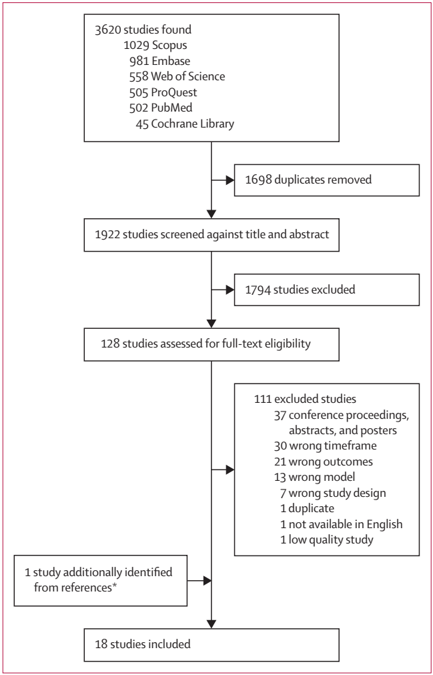
Background Machine learning and deep learning models have been increasingly used to predict long-term disease progression in patients with chronic obstructive pulmonary disease (COPD). We aimed to summarise the performance of such prognostic models for COPD, compare their relative performances, and identify key research gaps. Methods We conducted a systematic review and meta-analysis to compare the performance of machine learning and deep learning prognostic models and identify pathways for future research. We searched PubMed, Embase, the Cochrane Library, ProQuest, Scopus, and Web of Science from database inception to April 6, 2023, for studies in English using machine learning or deep learning to predict patient outcomes at least 6 months after initial clinical presentation in those with COPD. We included studies comprising human adults aged 18–90 years and allowed for any input modalities. We reported area under the receiver operator characteristic curve (AUC) with 95% CI for predictions of mortality, exacerbation, and decline in forced expiratory volume in 1 s (FEV 1 ). We reported the degree of interstudy heterogeneity using Cochran's Q test (significant heterogeneity was defined as p≤0·10 or I 2 >50%). Reporting quality was assessed using the TRIPOD checklist and a risk-of-bias assessment was done using the PROBAST checklist. This study was registered with PROSPERO (CRD42022323052). Findings We identified 3620 studies in the initial search. 18 studies were eligible, and, of these, 12 used conventional machine learning and six used deep learning models. Seven models analysed exacerbation risk, with only six reporting AUC and 95% CI on internal validation datasets (pooled AUC 0·77 [95% CI 0·69–0·85]) and there was significant heterogeneity ( I 2 97%, p<0·0001). 11 models analysed mortality risk, with only six reporting AUC and 95% CI on internal validation datasets (pooled AUC 0·77 [95% CI 0·74–0·80]) with significant degrees of heterogeneity ( I 2 60%, p=0·027). Two studies assessed decline in lung function and were unable to be pooled. Machine learning and deep learning models did not show significant improvement over pre-existing disease severity scores in predicting exacerbations (p=0·24). Three studies directly compared machine learning models against pre-existing severity scores for predicting mortality and pooled performance did not differ (p=0·57). Of the five studies that performed external validation, performance was worse than or equal to regression models. Incorrect handling of missing data, not reporting model uncertainty, and use of datasets that were too small relative to the number of predictive features included provided the largest risks of bias. Interpretation There is limited evidence that conventional machine learning and deep learning prognostic models demonstrate superior performance to pre-existing disease severity scores. More rigorous adherence to reporting guidelines would reduce the risk of bias in future studies and aid study reproducibility. Funding None.
Overview
The claims and statistics of this paper haven’t been checked yet.
Run the check — free, no account needed. It reads the open-access text and checks the sources it cites.
Integrity signals
Registry
Cites
Statistics
Figures
Verification
Claims the paper makes
The claims and statistics of this paper haven’t been checked yet.
Run the check — free, no account needed. It reads the open-access text and checks the sources it cites.
Claims other papers make about this one
Each is checked against this paper’s own text: does it say what the citing paper says it does?
The cited source doesn’t support the claim as written.
In the citing paper
“Our results indicated that DL models consistently outperform both regression-based and other ML models, aligning with findings from previous studies (71, 72).”
From Machine learning-based risk predictive models for diabetic kidney disease in type 2 diabetes mellitus patients: a systematic review and meta-analysis (2025) · cites this paper as [71]
Checked by a reasoning model — may be wrong.
Experimental — accuracy not yet measured
Self-check
Percentages, sums and reported differences re-computed from the paper’s own numbers.
The self-check needs the paper’s full text.
Citations
Cites
The PRISMA 2020 statement: An updated guideline for reporting systematic reviews
Page, M. J., McKenzie, J. E., Bossuyt, P. M., Boutron, I., Hoffmann, T. C., Mulrow, C. D., Shamseer, L., Tetzlaff, J. M., Akl, E. A., Brennan, S. E., et al. (2021) · BMJ · doi:10.1136/bmj.n71 · Cited by 108,283
Measuring inconsistency in meta-analyses
Higgins, J. P. T., Thompson, S. G., Deeks, J. J., & Altman, D. G. (2003) · BMJ · doi:10.1136/bmj.327.7414.557 · Cited by 63,139
(2014) · Cited by 33,419
A survey on deep learning in medical image analysis
Litjens, G., Kooi, T., Bejnordi, B. E., Setio, A. A. A., Ciompi, F., Ghafoorian, M., van der Laak, J. A. W. M., van Ginneken, B., & Sánchez, C. I. (2017) · Medical Image Analysis · doi:10.1016/j.media.2017.07.005 · Cited by 15,332
A survey on Image Data Augmentation for Deep Learning
Shorten, C., & Khoshgoftaar, T. M. (2019) · Journal of Big Data · doi:10.1186/s40537-019-0197-0 · Cited by 13,203
Machine learning: Trends, perspectives, and prospects
Jordan, M. I., & Mitchell, T. M. (2015) · Science · doi:10.1126/science.aaa8415 · Cited by 9,955
The use of the area under the ROC curve in the evaluation of machine learning algorithms
Bradley, A. P. (1997) · Pattern Recognition · doi:10.1016/s0031-3203(96)00142-2 · Cited by 7,217
Large language models encode clinical knowledge
Singhal, K., Azizi, S., Tu, T., Mahdavi, S. S., Wei, J., Chung, H. W., Scales, N., Tanwani, A., Cole-Lewis, H., Pfohl, S., et al. (2023) · Nature · doi:10.1038/s41586-023-06291-2 · Cited by 4,083
Large Language Models Encode Clinical Knowledge
Singhal, K., Azizi, S., Tu, T., Mahdavi, S. S., Wei, J., Chung, H. W., Scales, N., Tanwani, A., Cole-Lewis, H., Pfohl, S., et al. (2022) · arXiv · doi:10.48550/arxiv.2212.13138 · Cited by 4,083
Collins, P. G. S., Reitsma, J. B., Altman, D. G., & Moons, K. G. M. (2015) · British Journal of Cancer · doi:10.1038/bjc.2014.639 · Cited by 3,319
Research works printed but not linked: 3
- Boueiz, 2022, Machine learning prediction of progression in forced expiratory volume in 1 second in the copdgene study, Chronic Obstr Pulm Dis, 9, 349
- Ioffe S, Szegedy C. Batch normalization: accelerating deep network training by reducing internal covariate shift. 32nd International Conference on Machine Learning; July 6–11, 2015.
- Belkin M, Hsu D, Mitra P. Overfitting or perfect fitting? Risk bounds for classification and regression rules that interpolate. 32nd Conference on Neural Information Processing Systems; Dec 2–8, 2018.
Cited by
Sorted by citations
Fulke, A. B., Ratanpal, S., & Sonker, S. (2024) · Marine Pollution Bulletin · doi:10.1016/j.marpolbul.2024.116707 · Cited by 192
The role of artificial intelligence in drug screening, drug design, and clinical trials
Wu, Y., Ma, L., Li, X., Yang, J., Rao, X., Hu, Y., Xi, J., Tao, L., Wang, J., Du, L., et al. (2024) · Frontiers in Pharmacology · doi:10.3389/fphar.2024.1459954 · Cited by 53
Digital twins for chronic lung diseases
Gonsard, A., Genet, M., & Drummond, D. (2024) · European Respiratory Review · doi:10.1183/16000617.0159-2024 · Cited by 47
Hu, S., Song, D., Wan, S., Zhang, S., Luo, C., Li, N., Liu, G., Vasconcelos, J. D. G. E. S., de Carvalho, L. L. C., Neobísi, E., et al. (2025) · Frontiers in Public Health · doi:10.3389/fpubh.2025.1646802 · Cited by 72
Xu, W., Zhou, Y., Jiang, Q., Fang, Y., & Yang, Q. (2024) · Frontiers in Endocrinology · doi:10.3389/fendo.2024.1407348 · Cited by 34
Metadata
- Authors
- Smith, L. A., Oakden-Rayner, L., Bird, A., Zeng, M., To, M.-S., Mukherjee, S., & Palmer, L. J.
- Affiliations
- The University of Adelaide (AU)
- Flinders University (AU)
- Corresponding author
- Smith, Luke A
- Venue
- The Lancet Digital Health
- Publisher
- Elsevier BV
- Published
- 2023-12
- Volume
- 5
- Issue
- 12
- Pages
- e872-e881
- ISSN
- 2589-7500 (ISSN-L)
- OpenAlex
- W4388922522
- Cited by
- 116
- References
- 52
- Citations by year
- 2026: 42 · 2025: 50 · 2024: 24
- FWCI
- 5.40
- Type
- journal article
- Language
- en
- Open access
- gold
- doi.org
- Licence
- Locations
- The Lancet Digital Health (publishedVersion, cc-by)
- PubMed (publishedVersion)
- Funders
- Australian Government
- Topics
- Health Sciences › Medicine › Pulmonary and Respiratory Medicine › Chronic Obstructive Pulmonary Disease (COPD) Research
- Physical Sciences › Computer Science › Artificial Intelligence › Machine Learning in Healthcare
- Health Sciences › Health Professions › Health Information Management › Artificial Intelligence in Healthcare
- Keywords
- chronic obstructive pulmonary disease, machine learning, deep learning, prognostic model, long-term prognosis, COPD exacerbation risk, mortality prediction, FEV1 decline, lung function decline, disease severity index, model performance comparison, internal validation, risk of bias, generalizability, research gaps, health economics, health equity
- MeSH terms
- Deep Learning, Adult, Humans, Prognosis, Quality of Life, Reproducibility of Results, Pulmonary Disease, Chronic Obstructive
About these checks
Registry, retraction, Cites and statistics results are computed, not judged, with one exception: a printed reference that no index lists is read once by a model before it counts as a citation error. Claims are extracted by a model and kept only when their quote appears verbatim in the text; each cited source is then checked, with a model’s help, for whether it says what the claim relies on. Those verdicts can be wrong — read the claim’s quote and the cited source before relying on one.
Statistics and arithmetic are recomputed, not judged.
Confidence bands are shown only for fields calibrated on our annotated test set. None is calibrated yet, so no band is shown.
What counts as a claim ›How we measure confidence ›How we check this ›
Are you an author, or do you see a problem with this page? Request a review
