

How the War was Won: Air-Sea Power and Allied Victory in World War II
Open accessThe DOI matches its Crossref record; none of the 24 sources its claims cite is checked for support yet.
Abstract
World War II is usually seen as a titanic land battle, decided by mass armies, most importantly those on the Eastern Front. Phillips Payson O'Brien shows us the war in a completely different light. In this compelling new history of the Allied path to victory, he argues that in terms of production, technology and economic power, the war was far more a contest of air and sea than land supremacy. He shows how the Allies developed a predominance of air and sea power which put unbearable pressure on Germany and Japan's entire war-fighting machine from Europe and the Mediterranean to the Pacific. Air and sea power dramatically expanded the area of battle and allowed the Allies to destroy over half the Axis' equipment before it had even reached the traditional 'battlefield'. Battles such as El Alamein, Stalingrad and Kursk did not win World War II; air and sea power did.
Overview
CoChat Summary
## TL;DR
The paper argues that World War II was won primarily through Anglo-American air and sea power, not decisive land battles. It claims that the destruction and disruption of enemy equipment and production before it reached the battlefield mattered more than famous engagements like Stalingrad, Kursk, El Alamein, or Midway.
## Key findings
- The author argues that the war should be understood through a “super-battlefield” created by air and sea power, where equipment was destroyed in three phases: “pre-production,” “production,” and “deployment.”
- The text says the German army lost at most 350 AFV in the first ten days of Kursk, 1,331 AFV on the Eastern Front in July and August 1943, and that Germany produced just over 12,000 AFV in 1943; thus Kursk losses were less than 3% of annual AFV output, and El Alamein losses were just a little more than 0.1% of German armaments production for the year.
- It states that in Germany, airframe, air engine, and aircraft weapon production made up at least 50% of production every year of the war and at times 55%; in the UK, the share was “even higher,” and in all cases at least two-thirds of annual construction went to air and sea weapons.
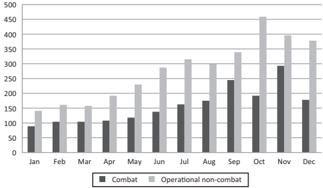
- For Japanese naval air losses in 1943, the text gives exact figures of 3,355 operational non-combat aircraft losses and 1,907 combat losses, and argues that non-combat losses were a more crippling drain than losses in action.
## Methods
- Conceptual and historiographical argument, explicitly not a study of tactics or individual battlefield performance.
- Uses comparative production and loss data from wartime sources and surveys, including figures from the USSBS and cited archival/statistical sources on German and Japanese aircraft and AFV losses.
- Main analysis compares battlefield losses with annual production, and traces how air and sea power affected enemy equipment across pre-production, production, and deployment stages.
## Limitations
- The author explicitly says the book will spend little time discussing combat or human bravery and cowardice, so battlefield experience is deliberately underweighted.
- The text says the Eastern Front is discussed only in parts of different chapters and will seem “woefully under-represented” to readers who see it as decisive; this is a stated scope choice, not a data limitation.
- Evidence evident from the text: the argument is largely historiographical and interpretive, so it depends heavily on how production, loss, and bombing data are framed rather than on a single empirical design.
Model-written summary. Check it against the paper before relying on it.
Integrity signals
Registry
Cites
Statistics
Figures
Verification
Claims the paper makes
0 Valid · 17 Not valid · 24 Not checked · 46 Own results and interpretations
In the paper
“By November 4 , 36 of these were left.”
What the sources say
- Not matchedcites [9]
We don’t have this paper’s reference list.
plain- Asserted: passes — The authors put it forward as true.
- Checkable: passes — It can be checked against evidence.
- Load-bearing: passes — The paper’s conclusions depend on it.
- Based: passes — The paper gives a reason why it holds.
- Not matched
In the paper
“During all of July and August 1943 on the Eastern Front the German army lost 1 , 331 AFV.”
What the sources say
- Not matchedcites [8]
We don’t have this paper’s reference list.
plain- Asserted: passes — The authors put it forward as true.
- Checkable: passes — It can be checked against evidence.
- Load-bearing: passes — The paper’s conclusions depend on it.
- Based: passes — The paper gives a reason why it holds.
- Not matched
A result the paper states — it cites no source for it, so there is none to check. The quote shows it is in the paper.
In the paper
“This means that the losses of AFV during the high point of the fighting at Kursk represented an inconsequential 0 . 2 percent of German armaments production for the year”
plain- Asserted: passes — The authors put it forward as true.
- Checkable: passes — It can be checked against evidence.
- Load-bearing: passes — The paper’s conclusions depend on it.
- Based: passes — The paper gives a reason why it holds.
A result the paper states — it cites no source for it, so there is none to check. The quote shows it is in the paper.
In the paper
“This means that the Germans lost less than 3 percent of the AFV they built in 1943 during the Battle of Kursk”
plain- Asserted: passes — The authors put it forward as true.
- Checkable: passes — It can be checked against evidence.
- Load-bearing: passes — The paper’s conclusions depend on it.
- Based: passes — The paper gives a reason why it holds.
A result the paper states — it cites no source for it, so there is none to check. The quote shows it is in the paper.
In the paper
“Yet, during 1943 as a whole, Germany produced just over 12 , 000 AFV.”
plain- Asserted: passes — The authors put it forward as true.
- Checkable: passes — It can be checked against evidence.
- Load-bearing: passes — The paper’s conclusions depend on it.
- Based: passes — The paper gives a reason why it holds.
41 more claims
Create a free account to see all 87 claims and every source verdict.
- Probably not a substantial claim. 34
- It may state two separate claims as one. 24
Citations
Cited by
Fighting the People's War: The British and Commonwealth Armies and the Second World War
Fennell, J. (2019) · Cambridge University Press eBooks · doi:10.1017/9781139380881 · Cited by 82
Magna Carta, the rule of law, and the limits on government
Fernández‐Villaverde, J. (2016) · International Review of Law and Economics · doi:10.1016/j.irle.2016.05.006 · Cited by 21
Adena, M., Сергеевич, Е. Р., Petrova, M., & Voth, H. (2020) · SSRN Electronic Journal · doi:10.2139/ssrn.3661643 · Cited by 22
Oyewole, S. (2021) · African Security Review · doi:10.1080/10246029.2020.1859394 · Cited by 11
Klovland, J. T. (2017) · SSRN Electronic Journal · doi:10.2139/ssrn.2979175 · Cited by 9
The strategic-level effects of long-range strike weapons: A framework for analysis
Hoffmann, F. R. (2024) · Journal of Strategic Studies · doi:10.1080/01402390.2024.2351500 · Cited by 11
Strangling the Axis: The Fight for Control of the Mediterranean during the Second World War
Hammond, R. (2020) · Cambridge University Press eBooks · doi:10.1017/9781108784566 · Cited by 7
Lindsay, J. R. (2024) · Journal of Peace Research · doi:10.1177/00223433231217664 · Cited by 7
Edele, M. (2019) · Journal of Strategic Studies · doi:10.1080/01402390.2019.1701443 · Cited by 4
O’Brien, P. P. (2019) · Journal of Strategic Studies · doi:10.1080/01402390.2018.1559150 · Cited by 4
Self-citationWhy Did Putin Invade Ukraine? A Theory of Degenerate AutocracyPreprint
Egorov, G., & Сонин, К. И. (2023) · SSRN Electronic Journal · doi:10.2139/ssrn.4410987 · Cited by 3
Golub, G. (2022) · Journal of Strategic Studies · doi:10.1080/01402390.2022.2104837 · Cited by 3
Oiling the War Machine? The Fuel Dilemma and Warfighting Capability
Kim, I. (2023) · International Studies Quarterly · doi:10.1093/isq/sqad096 · Cited by 2
Energy, Labor, and Soviet Aid: China’s Northwest Highway, 1937–1941
Baker, M. (2023) · Modern China · doi:10.1177/00977004231203897 · Cited by 2
O’Brien, P. P. (2015) · Cambridge University Press eBooks · doi:10.1017/cho9781139855969.026 · Cited by 2
Self-citationBuilding an Air Force for a Long, Big War
Layton, P. (2025) · Contemporary Issues in Air and Space Power · doi:10.58930/bp52184561 · Cited by 2
Fennell, J. (2019) · Cambridge University Press eBooks · doi:10.1017/9781139380881.002 · Cited by 1
Rumble, R. (2024) · Modern Italy · doi:10.1017/mit.2024.28 · Cited by 1
Magna Carta, the Rule of Law, and the Limits on GovernmentPreprint
Fernández‐Villaverde, J. (2015) · SSRN Electronic Journal · doi:10.2139/ssrn.2676184 · Cited by 1
ON THE ECONOMIC MECHANICS OF WARFARE
Vandenbroucke, G. (2024) · International Economic Review · doi:10.1111/iere.12740 · Cited by 1
Fennell, J. (2019) · Cambridge University Press eBooks · doi:10.1017/9781139380881.008
Fennell, J. (2019) · Cambridge University Press eBooks · doi:10.1017/9781139380881.013
Hammond, R. (2020) · Cambridge University Press eBooks · doi:10.1017/9781108784566.004
The Descent to War in the Mediterranean
Hammond, R. (2020) · Cambridge University Press eBooks · doi:10.1017/9781108784566.003
Fennell, J. (2019) · Cambridge University Press eBooks · doi:10.1017/9781139380881.017
Fennell, J. (2019) · Cambridge University Press eBooks · doi:10.1017/9781139380881.016
Fennell, J. (2019) · Cambridge University Press eBooks · doi:10.1017/9781139380881.009
The Great Imperial Morale Crisis
Fennell, J. (2019) · Cambridge University Press eBooks · doi:10.1017/9781139380881.007
The End in North Africa and the Shipping Crisis
Hammond, R. (2020) · Cambridge University Press eBooks · doi:10.1017/9781108784566.009
Hammond, R. (2020) · Cambridge University Press eBooks · doi:10.1017/9781108784566.010
Fennell, J. (2019) · Cambridge University Press eBooks · doi:10.1017/9781139380881.018
Fennell, J. (2019) · Cambridge University Press eBooks · doi:10.1017/9781139380881.010
Fennell, J. (2019) · Cambridge University Press eBooks · doi:10.1017/9781139380881.006
Fennell, J. (2019) · Cambridge University Press eBooks · doi:10.1017/9781139380881.024
Fennell, J. (2019) · Cambridge University Press eBooks · doi:10.1017/9781139380881.001
Fennell, J. (2019) · Cambridge University Press eBooks · doi:10.1017/9781139380881.015
Hammond, R. (2020) · Cambridge University Press eBooks · doi:10.1017/9781108784566.002
Hammond, R. (2020) · Cambridge University Press eBooks · doi:10.1017/9781108784566.007
Fennell, J. (2019) · Cambridge University Press eBooks · doi:10.1017/9781139380881.022
Hammond, R. (2020) · Cambridge University Press eBooks · doi:10.1017/9781108784566.013
Fennell, J. (2019) · Cambridge University Press eBooks · doi:10.1017/9781139380881.004
Quantitative Indicators of Morale
Fennell, J. (2019) · Cambridge University Press eBooks · doi:10.1017/9781139380881.021
Fennell, J. (2019) · Cambridge University Press eBooks · doi:10.1017/9781139380881.011
Hammond, R. (2020) · Cambridge University Press eBooks · doi:10.1017/9781108784566.006
Fennell, J. (2019) · Cambridge University Press eBooks · doi:10.1017/9781139380881.020
Ferris, J. R., & Mawdsley, E. (2015) · Cambridge University Press eBooks · doi:10.1017/cho9781139855969.022
Fennell, J. (2019) · Cambridge University Press eBooks · doi:10.1017/9781139380881.005
Hammond, R. (2020) · Cambridge University Press eBooks · doi:10.1017/9781108784566.008
Fennell, J. (2019) · Cambridge University Press eBooks · doi:10.1017/9781139380881.012
Hammond, R. (2020) · Cambridge University Press eBooks · doi:10.1017/9781108784566.011
Fennell, J. (2019) · Cambridge University Press eBooks · doi:10.1017/9781139380881.019
Fennell, J. (2019) · Cambridge University Press eBooks · doi:10.1017/9781139380881.003
Fennell, J. (2019) · Cambridge University Press eBooks · doi:10.1017/9781139380881.023
Fennell, J. (2019) · Cambridge University Press eBooks · doi:10.1017/9781139380881.025
Fennell, J. (2019) · Cambridge University Press eBooks · doi:10.1017/9781139380881.014
(2016) · Journal of Strategic Studies · doi:10.1080/01402390.2016.1195324
Hammond, R. (2020) · Cambridge University Press eBooks · doi:10.1017/9781108784566.012
Buchanan, A. N. (2019) · Wiley eBooks · doi:10.1002/9781119366102.ch10
Hammond, R. (2020) · Cambridge University Press eBooks · doi:10.1017/9781108784566.005
Hammond, R. (2020) · Cambridge University Press eBooks · doi:10.1017/9781108784566.014
Hammond, R. (2020) · Cambridge University Press eBooks · doi:10.1017/9781108784566.001
Stephen E. Ambrose, Patriot and Historian
Knapp, A. F. (2023) · Revue française d’études américaines · doi:10.3917/rfea.177.0027
Kiras, J. D. (2024) · Oxford University Press eBooks · doi:10.1093/9780198902096.001.0001
The Forgotten Arsenal: Advocating for NATO’s Strategic Use of Economic Warfare
Larcey, P. A. (2025) · Contributions to security and defence studies · doi:10.1007/978-3-031-90590-2_5
Harrison, M., & Voth, H. (2025) · Cambridge University Press eBooks · doi:10.1017/9781009474887.008
Broadberry, S., & Harrison, M. (2025) · Cambridge University Press eBooks · doi:10.1017/9781009474887.001
Economic Warfare and Sanctions since 1688: An Overview
Broadberry, S., & Harrison, M. (2025) · Cambridge University Press eBooks · doi:10.1017/9781009474887.002
Why did Putin invade Ukraine? A theory of degenerate autocracy
Egorov, G., & Sonin, K. (2026) · American Journal of Political Science · doi:10.1111/ajps.70039 · Cited by 2
Metadata
- Authors
- O'Brien, P. P.
- Venue
- Cambridge University Press eBooks
- Publisher
- Cambridge University Press
- Published
- 2015-02-05
- OpenAlex
- W4239820937
- Cited by
- 67
- References
- 0
- Citations by year
- 2026: 1 · 2025: 5 · 2024: 5 · 2023: 4 · 2022: 1 · 2021: 1 · 2020: 16 · 2019: 29 · 2017: 1 · 2016: 2 · 2015: 2
- FWCI
- 2.12
- Type
- book
- Language
- en
- Open access
- bronze
- doi.org
- Locations
- Cambridge University Press eBooks (publishedVersion)
- Topics
- Social Sciences › Political Science and International Relations › World Wars: History, Literature, and Impact
- Social Sciences › Political Science and International Relations › Military History and Strategy
- Physical Sciences › Engineering › Aerospace Engineering › Military Technology and Strategies
- Keywords
- World War II, air power, naval power, Allied victory, Axis powers, wartime production, military technology, economic power, air warfare, naval warfare, Eastern Front, Pacific War, El Alamein, Stalingrad, Battle of Kursk
About these checks
Registry, retraction, Cites and statistics results are computed, not judged, with one exception: a printed reference that no index lists is read once by a model before it counts as a citation error. Claims are extracted by a model and kept only when their quote appears verbatim in the text; each cited source is then checked, with a model’s help, for whether it says what the claim relies on. Those verdicts can be wrong — read the claim’s quote and the cited source before relying on one.
A language model drew the claims from the paper on 2026-10-05, under version 3 of the claim definition (model deepseek-v4.1-flash, prompt extract-v3).
A second model labelled each claim on 2026-10-05 (model jev-1.13-20260917, definition revision gold-guideline-v0.2).
Statistics and arithmetic are recomputed, not judged.
Confidence bands are shown only for fields calibrated on our annotated test set. None is calibrated yet, so no band is shown.
What counts as a claim ›How we measure confidence ›How we check this ›
Are you an author, or do you see a problem with this page? Request a review
Data sources
Bibliographic data: Semantic Scholar, OpenAlex, Crossref.
Contains information from the Semantic Scholar Academic Graph Datasets, made available under the ODC Attribution License (ODC-BY 1.0).
Semantic Scholar’s data is described in: Kinney, R., et al. (2023). The Semantic Scholar Open Data Platform. arXiv:2301.10140.
