

The DOI matches its Crossref record; 33 of the 34 references it cites were found in a registry or an index; none of the 46 sources its claims cite is checked for support yet.
Expanding mental health services in low- and middle-income countries: A task-shifting framework for delivery of comprehensive, collaborative, and community-based care
Open accessAbstract
This paper proposes a framework for comprehensive, collaborative, and community-based care (C4) for accessible mental health services in low-resource settings. Because mental health conditions have many causes, this framework includes social, public health, wellness and clinical services. It accommodates integration of stand-alone mental health programs with health and non-health community-based services. It addresses gaps in previous models including lack of community-based psychotherapeutic and social services, difficulty in addressing comorbidity of mental and physical conditions, and how workers interact with respect to referral and coordination of care. The framework is based on task-shifting of services to non-specialized workers. While the framework draws on the World Health Organization’s Mental Health Gap Action Program and other global mental health models, there are important differences. The C4 Framework delineates types of workers based on their skills. Separate workers focus on: basic psychoeducation and information sharing; community-level, evidence-based psychotherapeutic counseling; and primary medical care and more advanced, specialized mental health services for more severe or complex cases. This paper is intended for individuals, organizations and governments interested in implementing mental health services. The primary aim is to provide a framework for the provision of widely accessible mental health care and services.
Overview
AI snapshot
Written from the paper’s full text.
TL;DR
The paper proposes the C4 framework, a task-shifting model for comprehensive, collaborative, community-based mental health care in low- and middle-income countries, with up to five worker categories and three levels of MHPSS. It is an aspirational design framework intended to guide planners, governments, and organizations rather than report empirical outcomes.
Key findings
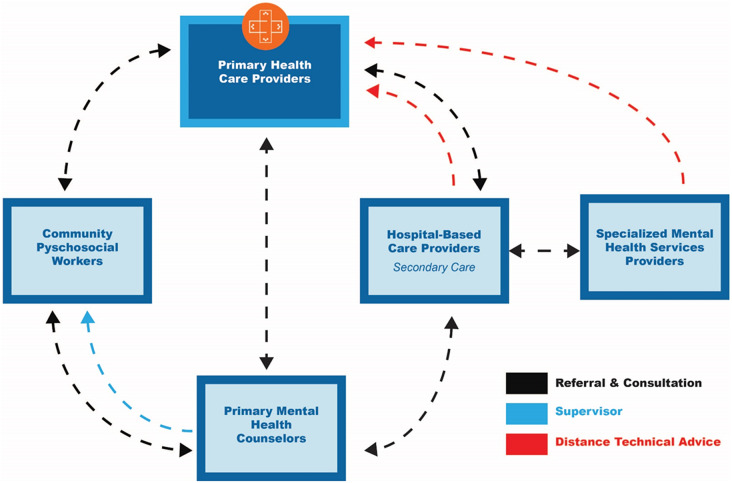
- The C4 Framework delineates up to five worker categories: Community Psychosocial Workers; Primary Health Care Providers; Primary Mental Health Counselors; Hospital-Based Care Providers; and Specialized Mental Health Services Providers, with complementary roles from basic psychoeducation to specialized mental health services.
- It organizes MHPSS into three levels: brief psychosocial intervention delivered by Community Psychosocial Workers; evidence-based psychotherapeutic interventions delivered by mental health counselors; and pharmacological interventions delivered by trained physicians, nurses, or psychiatrists.
- It cites global service gaps: minimally adequate services in low- and lower middle-income countries were 3.7% for major depressive conditions, 2.3% for anxiety conditions, and 1.0% for substance use conditions, compared with 20.0%, 13.8%, and 10.3% in high-income countries; median mental health workers per 100,000 population were 1.4 in low-income countries and 3.8 in lower middle-income countries, versus 62.2 in high-income countries.
- Training requirements include 3–7 days of didactic training plus 2–3 practice sessions and supervised practice for 5 or more sessions for Community Psychosocial Workers; 2–3 weeks of didactic instruction plus 6–12 months of supervised practice for Primary Mental Health Counselors; and 5–7 days of didactic training, or 3 days of mhGAP-HIG training in humanitarian settings, for Primary Health Care Providers.
Methods
- Design: conceptual framework paper proposing the C4 framework for low-resource settings, drawing on the WHO Mental Health Gap Action Program, WHO’s Transforming Mental Health for All model, Inter-Agency Standing Committee materials, NGOs, and the authors’ collective global mental health experience.
- Data or sample: no empirical sample, trial, or formal data collection; the paper describes worker roles, training logistics, resource requirements, and implementation issues.
- Main analysis: narrative synthesis and expert-informed system design; the framework is described as aspirational and not yet fully implemented.
Limitations
- Stated: the framework is aspirational and has not yet been fully implemented; in most places it will require substantially increased funding of the mental health sector above current levels.
- Stated: implementation assumes health system willingness and human resources at specialist hospitals, and high local leadership and governance mechanisms, which are often lacking; COVID-19 disrupted in-person mental health services, and digital options remain limited by low digital literacy, low smartphone penetration, data costs, and limited internet connection.
- Evident from the text: no empirical validation, outcome data, or C4-specific cost-effectiveness estimates are reported; the framework relies on expert opinion and existing models, and the authors note it is a basic framework for low-resource environments that may need local adaptation.
Model-written summary. Check it against the paper before relying on it.
Integrity signals
Registry
Cites
Statistics
Figures
Verification
Claims the paper makes
38 Not checked yet · 26 Own interpretation · 3 No basis given
None of the sources cited for this claim have been checked yet.
In the paper
“Despite the high prevalence and human and economic burden of mental health conditions in all countries, most people do not have access to effective interventions (Degenhardt et al., 2017; Thornicroft et al., 2017; Alonso et al., 2018).”
§ Expanding mental health services in low- and middle-income countries: A task-shifting framework for delivery of comprehensive, collaborative, and community-based care > Introduction > Global mental health needs, services gaps and implications
What the sources say
- Not checked yetcites Degenhardt et al., 2017
- Not checked yetcites Thornicroft et al., 2017
- Not checked yetcites Alonso et al., 2018
plain- Asserted: passes — The authors put it forward as true.
- Checkable: passes — It can be checked against evidence.
- Load-bearing: passes — The paper’s conclusions depend on it.
- Based: passes — The paper gives a reason why it holds.
A conclusion the paper draws from its own results — it cites no other source for it, so there is none to check. The quote shows it is in the paper.
In the paper
“While five categories of workers may seem excessive, in low-resource environments a concerted focus on efficient use of resources requires more types of workers than high-resource environments.”
§ Expanding mental health services in low- and middle-income countries: A task-shifting framework for delivery of comprehensive, collaborative, and community-based care > Proposed Comprehensive, Collaborative, and Community-based Care (C4) Framework
plaindirect- Asserted: passes — The authors put it forward as true.
- Checkable: passes — It can be checked against evidence.
- Load-bearing: passes — The paper’s conclusions depend on it.
- Based: passes — The paper gives a reason why it holds.
- Rests on an assumption: High-resource environments can generally afford to train and support professional health and specialty mental health providers who spend much of their time dealing with problems that do not tax their expertise.
- Rests on an assumption: Primary care physicians in HICs spend much of their time dealing with individuals who could just as well be treated by nurses or physician assistants.
In the paper
“Mental health conditions frequently lead individuals and families into poverty (Funk et al., 2010)”
§ Expanding mental health services in low- and middle-income countries: A task-shifting framework for delivery of comprehensive, collaborative, and community-based care > Introduction > Global mental health needs, services gaps and implications
What the sources say
- Not checked yetcites Funk et al., 2010
plaindirect- Asserted: passes — The authors put it forward as true.
- Checkable: passes — It can be checked against evidence.
- Load-bearing: unclear — It is unclear whether the paper’s conclusions depend on it.
- Based: passes — The paper gives a reason why it holds.
A conclusion the paper draws from its own results — it cites no other source for it, so there is none to check. The quote shows it is in the paper.
In the paper
“The result is an ongoing four level conversation (person living with illness/caregivers, provider, supervisor and trainer/expert), producing iterative adaptations that improve care.”
§ Expanding mental health services in low- and middle-income countries: A task-shifting framework for delivery of comprehensive, collaborative, and community-based care > Principles underlying the C4 Framework for LMICs > Support of roles for people living with illness and families in clinical decision making
plaindirect- Asserted: passes — The authors put it forward as true.
- Checkable: passes — It can be checked against evidence.
- Load-bearing: passes — The paper’s conclusions depend on it.
- Based: passes — The paper gives a reason why it holds.
In the paper
“Integration of mental health services within primary health care is achievable in LMICs (Jordans et al., 2019b).”
§ Expanding mental health services in low- and middle-income countries: A task-shifting framework for delivery of comprehensive, collaborative, and community-based care > Proposed Comprehensive, Collaborative, and Community-based Care (C4) Framework > Primary Health Care Providers
What the sources say
- Not checked yetcites Jordans et al., 2019b
plain- Asserted: passes — The authors put it forward as true.
- Checkable: passes — It can be checked against evidence.
- Load-bearing: passes — The paper’s conclusions depend on it.
- Based: passes — The paper gives a reason why it holds.
A conclusion the paper draws from its own results — it cites no other source for it, so there is none to check. The quote shows it is in the paper.
In the paper
“In most places it will require substantially increased funding of the mental health sector above current levels.”
§ Expanding mental health services in low- and middle-income countries: A task-shifting framework for delivery of comprehensive, collaborative, and community-based care > Introduction > Global mental health needs, services gaps and implications
hedgeddirect- Asserted: passes — The authors put it forward as true.
- Checkable: passes — It can be checked against evidence.
- Load-bearing: passes — The paper’s conclusions depend on it.
- Based: passes — The paper gives a reason why it holds.
None of the sources cited for this claim have been checked yet.
In the paper
“A wide range of generic medications are effective in treating mental health conditions, including severe psychotic and manic symptoms.”
§ Expanding mental health services in low- and middle-income countries: A task-shifting framework for delivery of comprehensive, collaborative, and community-based care > Proposed Comprehensive, Collaborative, and Community-based Care (C4) Framework > Primary Health Care Providers
What the sources say
- Not checked yetcites World Health Organization, 2015a, 2016b
- Not checked yetcites World Health Organization, 2018a
plaindirect- Asserted: passes — The authors put it forward as true.
- Checkable: passes — It can be checked against evidence.
- Load-bearing: passes — The paper’s conclusions depend on it.
- Based: passes — The paper gives a reason why it holds.
In the paper
“Apprenticeship-type training (Murray et al., 2011) involves feedback from people living with illness, family and providers.”
§ Expanding mental health services in low- and middle-income countries: A task-shifting framework for delivery of comprehensive, collaborative, and community-based care > Principles underlying the C4 Framework for LMICs > Support of roles for people living with illness and families in clinical decision making
What the sources say
- Not checked yetcites Murray et al., 2011
plain- Asserted: passes — The authors put it forward as true.
- Checkable: passes — It can be checked against evidence.
- Load-bearing: unclear — It is unclear whether the paper’s conclusions depend on it.
- Based: passes — The paper gives a reason why it holds.
In the paper
“Persons with MNS problems and their families have the right to make decisions regarding their own care in collaboration with mental healthcare providers, which can also improve services (World Health Organization, 2013b).”
§ Expanding mental health services in low- and middle-income countries: A task-shifting framework for delivery of comprehensive, collaborative, and community-based care > Principles underlying the C4 Framework for LMICs > Support of roles for people living with illness and families in clinical decision making
What the sources say
- Not checked yetcites World Health Organization, 2013b
plaindirect- Asserted: passes — The authors put it forward as true.
- Checkable: passes — It can be checked against evidence.
- Load-bearing: passes — The paper’s conclusions depend on it.
- Based: passes — The paper gives a reason why it holds.
A conclusion the paper draws from its own results — it cites no other source for it, so there is none to check. The quote shows it is in the paper.
In the paper
“Even in the absence of specialist expertise or medications, persons in crisis or with severe mental health conditions can benefit from the community-based providers under this framework.”
§ Expanding mental health services in low- and middle-income countries: A task-shifting framework for delivery of comprehensive, collaborative, and community-based care > Proposed Comprehensive, Collaborative, and Community-based Care (C4) Framework > Specialized Mental Health Services Providers
plaindirect- Asserted: passes — The authors put it forward as true.
- Checkable: passes — It can be checked against evidence.
- Load-bearing: passes — The paper’s conclusions depend on it.
- Based: unclear — It is unclear why the paper says it holds.
- Probably not a substantial claim. 25
- It may state two separate claims as one. 21
The paper states this without a source or data behind it here, so there is nothing to check it against. The quote shows it is in the paper.
In the paper
“Our experience is that LMIC Primary Health Care Providers are usually uncomfortable managing mental health conditions.”
§ Expanding mental health services in low- and middle-income countries: A task-shifting framework for delivery of comprehensive, collaborative, and community-based care > Proposed Comprehensive, Collaborative, and Community-based Care (C4) Framework > Primary Health Care Providers
plain- Asserted: passes — The authors put it forward as true.
- Checkable: passes — It can be checked against evidence.
- Load-bearing: passes — The paper’s conclusions depend on it.
- Based: fails — The paper may give no reason why it holds.
Probably not a substantial claim. The paper may give no reason why it holds.
- Rests on an assumption: Psychological counseling skills are different from the typical advice-giving counseling skills of Primary Health Care Providers.
- Rests on an assumption: Primary Health Care Providers are usually the most highly trained available care providers and the primary source of pharmacologic treatments.
- Rests on an assumption: In many LMICs most Primary Health Care Providers are non-physicians with more limited primary care training.
- Rests on an assumption: Most Primary Health Care Providers focus on physical health.
None of the sources cited for this claim have been checked yet.
In the paper
“The World Mental Health Surveys estimate rates of minimally adequate mental health services in low- and lower middle-income countries at 3.7% for persons with major depressive conditions (Thornicroft et al., 2017), 2.3% for anxiety conditions (Alonso et al., 2018), and 1.0% for substance use conditions”
§ Expanding mental health services in low- and middle-income countries: A task-shifting framework for delivery of comprehensive, collaborative, and community-based care > Introduction > Global mental health needs, services gaps and implications
What the sources say
- Not checked yetcites Thornicroft et al., 2017
- Not checked yetcites Alonso et al., 2018
hedged- Asserted: passes — The authors put it forward as true.
- Checkable: passes — It can be checked against evidence.
- Load-bearing: passes — The paper’s conclusions depend on it.
- Based: passes — The paper gives a reason why it holds.
It may state two separate claims as one.
A conclusion the paper draws from its own results — it cites no other source for it, so there is none to check. The quote shows it is in the paper.
In the paper
“The intent is to promote staff quality and retention by provision of a career pathway for workers at each level, and to reduce staff turnover by selecting committed persons already within the framework for further training. This minimizes extra training and resource needs.”
§ Expanding mental health services in low- and middle-income countries: A task-shifting framework for delivery of comprehensive, collaborative, and community-based care > Principles underlying the C4 Framework for LMICs > Workforce care, maintenance and development
plaindirect- Asserted: passes — The authors put it forward as true.
- Checkable: passes — It can be checked against evidence.
- Load-bearing: passes — The paper’s conclusions depend on it.
- Based: passes — The paper gives a reason why it holds.
Probably not a substantial claim. It may state two separate claims as one.
In the paper
“Homelessness and inappropriate incarceration are far more common among people living with mental health conditions than for the general population, worsening their marginalization and vulnerability (World Health Organization, 2013a).”
§ Expanding mental health services in low- and middle-income countries: A task-shifting framework for delivery of comprehensive, collaborative, and community-based care > Introduction > Global mental health needs, services gaps and implications
What the sources say
- Not checked yetcites World Health Organization, 2013a
plaincorrelational- Asserted: passes — The authors put it forward as true.
- Checkable: passes — It can be checked against evidence.
- Load-bearing: unclear — It is unclear whether the paper’s conclusions depend on it.
- Based: passes — The paper gives a reason why it holds.
It may state two separate claims as one.
In the paper
“compared to 20.0%, 13.8% and 10.3%, respectively for high-income countries (HICs) (Degenhardt et al., 2017).”
§ Expanding mental health services in low- and middle-income countries: A task-shifting framework for delivery of comprehensive, collaborative, and community-based care > Introduction > Global mental health needs, services gaps and implications
What the sources say
- Not checked yetcites Degenhardt et al., 2017
plain- Asserted: passes — The authors put it forward as true.
- Checkable: passes — It can be checked against evidence.
- Load-bearing: unclear — It is unclear whether the paper’s conclusions depend on it.
- Based: passes — The paper gives a reason why it holds.
It may state two separate claims as one.
A conclusion the paper draws from its own results — it cites no other source for it, so there is none to check. The quote shows it is in the paper.
In the paper
“It therefore helps to ensure that persons with mental health conditions receive adequate physical health care, and vice versa.”
§ Expanding mental health services in low- and middle-income countries: A task-shifting framework for delivery of comprehensive, collaborative, and community-based care > Principles underlying the C4 Framework for LMICs > The central role of Primary Health Care Providers
plaindirect- Asserted: passes — The authors put it forward as true.
- Checkable: passes — It can be checked against evidence.
- Load-bearing: passes — The paper’s conclusions depend on it.
- Based: passes — The paper gives a reason why it holds.
It may state two separate claims as one.
A conclusion the paper draws from its own results — it cites no other source for it, so there is none to check. The quote shows it is in the paper.
In the paper
“This role is enhanced significantly by collaboration with Community Psychosocial Workers, facilitating better follow-up in the community.”
§ Expanding mental health services in low- and middle-income countries: A task-shifting framework for delivery of comprehensive, collaborative, and community-based care > Principles underlying the C4 Framework for LMICs > The central role of Primary Health Care Providers
boosteddirect- Asserted: passes — The authors put it forward as true.
- Checkable: passes — It can be checked against evidence.
- Load-bearing: passes — The paper’s conclusions depend on it.
- Based: fails — The paper may give no reason why it holds.
Probably not a substantial claim. The paper may give no reason why it holds.
The paper states this without a source or data behind it here, so there is nothing to check it against. The quote shows it is in the paper.
In the paper
“The existing literature suggests that positive exposure to persons with lived experience is effective in reducing the stigma of mental health conditions.”
§ Expanding mental health services in low- and middle-income countries: A task-shifting framework for delivery of comprehensive, collaborative, and community-based care > Principles underlying the C4 Framework for LMICs > Engaging persons with lived experience as providers
hedgeddirect- Asserted: passes — The authors put it forward as true.
- Checkable: passes — It can be checked against evidence.
- Load-bearing: fails — The paper’s conclusions may not depend on it.
- Based: fails — The paper may give no reason why it holds.
Probably not a substantial claim. The paper’s conclusions may not depend on it. The paper may give no reason why it holds.
A conclusion the paper draws from its own results — it cites no other source for it, so there is none to check. The quote shows it is in the paper.
In the paper
“This would provide for earlier discharge from hospitals and specialist care.”
§ Expanding mental health services in low- and middle-income countries: A task-shifting framework for delivery of comprehensive, collaborative, and community-based care > Principles underlying the C4 Framework for LMICs > The central role of Primary Health Care Providers
hedgeddirect- Asserted: passes — The authors put it forward as true.
- Checkable: passes — It can be checked against evidence.
- Load-bearing: passes — The paper’s conclusions depend on it.
- Based: fails — The paper may give no reason why it holds.
Probably not a substantial claim. The paper may give no reason why it holds.
A conclusion the paper draws from its own results — it cites no other source for it, so there is none to check. The quote shows it is in the paper.
In the paper
“Workers also learn from the extensive referral, back-referral and consultations built into the framework, which makes referrals, consultations and, ultimately, care, more efficient.”
§ Expanding mental health services in low- and middle-income countries: A task-shifting framework for delivery of comprehensive, collaborative, and community-based care > Principles underlying the C4 Framework for LMICs > Workforce care, maintenance and development
plaindirect- Asserted: passes — The authors put it forward as true.
- Checkable: passes — It can be checked against evidence.
- Load-bearing: fails — The paper’s conclusions may not depend on it.
- Based: fails — The paper may give no reason why it holds.
Probably not a substantial claim. The paper’s conclusions may not depend on it. The paper may give no reason why it holds.
A conclusion the paper draws from its own results — it cites no other source for it, so there is none to check. The quote shows it is in the paper.
In the paper
“Monitoring the well-being of workers as part of supervision and addressing their mental health needs are critical to sustainability.”
§ Expanding mental health services in low- and middle-income countries: A task-shifting framework for delivery of comprehensive, collaborative, and community-based care > Principles underlying the C4 Framework for LMICs > Workforce care, maintenance and development
plaindirect- Asserted: passes — The authors put it forward as true.
- Checkable: fails — It may be too vague to check against evidence.
- Load-bearing: passes — The paper’s conclusions depend on it.
- Based: fails — The paper may give no reason why it holds.
Probably not a substantial claim. It may be too vague to check against evidence. The paper may give no reason why it holds. It may state two separate claims as one.
- Rests on an assumption: Mental health workers are subject to significant stresses.
In the paper
“Fifty percent of mental disorders develop before the age of 14, and 75% before the age of 24 (Kessler et al., 2005).”
§ Expanding mental health services in low- and middle-income countries: A task-shifting framework for delivery of comprehensive, collaborative, and community-based care > Proposed Comprehensive, Collaborative, and Community-based Care (C4) Framework
What the sources say
- Not checked yetcites Kessler et al., 2005
plain- Asserted: passes — The authors put it forward as true.
- Checkable: passes — It can be checked against evidence.
- Load-bearing: fails — The paper’s conclusions may not depend on it.
- Based: passes — The paper gives a reason why it holds.
Probably not a substantial claim. The paper’s conclusions may not depend on it. It may state two separate claims as one.
In the paper
“The WHO QualityRights Initiative and Toolkit are key resources in assisting these populations in ways that protect human rights and are community-based as well as rehabilitation- and recovery-oriented (World”
§ Expanding mental health services in low- and middle-income countries: A task-shifting framework for delivery of comprehensive, collaborative, and community-based care > Principles underlying the C4 Framework for LMICs > Severe mental health conditions must be addressed
What the sources say
- Not checked yetcites World Health Organization, 2012
plaindirect- Asserted: passes — The authors put it forward as true.
- Checkable: passes — It can be checked against evidence.
- Load-bearing: fails — The paper’s conclusions may not depend on it.
- Based: passes — The paper gives a reason why it holds.
Probably not a substantial claim. The paper’s conclusions may not depend on it.
A conclusion the paper draws from its own results — it cites no other source for it, so there is none to check. The quote shows it is in the paper.
In the paper
“Each type of worker requires supervision as well as training that includes attention to well-being, to maintain quality of care and reduce turnover.”
§ Expanding mental health services in low- and middle-income countries: A task-shifting framework for delivery of comprehensive, collaborative, and community-based care > Principles underlying the C4 Framework for LMICs > Workforce care, maintenance and development
plaindirect- Asserted: passes — The authors put it forward as true.
- Checkable: passes — It can be checked against evidence.
- Load-bearing: passes — The paper’s conclusions depend on it.
- Based: fails — The paper may give no reason why it holds.
Probably not a substantial claim. The paper may give no reason why it holds. It may state two separate claims as one.
A conclusion the paper draws from its own results — it cites no other source for it, so there is none to check. The quote shows it is in the paper.
In the paper
“This is due to existing workloads, lack of training, and the greater time required to treat these conditions.”
§ Expanding mental health services in low- and middle-income countries: A task-shifting framework for delivery of comprehensive, collaborative, and community-based care > Proposed Comprehensive, Collaborative, and Community-based Care (C4) Framework > Primary Health Care Providers
plaindirect- Asserted: passes — The authors put it forward as true.
- Checkable: passes — It can be checked against evidence.
- Load-bearing: passes — The paper’s conclusions depend on it.
- Based: passes — The paper gives a reason why it holds.
Probably not a substantial claim. It may state two separate claims as one.
- Rests on an assumption: Psychological counseling skills are different from the typical advice-giving counseling skills of Primary Health Care Providers.
- Rests on an assumption: Primary Health Care Providers are usually the most highly trained available care providers and the primary source of pharmacologic treatments.
- Rests on an assumption: In many LMICs most Primary Health Care Providers are non-physicians with more limited primary care training.
- Rests on an assumption: Most Primary Health Care Providers focus on physical health.
In the paper
“median annual government expenditures for mental health in low-income countries (LICs) estimated to be 0.08 USD (eight cents) per capita compared to 0.37 USD in lower middle-income and 52.73 USD in HICs (World Health Organization, 2021a).”
§ Expanding mental health services in low- and middle-income countries: A task-shifting framework for delivery of comprehensive, collaborative, and community-based care > Introduction > Global mental health needs, services gaps and implications
What the sources say
- Not checked yetcites World Health Organization, 2021a
hedged- Asserted: passes — The authors put it forward as true.
- Checkable: passes — It can be checked against evidence.
- Load-bearing: passes — The paper’s conclusions depend on it.
- Based: passes — The paper gives a reason why it holds.
It may state two separate claims as one.
In the paper
“According to the WHO mhGAP Operations Manual, “Caring for people with MNS conditions and chronic diseases must be provided in a person-centered, integrated approach, with integration at various levels, from screening and early detection of physical health conditions…and management of established physical and mental health conditions” (World Health Organization, 2018h).”
§ Expanding mental health services in low- and middle-income countries: A task-shifting framework for delivery of comprehensive, collaborative, and community-based care > Principles underlying the C4 Framework for LMICs > The central role of Primary Health Care Providers
What the sources say
- Not checked yetcites World Health Organization, 2018h
plain- Asserted: passes — The authors put it forward as true.
- Checkable: passes — It can be checked against evidence.
- Load-bearing: passes — The paper’s conclusions depend on it.
- Based: passes — The paper gives a reason why it holds.
Probably not a substantial claim.
In the paper
“Yet appropriate support and engagement can lead to better outcomes (McGorry and van Os, 2013) and are therefore preventive.”
§ Expanding mental health services in low- and middle-income countries: A task-shifting framework for delivery of comprehensive, collaborative, and community-based care > Principles underlying the C4 Framework for LMICs > Collaborative, stepped care approach at all stages of mental health care delivery
What the sources say
- Not checked yetcites McGorry and van Os, 2013
plaindirect- Asserted: passes — The authors put it forward as true.
- Checkable: passes — It can be checked against evidence.
- Load-bearing: passes — The paper’s conclusions depend on it.
- Based: passes — The paper gives a reason why it holds.
It may state two separate claims as one.
In the paper
“Client input can make services more acceptable while family members can be instrumental in accessing important resources such as social support, recommended coping strategies, and self-help programs (Patel et al., 2018).”
§ Expanding mental health services in low- and middle-income countries: A task-shifting framework for delivery of comprehensive, collaborative, and community-based care > Principles underlying the C4 Framework for LMICs > Support of roles for people living with illness and families in clinical decision making
What the sources say
- Not checked yetcites Patel et al., 2018 source
plaindirect- Asserted: passes — The authors put it forward as true.
- Checkable: passes — It can be checked against evidence.
- Load-bearing: passes — The paper’s conclusions depend on it.
- Based: passes — The paper gives a reason why it holds.
It may state two separate claims as one.
In the paper
“Treatment of depressive disorders or anxiety disorders often also involves medications, particularly when a combined approach is indicated or if other methods have failed.”
§ Expanding mental health services in low- and middle-income countries: A task-shifting framework for delivery of comprehensive, collaborative, and community-based care > Proposed Comprehensive, Collaborative, and Community-based Care (C4) Framework > Primary Health Care Providers
What the sources say
- Not checked yetcites World Health Organization, 2015a, 2016b
plain- Asserted: passes — The authors put it forward as true.
- Checkable: passes — It can be checked against evidence.
- Load-bearing: fails — The paper’s conclusions may not depend on it.
- Based: passes — The paper gives a reason why it holds.
Probably not a substantial claim. The paper’s conclusions may not depend on it.
A conclusion the paper draws from its own results — it cites no other source for it, so there is none to check. The quote shows it is in the paper.
In the paper
“Local circumstances may sometimes dictate moving some of the described tasks to different types of providers than those presented in this C4 Framework, which would in turn affect the necessary training requirements and resources.”
§ Expanding mental health services in low- and middle-income countries: A task-shifting framework for delivery of comprehensive, collaborative, and community-based care > Implementation issues and challenges
hedgedconditional- Asserted: passes — The authors put it forward as true.
- Checkable: passes — It can be checked against evidence.
- Load-bearing: fails — The paper’s conclusions may not depend on it.
- Based: passes — The paper gives a reason why it holds.
Probably not a substantial claim. The paper’s conclusions may not depend on it.
In the paper
“Data from LICs and LMICs indicate a median of only 1.4 and 3.8, respectively, mental health workers per 100,000 population, compared to 62.2 in HICs (World Health Organization, 2021a).”
§ Expanding mental health services in low- and middle-income countries: A task-shifting framework for delivery of comprehensive, collaborative, and community-based care > Introduction > Global mental health needs, services gaps and implications
What the sources say
- Not checked yetcites World Health Organization, 2021a
hedged- Asserted: passes — The authors put it forward as true.
- Checkable: passes — It can be checked against evidence.
- Load-bearing: passes — The paper’s conclusions depend on it.
- Based: passes — The paper gives a reason why it holds.
It may state two separate claims as one.
A conclusion the paper draws from its own results — it cites no other source for it, so there is none to check. The quote shows it is in the paper.
In the paper
“Better integration and reduced costs associated with not needing to hire other workers make combining these duties with an existing position more efficient.”
§ Expanding mental health services in low- and middle-income countries: A task-shifting framework for delivery of comprehensive, collaborative, and community-based care > Proposed Comprehensive, Collaborative, and Community-based Care (C4) Framework > Community psychosocial workers
plaindirect- Asserted: passes — The authors put it forward as true.
- Checkable: passes — It can be checked against evidence.
- Load-bearing: fails — The paper’s conclusions may not depend on it.
- Based: passes — The paper gives a reason why it holds.
Probably not a substantial claim. The paper’s conclusions may not depend on it. It may state two separate claims as one.
A conclusion the paper draws from its own results — it cites no other source for it, so there is none to check. The quote shows it is in the paper.
In the paper
“However, under this framework, expanded efforts to reduce stigma and improve identification and screening for problems at the community level will likely result in more referrals and more need for distance consultations.”
§ Expanding mental health services in low- and middle-income countries: A task-shifting framework for delivery of comprehensive, collaborative, and community-based care > Proposed Comprehensive, Collaborative, and Community-based Care (C4) Framework > Specialized Mental Health Services Providers
hedgedconditional- Asserted: passes — The authors put it forward as true.
- Checkable: passes — It can be checked against evidence.
- Load-bearing: fails — The paper’s conclusions may not depend on it.
- Based: fails — The paper may give no reason why it holds.
Probably not a substantial claim. The paper’s conclusions may not depend on it. The paper may give no reason why it holds. It may state two separate claims as one.
In the paper
“For example, in Sri Lanka after the 2004 tsunami, there were no services. Psychiatrists typically covered populations of a million people or more. Other than a few inpatient units, there were no staff trained in psychiatry so a model of full-time Medical Officers of Mental Health and non-professional Community Support Officers was implemented and proved to be highly effective (Mahoney et al., 2006”
§ Expanding mental health services in low- and middle-income countries: A task-shifting framework for delivery of comprehensive, collaborative, and community-based care > Implementation issues and challenges > This approach assumes that the health system will have the willingness and human resources at specialist hospitals for implementation
What the sources say
- Not checked yetcites Mahoney et al., 2006 source
boosteddirect- Asserted: passes — The authors put it forward as true.
- Checkable: passes — It can be checked against evidence.
- Load-bearing: unclear — It is unclear whether the paper’s conclusions depend on it.
- Based: passes — The paper gives a reason why it holds.
It may state two separate claims as one.
In the paper
“Ideally, community-based alternatives need to be in place in advance of reform or closure of existing institutions; hence the need for “bridging funds” and clear commitments to reinvest funds saved from specialist hospitals to community-based services (World Health Organization, 2014).”
§ Expanding mental health services in low- and middle-income countries: A task-shifting framework for delivery of comprehensive, collaborative, and community-based care > Implementation issues and challenges > This approach will require a large increase in spending, both to set up and to maintain, which is currently not available in many LMICs
What the sources say
- Not checked yetcites World Health Organization, 2014
plaindirect- Asserted: passes — The authors put it forward as true.
- Checkable: fails — It may be too vague to check against evidence.
- Load-bearing: fails — The paper’s conclusions may not depend on it.
- Based: passes — The paper gives a reason why it holds.
Probably not a substantial claim. It may be too vague to check against evidence. The paper’s conclusions may not depend on it. It may state two separate claims as one.
In the paper
“In LMICs, investments in mental health services have historically been pitifully low compared to the very high relative burden of diseases, with the limited mental health budgets tending to be inefficiently allocated, and with estimates that many countries with unreformed services spend over 80% of their budgets on outdated specialist hospitals (Saxena et al., 2007).”
§ Expanding mental health services in low- and middle-income countries: A task-shifting framework for delivery of comprehensive, collaborative, and community-based care > Implementation issues and challenges > This approach will require a large increase in spending, both to set up and to maintain, which is currently not available in many LMICs
What the sources say
- Not checked yetcites Saxena et al., 2007 source
hedgedcorrelational- Asserted: passes — The authors put it forward as true.
- Checkable: passes — It can be checked against evidence.
- Load-bearing: passes — The paper’s conclusions depend on it.
- Based: passes — The paper gives a reason why it holds.
It may state two separate claims as one.
The paper states this without a source or data behind it here, so there is nothing to check it against. The quote shows it is in the paper.
In the paper
“Reallocation of resources toward more efficient, decentralized, community-based services has long been accepted as a logical approach, but political considerations often prevent reduction in funding to established services.”
§ Expanding mental health services in low- and middle-income countries: A task-shifting framework for delivery of comprehensive, collaborative, and community-based care > Implementation issues and challenges > This approach will require a large increase in spending, both to set up and to maintain, which is currently not available in many LMICs
plaindirect- Asserted: passes — The authors put it forward as true.
- Checkable: passes — It can be checked against evidence.
- Load-bearing: fails — The paper’s conclusions may not depend on it.
- Based: passes — The paper gives a reason why it holds.
Probably not a substantial claim. The paper’s conclusions may not depend on it. It may state two separate claims as one.
A conclusion the paper draws from its own results — it cites no other source for it, so there is none to check. The quote shows it is in the paper.
In the paper
“These challenges enhance the need for efficient mental health services through task-shifting to non-professional providers, better access by training local workers, and use of telemedicine, teletherapy and other innovative virtual services or social media applications.”
§ Expanding mental health services in low- and middle-income countries: A task-shifting framework for delivery of comprehensive, collaborative, and community-based care > Implementation issues and challenges > While the demand for mental health services worldwide has increased considerably, the COVID pandemic has disrupted the already low levels of in-person mental health services
plaindirect- Asserted: passes — The authors put it forward as true.
- Checkable: fails — It may be too vague to check against evidence.
- Load-bearing: passes — The paper’s conclusions depend on it.
- Based: fails — The paper may give no reason why it holds.
Probably not a substantial claim. It may be too vague to check against evidence. The paper may give no reason why it holds. It may state two separate claims as one.
A conclusion the paper draws from its own results — it cites no other source for it, so there is none to check. The quote shows it is in the paper.
In the paper
“This was deemed to be a conservative figure, as treatment outcomes were restricted to economic impacts at the individual and family levels.”
§ Expanding mental health services in low- and middle-income countries: A task-shifting framework for delivery of comprehensive, collaborative, and community-based care > Implementation issues and challenges > This approach will require a large increase in spending, both to set up and to maintain, which is currently not available in many LMICs
plaindirect- Asserted: passes — The authors put it forward as true.
- Checkable: passes — It can be checked against evidence.
- Load-bearing: fails — The paper’s conclusions may not depend on it.
- Based: passes — The paper gives a reason why it holds.
Probably not a substantial claim. The paper’s conclusions may not depend on it.
In the paper
“Mental health services have also been incorporated into the OneHealth Tool for costing and national health strategic planning in LMICs (Chisholm et al., 2017).”
§ Expanding mental health services in low- and middle-income countries: A task-shifting framework for delivery of comprehensive, collaborative, and community-based care > Implementation issues and challenges > This approach will require a large increase in spending, both to set up and to maintain, which is currently not available in many LMICs
What the sources say
- Not checked yetcites Chisholm et al., 2017 source
plain- Asserted: passes — The authors put it forward as true.
- Checkable: passes — It can be checked against evidence.
- Load-bearing: fails — The paper’s conclusions may not depend on it.
- Based: passes — The paper gives a reason why it holds.
Probably not a substantial claim. The paper’s conclusions may not depend on it.
A conclusion the paper draws from its own results — it cites no other source for it, so there is none to check. The quote shows it is in the paper.
In the paper
“As community-based and local hospital psychiatric services become accessible, this would also enable a move away from custodial care in psychiatric hospitals, reducing the number and length of admissions, and increasing discharges of long-term residents.”
§ Expanding mental health services in low- and middle-income countries: A task-shifting framework for delivery of comprehensive, collaborative, and community-based care > Implementation issues and challenges
hedgeddirect- Asserted: passes — The authors put it forward as true.
- Checkable: passes — It can be checked against evidence.
- Load-bearing: fails — The paper’s conclusions may not depend on it.
- Based: fails — The paper may give no reason why it holds.
Probably not a substantial claim. The paper’s conclusions may not depend on it. The paper may give no reason why it holds. It may state two separate claims as one.
A conclusion the paper draws from its own results — it cites no other source for it, so there is none to check. The quote shows it is in the paper.
In the paper
“The C4 Framework builds upon these existing models to propose a pragmatic, task-shifting approach that describes a specific structure of a comprehensive, collaborative, and community-based mental health system with focus on worker roles, training and resources.”
§ Expanding mental health services in low- and middle-income countries: A task-shifting framework for delivery of comprehensive, collaborative, and community-based care > Summary and conclusion
plain- Asserted: passes — The authors put it forward as true.
- Checkable: passes — It can be checked against evidence.
- Load-bearing: passes — The paper’s conclusions depend on it.
- Based: passes — The paper gives a reason why it holds.
Probably not a substantial claim.
In the paper
“Such work has led to the development of a methodology for supporting national investment decisions in mental health (“Investment Cases”) (World Health Organization, 2021d).”
§ Expanding mental health services in low- and middle-income countries: A task-shifting framework for delivery of comprehensive, collaborative, and community-based care > Implementation issues and challenges > This approach will require a large increase in spending, both to set up and to maintain, which is currently not available in many LMICs
What the sources say
- Not checked yetcites World Health Organization, 2021d
plaindirect- Asserted: passes — The authors put it forward as true.
- Checkable: passes — It can be checked against evidence.
- Load-bearing: fails — The paper’s conclusions may not depend on it.
- Based: passes — The paper gives a reason why it holds.
Probably not a substantial claim. The paper’s conclusions may not depend on it.
A conclusion the paper draws from its own results — it cites no other source for it, so there is none to check. The quote shows it is in the paper.
In the paper
“A rational approach to funding of public services, including health services, would transform the availability of effective mental health services.”
§ Expanding mental health services in low- and middle-income countries: A task-shifting framework for delivery of comprehensive, collaborative, and community-based care > Implementation issues and challenges
hedgeddirect- Asserted: passes — The authors put it forward as true.
- Checkable: fails — It may be too vague to check against evidence.
- Load-bearing: fails — The paper’s conclusions may not depend on it.
- Based: fails — The paper may give no reason why it holds.
Probably not a substantial claim. It may be too vague to check against evidence. The paper’s conclusions may not depend on it. The paper may give no reason why it holds.
The paper relies on this without support.
Mental health issues of one family member affect all family members.
“Mental health issues of one family member affect all family members.”
The paper relies on this without support.
The main mental health issues affecting children are often those of their parents.
“While children are often the focus of programming, the main mental health issues affecting them are often those of their parents.”
The paper relies on this without support.
Women bear a disproportionate burden in parenting, supporting the family unit, and caring for relatives with chronic mental disorders.
“Women bear a disproportionate burden in parenting and supporting the family unit, as well as caring for relatives with chronic mental disorders”
The paper relies on this without support.
Peer-based models are particularly effective in marginalized or stigmatized populations.
“Peer-based models are particularly effective in marginalized or stigmatized populations.”
The paper relies on this without support.
Psychological counseling skills are different from the typical advice-giving counseling skills of Primary Health Care Providers.
“Also, psychological counseling skills are different from the typical advice-giving counseling skills of Primary Health Care Providers.”
The paper relies on this without support.
Primary Health Care Providers are usually the most highly trained available care providers and the primary source of pharmacologic treatments.
“since they are usually the most highly trained available care providers and the primary source of pharmacologic treatments.”
The paper relies on this without support.
In many LMICs most Primary Health Care Providers are non-physicians with more limited primary care training.
“In many LMICs most Primary Health Care Providers are non-physicians with more limited primary care training.”
The paper relies on this without support.
Most Primary Health Care Providers focus on physical health.
“Most Primary Health Care Providers focus on physical health.”
The paper relies on this without support.
High-resource environments can generally afford to train and support professional health and specialty mental health providers who spend much of their time dealing with problems that do not tax their expertise.
“High-resource environments can generally afford to train and support professional health and specialty mental health providers who spend much of their time dealing with problems that do not tax their expertise.”
The paper relies on this without support.
Primary care physicians in HICs spend much of their time dealing with individuals who could just as well be treated by nurses or physician assistants.
“An example is primary care physicians in HICs who spend much of their time dealing with individuals who could just as well be treated by nurses or physician assistants.”
The paper relies on this without support.
In LMICs, hospital-based mental health services are often limited to a few psychiatric hospitals in the capital or major cities.
“In LMICs hospital-based mental health services are often limited to a few psychiatric hospitals in the capital or major cities”
The paper relies on this without support.
Most patients needing psychiatric care cannot get to specialized hospitals.
“Since most patients needing psychiatric care cannot get to specialized hospitals, this increases the typical quality of care by making psychiatric care more available and integrated into the health system.”
The paper relies on this without support.
Effective care requires multiple intervention sessions of an hour or more each.
“while effective care requires multiple intervention sessions of an hour or more each.”
The paper relies on this without support.
Primary Health Care Providers are unlikely to commit to mental health care delivery unless care, support and supervision are available at a higher level of the system.
“as Primary Health Care Providers are unlikely to commit to mental health care delivery unless care, support and supervision are available at a higher level of the system.”
The paper relies on this without support.
Specialized Mental Health Services Providers are not readily available to most LMIC populations, being few in number and usually working in large cities in private practice or psychiatric hospitals.
“They are not readily available to most LMIC populations, being few in number and usually working in large cities in private practice or psychiatric hospitals.”
The paper relies on this without support.
In many countries psychologists do not receive significant clinical training and therefore are generally not able to provide evidence-based psychotherapeutic or psychosocial counseling.
“In many countries psychologists do not receive significant clinical training and therefore are generally not able to provide evidence-based psychotherapeutic or psychosocial counseling.”
The paper relies on this without support.
In the early stages, symptoms are often transient and not suggestive of a particular condition.
“In the early stages, symptoms are often transient and not suggestive of a particular condition.”
The paper relies on this without support.
Comorbidity is common.
“Since comorbidity is common, interventions should be transdiagnostic, using a single, flexible approach to address a variety of conditions.”
The paper relies on this without support.
Families may not trust mental health services or fear using them due to stigma.
“Families may not trust mental health services or fear using them due to stigma.”
The paper relies on this without support.
Engaging persons with lived experience as providers increases the interest and understanding of mental health by providers even prior to training.
“This increases the interest and understanding of mental health by providers even prior to training.”
The paper relies on this without support.
Engaging persons with lived experience as providers enhances their credibility as mental health providers and makes them more approachable in the community.
“It also enhances their credibility as mental health providers and makes them more approachable in the community.”
The paper relies on this without support.
Engaging persons with lived experience as providers themselves reduces stigma by challenging the common myth that they have reduced capacity to lead or take on responsible roles and more formal positions in their communities.
“Engaging persons with lived experience as providers themselves also reduces stigma by challenging the common myth that they have reduced capacity to lead or take on responsible roles and more formal positions in their communities.”
The paper relies on this without support.
Persons with symptoms due to anemia and nutritional deficiencies can be misdiagnosed with depression when based solely on mental health assessments without a physical health assessment.
“For example, persons with symptoms due to anemia and nutritional deficiencies can be misdiagnosed with depression when based solely on mental health assessments without a physical health assessment.”
The paper relies on this without support.
The model of care in which hospital-based mental health services are limited to a few psychiatric hospitals in the capital or major cities is too often associated with human rights violations.
“which is a model of care too often associated with human rights violations.”
The paper relies on this without support.
Restrictive environments where individuals are locked or chained result in stigma and fear toward persons with severe mental health conditions.
“This approach is required to reduce the use of restrictive environments where individuals are locked or chained, resulting in stigma and fear toward persons with severe mental health conditions.”
The paper relies on this without support.
Mental health workers are subject to significant stresses.
“Mental health workers are subject to significant stresses and should not be harmed by their work.”
The paper relies on this without support.
Persons living with severe mental health conditions may be abandoned or receive poor care, including acute and chronic physical restraint.
“Vulnerable to stigma and fear, persons living with severe mental health conditions may be abandoned or receive poor care, including acute and chronic physical restraint.”
The paper relies on this without support.
Individuals living with severe mental health problems are often the first to present to mental health programs.
“Individuals living with these problems are often the first to present to mental health programs.”
The paper relies on this without support.
People with intellectual disabilities and developmental disorders, and their families and caregivers, can benefit from psychoeducation, caregiver training, psychosocial support and referral offered by Community Psychosocial Workers.
“While specific treatments for intellectual disabilities and developmental disorders may not be available, those affected as well as their families and caregivers can benefit from the psychoeducation, training for caregivers, psychosocial support and referral (to other services when needed) offered by Community Psychosocial Workers.”
The paper relies on this without support.
Most mental health problems can be addressed by locally trained individuals with sufficient supervision, and generally without requiring pharmacology or equipment.
“Most mental health problems can be addressed by locally trained individuals with sufficient supervision, and generally without requiring pharmacology or equipment.”
The paper relies on this without support.
The major challenge is the lack of funding for mental health services commensurate with their importance in addressing mortality, morbidity and disability.
“The major challenge is the lack of funding for mental health services commensurate with their importance in addressing mortality, morbidity and disability.”
The paper relies on this without support.
In many LMICs both general and specialty hospitals do not routinely have adequate services of psychiatrists, psychologists, social workers or mental health nurses to carry out the designated roles outlined in the paper.
“In many LMICs both general and specialty hospitals do not routinely have adequate services of psychiatrists, psychologists, social workers or mental health nurses to carry out the designated roles outlined in this paper.”
The paper relies on this without support.
High levels of local leadership and governance are often lacking in some places but present in others.
“While high levels of local leadership and governance are often lacking in some places, they are present in others.”
The paper relies on this without support.
The incorporation of professional development is missing from most service models.
“This incorporation of professional development is missing from most service models.”
The paper relies on this without support.
The WHO has recognized that substantial increases in global access to mental health services require a substantial increase in funding, and has consistently called for LMICs to substantially increase their funding for mental health services.
“The WHO has recognized that substantial increases in global access to mental health services require a substantial increase in funding, and have consistently called for LMICs to substantially increase their funding for mental health services.”
The paper relies on this without support.
What is effective and acceptable across populations, how to train each category of worker, and how to connect them and support them, have been explored in previous work.
“What is effective and acceptable across populations, how to train each category of worker, and how to connect them and support them, have been explored in previous work.”
Claims other papers make about this one
Each is checked against this paper’s own text: does it say what the citing paper says it does?
The source backs part of the claim, not all of it — or backs it for a different population, condition or comparison.
In the citing paper
“Digital supervision platforms appear to offer practical mechanisms for extending specialist reach in resource-constrained settings, although governance and accountability considerations remain salient (Bolton et al. 2023, Ndetei et al. 2023).”
From Government-led scale-up of task-shifted mental health services in Lagos State, Nigeria: a mixed-methods descriptive-explanatory case study (2026) · cites this paper as Bolton et al. 2023
Experimental — accuracy not yet measuredThe source backs part of the claim, not all of it — or backs it for a different population, condition or comparison.
In the citing paper
“Task-shifting and task-sharing are strategies that have been explored in generic adult services in lowresource and middle-resource settings. 448,449”
From The Lancet Psychiatry Commission on youth mental health (2024) · cites this paper as [448]
Experimental — accuracy not yet measuredThe cited source says what the claim attributes to it.
In the citing paper
“Over the past two decades, task-shifting strategies (redistributing selected clinical functions from specialist providers to trained nonspecialist health workers) have emerged as a pragmatic response to workforce scarcity and service inequities (Bolton et al. 2023, Ndetei et al. 2023).”
From Government-led scale-up of task-shifted mental health services in Lagos State, Nigeria: a mixed-methods descriptive-explanatory case study (2026) · cites this paper as Bolton et al. 2023
The cited source says what the claim attributes to it.
In the citing paper
“These patterns align with evidence that structured supervision is central to maintaining quality and safety in task-shared mental health services (World Health Organization 2008, Bolton et al. 2023).”
From Government-led scale-up of task-shifted mental health services in Lagos State, Nigeria: a mixed-methods descriptive-explanatory case study (2026) · cites this paper as Bolton et al. 2023
Self-check
Percentages, sums and reported differences re-computed from the paper’s own numbers.
Each contradiction between two passages listed here was confirmed by an independent check.
Rated minor: it would not touch a result — a value no result rests on, a p-value that stays on the same side of the significance level, or a conflict that is clerical, resolved elsewhere in the paper, or outside its own findings.
In the paper
§ Expanding mental health services in low- and middle-income countries: A task-shifting framework for delivery of comprehensive, collaborative, and community-based care > Implementation issues and challenges > This approach will require a large increase in spending, both to set up and to maintain, which is currently not available in many LMICs
“In Nigeria, a package of care for psychosis, depression, anxiety, alcohol use and epilepsy was estimated to produce one extra year of healthy life at a cost of less than US $320, which is the Nigerian average per capita income (Chisholm et al., 2016).”
§ Expanding mental health services in low- and middle-income countries: A task-shifting framework for delivery of comprehensive, collaborative, and community-based care > References
“Chisholm D, Sweeny K, Sheehan P, Rasmussen B, Smit F, Cuijpers P and Saxena S (2016) Scaling-up treatment of depression and anxiety: A global return on investment analysis.”
Citations
Cites
Kessler, R. C., Berglund, P., Demler, O., Jin, R., Merikangas, K. R., & Walters, E. E. (2005) · Archives of General Psychiatry · doi:10.1001/archpsyc.62.6.593 · Cited by 20,391
The Lancet Commission on global mental health and sustainable development
Patel, V., Saxena, S., Lund, C., Thornicroft, G., Baingana, F., Bolton, P., Chisholm, D., Collins, P. Y., Cooper, J. L., Eaton, J., et al. (2018) · The Lancet · doi:10.1016/s0140-6736(18)31612-x · Cited by 3,692
Self-citationResources for mental health: scarcity, inequity, and inefficiency
Saxena, S., Thornicroft, G., Knapp, M., & Whiteford, H. (2007) · The Lancet · doi:10.1016/s0140-6736(07)61239-2 · Cited by 1,789 · cited 1×
“Some of the authors have previously promoted an integrated, patientcentered approach through greatly expanded training of Primary Health Care Providers in assessment and intervention (Thornicroft et al., 2019).”
BackgroundSelf-citationScaling-up treatment of depression and anxiety: a global return on investment analysis
Chisholm, D., Sweeny, K., Sheehan, P., Rasmussen, B., Smit, F., Cuijpers, P., & Saxena, S. (2016) · The Lancet Psychiatry · doi:10.1016/s2215-0366(16)30024-4 · Cited by 1,451
Rebooting psychotherapy research and practice to reduce the burden of mental illness
Kazdin, A. E., & Blase, S. L. (2011) · Perspectives on Psychological Science · doi:10.1177/1745691610393527 · Cited by 1,254
Undertreatment of people with major depressive disorder in 21 countries
Thornicroft, G., Chatterji, S., Evans-Lacko, S., Gruber, M., Sampson, N., Aguilar-Gaxiola, S., Al-Hamzawi, A., Alonso, J., Andrade, L., Borges, G., et al. (2017) · British Journal of Psychiatry · doi:10.1192/bjp.bp.116.188078 · Cited by 1,121
Self-citationBarriers to improvement of mental health services in low-income and middle-income countries
Saraceno, B., van Ommeren, M., Batniji, R., Cohen, A., Gureje, O., Mahoney, J., Sridhar, D., & Underhill, C. (2007) · The Lancet · doi:10.1016/s0140-6736(07)61263-x · Cited by 1,088
Self-citationHuman resources for mental health care: current situation and strategies for action
Kakuma, R., Minas, H., van Ginneken, N., Dal Poz, M. R., Desiraju, K., Morris, J. E., Saxena, S., & Scheffler, R. M. (2011) · The Lancet · doi:10.1016/s0140-6736(11)61093-3 · Cited by 979
Alonso, J., Liu, Z., Evans-Lacko, S., Sadikova, E., Sampson, N., Chatterji, S., Abdulmalik, J., Aguilar-Gaxiola, S., Al-Hamzawi, A., Andrade, L. H., et al. (2018) · Depression and Anxiety · doi:10.1002/da.22711 · Cited by 716 · cited 3×
“Despite the high prevalence and human and economic burden of mental health conditions in all countries, most people do not have access to effective interventions (Degenhardt et al., 2017; Thornicroft et al., 2017; Alonso et al., 2018).”
BackgroundInfluentialSelf-citationIntensive case management for severe mental illness
Dieterich, M., Irving, C. B., Park, B., & Marshall, M. (2010) · Cochrane Database of Systematic Reviews · doi:10.1002/14651858.cd007906.pub2 · Cited by 493
Cited by
Sorted by citations
Items 101–110 of 110
Mfuru, G. H., Yahya-Malima, K. I., Osima, D., Massawe, E., Goodluck, T., Bendera, A., Ubuguyu, O., & Kibusi, S. M. (2026) · BMJ Open · doi:10.1136/bmjopen-2025-111089
Guo, H., Wang, Q., & Guo, Y. (2026) · International Journal of Environmental Research and Public Health · doi:10.3390/ijerph23091134
Chen, Y., & Bao, S. (2026) · International Journal for Equity in Health · doi:10.1186/s12939-026-03015-6
Lin, Y., Qu, Y., Qiu, X., Huan, Q., Wang, J., Fang, T., Qiu, Z., & Xie, Y. (2026) · Clinical Rheumatology · doi:10.1007/s10067-026-08358-7
Sohrabi, F., Saed, G., Shires, A. G., Cayoun, B. A., Yousefi, F., & Shams‐Alizadeh, N. (2026) · Research Square · doi:10.21203/rs.3.rs-10644557/v1
Public Health and Socioeconomic Dimensions of Major Depressive Disorder
Naderian, R. (2026) · IGI Global eBooks · doi:10.4018/979-8-2600-4270-0.ch009
Jadeja, B., Srinivasan, S., Kamal, M., Bhardwaj, P., Gupta, M. K., Jaod, A. K., Paliwal, B., & Latha, A. (2026) · International Journal of Community Medicine and Public Health · doi:10.18203/2394-6040.ijcmph20263595
Humayun, A., Muneeb, N. U. A., Nisa, A., & Aziz, A. (2026) · medRxiv · doi:10.64898/2026.09.29.26363287
Thompson, M., Cardno, A., & Joshi, D. (2026) · Cureus · doi:10.7759/cureus.117755
Bui, C. L., Rampling, S., Nguyen, L. K. L., & van den Berg, M. (2026) · Aging & Mental Health · doi:10.1080/13607863.2026.2750963
Metadata
- Authors
- Bolton, P., West, J., Whitney, C., Jordans, M. J. D., Bass, J., Thornicroft, G., Murray, L., Snider, L., Eaton, J., Collins, P. Y., Ventevogel, P., Smith, S., Stein, D. J., Petersen, I., Silove, D., Ugo, V., Mahoney, J., el Chammay, R., Contreras, C., Eustache, E., Koyiet, P., Wondimu, E. H., Upadhaya, N., & Raviola, G.
- Affiliations
- United States Agency for International Development (US)
- Johns Hopkins University (US)
- International Medical Corps (US)
- King's College London (GB)
- University of Washington (US)
- Office of the United Nations High Commissioner for Refugees (CH)
- Brigham and Women's Hospital (US)
- South African Medical Research Council (ZA)
- University of KwaZulu-Natal (ZA)
- UNSW Sydney (AU)
- The University of Melbourne (AU)
- Partners In Health (US)
- World Vision International (GB)
- International Rescue Committee (US)
- HealthRight International (US)
- Harvard University (US)
- Corresponding author
- Bolton, Paul
- ORCID
- Venue
- Cambridge Prisms: Global Mental Health
- Publisher
- Cambridge University Press (CUP)
- Published
- 2023
- Volume
- 10
- Pages
- e16-e16
- ISSN
- 2054-4251 (ISSN-L)
- PMC
- PMC10579648
- OpenAlex
- W4322502293
- Cited by
- 110
- References
- 34
- Citations by year
- 2026: 37 · 2025: 36 · 2024: 17 · 2023: 17
- FWCI
- 31.56
- Type
- journal article
- Language
- en
- Open access
- gold
- doi.org
- Locations
- Cambridge Prisms Global Mental Health (publishedVersion, cc-by)
- PubMed Central (publishedVersion, cc-by)
- PubMed (publishedVersion)
- DOAJ (DOAJ: Directory of Open Access Journals) (submittedVersion, cc-by-sa)
- Funders
- United States Agency for International Development
- National Institute for Health and Care Research
- South African Medical Research Council
- Grand Challenges Canada
- Medical Research Council (MR/S001255/1)
- National Institute of Mental Health (P30MH123248)
- Topics
- Health Sciences › Medicine › Psychiatry and Mental health › Mental Health Treatment and Access
- Social Sciences › Psychology › Clinical Psychology › Psychiatric care and mental health services
- Health Sciences › Medicine › Public Health, Environmental and Occupational Health › Global Health Workforce Issues
- Keywords
- task shifting, mental health services, low- and middle-income countries, community-based care, comprehensive care, Mental Health Gap Action Programme, integration of mental health into primary care, psychoeducation, access to mental health care
About these checks
Registry, retraction, Cites and statistics results are computed, not judged, with one exception: a printed reference that no index lists is read once by a model before it counts as a citation error. Claims are extracted by a model and kept only when their quote appears verbatim in the text; each cited source is then checked, with a model’s help, for whether it says what the claim relies on. Those verdicts can be wrong — read the claim’s quote and the cited source before relying on one.
A language model drew the claims from the paper on 2026-10-07, under version 3 of the claim definition (model deepseek-v4.1-flash, prompt extract-v3).
A second model labelled each claim on 2026-10-07 (model jev-1.13-20260917, definition revision gold-guideline-v0.2).
Statistics and arithmetic are recomputed, not judged.
Confidence bands are shown only for fields calibrated on our annotated test set. None is calibrated yet, so no band is shown.
What counts as a claim ›How we measure confidence ›How we check this ›
Are you an author, or do you see a problem with this page? Request a review
