

ESTABLISHING AN ABSOLUTE CHRONOLOGICAL FRAMEWORK FOR THE LATE CHALCOLITHIC TO EARLY BRONZE AGE IN IRAQI KURDISTAN: RADIOCARBON DATES FROM KANI SHAIE
Open accessThe DOI matches its Crossref record; 38 of the 41 references it cites were found in a registry or an index; none of the 32 sources its claims cite is checked for support yet.
Abstract
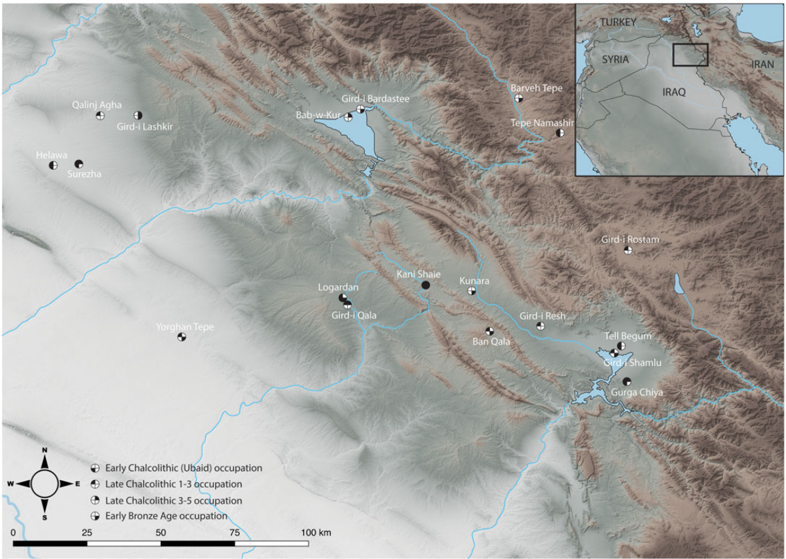
The possibility to conduct new fieldwork projects in previously largely unexplored Iraqi Kurdistan during the past decade has reinvigorated research into the transformative fifth to third millennium BCE (Chalcolithic to Early Bronze Age) in southwest Asia when human societies grew from small, autonomous villages to centralized states with urban centers. Major efforts to synchronize stratigraphic sequences from various sites in order to reach a consensus on archaeological periodization and to identify the absolute chronology of societal transformations necessarily focused on available datasets from Syria, Turkey, and Iran. However, increased understanding of differences in communities’ adoption, adaptation, or rejection of new forms of technologies and social organization demands the need for constructing region-specific absolute chronological models for comparative analysis. Such work is particularly challenging in the case of Iraqi Kurdistan where sites frequently have major hiatuses in occupation. The site of Kani Shaie (Sulaymaniyah Governorate) offers the rare opportunity to investigate the Chalcolithic to Early Bronze Age with a largely uninterrupted sequence of occupation from ca. 5500 to 2500 BCE. This paper presents a series of fourteen radiocarbon dates, representing every archaeological period in this timeframe, as a first step toward the construction of a regional absolute chronology.
Overview
CoChat Summary
TL;DR
Fourteen radiocarbon dates from a stratigraphic sounding at Kani Shaie provide a site-based absolute chronology for the Late Chalcolithic through early EBA in Iraqi Kurdistan, largely matching conventional northern Mesopotamian periodization. The sequence supports a distinguishable LC5 and an EBA II start no earlier than 2900 BCE, but leaves the ’Ubaid–LC1 transition unresolved.
Key findings
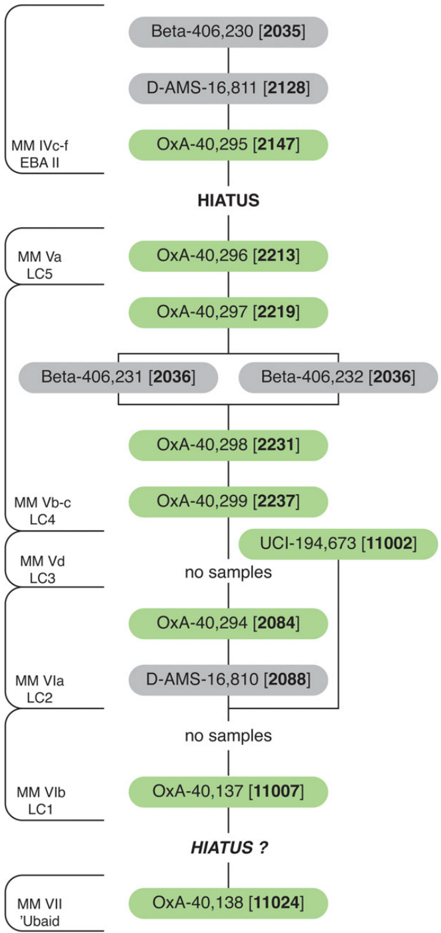
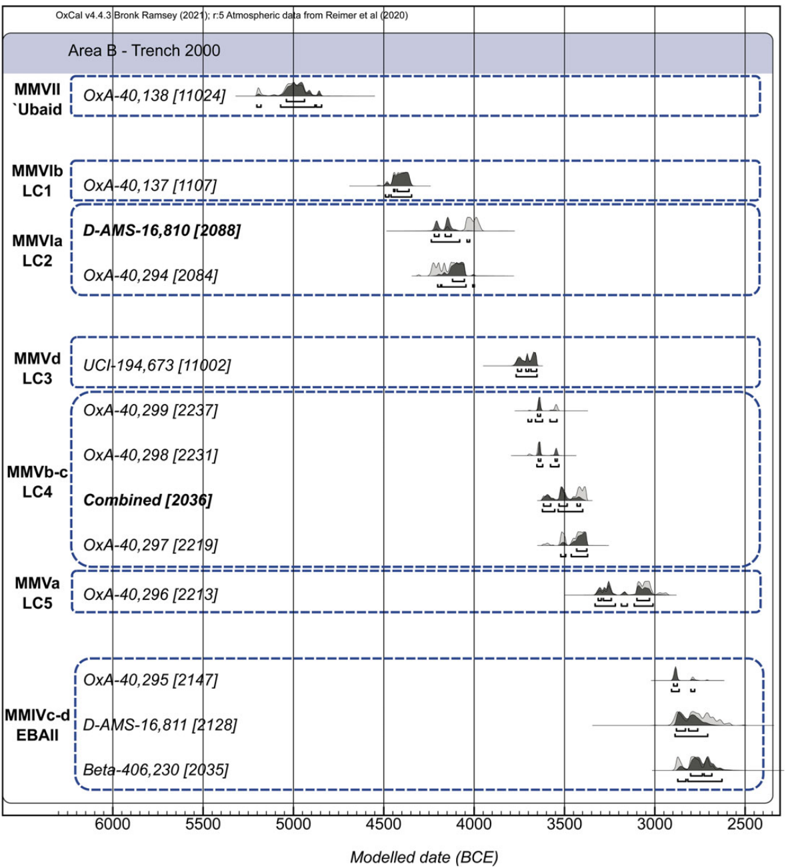
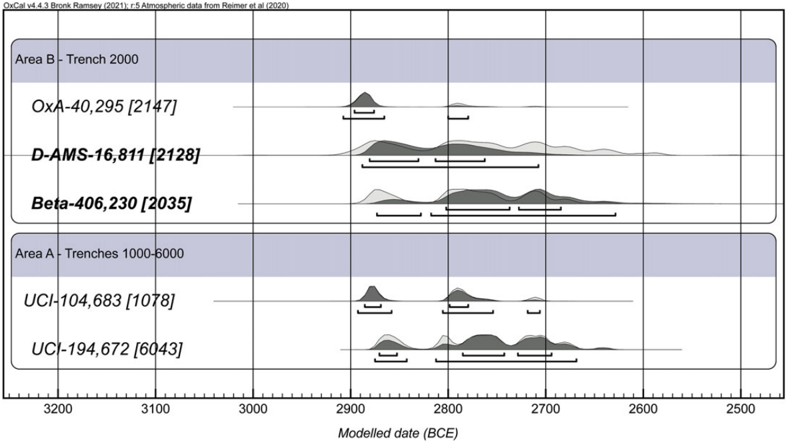
- The modeled dates span LC1–5 and early EBA: LC1 ca. 4450–4350 BCE; LC2 ca. 4230–4050 BCE; LC3 ca. 3750–3650 BCE; LC4 ca. 3650–3375 BCE; LC5 ca. 3325–3025 BCE (authors favor the earlier peak, 3314–3242 BCE); EBA II ca. 2900–2650 BCE, with EBA occupation starting no earlier than 2900 BCE after a 150–350 year hiatus.
- The results largely match the conventional absolute chronology and periodization of northern Mesopotamia, providing first reliable evidence that ceramic developments and associated cultural trends in the western Zagros foothills of Iraqi Kurdistan were on par with general trends across Greater Mesopotamia despite local variation.
- LC5 can be distinguished at Kani Shaie, but its assemblage is very similar to LC4 with only minor changes; major LC5 markers elsewhere—drooping spouts, strap and twisted handles, sharply carinated bowls, and trays—are largely absent.
- The ’Ubaid–LC1 transition remains unresolved: one ’Ubaid date (OxA-40,138) modeled to 5100–4900 BCE is at least 200 years earlier than the hypothesized 4700 BCE and creates a ca. 500-year hiatus before LC1, conflicting with stratigraphic and ceramic continuity; the paper calls for more dates.
Methods
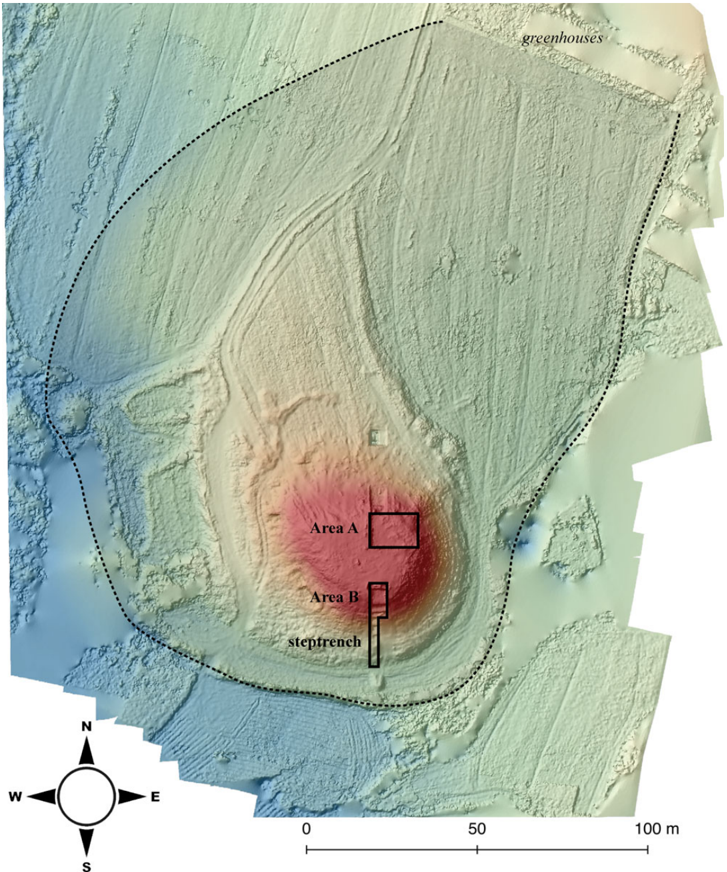
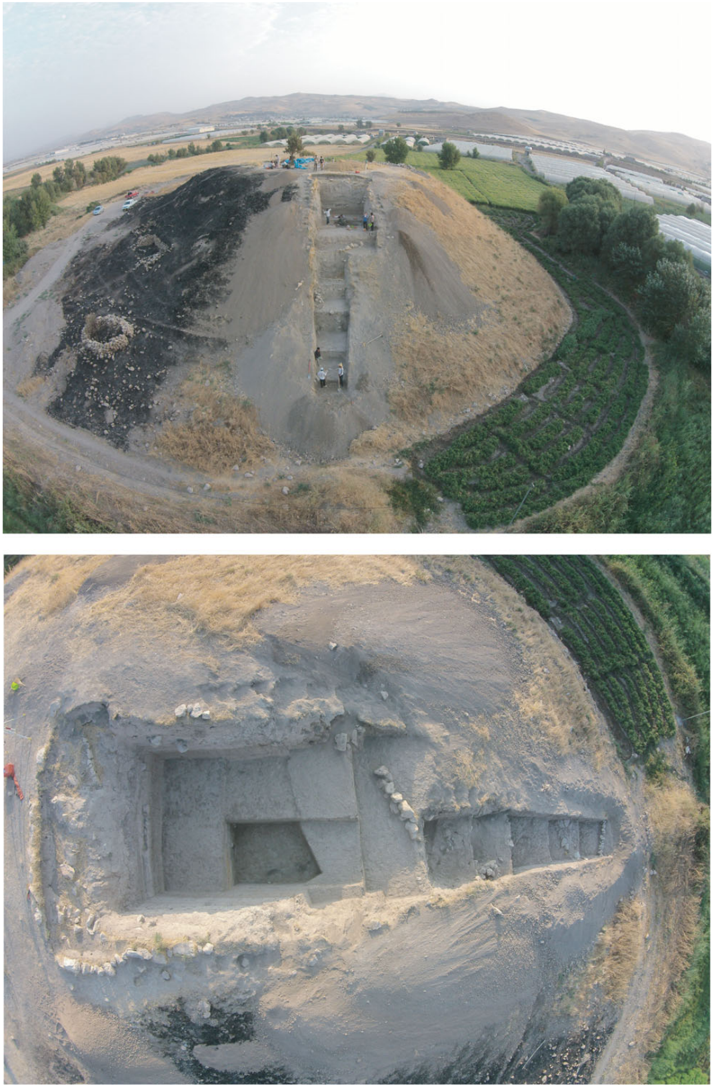
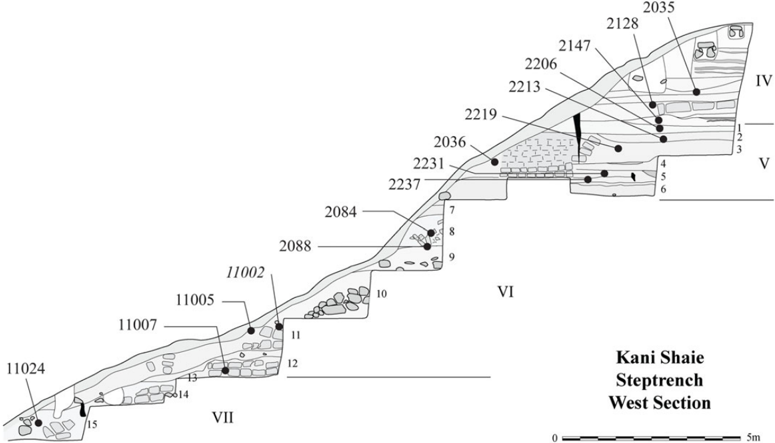
- Excavations at Kani Shaie (Sulaymaniyah Governorate) in 2013–2016; a step trench on the southern slope (Area B/Stratigraphic Sounding) documented a sequence from the ’Ubaid to the EBA. The study uses 14 reliable radiocarbon dates from secure contexts, including ten plant remains from flotation analyzed at Oxford, one wheat grain at UC Irvine, and five charcoal samples analyzed by BetaAnalytic/DirectAMS; two anomalous dates were removed from the model.
- Relative chronology was based on ceramic assemblages—fabrics, vessel shapes, and surface treatment—and stratigraphy, with limited support from administrative clay sealings.
- Dates were calibrated with IntCal20 and modeled in OxCal 4.4 using a Bayesian sequence of contiguous phases, empty phases for hiatuses, and outlier models by sample type; two dates from the same depositional event were combined.
Limitations
- Stated: the dataset is small and unevenly distributed; lower levels (SS-8–15; MM VI–VII) have only singular dates requiring confirmation; single charred seeds can move postdepositionally; two dates (OxA-40,136 and OxA-40,300) were anomalous and removed; LC3 is dated by one sample from a pit; no radiocarbon dates are available for upper EBA III/ETG 5–6; animal bones were not used.
- Stated: lower-half stratigraphic relationships were modeled by projected superimposition into the unexcavated mound and ceramic sequence rather than direct superimposition; the ’Ubaid date’s reliability requires testing; the LC5 single date and a calibration plateau produce an unusually long range with two probability peaks.
- Evident from the text: the ceramic typology for several LC subphases and arguably the entire EBA in Iraqi Kurdistan remains too poorly understood and low-resolution for reliable cross-site comparison, so the framework is skeletal and should be used alongside ceramic publications.
Model-written summary. Check it against the paper before relying on it.
Integrity signals
Registry
Cites
Statistics
Figures
Verification
Claims the paper makes
0 Valid · 1 Not valid · 20 Not checked · 99 Own results and interpretations
A result the paper reports from its own data — it cites no other source for it, so there is none to check. The quote shows it is in the paper.
In the paper
“However, a feature dug into lower levels within the stratigraphic sounding was dated to this phase based on pot sherds.”
§ ESTABLISHING AN ABSOLUTE CHRONOLOGICAL FRAMEWORK FOR THE LATE CHALCOLITHIC TO EARLY BRONZE AGE IN IRAQI KURDISTAN: RADIOCARBON DATES FROM KANI SHAIE > RESULTS
plainstates an associationSingle case- Asserted: passes — The authors put it forward as true.
- Checkable: passes — It can be checked against evidence.
- Load-bearing: unclear — It is unclear whether the paper’s conclusions depend on it.
- Based: passes — The paper gives a reason why it holds.
A result the paper reports from its own data — it cites no other source for it, so there is none to check. The quote shows it is in the paper.
In the paper
“Two samples from Phase MM VIa (LC2) provide a date within the range of ca.4230-4050 BCE for the use and subsequent collapse of the excavated structure.”
§ ESTABLISHING AN ABSOLUTE CHRONOLOGICAL FRAMEWORK FOR THE LATE CHALCOLITHIC TO EARLY BRONZE AGE IN IRAQI KURDISTAN: RADIOCARBON DATES FROM KANI SHAIE > RESULTS
plainstates an associationn = 2- Asserted: passes — The authors put it forward as true.
- Checkable: passes — It can be checked against evidence.
- Load-bearing: passes — The paper’s conclusions depend on it.
- Based: passes — The paper gives a reason why it holds.
- Rests on an assumption not shown here.
A result the paper states — it cites no source for it, so there is none to check. The quote shows it is in the paper.
In the paper
“The subsequent deposits of Phase MM Vd (LC3; traditionally dated to 3800-3600 BCE) did not contain short-lived archaeological plant remains.”
§ ESTABLISHING AN ABSOLUTE CHRONOLOGICAL FRAMEWORK FOR THE LATE CHALCOLITHIC TO EARLY BRONZE AGE IN IRAQI KURDISTAN: RADIOCARBON DATES FROM KANI SHAIE > RESULTS
plain- Asserted: passes — The authors put it forward as true.
- Checkable: passes — It can be checked against evidence.
- Load-bearing: passes — The paper’s conclusions depend on it.
- Based: passes — The paper gives a reason why it holds.
A result the paper reports from its own data — it cites no other source for it, so there is none to check. The quote shows it is in the paper.
In the paper
“A carbonized wheat grain from this pit (UCI-194,673 [11002]) confirms this chronological assessment.”
§ ESTABLISHING AN ABSOLUTE CHRONOLOGICAL FRAMEWORK FOR THE LATE CHALCOLITHIC TO EARLY BRONZE AGE IN IRAQI KURDISTAN: RADIOCARBON DATES FROM KANI SHAIE > RESULTS
plainstates a causeSingle case- Asserted: passes — The authors put it forward as true.
- Checkable: passes — It can be checked against evidence.
- Load-bearing: passes — The paper’s conclusions depend on it.
- Based: passes — The paper gives a reason why it holds.
A result the paper states — it cites no source for it, so there is none to check. The quote shows it is in the paper.
In the paper
“The site of Kani Shaie (Sulaymaniyah Governorate) offers the rare opportunity to investigate the Chalcolithic to Early Bronze Age with a largely uninterrupted sequence of occupation from ca. 5500 to 2500 BCE.”
§ ESTABLISHING AN ABSOLUTE CHRONOLOGICAL FRAMEWORK FOR THE LATE CHALCOLITHIC TO EARLY BRONZE AGE IN IRAQI KURDISTAN: RADIOCARBON DATES FROM KANI SHAIE > Abstract
plainSingle case- Asserted: passes — The authors put it forward as true.
- Checkable: passes — It can be checked against evidence.
- Load-bearing: passes — The paper’s conclusions depend on it.
- Based: passes — The paper gives a reason why it holds.
58 more claims
Create a free account to see all 120 claims and to verify the 17 references still open.
- It may state two separate claims as one. 50
- Probably not a substantial claim. 13
- The quote only partly states this claim. 2
Self-check
Percentages, sums and reported differences re-computed from the paper’s own numbers.
Each contradiction between two passages listed here was confirmed by an independent check.
Rated minor: it would not touch a result — a value no result rests on, a p-value that stays on the same side of the significance level, or a conflict that is clerical, resolved elsewhere in the paper, or outside its own findings.
In the paper
§ ESTABLISHING AN ABSOLUTE CHRONOLOGICAL FRAMEWORK FOR THE LATE CHALCOLITHIC TO EARLY BRONZE AGE IN IRAQI KURDISTAN: RADIOCARBON DATES FROM KANI SHAIE > Abstract
“a largely uninterrupted sequence of occupation from ca. 5500 to 2500 BCE”
§ ESTABLISHING AN ABSOLUTE CHRONOLOGICAL FRAMEWORK FOR THE LATE CHALCOLITHIC TO EARLY BRONZE AGE IN IRAQI KURDISTAN: RADIOCARBON DATES FROM KANI SHAIE > KANI SHAIE-STRATIGRAPHIC SEQUENCE
“a largely continuous sequence of occupation from the 'Ubaid in the early fifth millennium to the Early Bronze Age of the mid-third millennium BCE, spanning roughly 2500 years”
Citations
Cites
Bayesian Analysis of Radiocarbon Dates
Bronk Ramsey, C. (2009) · Radiocarbon · doi:10.1017/s0033822200033865 · Cited by 8,725
The IntCal20 Northern Hemisphere Radiocarbon Age Calibration Curve (0–55 cal kBP)
Reimer, P. J., Austin, W. E. N., Bard, E., Bayliss, A., Blackwell, P. G., Bronk Ramsey, C., Butzin, M., Cheng, H., Edwards, R. L., Friedrich, M., et al. (2020) · Radiocarbon · doi:10.1017/rdc.2020.41 · Cited by 7,900
Dealing with outliers and offsets in radiocarbon dating
Bronk Ramsey, C. (2009) · Radiocarbon · doi:10.1017/s0033822200034093 · Cited by 1,204 · cited 2×
“Each date was assigned an Outlier Model parameter depending on whether the date was derived from a short-lived specimen or charcoal (Bronk Ramsey 2009b; Dee and Bronk Ramsey 2014).”
BackgroundMethodInfluentialBrock, F., Higham, T., Ditchfield, P., & Ramsey, C. B. (2010) · Radiocarbon · doi:10.1017/s0033822200045069 · Cited by 926
Radiocarbon dating and the “old wood” problem: The case of the Hohokam chronology
Schiffer, M. B. (1986) · Journal of Archaeological Science · doi:10.1016/0305-4403(86)90024-5 · Cited by 425
Principles of Archaeological Stratigraphy
Humphreys, A. J. B., & Edward, C. H. (1990) · The South African Archaeological Bulletin · doi:10.2307/3887924 · Cited by 301
Method and Theory in Paleoethnobotany
address:, M., University Press of Colorado, 226, 1. M. S. S., 39883, P., Denver, 8, C., & (720), P. (2015) · University of Colorado Press eBooks · doi:10.5876/9781607323167 · Cited by 165
The Oxford Handbook of Ancient Iran
(2013) · Oxford University Press eBooks · doi:10.1093/oxfordhb/9780199733309.001.0001 · Cited by 152
Early Urbanism in Northern Mesopotamia
McMahon, A. (2020) · Journal of Archaeological Research · doi:10.1007/s10814-019-09136-7 · Cited by 137
High-Precision Bayesian Modeling of Samples Susceptible to Inbuilt Age
Dee, M. W., & Ramsey, C. B. (2014) · Radiocarbon · doi:10.2458/56.16685 · Cited by 131
Research works printed but not linked: 20
- Arrivabeni M. 2019. Pottery. In: Rova E, editor. Tigridian Region. ARCANE 5. Turnhout: Brepols. p. 45-129.
- Lebeau M, editor. 2011. Jezirah. ARCANE 1. Turnhout: Brepols.
- Boaretto, 2019, Tigridian Region, 355
- Boaretto E, Rova E. 2019. Radiocarbon dates and periodisation for the Tigridian region. In: Rova E, editor. Tigridian Region. ARCANE 5. Turnhout: Brepols. p. 355-360.
- Kroll S. 2005. Early Bronze Age settlement patterns in the Orumiye Basin. Archäologische Mitteilungen aus Iran und Turan 37:115-121.
- Helwing B, editor. In press. Western Iran. ARCANE 6. Turnhout: Brepols.
- Rova E. 2003. Relative chronology, periodization and distribution: An introduction. In: Rova E, Weiss H, editors. The origins of North Mesopotamian civilization: Ninevite 5 chronology, economy, society. Subartu IX. Turnhout: Brepols. p. 1-10.
- Ristvet L. 2012. Radiocarbon. In: Lebeau M, editor. Jezirah. ARCANE 1. Turnhout: Brepols. p. 301- 326.
- Sallaberger W, Schrakamp I, editors. 2015. History & philology. ARCANE 3. Turnhout: Brepols.
- Rova E. 2014. Post-LC5 North Mesopotamian developments. In: Lebeau M, editor. ARCANE Interregional: Ceramics. ARCANE Interregional 1. Turnhout: Brepols. p. 1-29.
- Pollard AM, Fazeli NH, Davoudi H, Sarlak S, Helwing B, Anaraki FS. 2013. A new radiocarbon chronology for the north central plateau of Iran from the Late Neolithic to the Iron Age. Archäologische Mitteilungen aus Iran und Turan 45:27-50.
- Danti MD, Voigt MM, Dyson RH, Jr. 2004. The search for the Late Chalcolithic/Early Bronze Age transition in the Ushnu-Solduz Valley, Iran. In: Sagona A, editor. A view from the highlands: archaeological studies in honour of Charles Burney. Ancient Near Eastern Studies Supplement 12. Herent: Peeters. p. 583-616.
- Renette S. 2019. Stratigraphy. In: Rova E, editor. Tigridian Region. ARCANE 5. Turnhout: Brepols. p. 21-44.
- Rothman MS. 2001. The local and the regional: An introduction. In: Rothman MS, editor. Uruk Mesopotamia & its neighbors. Cross-cultural interactions in the era of state formation. Santa Fe: School of American Research Press and Oxford: James Currey. p. 3-26.
- Hundman B, Lacey T, Tate A, Adler J, Heile J, Zoppi U, Chatters J. 2021. Current sample pretreatment protocols for AMS radiocarbon dating by DirectAMS (D-AMS). Paper presented at the 15th International Conference on Accelerator Mass Spectrometry (AMS-15), 15-19 November 2021, Sydney.
- Renette, 2019, Tigridian Region, 21
- Petrie CA. 2014. Iran and Uruk Mesopotamia: Chronologies and connections in the fourth millennium BC. In: McMahon A, Crawford H, 230 S Renette et al. https://doi.org/10.1017/RDC.2022.72 Published online by Cambridge University Press editors. Preludes to urbanism: the Late Chalcolithic of Mesopotamia. McDonald Institute Monographs. Cambridge: McDonald Institute for Archaeological Research. p. 137- 156.
- 10.2307/4299764 · doi:10.2307/4299764
- Kavtaradze GL. 2014. On the importance of the Caucasian chronology for the foundation of the common Near Eastern -East European chronological system. In: Kiknadze V, editor. The Proceedings of the Ivane Javakhishvili Institute of History and Ethnology XII-XIII: Dedicated to the 75th Year Anniversary of Professor Tamaz Beradze's Birth. Tbilisi: Ivane Javakhisvili Tbilisi State University. p. 23-45.
- Weiss H. 2003. Ninevite 5 periods and processes. In: Rova E, Weiss H, editors. The origins of North Mesopotamian civilization: Ninevite 5 chronology, economy, society. Subartu IX. Turnhout: Brepols. p. 593-617.
Cited by
Lewis, M. P. (2025) · Journal of Archaeological Science Reports · doi:10.1016/j.jasrep.2025.105005 · Cited by 9
Self-citationLewis, M. P. (2025) · Cambridge Archaeological Journal · doi:10.1017/s0959774324000404 · Cited by 5
Self-citationNEW RADIOCARBON DATES FOR THE MIDDLE CHALCOLITHIC PERIOD OF THE CENTRAL ZAGROS, IRAN
Bahranipoor, H. (2023) · Radiocarbon · doi:10.1017/rdc.2023.41 · Cited by 4
Sealings and Seal Impressions from Kani Shaie
Renette, S. (2024) · Apollo (University of Cambridge) · doi:10.17863/cam.113266 · Cited by 1
Self-citationde Pablo, J. S.-L., Molist, M., Othman, A. B., Monforte-Barberán, A., Gluitz, A., Rofes, I. G., Breu, A., Abdullrahman, H. A., Ramis, F. X. G., Douché, C., et al. (2026) · Archaeological Research in Asia · doi:10.1016/j.ara.2026.100738
Metadata
- Authors
- Renette, S., Lewis, M. P., Wencel, M. M., Farahani, A., & Tomé, A.
- Affiliations
- University of British Columbia (CA)
- University of Cambridge (GB)
- University of Oxford (GB)
- University of Nevada, Las Vegas (US)
- University of Coimbra (PT)
- Corresponding author
- Lewis, M P
- Venue
- Radiocarbon
- Publisher
- Cambridge University Press (CUP)
- Published
- 2022-12-06
- Volume
- 65
- Issue
- 1
- Pages
- 209-231
- ISSN
- 0033-8222 (ISSN-L)
- 1945-5755
- OpenAlex
- W4311630572
- Cited by
- 11
- References
- 41
- Citations by year
- 2026: 5 · 2025: 2 · 2024: 3 · 2023: 1
- FWCI
- 2.13
- Type
- journal article
- Language
- en
- Open access
- hybrid
- doi.org
- Locations
- Radiocarbon (publishedVersion, cc-by)
- Apollo (University of Cambridge) (submittedVersion, cc-by)
- Funders
- Natural Environment Research Council (NE/V003917/1)
- Topics
- Social Sciences › Archeology › Archaeology and ancient environmental studies
- Social Sciences › Arts and Humanities › Archeology (arts and humanities) › Ancient and Medieval Archaeology Studies
- Social Sciences › Arts and Humanities › Archeology (arts and humanities) › Ancient Near East History
- Keywords
- Chalcolithic, Early Bronze Age, absolute chronology, radiocarbon dating, Iraqi Kurdistan, Sulaymaniyah, periodization, urbanization, state formation, West Asia
About these checks
Registry, retraction, Cites and statistics results are computed, not judged, with one exception: a printed reference that no index lists is read once by a model before it counts as a citation error. Claims are extracted by a model and kept only when their quote appears verbatim in the text; each cited source is then checked, with a model’s help, for whether it says what the claim relies on. Those verdicts can be wrong — read the claim’s quote and the cited source before relying on one.
A language model drew the claims from the paper on 2026-11-23, under version 3 of the claim definition (model deepseek-v4.1-flash, prompt extract-v3).
A second model labelled each claim on 2026-11-23 (model jev-1.13-20260917, definition revision gold-guideline-v0.2).
Statistics and arithmetic are recomputed, not judged.
Confidence bands are shown only for fields calibrated on our annotated test set. None is calibrated yet, so no band is shown.
What counts as a claim ›How we measure confidence ›How we check this ›
Are you an author, or do you see a problem with this page? Request a review
Data sources
Bibliographic data: Semantic Scholar, OpenAlex, Crossref.
Contains information from the Semantic Scholar Academic Graph Datasets, made available under the ODC Attribution License (ODC-BY 1.0).
Semantic Scholar’s data is described in: Kinney, R., et al. (2023). The Semantic Scholar Open Data Platform. arXiv:2301.10140.
