

DATING ANCIENT CANAL SYSTEMS USING RADIOCARBON DATING AND ARCHAEOLOGICAL EVIDENCE AT TELLO/GIRSU, SOUTHERN MESOPOTAMIA, IRAQ
Open accessThe DOI matches its Crossref record; 63 of the 64 references it cites were found in a registry or an index; none of the 34 sources its claims cite is checked for support yet.
Abstract
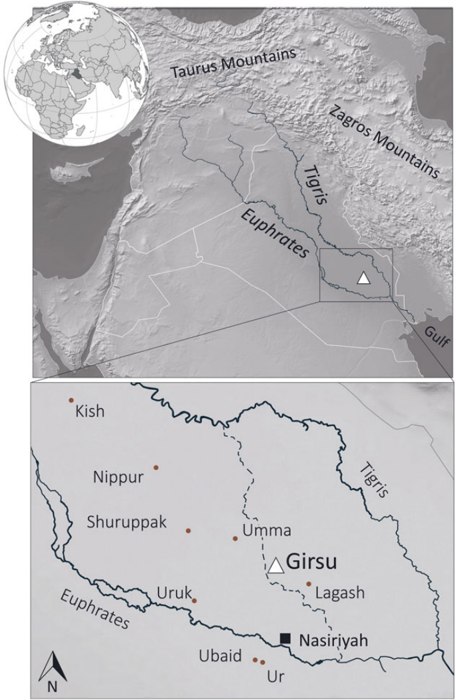
Mesopotamia is often regarded the “cradle of civilization.” The development of water management practices in the region is thought to have played a key role in the emergence of these early civilizations. We present the first direct dating of a palaeo-canal system at the ancient city of Girsu, Mesopotamia (modern Iraq) (occupied between 4800 and 1600 BC). We describe the use of archaeological and radiocarbon (14 C) dating techniques to establish the age of this canal system. Our results show considerable differences between shell 14 C dates on the one hand and charcoal 14 C dates and archaeological evidence on the other. This likely reflects the impact of freshwater reservoir effects from the Tigris and Euphrates Rivers. Although the FRE from rivers is widely acknowledged, its impact on 14 C dates in Mesopotamia is rarely discussed and poorly understood. Our results provide a first indication of its variability and magnitude. With the publication of our results we aim to highlight the problem and re-initiate collaborative research efforts in improving 14 C dating in this important region.
Overview
CoChat Summary
TL;DR
This paper presents the first direct dating of a palaeo-canal system at Girsu (Tello), southern Mesopotamia, combining 14C dating of shell and charcoal with archaeological evidence. It finds that shell 14C dates are systematically older than charcoal dates and associated pottery, likely due to a freshwater reservoir effect (FRE) from the Tigris and Euphrates.
Key findings
- Shell 14C dates from canals and lacustrine deposits were older than the associated archaeological layers, while charcoal dates agreed with Ubaid 4/5 archaeology. For example, in E3 context 13005, charcoal samples dated 5710 ± 30 BP (4672–4456 cal BC) and 5640 ± 30 BP (4542–4367 cal BC), whereas a shell from the same context dated 6020 ± 30 BP (4999–4803 cal BC).
- The FRE was estimated from paired E3 samples as R1 = 310 ± 42 and R2 = 380 ± 42 14C years; an average correction of 345 ± 60 14C years was applied. After correction, all fluvial 14C dates fell within the period of known occupation at Girsu, but many corrected shell dates still pre-dated the associated archaeological material.
- Archaeological evidence suggests the canals were in use from at least the ED I period (2900–2600 BC), and the youngest archaeological evidence below several canal fills dates to the Isin-Larsa period (2000–1800 BC), indicating the canals fell out of use at or shortly after this time when Girsu was largely abandoned.
- All 14C dates fell between the beginning of Ubaid 1 and the end of the Early Akkadian period; the oldest fluvial date came from palaeocanal 7 (5324–5132 cal BC, Ubaid 3), and the youngest from lacustrine deposits (2456–2204 cal BC, Early Akkadian).
Methods
- Geoarchaeological trenches were excavated across palaeo-canals, lake, and floodplain deposits around Girsu; the paper states 15 14C samples were collected from 7 different palaeo-canals, plus two samples from ancient lacustrine sediments. Shell and charcoal samples were selected from key stratigraphic units and analyzed by Beta Analytic using AMS.
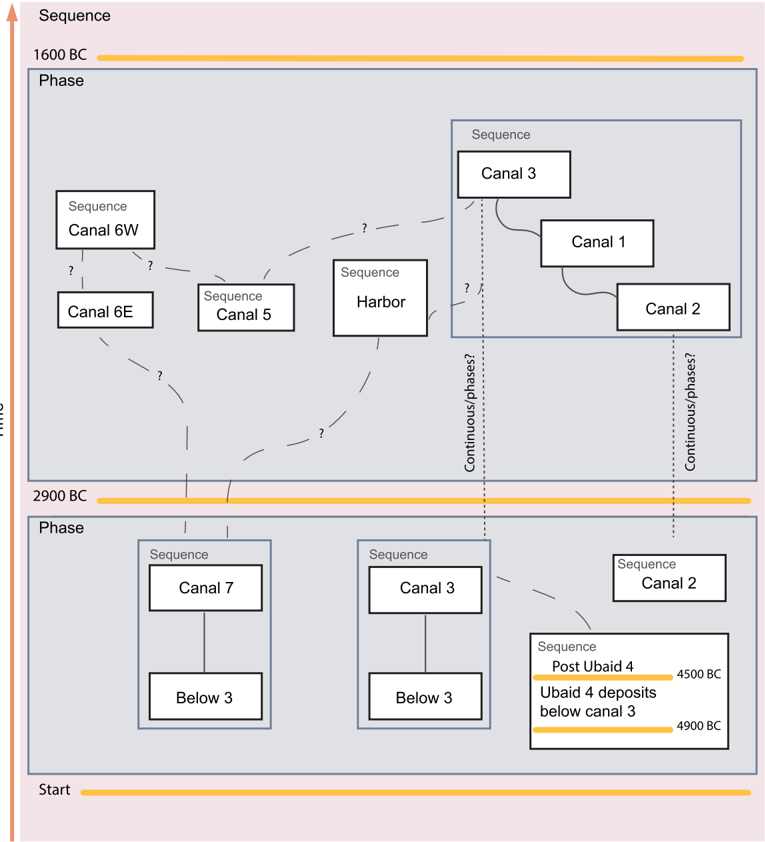
- Dates were calibrated with OxCal v4.4.4 using the IntCal20 Northern Hemisphere curve. A two-phase sequential Bayesian model incorporated stratigraphic relationships, archaeological evidence, and a relative channel chronology based on remote sensing, a high-resolution DEM, and field observations.
- Archaeological dating relied on pottery/cultural chronologies and stratigraphic associations.
Limitations
- The paper states that the chronological framework is a working hypothesis; that FRE in hard-water rivers can be variable over time, geographically, and between/within species, making the average correction an oversimplistic representation; and that most corrected shell dates still pre-date associated archaeology, so the FRE at Girsu needs further characterization.
- The paper notes that 14C dates for Mesopotamia are limited, organic preservation is poor, and shell dating remains the go-to method; it also notes that no pre-bomb or living specimens are available for local correction.
- Evident from the text: the FRE estimate rests on only two charcoal dates and one shell from one close context (E3); two calibrated results were treated as outliers (508715/TH6-SH4-100 and 545370/TH14-SH1-60); and in Bayesian modeling, several samples fell below the 60% agreement threshold.
Model-written summary. Check it against the paper before relying on it.
Integrity signals
Registry
Cites
Statistics
Figures
Verification
Claims the paper makes
0 Valid · 4 Not valid · 19 Not checked · 98 Own results and interpretations
A result the paper reports from its own data — it cites no other source for it, so there is none to check. The quote shows it is in the paper.
In the paper
“Our results show a clear discrepancy between 14 C shell dates and the age of the archaeological evidence.”
§ DATING ANCIENT CANAL SYSTEMS USING RADIOCARBON DATING AND ARCHAEOLOGICAL EVIDENCE AT TELLO/GIRSU, SOUTHERN MESOPOTAMIA, IRAQ > Dating Ancient Canal Systems 17
boosted- Asserted: passes — The authors put it forward as true.
- Checkable: passes — It can be checked against evidence.
- Load-bearing: passes — The paper’s conclusions depend on it.
- Based: passes — The paper gives a reason why it holds.
A result the paper reports from its own data — it cites no other source for it, so there is none to check. The quote shows it is in the paper.
In the paper
“Trench TH9 across palaeocanal 6E (31°33'10.9“N46°10'28.0”E)4080 ± 30 BP 2857-2492 cal BC 515277 -TH9-CH1-70 δ 13 C= -29.1”
§ DATING ANCIENT CANAL SYSTEMS USING RADIOCARBON DATING AND ARCHAEOLOGICAL EVIDENCE AT TELLO/GIRSU, SOUTHERN MESOPOTAMIA, IRAQ > Canal 6E
plainSingle case- Asserted: passes — The authors put it forward as true.
- Checkable: passes — It can be checked against evidence.
- Load-bearing: passes — The paper’s conclusions depend on it.
- Based: passes — The paper gives a reason why it holds.
A result the paper states — it cites no source for it, so there is none to check. The quote shows it is in the paper.
In the paper
“There are two clearly outlying calibrated results (508715/TH6-SH4-100 and 545370/TH14-SH1-60).”
§ DATING ANCIENT CANAL SYSTEMS USING RADIOCARBON DATING AND ARCHAEOLOGICAL EVIDENCE AT TELLO/GIRSU, SOUTHERN MESOPOTAMIA, IRAQ > A Relative Chronological Model
boosted- Asserted: passes — The authors put it forward as true.
- Checkable: passes — It can be checked against evidence.
- Load-bearing: passes — The paper’s conclusions depend on it.
- Based: passes — The paper gives a reason why it holds.
A result the paper reports from its own data — it cites no other source for it, so there is none to check. The quote shows it is in the paper.
In the paper
“Both samples are older than the archaeological evidence obtained from below the canal fill, which dates to 2100-1600 BC.”
§ DATING ANCIENT CANAL SYSTEMS USING RADIOCARBON DATING AND ARCHAEOLOGICAL EVIDENCE AT TELLO/GIRSU, SOUTHERN MESOPOTAMIA, IRAQ > Canal 6W
plain- Asserted: passes — The authors put it forward as true.
- Checkable: passes — It can be checked against evidence.
- Load-bearing: passes — The paper’s conclusions depend on it.
- Based: passes — The paper gives a reason why it holds.
A result the paper reports from its own data — it cites no other source for it, so there is none to check. The quote shows it is in the paper.
In the paper
“4130 ± 30 BP 2871-2581 cal BC 508717 -TH7-SH2-90 δ 13 C= -4.9”
§ DATING ANCIENT CANAL SYSTEMS USING RADIOCARBON DATING AND ARCHAEOLOGICAL EVIDENCE AT TELLO/GIRSU, SOUTHERN MESOPOTAMIA, IRAQ > Canal 6W
plainSingle case- Asserted: passes — The authors put it forward as true.
- Checkable: passes — It can be checked against evidence.
- Load-bearing: passes — The paper’s conclusions depend on it.
- Based: passes — The paper gives a reason why it holds.
69 more claims
Create a free account to see all 121 claims and to verify the 22 references still open.
- It may state two separate claims as one. 39
- The quote only partly states this claim. 2
- Probably not a substantial claim. 13
Claims other papers make about this one
Each is checked against this paper’s own text: does it say what the citing paper says it does?
In the citing paper
“and therefore a clearer and more empirical chronology is emerging to which our research contributes.”
From LANDSCAPE ARCHAEOLOGY OF THE ERIDU REGION: DISCOVERING THE IRRIGATION SYSTEMS OF ANCIENT FARMS (2026) · cites this paper as Egberts et al. 2023
In the citing paper
“Egberts et al. (2023) suggest that the dates obtained from shells at Girsu were offset by the freshwater reservoir effect, for which they model a correction at Girsu (between 310 ± 42 and 380 ± 42 14C years).”
From LANDSCAPE ARCHAEOLOGY OF THE ERIDU REGION: DISCOVERING THE IRRIGATION SYSTEMS OF ANCIENT FARMS (2026) · cites this paper as Egberts et al. (2023)
Self-check
Percentages, sums and reported differences re-computed from the paper’s own numbers.
Each contradiction between two passages listed here was confirmed by an independent check.
Rated minor: it would not touch a result — a value no result rests on, a p-value that stays on the same side of the significance level, or a conflict that is clerical, resolved elsewhere in the paper, or outside its own findings.
In the paper
§ DATING ANCIENT CANAL SYSTEMS USING RADIOCARBON DATING AND ARCHAEOLOGICAL EVIDENCE AT TELLO/GIRSU, SOUTHERN MESOPOTAMIA, IRAQ > Below the bridge and Canal 3
“Excavation area E6, east of the bridge (31°33'43.4"N46°10'54.1"E)5590 ± 30 BP 4691-4502 cal BC 545371 -TG-E6”
§ DATING ANCIENT CANAL SYSTEMS USING RADIOCARBON DATING AND ARCHAEOLOGICAL EVIDENCE AT TELLO/GIRSU, SOUTHERN MESOPOTAMIA, IRAQ > Comparing Radiocarbon Dates and Archaeological Evidence
“The four charcoal 14 C dates obtained from these deposits range from 4691-4502 cal BC (E4) to 4491-4352 cal BC (E6)”
Citations
Cites
Bayesian Analysis of Radiocarbon Dates
Bronk Ramsey, C. (2009) · Radiocarbon · doi:10.1017/s0033822200033865 · Cited by 8,725
The IntCal20 Northern Hemisphere Radiocarbon Age Calibration Curve (0–55 cal kBP)
Reimer, P. J., Austin, W. E. N., Bard, E., Bayliss, A., Blackwell, P. G., Bronk Ramsey, C., Butzin, M., Cheng, H., Edwards, R. L., Friedrich, M., et al. (2020) · Radiocarbon · doi:10.1017/rdc.2020.41 · Cited by 7,900
Anastomosing rivers: a review of their classification, origin and sedimentary products
Makaske, B. (2001) · Earth-Science Reviews · doi:10.1016/s0012-8252(00)00038-6 · Cited by 584
The freshwater reservoir effect in radiocarbon dating
Philippsen, B. (2013) · Heritage Science · doi:10.1186/2050-7445-1-24 · Cited by 379
Ancient Mesopotamia at the Dawn of Civilization: The Evolution of an Urban Landscape
Algaze, G. (2008) · University of Chicago Press eBooks · doi:10.7208/chicago/9780226013787.001.0001 · Cited by 280
Bar-Yosef, O. (1982) · The Biblical Archaeologist · doi:10.2307/3209772 · Cited by 218
Chiefdoms and early states in the Near East : the organizational dynamics of complexity
Stein, G. J., & Rothman, M. S. (1994) · Medical Entomology and Zoology · Cited by 178
Irrigation's Impact on Society
Woodbury, R. B., Downing, T. E., & Gibson, M. (1974) · Ethnohistory · doi:10.2307/480962 · Cited by 176
Crawford, H. (2004) · Cambridge University Press eBooks · doi:10.1017/cbo9780511816208 · Cited by 159
The Uruk world system: the dynamics of expansion of early Mesopotamian civilization
(1993) · Choice Reviews Online · doi:10.5860/choice.31-2243 · Cited by 157
Research works printed but not linked: 10
- Adams RM, Nissen HJ. 1972. The Uruk countryside: the natural setting of urban societies. Chicago: University of Chicago Press.
- Van Ess M, Heußner K. 2015. Absolute chronology of the Uruk and Jemdet Nasr periods at Uruk, southern Mesopotamia: the interpretation of additional 14 C sample. Zeitschrift Für Orient- Archäologie 8:10-37.
- Postgate N. 1986. The transition from Uruk to Early Dynastic: continuities and discontinuities in the record of settlement. In: Finkbeiner U, Röllig W, editors. Gamdat Nasr : period or regional style? : papers given at a symposium held in Tübingen, November 1983. Wiesbaden: Reichert. p. 90-106.
- Campbell G, Moffett L, Straker V. 2011. Environmental archaeology. A guide to the theory and practice of methods, from sampling and recovery to post-excavation. 2nd ed. English Heritage.
- Münnich KO. 1957. Heidelberg natural radiocarbon measurements I. Science 126(3266):194-199. doi: 10.1126/science.os-2.57.341-a Nissen HJ. 2016. The development of urban life in Mesopotamia and the implementation of canal systems. In: Madsen JK, Andersen NO, Thuesen I, editors. Water of life. Essays from a symposium held on the occasion of Peder Mortensen's 80th birthday. Copenhagen: Orbis Publishing House. p. 86-96. · DOI
- Wilkinson TJ. 2013. Hydraulic Landscapes and Irrigation Systems of Sumer. In: Crawford H, editor. The Sumerian world. 1st ed. Abingdon: Routledge. p. 33-54.
- Genouillac H. 1936. Fouilles de Telloh. Tome I: Epoques présargoniques. Tome II: Epoques d'Ur, IIIe dynastie et de Larsa. Paris: Paul Geuthner.
- Algaze G. 2008a. Ancient Mesopotamia at the dawn of civilization: the evolution of an urban landscape. Chicago: University of Chicago Press. · DOI · Paper page
- Postgate N. 1992. Early Mesopotamia. Society and economy at the dawn of history. 1st ed. London: Routledge.
- Sallaberger W, Schrakamp I. 2015. Part I: philological data for a historical chronology of Mesopotamia in the 3rd millennium. In: Sallaberger W, Schrakamp I, editors. History & Philology, ARCANE 3. Turnhout, Belgium: Brepols. p. 3-136.
Cited by
Anthony, E. J., Syvitski, J. P. M., Cohen, K. M., Saito, Y., Zăinescu, F. I., Vespremeanu‐Stroe, A., Nicholls, R. J., Marriner, N., Amorosi, A., Maselli, V., et al. (2025) · Earth-Science Reviews · doi:10.1016/j.earscirev.2025.105302 · Cited by 22
Brown, P. J., Jotheri, J., Rayne, L., Abdalwahab, N. S., & Andrieux, E. (2025) · Antiquity · doi:10.15184/aqy.2025.72 · Cited by 6
Self-citationMorphodynamic Foundations of Sumer
Giosan, L., & Goodman, R. C. (2025) · PLoS ONE · doi:10.1371/journal.pone.0329084 · Cited by 4
Briant, R. M., Jotheri, J., Al‐Ameri, I., Ahmed, A., Bateman, M. D., Engels, S., Garzanti, E., Nymark, A., & Reynolds, T. E. (2024) · Earth Surface Processes and Landforms · doi:10.1002/esp.5779 · Cited by 3
Self-citationSacred Space and Ritual Behaviour in Ancient Mesopotamia: A View from Tello/Girsu
Greenfield, T. L., Michele, A. D., Husain, F., & Rey, S. (2024) · Humans · doi:10.3390/humans4030015 · Cited by 2
Self-citationDarras, L., Cez, L., & Vallet, R. (2024) · E3S Web of Conferences · doi:10.1051/e3sconf/202450401001 · Cited by 2
LANDSCAPE ARCHAEOLOGY OF THE ERIDU REGION: DISCOVERING THE IRRIGATION SYSTEMS OF ANCIENT FARMS
Rayne, L., de Gruchy, M., Jotheri, J., & Abdan, R. (2026) · Iraq · doi:10.1017/irq.2025.10037 · Cited by 1
Self-citationGoodman, R. C., Giosan, L., Shen, Z., Zimmerman, P., Lang, A., Constantinescu, Ș., Pizzimenti, S., Alrawi, Z., & Pittman, H. (2025) · Geoarchaeology · doi:10.1002/gea.70027 · Cited by 1
Back Matter ("About ARWA and the Sumer and the Sea Conference", "Works Cited")
(2025) · Brepols Publishers eBooks · doi:10.1484/m.aratta-eb.5.151079
The Natural Environment of Southern Mesopotamia: Animals, Plants, and Landscape in Cuneiform Texts
Alivernini, S., Greco, A., & Widell, M. (2026) · Environmental Archaeology · doi:10.1080/14614103.2026.2680740
Strontium Varied Across the City: 87 Sr/ 86 Sr Values at Ur (Tell al-Muqayyar, Iraq)
Iorga, A., Hammer, E. L., Twiss, K. C., Wright, C. C., Rasbury, E. T., & Wooton, K. M. (2026) · Environmental Archaeology · doi:10.1080/14614103.2026.2717497
الموانئ النهرية في العراق القديم: منذ العصر الأكدي حتى العصر الآشوري الحديث
الدسوقي, م. ع. ا. أ., عجلان, ر. ص., & عطية, ص. س. (2026) · Mağallaẗ Ǧamʿiyyaẗ Turāṯ Miṣr · doi:10.21608/mgtm.2025.433063.1047
Torun, E., Rey, S., Goodburn-Brown, D., Üner, G., Eguílaz, U. R., & Husain, F. (2026) · Studies in Conservation · doi:10.1080/00393630.2025.2610673
Self-citation
Metadata
- Authors
- Egberts, E., Jotheri, J., Di Michele, A., Baxter, A., & Rey, S.
- Affiliations
- British Museum (GB)
- Durham University (GB)
- Museum of London Archaeology (GB)
- Corresponding author
- Egberts, Ella
- Venue
- Radiocarbon
- Publisher
- Cambridge University Press (CUP)
- Published
- 2023-08
- Volume
- 65
- Issue
- 4
- Pages
- 979-1002
- ISSN
- 0033-8222 (ISSN-L)
- 1945-5755
- OpenAlex
- W4385663455
- Semantic Scholar
- 84681e239096aed4a0257be6f3862aaeed3adad7
- Cited by
- 14
- References
- 59
- Citations by year
- 2026: 5 · 2025: 5 · 2024: 4
- FWCI
- 5.46
- Type
- journal article
- Language
- en
- Open access
- hybrid
- doi.org
- Licence
- Locations
- Radiocarbon (publishedVersion, cc-by-nc-sa)
- VUBIR (Vrije Universiteit Brussel) (publishedVersion)
- Funders
- Getty Foundation
- Queen's University Belfast
- Queen's University
- Topics
- Social Sciences › Archeology › Archaeology and ancient environmental studies
- Social Sciences › Arts and Humanities › Archeology (arts and humanities) › Ancient Near East History
- Social Sciences › Arts and Humanities › History › Water management and technologies
- Keywords
- ancient canals, Girsu, Tello, radiocarbon dating, freshwater reservoir effect, Tigris and Euphrates rivers, water management, Mesopotamian civilization, archaeological chronology
About these checks
Registry, retraction, Cites and statistics results are computed, not judged, with one exception: a printed reference that no index lists is read once by a model before it counts as a citation error. Claims are extracted by a model and kept only when their quote appears verbatim in the text; each cited source is then checked, with a model’s help, for whether it says what the claim relies on. Those verdicts can be wrong — read the claim’s quote and the cited source before relying on one.
A language model drew the claims from the paper on 2026-11-24, under version 3 of the claim definition (model deepseek-v4.1-flash, prompt extract-v3).
A second model labelled each claim on 2026-11-24 (model jev-1.13-20260917, definition revision gold-guideline-v0.2).
Statistics and arithmetic are recomputed, not judged.
Confidence bands are shown only for fields calibrated on our annotated test set. None is calibrated yet, so no band is shown.
What counts as a claim ›How we measure confidence ›How we check this ›
Are you an author, or do you see a problem with this page? Request a review
Data sources
Bibliographic data: Semantic Scholar, OpenAlex, Crossref.
Contains information from the Semantic Scholar Academic Graph Datasets, made available under the ODC Attribution License (ODC-BY 1.0).
Semantic Scholar’s data is described in: Kinney, R., et al. (2023). The Semantic Scholar Open Data Platform. arXiv:2301.10140.
