

INTERNATIONAL HUMAN RIGHTS LAW AS A FRAMEWORK FOR ALGORITHMIC ACCOUNTABILITY
Open accessThe DOI matches its Crossref record; 11 of the 16 references it cites were found in a registry or an index; 1 of the 85 sources its claims cite were checked for support.
Abstract
Abstract Existing approaches to ‘algorithmic accountability’, such as transparency, provide an important baseline, but are insufficient to address the (potential) harm to human rights caused by the use of algorithms in decision-making. In order to effectively address the impact on human rights, we argue that a framework that sets out a shared understanding and means of assessing harm; is capable of dealing with multiple actors and different forms of responsibility; and applies across the full algorithmic life cycle, from conception to deployment, is needed. While generally overlooked in debates on algorithmic accountability, in this article, we suggest that international human rights law already provides this framework. We apply this framework to illustrate the effect it has on the choices to employ algorithms in decision-making in the first place and the safeguards required. While our analysis indicates that in some circumstances, the use of algorithms may be restricted, we argue that these findings are not ‘anti-innovation’ but rather appropriate checks and balances to ensure that algorithms contribute to society, while safeguarding against risks.
Overview
CoChat Summary
TL;DR
The article argues that existing algorithmic accountability approaches such as transparency are necessary but insufficient, and that international human rights law (IHRL) provides a shared framework for defining harm, allocating responsibilities, and covering the full algorithmic life cycle. Applying IHRL yields red lines, required safeguards, and heightened rather than reduced responsibility for unpredictable algorithmic effects.
Key findings
- Transparency, explainability, and technical fixes are a necessary baseline but incomplete; the authors identify gaps around defining harm, addressing the full algorithmic life cycle, allocating State/business responsibilities, providing remedies, and moving beyond after-the-fact accountability.
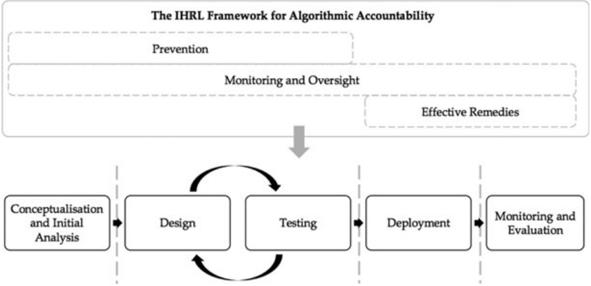
- IHRL supplies a framework: substantive and procedural rights define harm; States have obligations to prevent, protect, monitor, oversee, and remedy; businesses have expectations under the UN Guiding Principles on Business and Human Rights; and the framework applies from conception and design through deployment.
- Applying IHRL produces three effects: it may prohibit algorithms in certain decisions, such as where use would circumvent IHRL or where sentencing, bail, or parole decisions are made exclusively by algorithm due to arbitrariness and group-based correlation; it may require modifications or safeguards and thus delay deployment; and it rejects reduced responsibility where algorithmic effects cannot be predicted, potentially increasing responsibility.
- A human “in the loop” is not automatically an effective safeguard; the article’s discussion of *State of Wisconsin v Eric L. Loomis* and COMPAS illustrates risks of deference and inability to challenge proprietary algorithmic reasoning, so safeguards must address how the algorithm functions, not only input data and outcomes.
Methods
- Design: conceptual and doctrinal legal analysis; no empirical sample or dataset is reported.
- Data/sources: IHRL instruments and commentary, including UN Human Rights Committee General Comments, the Ruggie Principles, ECtHR cases, and existing algorithmic accountability literature.
- Main analysis: maps IHRL obligations and business expectations onto the algorithmic life cycle and applies the framework to illustrative contexts including criminal justice risk assessment, social security, child safeguarding, credit scoring, content moderation, and facial-image sexual-orientation inference.
Limitations
- The paper states that IHRL is not an exclusive or ready-made solution; business human rights responsibilities are still developing, IHRL does not currently impose direct obligations on businesses under international law, global business operations create regulatory and enforcement gaps, and IHRL cannot resolve all algorithmic accountability challenges, some of which belong to fields such as data protection.
- The paper states that its scope excludes discussion of established human rights mechanisms and that much work remains to operationalize and apply the IHRL framework.
- Evident from the text: the framework is not empirically tested or validated, and the examples are illustrative rather than a systematic sample; no quantitative outcomes are reported.
Model-written summary. Check it against the paper before relying on it.
Integrity signals
Registry
Cites
Statistics
Figures
Verification
Claims the paper makes
1 Valid · 14 Not valid · 72 Not checked · 182 Own results and interpretations
None of the sources cited for this claim could be matched to a paper, so there is nothing to check it against.
In the paper
“As a result of a narrow conceptualization of harm, impact assessments in an algorithmic context have typically focused on issues relating to discrimination and privacy.”
What the sources say
- Not matchedcites K Crawford and J Schultz, 'Big Data and Due Process: Toward a Framework to Redress Predictive Privacy Harms' (2014) 55(1) Boston College Law Review 93, 95
An author–year citation the paper’s reference list doesn’t settle. We don’t search these by name.
- Not matchedcites Kroll et al. (n 9) 678.
This doesn’t read as a citation we can look up.
plainstates a cause- Asserted: passes — The authors put it forward as true.
- Checkable: passes — It can be checked against evidence.
- Load-bearing: passes — The paper’s conclusions depend on it.
- Based: passes — The paper gives a reason why it holds.
- Not matched
None of the sources cited for this claim could be matched to a paper, so there is nothing to check it against.
In the paper
“This is important as States are increasingly reported to be integrating algorithms within their decisionmaking processes across a range of sectors that may have signi fi cant consequences for individuals and groups in areas such as policing, sentencing, social security and the identi fi cation of children at risk, as noted above.”
What the sources say
- Not matchedcites Canadian Institute for Advanced Research, 'CIFAR Pan-Canadian Artificial Intelligence Strategy'
This doesn’t read as a citation we can look up.
- Not matchedcites E Macron, 'Artificial Intelligence: Making France a Leader'
This doesn’t read as a citation we can look up.
- Not matchedcites NITI Aayog, 'National Strategy for Artificial Intelligence #AIFORALL'
This doesn’t read as a citation we can look up.
hedged- Asserted: passes — The authors put it forward as true.
- Checkable: passes — It can be checked against evidence.
- Load-bearing: passes — The paper’s conclusions depend on it.
- Based: passes — The paper gives a reason why it holds.
- Not matched
A conclusion the paper draws from its own results — it cites no other source for it, so there is none to check. The quote shows it is in the paper.
In the paper
“While generally overlooked in debates on algorithmic accountability, in this article, we suggest that international human rights law already provides this framework.”
hedgedstates a cause- Asserted: passes — The authors put it forward as true.
- Checkable: passes — It can be checked against evidence.
- Load-bearing: passes — The paper’s conclusions depend on it.
- Based: unclear — It is unclear why the paper says it holds.
A statement the paper makes itself — it cites no source for it, so there is none to check. The quote shows it is in the paper.
In the paper
“Yet, big datadriven algorithmic models may be used to make individually-focused decisions.”
hedgedstates a possible cause- Asserted: passes — The authors put it forward as true.
- Checkable: passes — It can be checked against evidence.
- Load-bearing: passes — The paper’s conclusions depend on it.
- Based: passes — The paper gives a reason why it holds.
In the paper
“However, the nature of big data-driven algorithms means that they generate results that describe group behaviour, but which are not tailored to speci fi c individuals within that group, irrespective of the size or quality of the input dataset. 30”
What the sources say
- Not matchedcites [30]
The reference list we hold has no entry [30].
plainstates a cause- Asserted: passes — The authors put it forward as true.
- Checkable: passes — It can be checked against evidence.
- Load-bearing: passes — The paper’s conclusions depend on it.
- Based: passes — The paper gives a reason why it holds.
- Not matched
85 more claims
Create a free account to see all 269 claims and every source verdict.
- Probably not a substantial claim. 136
- It may state two separate claims as one. 84
Citations
Cites
Ananny, M., & Crawford, K. (2018) · New Media & Society · doi:10.1177/1461444816676645 · Cited by 1,836
On the Morality of Artificial Agents
Floridi, L., & Sanders, J. W. (2004) · Minds and Machines · doi:10.1023/b:mind.0000035461.63578.9d · Cited by 1,218
The responsibility gap: Ascribing responsibility for the actions of learning automata
Matthias, A. (2004) · Ethics and Information Technology · doi:10.1007/s10676-004-3422-1 · Cited by 1,101
Counterfactual explanations without opening the black box: automated decisions and the GDPR
Wachter, S., Mittelstadt, B., & Russell, C. (2017) · SSRN Electronic Journal · doi:10.2139/ssrn.3063289 · Cited by 1,061
Wang, Y., & Kosinski, M. (2018) · Journal of Personality and Social Psychology · doi:10.1037/pspa0000098 · Cited by 766
Algorithmic Accountability: Journalistic investigation of computational power structures
Diakopoulos, N. (2015) · Digital Journalism · doi:10.1080/21670811.2014.976411 · Cited by 733
(2014) · Digital Commons at University of Maryland Carey Law (University of Maryland Francis King Carey School of Law) · Cited by 524
Zarsky, T. (2016) · Science, Technology, & Human Values · doi:10.1177/0162243915605575 · Cited by 422
Dodig Crnkovic, G., & Çürüklü, B. (2012) · Ethics and Information Technology · doi:10.1007/s10676-011-9278-2 · Cited by 90
(2017) · The Knowledge Bank (The Ohio State University) · Cited by 29
Cited by
AI for humanitarian action: human rights and ethics
Pizzi, M., Romanoff, M., & Engelhardt, T. (2020) · International Review of the Red Cross · doi:10.1017/s1816383121000011 · Cited by 145
International migration management in the age of artificial intelligence
Beduschi, A. (2021) · Migration Studies · doi:10.1093/migration/mnaa003 · Cited by 141
“Identifying such gaps and acting on them would allow state authorities to prepare and adapt their reception conditions, thus complying with their legal obligations under international human rights law (IHRL).”
BackgroundInfluentialFrom human resources to human rights: Impact assessments for hiring algorithms
Yam, J., & Skorburg, J. A. (2021) · Ethics and Information Technology · doi:10.1007/s10676-021-09599-7 · Cited by 172
Koshiyama, A., Kazim, E., Treleaven, P., Rai, P., Szpruch, L., Pavey, G., Ahamat, G., Leutner, F., Goebel, R., Knight, A., et al. (2024) · Royal Society Open Science · doi:10.1098/rsos.230859 · Cited by 110
“As such, we believe this will stifle innovation.”
Beyond a Human Rights-Based Approach to AI Governance: Promise, Pitfalls, Plea
Smuha, N. A. (2020) · Philosophy & Technology · doi:10.1007/s13347-020-00403-w · Cited by 120
Chatila, R., Dignum, V., Fisher, M., Giannotti, F., Morik, K. J., Russell, S., & Yeung, K. (2021) · Lecture notes in computer science · doi:10.1007/978-3-030-69128-8_2 · Cited by 118
Dixon, R. B. L. (2022) · AI and Ethics · doi:10.1007/s43681-022-00205-0 · Cited by 111
“This implies that regulations must incorporate or be founded upon relevant human rights laws (such as international human rights laws), and SDGs [17, 29].”
BackgroundInfluentialThe Advent of Artificial Intelligence in Space Activities: New Legal Challenges
Martin, A.-S., & Freeland, S. (2020) · Space Policy · doi:10.1016/j.spacepol.2020.101408 · Cited by 90
Evaluation Gaps in Machine Learning Practice
Hutchinson, B., Rostamzadeh, N., Greer, C., Heller, K., & Prabhakaran, V. (2022) · 2022 ACM Conference on Fairness Accountability and Transparency · doi:10.1145/3531146.3533233 · Cited by 62
“[114, 137], and Does it satisfy social expectations of inclusion, such as the “nothing about us without us” principle?”
BackgroundFrom the “rush to ethics” to the “race for governance” in Artificial Intelligence
Koniakou, V. (2022) · Information Systems Frontiers · doi:10.1007/s10796-022-10300-6 · Cited by 101
“Moreover, “the increasing use of algorithms to inform decisions on access to social security potentially impacts a range of social rights” (McGregor et al., 2019) including family life, as algorithmic bias in identifying children at risk may have devastating effects on already vulnerable families.”
BackgroundMethodInfluentialEstablishing and evaluating trustworthy AI: overview and research challenges
Kowald, D., Scher, S., Pammer-Schindler, V., Müllner, P., Waxnegger, K., Demelius, L., Fessl, A., Toller, M., Mendoza Estrada, I. G., Šimić, I., et al. (2024) · Frontiers in Big Data · doi:10.3389/fdata.2024.1467222 · Cited by 59
Rachovitsa, A., & Johann, N. (2022) · Human Rights Law Review · doi:10.1093/hrlr/ngac010 · Cited by 57
Barbaria, S., Jemai, A., Ceylan, H. İ., Muntean, R. I., Dergaa, I., & Boussi Rahmouni, H. (2025) · Healthcare · doi:10.3390/healthcare13202594 · Cited by 53
“…smart contracts can effectively automate routine compliance tasks such as consent verification and access logging, the nuanced understanding of medical necessity, privacy risk assessment, and determination of appropriate safeguards require human expertise that cannot be fully algorithmized [72].”
Beduschi, A. (2021) · Data & Policy · doi:10.1017/dap.2021.15 · Cited by 60
“State responsibility is engaged when harmful conduct is attributable to a State andwhen it constitutes a breach of one of the State’s obligations under international law (International Law Commission, 2001; Marks and Azizi, 2010; McGregor et al. 2019).”
BackgroundEke, D., & Stahl, B. C. (2024) · Digital Society · doi:10.1007/s44206-024-00101-6 · Cited by 78
“Mcgregor et al. (2019) have pointed out a number of situations where fundamental rights can be invoked in the application of algorithms.”
Bu, Q. (2021) · International Cybersecurity Law Review · doi:10.1365/s43439-021-00022-x · Cited by 51
“There is considerable need for a normative framework for AFR to help determine whether or not a specific deployment of AFR is human rights compliant [131].”
BackgroundThe Promise and Perils of International Human Rights Law for AI Governance
Su, A. (2022) · Law Technology and Humans · doi:10.5204/lthj.2332 · Cited by 39
Nordic lights? National AI policies for doing well by doing good
Dexe, J., & Franke, U. (2020) · Journal of Cyber Policy · doi:10.1080/23738871.2020.1856160 · Cited by 32
State responsibility in relation to military applications of artificial intelligence
Boutin, B. (2022) · Leiden Journal of International Law · doi:10.1017/s0922156522000607 · Cited by 68
Ethical Tensions in Applications of AI for Addressing Human Trafficking: A Human Rights Perspective
Deeb-Swihart, J., Endert, A., & Bruckman, A. S. (2022) · Proceedings of the ACM on Human-Computer Interaction · doi:10.1145/3555186 · Cited by 41
“In practice, rightsbased approaches have been used by scholars and policy experts to recommend best practices for preserving data privacy during pandemic response [82], highlight ethical considerations when using big data in healthcare settings [107], and to access harm cause by algorithms used in key decision-making…”
BackgroundMethodRefugee protection in the artificial intelligence era: a test case for rights
Forster, M. (2022) · doi:10.55317/9781784135324 · Cited by 35
Sony, M. M. A. A. M., Amin, M. B., Ashraf, A., Islam, K. M. A., Debnath, N. C., & Debnath, G. C. (2025) · Social Sciences & Humanities Open · doi:10.1016/j.ssaho.2025.102082 · Cited by 82
Descampe, A., Massart, C., Poelman, S., Standaert, F., & Standaert, O. (2021) · AI & Society · doi:10.1007/s00146-021-01159-3 · Cited by 28
Transforming Justice: Implications of Artificial Intelligence in Legal Systems
Vargas-Murillo, A. R., Pari-Bedoya, I. N. M. D. L. A., Turriate-Guzmán, A. M., Delgado-Chávez, C. A., & Sanchez-Paucar, F. (2024) · Academic Journal of Interdisciplinary Studies · doi:10.36941/ajis-2024-0059 · Cited by 51
“The legal sphere and the judicial system have had substantial impact from technological advancements in recent decades (Mcgregor et al., 2019).”
BackgroundETHICAL IMPLICATIONS AND HUMAN RIGHTS VIOLATIONS IN THE AGE OF ARTIFICIAL INTELLIGENCE
Hoxhaj, O., Halilaj, B., & HARIZI, A. (2023) · Balkan Social Science Review · doi:10.46763/bssr232222153h · Cited by 46
“Humanity's new frontier”: Human rights implications of artificial intelligence and new technologies
Nagy, N. (2023) · Hungarian Journal of Legal Studies · doi:10.1556/2052.2023.00481 · Cited by 40
Corporate accountability and big data analytics: is non-financial disclosure a missing link?
Agostini, M., Arkhipova, D., & Mio, C. (2023) · Sustainability Accounting Management and Policy Journal · doi:10.1108/sampj-02-2022-0110 · Cited by 36
Human Rights in the Era of Surveillance: Balancing Security and Privacy Concerns
Nandy, D. (2023) · Journal of Current Social and Political Issues · doi:10.15575/jcspi.v1i1.442 · Cited by 18
“While previous research has often focused on specific aspects of surveillance or its impact on individual rights (McGregor, Murray and Ng, 2019; Zuboff, 2019), this study takes a comprehensive approach, providing a holistic understanding of the intricate dynamics at play.”
MethodWijermars, M., & Makhortykh, M. (2022) · New Media & Society · doi:10.1177/14614448221079033 · Cited by 40
“At the same time, the ongoing algorithmization of governance raises concerns about potential negative effects that algorithmic biases or manipulations can have on individual citizens’ rights and the functioning of societal institutions (McGregor et al., 2019).”
BackgroundZidouemba, M. T. (2025) · Discover Artificial Intelligence · doi:10.1007/s44163-025-00229-5 · Cited by 40
The questionable necessity of a new human right against being subject to automated decision-making
Abrusci, E., & Scott, R. M.-G. (2023) · International Journal of Law and Information Technology · doi:10.1093/ijlit/eaad013 · Cited by 25
Niklas, J., & Dencik, L. (2021) · Internet Policy Review · doi:10.14763/2021.3.1579 · Cited by 34
“Furthermore, a more ‘holistic evaluation’ of the impact of optimisation technologies has been said to be needed in order to consider international human rights law in earnest (McGregor et al., 2019).”
BackgroundThe social dilemma in artificial intelligence development and why we have to solve it
Strümke, I., Slavkovik, M., & Madai, V. I. (2021) · AI and Ethics · doi:10.1007/s43681-021-00120-w · Cited by 33
“So are alternative approaches to AI governance such as human rights-centered design [52, 65, 72], AI for social good [31], algorithmic impact assessment [21], or Ubuntu [55].”
MethodBertaina, S., Biganzoli, I., Desiante, R., Fontanella, D., Inverardi, N., Penco, I. G., & Cosentini, A. C. (2025) · Computer Law & Security Review · doi:10.1016/j.clsr.2024.106101 · Cited by 16
11 Artificial Intelligence, Migration and Mobility: Implications for Policy and Practice
Beduschi, A., & McAuliffe, M. (2022) · World Migration Report · doi:10.1002/wom3.32 · Cited by 22
“102 McGregor et al., 2019.”
Hall, L. B. (2021) · Internet Policy Review · doi:10.14763/2021.4.1601 · Cited by 30
Advancing AI governance with a unified theoretical framework: a systematic review
Robles, P., & Mallinson, D. J. (2025) · Perspectives on Public Management and Governance · doi:10.1093/ppmgov/gvaf013 · Cited by 18
EXPANDING THE BOUNDARIES OF JURISPRUDENCE IN THE ERA OF TECHNOLOGICAL ADVANCEMENTS
Khan, A., & Jillani, M. A. H. S. (2023) · IIUM Law Journal · doi:10.31436/iiumlj.v31i2.856 · Cited by 78
Negative Human Rights as a Basis for Long-term AI Safety and Regulation
Bajgar, O., & Hořeňovský, J. (2023) · Journal of Artificial Intelligence Research · doi:10.1613/jair.1.14020 · Cited by 20
“McGregor et al. (2019) propose using international human rights law in particular as a framework for algorithmic accountability in a paper very close in spirit to our proposal — though they take as their point of departure work on algorithmic transparency, while our emphasis in on long-term AI…”
BackgroundLa gobernanza de la inteligencia artificial: contexto y parámetros generales
Carrillo, M. R. (2020) · Revista Electrónica de Estudios Internacionales · doi:10.17103/reei.39.07 · Cited by 37
CASABURO, D., & Marsh, I. (2024) · AI and Ethics · doi:10.1007/s43681-024-00560-0 · Cited by 27
Fostering Human Rights in Responsible AI: A Systematic Review for Best Practices in Industry
Baldassarre, M. T., Caivano, D., Nieto, B. F., Gigante, D., & Ragone, A. (2024) · IEEE Transactions on Artificial Intelligence · doi:10.1109/tai.2024.3394389 · Cited by 22
“Nowadays, a substantial body of scholarly literature focuses on human rights and AI [5], [31], [41], [64], [100], [102], [105], [106], [111], [113].”
Human Rights in The Digital Era: Online Privacy, Freedom Of Speech, and Personal Data Protection
Siagian, R., Siahaan, L., & Hamzah, M. I. (2023) · JOURNAL OF DIGITAL LEARNING AND DISTANCE EDUCATION · doi:10.56778/jdlde.v2i4.149 · Cited by 11
“There are also findings about research (Mcgregor, 2019) that focus on assessment algorithms that contribute to society while guarding against risk.”
BackgroundRisk and Harm: Unpacking Ideologies in the AI Discourse
Ferri, G., & Gloerich, I. (2023) · ACM Conference on Conversational User Interfaces (CUI) · doi:10.1145/3571884.3603751 · Cited by 18
“The “lens of ongoing harm” addresses human rights-based approaches to AI [33] and, to illustrate its significance for our analysis, we refer to a paper by Prabhakaran, Mitchell, Gebru, and Gabriel [41], which is notable because two authors (Mitchell and Gebru) are also co-signatories of the DAIR letter.”
MethodCase Studies on AI Skills Capacity Building and AI in Workforce Development in Africa
Sey, A., & Mudongo, O. (2021) · Cited by 11
Artificial Intelligence and Human Rights
Quintavalla, A., & Temperman, J. (2023) · Oxford University Press eBooks · doi:10.1093/law/9780192882486.001.0001 · Cited by 16
Celeste, E., Palladino, N., Redeker, D., & Yilma, K. (2023) · Springer eBooks · doi:10.1007/978-3-031-32924-1 · Cited by 23
Beyond principles: Embedding ethical AI risks in public sector risk management practice
Sattlegger, A., & Bharosa, N. (2024) · Annual International Conference on Digital Government Research · doi:10.1145/3657054.3657063 · Cited by 21
“In the public sector, these violations are sometimes conceptualized as human-rights violations [27].”
BackgroundArtificial Intelligence in Disability Employment: Incorporating a Human Rights Approach
Alexiadou, E. A. (2022) · Information technology and law series/Information technology & law series · doi:10.1007/978-94-6265-523-2_7 · Cited by 13
Taking Fundamental Rights Seriously in the Digital Services Act’s Platform Liability RegimePreprint
Frosio, G. F., & Geiger, C. (2021) · SSRN Electronic Journal · doi:10.2139/ssrn.3747756 · Cited by 9
Molnar, P. (2020) · Oxford University Press eBooks · doi:10.1093/oxfordhb/9780190067397.013.49 · Cited by 9
Navigating the decision‐making landscape of AI in risk finance: Techno‐accountability unveiled
Issa, H., Dakroub, R., Lakkis, H., & Jaber, J. (2024) · Risk Analysis · doi:10.1111/risa.14336 · Cited by 14
“In certain risky situations, these challenges can have far-reaching effects if not swiftly and effectively addressed (McGregor et al., 2019).”
Utopia Lost – Human Rights in a Digital World
Brantly, A. F. (2022) · Applied Cybersecurity & Internet Governance · doi:10.5604/01.3001.0016.1238 · Cited by 13
İNSAN HAKLARININ KORUNMASI BAĞLAMINDA YAPÂY ZEKA UYGULAMALARI
Eltimur, D. (2022) · Akdeniz Üniversitesi Hukuk Fakültesi Dergisi · doi:10.54704/akdhfd.1155778 · Cited by 20
Machine Learning Technologies and Their Inherent Human Rights Issues in Criminal Justice Contexts
Grace, J. (2019) · SSRN Electronic Journal · doi:10.2139/ssrn.3487454 · Cited by 8
The Future of Privacy: A Review on AI's Role in Shaping Data Security
Vardalachakis, M., Tampouratzis, M. G., Papadakis, N., & Vasilakis, M. (2024) · International Conference in Electronic Engineering & Information Technology (EEITE) · doi:10.1109/eeite61750.2024.10654397 · Cited by 12
“The difficulty in the global and ethical environment of AI and data privacy is establishing an international framework that protects individual freedoms in various regulatory and cultural environments [35].”
BackgroundHaitsma, L. M. (2023) · Recht der Werkelijkheid · doi:10.5553/rdw/138064242023044002004 · Cited by 7
Smart cities and cumulative effects on fundamental rights
Christofi, A. (2023) · Internet Policy Review · doi:10.14763/2023.1.1701 · Cited by 7
Wernick, A., & Artyushina, A. (2023) · Internet Policy Review · doi:10.14763/2023.1.1695 · Cited by 22
The Impoverished Publicness of Algorithmic Decision Making
Frost, N. (2024) · Oxford Journal of Legal Studies · doi:10.1093/ojls/gqae027 · Cited by 15
Artificial Intelligence and Fair Trial Rights
Molbæk-Steensig, H., & Quemy, A. (2023) · Oxford University Press eBooks · doi:10.1093/law/9780192882486.003.0018 · Cited by 10
Artificial Intelligence and Freedom of Expression
Gregorio, G. D., & Dunn, P. (2023) · Oxford University Press eBooks · doi:10.1093/law/9780192882486.003.0005 · Cited by 10
A DC State of Mind? A Review of the World Development Report 2021: Data for Better Lives
Mukiri‐Smith, H., Mann, L., & Azmeh, S. (2022) · Development and Change · doi:10.1111/dech.12741 · Cited by 7
AI Accountability in Judicial Proceedings: An Actor–Network Approach
Contini, F., Onţanu, E. A., & Velicogna, M. (2024) · Laws · doi:10.3390/laws13060071 · Cited by 23
Artificial Intelligence and Human Rights at Work
Atkinson, J., & Collins, P. (2023) · Oxford University Press eBooks · doi:10.1093/law/9780192882486.003.0025 · Cited by 8
The AI is now in session – The impact of digitalisation on courts
Papp, D., Krausz, B., & Gyuranecz, F. (2022) · Cybersecurity and Law · doi:10.35467/cal/151833 · Cited by 11
(Dis)Obedience in Digital Societies: Perspectives on the Power of Algorithms and Data
Quadflieg, S., Neuburg, K., & Nestler, S. (2022) · Digitale Gesellschaft · doi:10.1515/9783839457634 · Cited by 54
Artificial Intelligence ante portas: Reactions of Law
Weber, R. H. (2021) · J — Multidisciplinary Scientific Journal · doi:10.3390/j4030037 · Cited by 11
“As an additional issue being closely related to transparency [41] (p.”
BackgroundConsensus and legitimation in global AI regulations: a sociosemiotic perspective
Qiu, J., & Cheng, L. (2026) · International Journal of Law in Context · doi:10.1017/s1744552326100469 · Cited by 6
“…diversification of international legal subjects and objects, where individuals and private firms now bear international legal rights, duties and liabilities under indirectly applicable regimes (e.g. international human rights law requiring technical accountability for AI systems (McGregor et al .”
Bangura, G. (2025) · SSRN Electronic Journal · doi:10.2139/ssrn.5087870 · Cited by 4
Leveraging Artificial Intelligence in Healthcare: Safeguarding Human Rights through State Policies
Mustafa, S. M. N. (2024) · Advances in healthcare information systems and administration book series · doi:10.4018/979-8-3693-7051-3.ch012 · Cited by 5
Impact Assessment as a Legal Design Pattern—A “Timeless Way” of Managing Future Risks?
Wernick, A. (2024) · Digital Society · doi:10.1007/s44206-024-00111-4 · Cited by 12
Artificial Intelligence Human Rights Impact Assessment
Ortalda, A., & Hert, P. D. (2023) · Oxford University Press eBooks · doi:10.1093/law/9780192882486.003.0035 · Cited by 4
Artificial Intelligence and the Right to a Healthy Environment
Quintavalla, A. (2023) · Oxford University Press eBooks · doi:10.1093/law/9780192882486.003.0028 · Cited by 5
Backer, L. C., & McQuilla, M. B. (2020) · International Journal of Law in Context · doi:10.1017/s1744552322000453 · Cited by 7
Integration of RPA in Public Services: A Tension Approach to the Case of Income Support in Sweden
Gustafsson, M. S. (2022) · Progress in IS · doi:10.1007/978-3-030-92644-1_6 · Cited by 10
Machine Learning and Asylum Adjudications: From Analysis of Variations to Outcome Predictions
Katsikouli, P., Byrne, W. H., Gammeltoft‐Hansen, T., Høgenhaug, A. H., Møller, N. H., Nielsen, T. R., Olsen, H. P., & Slaats, T. (2022) · IEEE Access · doi:10.1109/access.2022.3229053 · Cited by 12
“There is a growing literature on automated decision-making in the legal domain and public administration [5], [13], [23], [24], [25], [26], [27].”
BackgroundAI’S IMPACT ON HUMAN RIGHTS: THE NEED FOR LEGAL EVOLUTION
Leite, E., Leite, M., & Leite, A. (2023) · Journal of Entrepreneurial Researchers · doi:10.29073/jer.v1i2.16 · Cited by 3
Artificial Intelligence and Data Analytics: A Recipe for Human Rights Violations
Laukyte, M. (2023) · Oxford University Press eBooks · doi:10.1093/law/9780192882486.003.0019 · Cited by 5
AI Life Cycle and Human Rights: Risks and Remedies
Martina, Š., Luboš, K., & Drchal, J. (2023) · Oxford University Press eBooks · doi:10.1093/law/9780192882486.003.0002 · Cited by 4
Quintavalla, A., & Temperman, J. (2023) · Oxford University Press eBooks · doi:10.1093/law/9780192882486.003.0037 · Cited by 3
Artificial Intelligence and Women’s Rights: Deepfake Technology
Gagliardi, M. P. (2023) · Oxford University Press eBooks · doi:10.1093/law/9780192882486.003.0016 · Cited by 4
Quintavalla, A., & Temperman, J. (2023) · Oxford University Press eBooks · doi:10.1093/law/9780192882486.003.0001 · Cited by 4
The Phenomenon of Development Misyar Marriage from the Perspective of Islamic Law and Human Rights
Putri.J, P. S. A., Anadi, Y. R., & Deuraseh, N. (2023) · De Jure Jurnal Hukum dan Syar iah · doi:10.18860/j-fsh.v15i1.19013 · Cited by 8
Lane, L. (2023) · Critical criminological perspectives · doi:10.1007/978-3-031-19149-7_8 · Cited by 3
Imam Al-Shafi'i's Thought About Human Obligations and Rights in Islamic Law
Rizal, M. S. K. M., & Bahri, A. H. (2022) · Mazahibuna · doi:10.24252/mh.vi.25461 · Cited by 10
Digital Transformations in Public International Law
Golia, A. J., Kettemann, M. C., Kunz, R., Hüsch, P., Celeste, E., Orji, U. J., Douhan, A., Schmahl, S., Pulvirenti, R., Krzywoń, A., et al. (2022) · Nomos Verlagsgesellschaft mbH & Co. KG eBooks · doi:10.5771/9783748931638 · Cited by 3
Iza, D. G. (2021) · MALIM JURNAL PENGAJIAN UMUM ASIA TENGGARA (SEA JOURNAL OF GENERAL STUDIES) · doi:10.17576/malim-2021-2201-01 · Cited by 4
Migration Intelligence. AI and Bio-surveillance of Migration Flows
Buoncompagni, G. (2021) · Journal of Digital Information Management · doi:10.6025/jdim/2021/19/2/59-64 · Cited by 3
Backer, L. C., & McQuilla, M. B. (2020) · SSRN Electronic Journal · doi:10.2139/ssrn.3684196 · Cited by 3
Algorithmic Decision Making in Education: Challenges and Opportunities
Levantis, N., & Sgora, A. (2024) · IEEE Global Engineering Education Conference (EDUCON) · doi:10.1109/educon60312.2024.10578645 · Cited by 12
“This finding is further supported by Ross [20] who notes that people frequently ”reproduce an understating of technology as inevitable and feel powerless to generate different kinds of futures” [21], [22].”
BackgroundMethodResultInfluentialNnawuchi, U., & George, C. E. (2025) · Discover Computing · doi:10.1007/s10791-025-09559-5 · Cited by 9
Towards a Feminist Decolonial Governance of AI: Epistemic Justice for the Majority World
Mesa-Vélez, L. (2025) · Oxford University Press eBooks · doi:10.1093/9780198945215.003.0043 · Cited by 5
Navigating Ethical Complexities of Artificial Intelligence in Civil Justice: A Discourse Analysis
Roozafzai, Z. S. (2024) · Journal of Digital Art & Humanities · doi:10.33847/2712-8149.5.2_2 · Cited by 2
Cugurra, M. D. B. I., Koussouris, S., Cutrona, V., & Canetta, L. (2024) · IEEE International Conference on Engineering, Technology and Innovation (ICE/ITMC) · doi:10.1109/ice/itmc61926.2024.10794210 · Cited by 2
“…for AI and functional to address rights-based concerns: human rights can contribute to identify the proper solutions to address a potential bias brought by certain technical approaches, offering a method for understanding when a bias is unlawful or prohibited, and thereby constitutes harm [16].”
Artificial intelligence for legal system: Jurisprudence in the digital age
Ramachandran, D., & Rana, R. S. (2024) · International Journal of Advanced Academic Studies · doi:10.33545/27068919.2024.v6.i5a.1158 · Cited by 5
Addressing Algorithmic Errors in Data-Driven Border Control Procedures
Forti, M. (2024) · German Law Journal · doi:10.1017/glj.2023.102 · Cited by 18
Hueso, L. C., & de Ágreda, Á. G. (2024) · Novum Jus · doi:10.14718/novumjus.2024.18.1.9 · Cited by 13
Global Legal Contexts for the Protection of Human Rights: A Comparative Analysis
Yadav, A. K., Singh, A. K., & Indravesh (2023) · Journal of Law and Sustainable Development · doi:10.55908/sdgs.v11i5.1179 · Cited by 4
Real-Life Experimentation with Artificial Intelligence
Elizaveta, G., & Evert, S. (2023) · Oxford University Press eBooks · doi:10.1093/law/9780192882486.003.0036 · Cited by 5
Metadata
- Authors
- McGregor, L., Murray, D., & Ng, V.
- Affiliations
- University of Essex (GB)
- Corresponding author
- Ng, Vivian
- Venue
- International and Comparative Law Quarterly
- Publisher
- Cambridge University Press (CUP)
- Published
- 2019-04
- Volume
- 68
- Issue
- 2
- Pages
- 309-343
- ISSN
- 0020-5893 (ISSN-L)
- 1471-6895
- OpenAlex
- W2940105172
- Cited by
- 207
- References
- 16
- Citations by year
- 2026: 12 · 2025: 36 · 2024: 26 · 2023: 72 · 2022: 36 · 2021: 14 · 2020: 9 · 2019: 2
- FWCI
- 26.66
- Type
- journal article
- Language
- en
- Open access
- hybrid
- doi.org
- Licence
- Locations
- International and Comparative Law Quarterly (publishedVersion, cc-by-nc-sa)
- Open Access at Essex (University of Essex) (acceptedVersion)
- Funders
- Economic and Social Research Council (ES/M010236/1)
- Topics
- Physical Sciences › Computer Science › Artificial Intelligence › Ethics and Social Impacts of AI
- Social Sciences › Law › Digitalization, Law, and Regulation
- Social Sciences › Law › Artificial Intelligence in Law
- Keywords
- algorithmic accountability, international human rights law, algorithmic decision-making, algorithmic transparency, harm assessment, algorithmic discrimination, algorithmic governance, algorithmic innovation
About these checks
Registry, retraction, Cites and statistics results are computed, not judged, with one exception: a printed reference that no index lists is read once by a model before it counts as a citation error. Claims are extracted by a model and kept only when their quote appears verbatim in the text; each cited source is then checked, with a model’s help, for whether it says what the claim relies on. Those verdicts can be wrong — read the claim’s quote and the cited source before relying on one.
A language model drew the claims from the paper on 2026-10-10, under version 3 of the claim definition (model deepseek-v4.1-flash, prompt extract-v3).
A second model labelled each claim on 2026-10-10 (model jev-1.13-20260917, definition revision gold-guideline-v0.2).
Statistics and arithmetic are recomputed, not judged.
Confidence bands are shown only for fields calibrated on our annotated test set. None is calibrated yet, so no band is shown.
What counts as a claim ›How we measure confidence ›How we check this ›
Are you an author, or do you see a problem with this page? Request a review
Data sources
Bibliographic data: Semantic Scholar, OpenAlex, Crossref.
Contains information from the Semantic Scholar Academic Graph Datasets, made available under the ODC Attribution License (ODC-BY 1.0).
Semantic Scholar’s data is described in: Kinney, R., et al. (2023). The Semantic Scholar Open Data Platform. arXiv:2301.10140.
